CHAPTER 11 SUPPLY CHAIN MANAGEMENT 1 Copyright 2012
- Slides: 32
CHAPTER 11 SUPPLY CHAIN MANAGEMENT 1 Copyright © 2012 Pearson Education, Inc. Publishing as Prentice Hall
Learning Objectives • Learn about the supply chain network and management drivers. • Understand the complexity and importance of the integration of supply chain. • Learn about supply chain components, processes, and flows. • Know the different levels of supply chain integration. • Examine the impact of the ERP on supply chain management. 2 Copyright © 2012 Pearson Education, Inc. Publishing as Prentice Hall
Preview • A good supply chain management (SCM) system can act as a digital nerve center for the entire business and save the company millions of dollars in costs in order fulfillment and other back-end support processes. • SCM gives companies access to all of the critical information they need to plan their operations in an efficient way whenever and wherever they need it. • SCM improves efficiencies and reduces costs substantially while also giving companies the adaptability to modify their business processes. 3 Copyright © 2012 Pearson Education, Inc. Publishing as Prentice Hall
Supply Chain Management • Supply chain is the network of services, material, and information flow that link a firm’s customer relations, order fulfillment, and supplier relations processes to those of its suppliers and customers. • Michael Potter – A business value chain consists of a series of processes or activities conducted by the company to add value to the existing product or service and to provide a competitive advantage in the market. • Companies need to understand their supply chain and build the strategy such that its competitive strategy and supply chain strategy are aligned. 4 Copyright © 2012 Pearson Education, Inc. Publishing as Prentice Hall
Supply Chain Management (Cont’d) • Corporations are striving to focus on core competencies and become more flexible and reduced their ownership of raw materials sources and distribution channels. • All the functions of a company’s supply chain contribute to its success or failure and they all need to work together to ensure success. • To achieve strategic fit, a company must ensure that its supply chain capabilities support its ability to satisfy the targeted customer segments. 5 Copyright © 2012 Pearson Education, Inc. Publishing as Prentice Hall
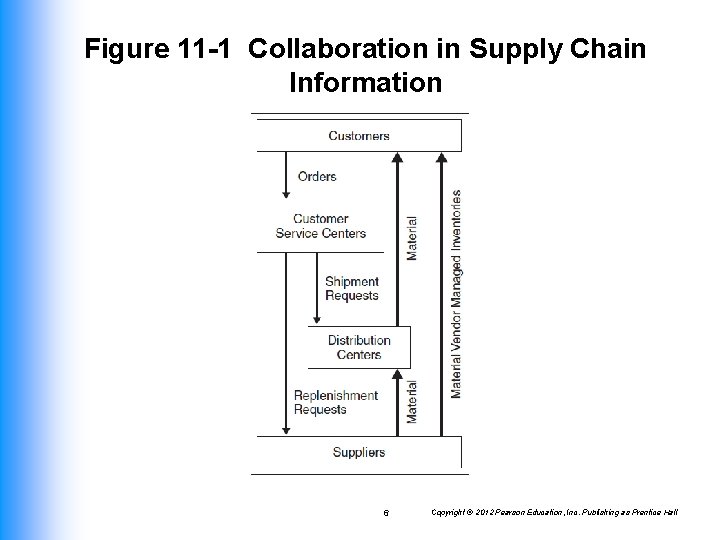
Figure 11 -1 Collaboration in Supply Chain Information 6 Copyright © 2012 Pearson Education, Inc. Publishing as Prentice Hall
SCM Drivers Facilities • Facilities are the places in the supply chain network where product is manufactured, stored, or shipped. • The two major types of facilities are production sites (plants) and storage sites (warehouses). • A company needs to decide how many suppliers, manufacturing facilities, distribution centers, and warehouses to have. Information • Information consists of data and analysis concerning facilities, inventory, transportation, and customers throughout the supply chain. 7 Copyright © 2012 Pearson Education, Inc. Publishing as Prentice Hall
SCM Drivers (Cont’d) Inventory • Inventory is the raw materials, work in process, and finished goods that belong to the company. • A successful inventory management policy is to achieve that right balance of responsiveness and efficiency. Transportation • Transportation moves the product between different stages in a supply chain. • The type of transportation a company uses also affects the inventory and facility locations in the supply chain. 8 Copyright © 2012 Pearson Education, Inc. Publishing as Prentice Hall
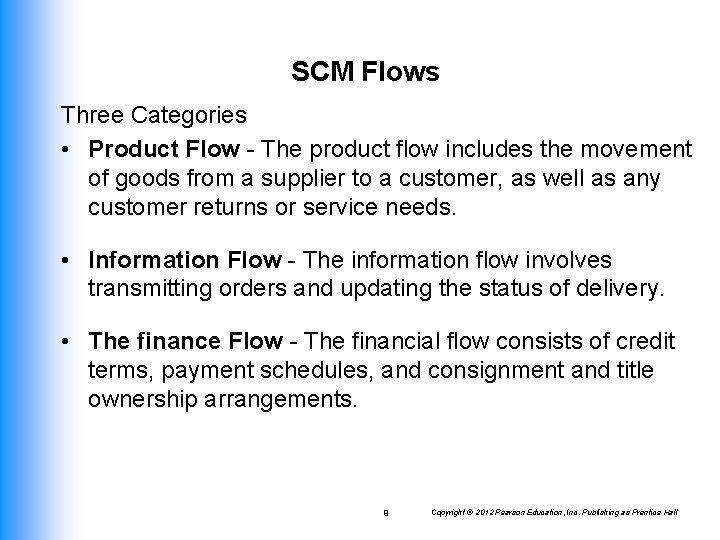
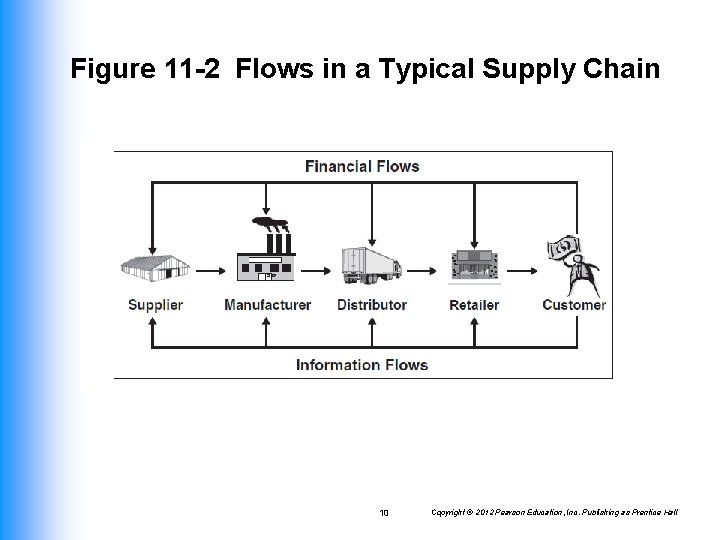
SCM Flows Three Categories • Product Flow - The product flow includes the movement of goods from a supplier to a customer, as well as any customer returns or service needs. • Information Flow - The information flow involves transmitting orders and updating the status of delivery. • The finance Flow - The financial flow consists of credit terms, payment schedules, and consignment and title ownership arrangements. 9 Copyright © 2012 Pearson Education, Inc. Publishing as Prentice Hall
Figure 11 -2 Flows in a Typical Supply Chain 10 Copyright © 2012 Pearson Education, Inc. Publishing as Prentice Hall
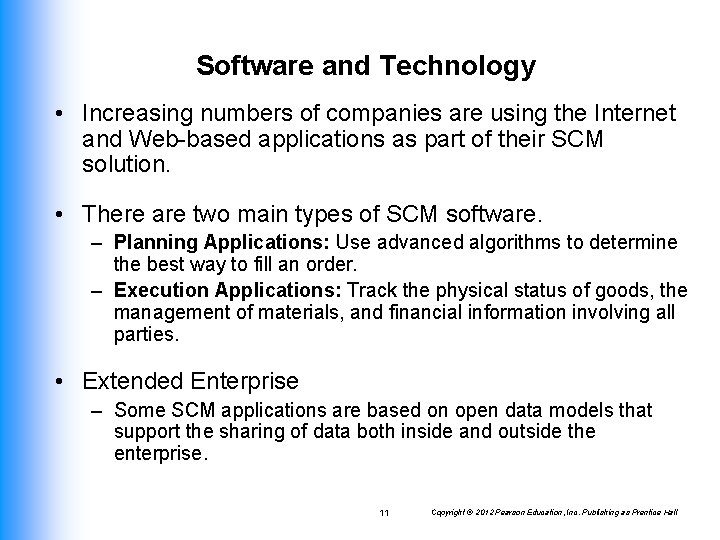
Software and Technology • Increasing numbers of companies are using the Internet and Web-based applications as part of their SCM solution. • There are two main types of SCM software. – Planning Applications: Use advanced algorithms to determine the best way to fill an order. – Execution Applications: Track the physical status of goods, the management of materials, and financial information involving all parties. • Extended Enterprise – Some SCM applications are based on open data models that support the sharing of data both inside and outside the enterprise. 11 Copyright © 2012 Pearson Education, Inc. Publishing as Prentice Hall
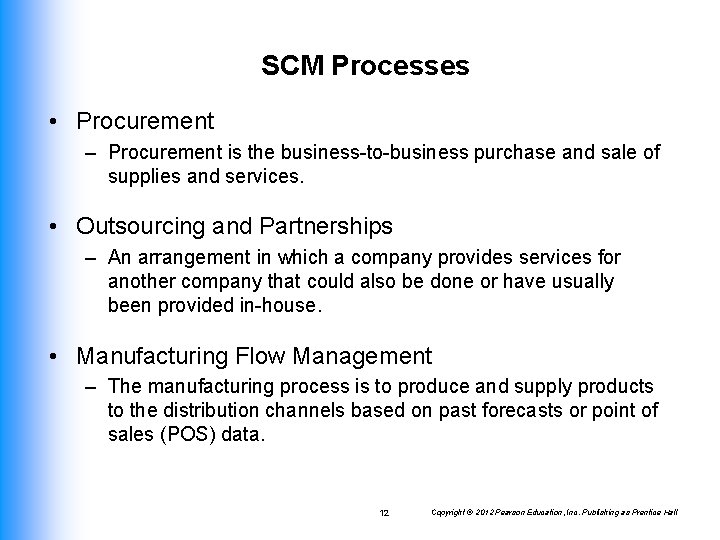
SCM Processes • Procurement – Procurement is the business-to-business purchase and sale of supplies and services. • Outsourcing and Partnerships – An arrangement in which a company provides services for another company that could also be done or have usually been provided in-house. • Manufacturing Flow Management – The manufacturing process is to produce and supply products to the distribution channels based on past forecasts or point of sales (POS) data. 12 Copyright © 2012 Pearson Education, Inc. Publishing as Prentice Hall
SCM Processes (Cont’d) • Order Fulfillment – Process that responds to customer demand by merging several important functions: order management, storage, and delivery of finished goods. • Customer Service Management Process – Source of customer information and also provides the customer with real-time information on promising dates and product availability through interfaces with the company’s production and distribution operations. • Forecasting – Seeks to predict levels of weekly or monthly product activity over a time horizon. 13 Copyright © 2012 Pearson Education, Inc. Publishing as Prentice Hall
E-business and Supply Chain Management (E-SCM) • A Web-enabled supply chain management (e-SCM) solution is the digital nerve center of the entire business. • e-SCM is the optimal combination of technology and business processes that optimizes delivery of goods, services, and information from the supplier to the consumer in an organized and efficient way. • e-SCM can use e-business concepts and Web technologies to manage inventory and information beyond the organization, both upstream and downstream. 14 Copyright © 2012 Pearson Education, Inc. Publishing as Prentice Hall
E-SCM Components • Replenishment Systems • E-procurement • Collaborative Planning • Collaborative Design and Product Development • E-logistics • Supply Webs (Exchanges) 15 Copyright © 2012 Pearson Education, Inc. Publishing as Prentice Hall
ERP System and Supply Chain • ERP focus is on providing an integrated transaction processing that enhances organizational performance by increasing information consistency and transaction efficiency. • SCM, on the other hand, are aimed at providing a higher level of business planning and decision support functionality for effective coordination and execution of inter-organizational business processes. • Web-based technologies have revolutionized the way business is carried on and SCM and ERP are no exceptions. 16 Copyright © 2012 Pearson Education, Inc. Publishing as Prentice Hall
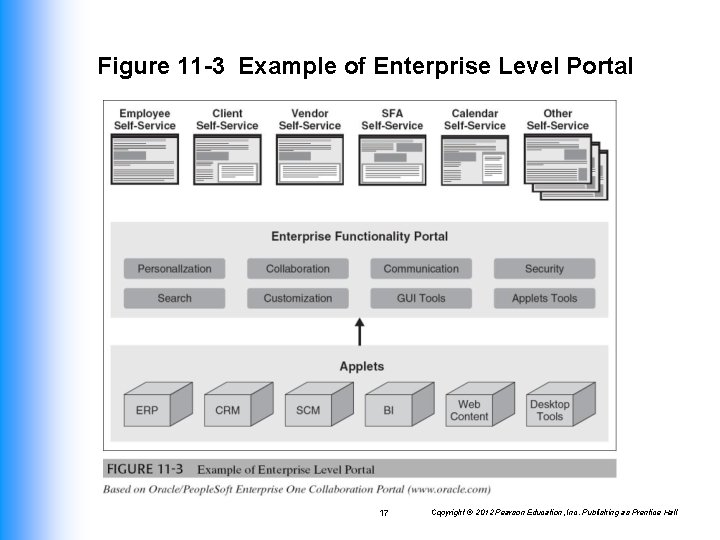
Figure 11 -3 Example of Enterprise Level Portal 17 Copyright © 2012 Pearson Education, Inc. Publishing as Prentice Hall
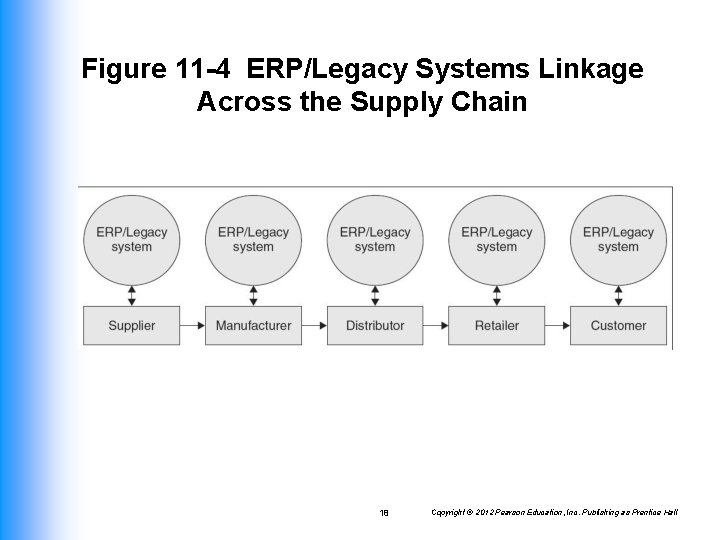
Figure 11 -4 ERP/Legacy Systems Linkage Across the Supply Chain 18 Copyright © 2012 Pearson Education, Inc. Publishing as Prentice Hall
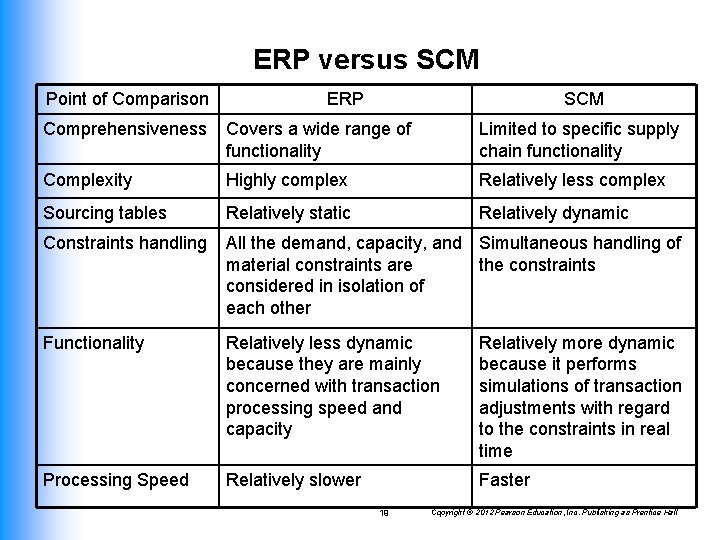
ERP versus SCM Point of Comparison ERP SCM Comprehensiveness Covers a wide range of functionality Limited to specific supply chain functionality Complexity Highly complex Relatively less complex Sourcing tables Relatively static Relatively dynamic Constraints handling All the demand, capacity, and Simultaneous handling of material constraints are the constraints considered in isolation of each other Functionality Relatively less dynamic because they are mainly concerned with transaction processing speed and capacity Relatively more dynamic because it performs simulations of transaction adjustments with regard to the constraints in real time Processing Speed Relatively slower Faster 19 Copyright © 2012 Pearson Education, Inc. Publishing as Prentice Hall
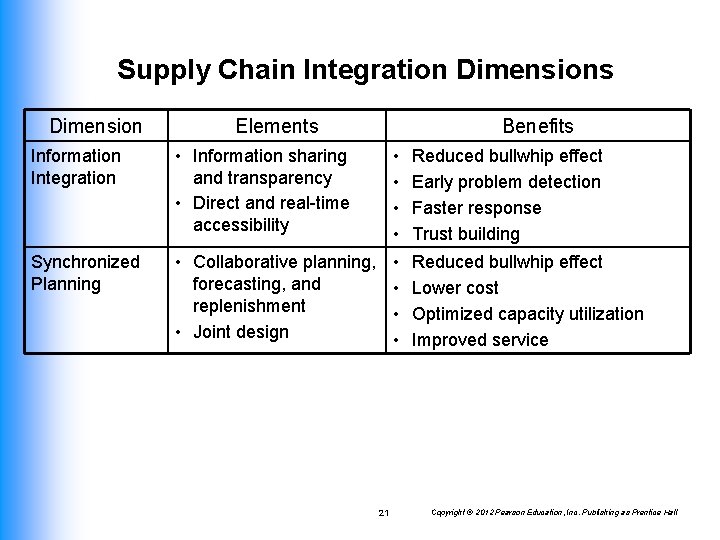
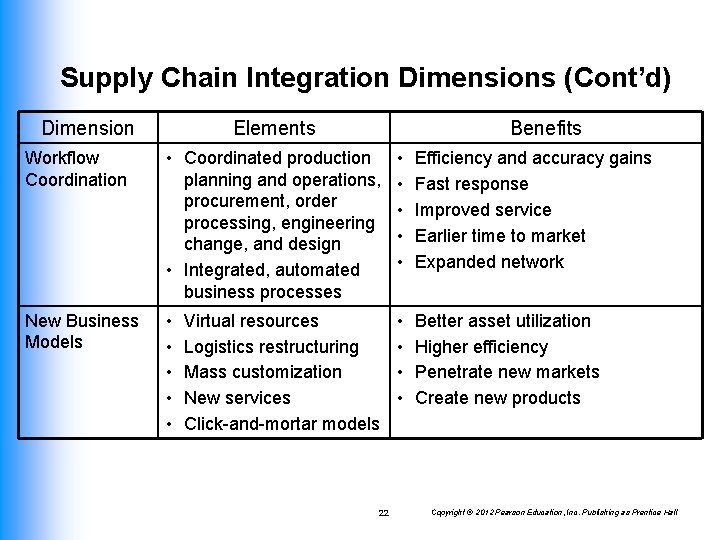
Supply Chain Integration • To stay competitive, enlightened companies have strived to achieve greater coordination and collaboration among supply chain partners. • Information integration refers to the sharing of information among members of the supply chain. • Planning synchronization refers to the joint design and execution of plans for product introduction, forecasting, and replenishment. • Workflow coordination refers to streamlined and automated workflow activities between supply chain partners. 20 Copyright © 2012 Pearson Education, Inc. Publishing as Prentice Hall
Supply Chain Integration Dimensions Dimension Elements Benefits Information Integration • Information sharing and transparency • Direct and real-time accessibility • • Reduced bullwhip effect Early problem detection Faster response Trust building Synchronized Planning • Collaborative planning, forecasting, and replenishment • Joint design • • Reduced bullwhip effect Lower cost Optimized capacity utilization Improved service 21 Copyright © 2012 Pearson Education, Inc. Publishing as Prentice Hall
Supply Chain Integration Dimensions (Cont’d) Dimension Elements Benefits Workflow Coordination • Coordinated production planning and operations, procurement, order processing, engineering change, and design • Integrated, automated business processes • • • Efficiency and accuracy gains Fast response Improved service Earlier time to market Expanded network New Business Models • • • Better asset utilization Higher efficiency Penetrate new markets Create new products Virtual resources Logistics restructuring Mass customization New services Click-and-mortar models 22 Copyright © 2012 Pearson Education, Inc. Publishing as Prentice Hall
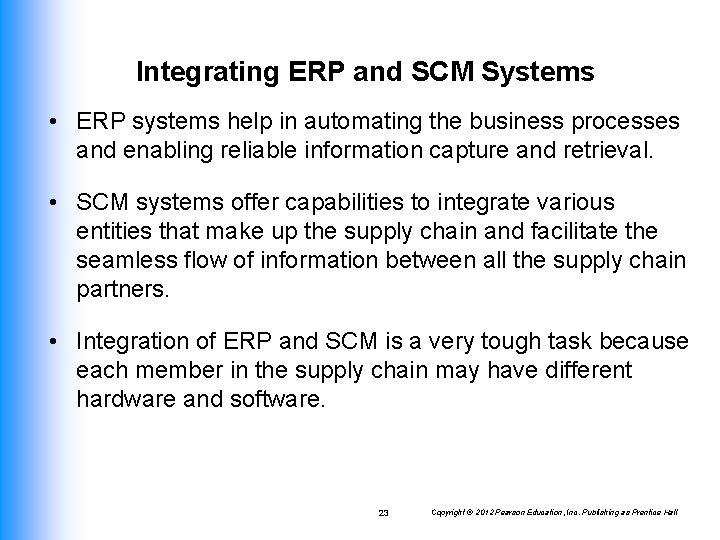
Integrating ERP and SCM Systems • ERP systems help in automating the business processes and enabling reliable information capture and retrieval. • SCM systems offer capabilities to integrate various entities that make up the supply chain and facilitate the seamless flow of information between all the supply chain partners. • Integration of ERP and SCM is a very tough task because each member in the supply chain may have different hardware and software. 23 Copyright © 2012 Pearson Education, Inc. Publishing as Prentice Hall
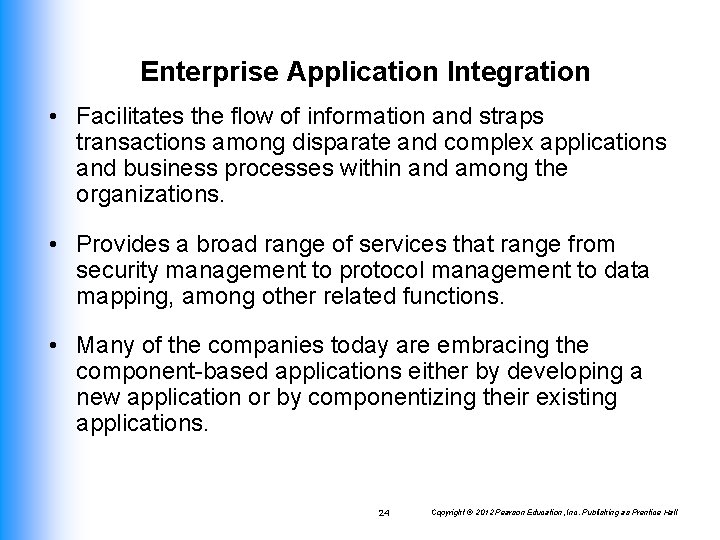
Enterprise Application Integration • Facilitates the flow of information and straps transactions among disparate and complex applications and business processes within and among the organizations. • Provides a broad range of services that range from security management to protocol management to data mapping, among other related functions. • Many of the companies today are embracing the component-based applications either by developing a new application or by componentizing their existing applications. 24 Copyright © 2012 Pearson Education, Inc. Publishing as Prentice Hall
Phases of Enterprise Application Integration Process • Solution outline phase • Architecture phase • Design phase • Implementation phase 25 Copyright © 2012 Pearson Education, Inc. Publishing as Prentice Hall
Benefits of Enterprise Application Integration • Increased Efficiency: Automation of processes. • Value of Information: Redundant databases are aligned, eliminating duplicate data. • Lower Costs: One interface per application lowering the cost of upgrades. • Increased Productivity: Results from business process automation and access to real-time information. • Improved Customer Service: Employees have real-time access to give accurate information to customers. • Enhanced Access: Ability to extend applications to more users from anywhere and anytime over the VPN 26 Copyright © 2012 Pearson Education, Inc. Publishing as Prentice Hall
RFID • Allows for real-time automation of many data collection functions originally conducted by paid employees. • Hardware - Each hardware implementation will need to be designed specifically to meet the needs of purchaser as there are no off-the-shelf alternatives • Software - Much easier to design. There are cases where a near vanilla implementation would be sufficient giving the company some cost savings • Changing any process where these steps occur to automated RFID data collection will eliminate the possibility of human error 27 Copyright © 2009 Pearson Education, Inc. Publishing as Prentice Hall
Implications for Management • Managers should understand that SCM is an important component for the successful implementation of ERP systems. • Balancing the supply chain efficiency and responsiveness is more an art than science. • E-Supply chain provides great competitive advantage in today’s Web-enabled economy. • Integrating is the key issue to the success of the supply chain. – Integration must occur at multiple levels, and not just at the network or hardware platform level. 28 Copyright © 2012 Pearson Education, Inc. Publishing as Prentice Hall
Summary • Supply Chain Management (SCM) is a central piece of technology in today’s enterprise system. • SCM provides a link for services, materials, and information across the value chain of the organization. • ERP vendors have started including SCM as a component or module of the software. • There are four main drivers for the SCM system performance: – Facilities – Inventory – Transportation – Information 29 Copyright © 2012 Pearson Education, Inc. Publishing as Prentice Hall
Summary (Cont’d) • SCM involves the operation or management of many organizations’ processes and procedures. • SCM plays a major role in the success of e-business and e-commerce. • A good SCM is designed in collaboration with the organizations’ partners rather than stand-alone. • Integration with SCM system is of many types (e. g. , supply chain, ERP system, and enterprise application). • Enterprise Application Integration process is very complex and has a multiphase life cycle. 30 Copyright © 2012 Pearson Education, Inc. Publishing as Prentice Hall
Review Questions 1. What are the motivations for an organization to have a good supply chain management (SCM) system? 2. Define SCM in your own words. 3. List the four drivers of SCM and how they impact the system’s responsiveness. 4. What are the major types of SCM software? 5. Briefly describe the SCM processes. 6. Why is SCM implementation critical for the success of ebusiness? 7. What are the major components of e-SCM? 31 Copyright © 2012 Pearson Education, Inc. Publishing as Prentice Hall
All rights reserved. No part of this publication may be reproduced, stored in a retrieval system, or transmitted, in any form or by any means, electronic, mechanical, photocopying, recording, or otherwise, without the prior written permission of the publisher. Printed in the United States of America. Copyright © 2012 Pearson Education, Inc. Publishing as Prentice Hall 32 Copyright © 2012 Pearson Education, Inc. Publishing as Prentice Hall