Chapter 1 Data Communications and Network Management Overview
- Slides: 37
Chapter 1 Data Communications and Network Management Overview
Telephone Network • Modern network evolution from Telephone /Telecommunications Network • Characteristics of Telephone network • Reliable - does what is expected of it • Dependable - always there when you need it (remember 911? ) • Good quality (connection) - hearing each other well • Reasons for Qo. S: • Good planning, design, and implementation • Good operation and management of network • Migration to new technologies – • e. g. , From analog to digital technology
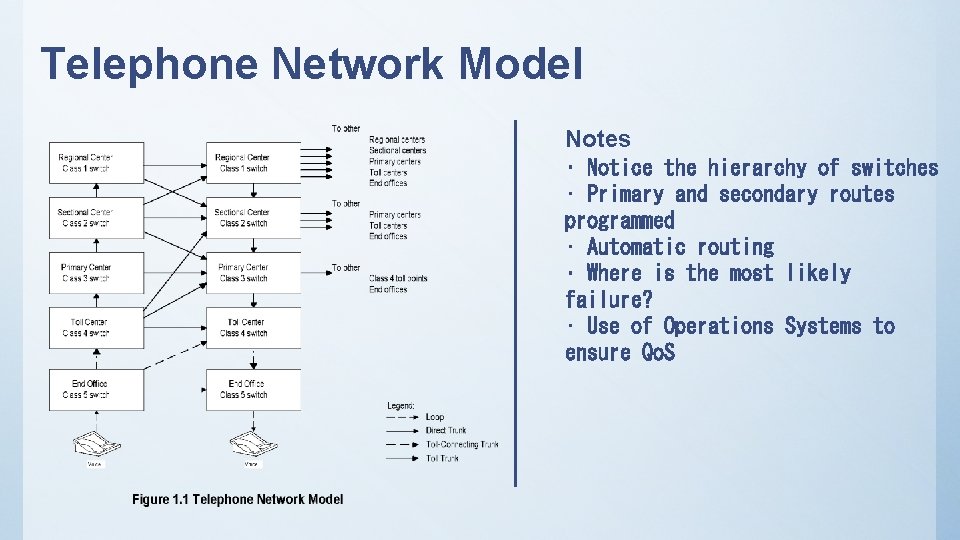
Telephone Network Model Notes • Notice the hierarchy of switches • Primary and secondary routes programmed • Automatic routing • Where is the most likely failure? • Use of Operations Systems to ensure Qo. S
OSSs / NOC • Operations Support Systems (OSSs) help manage the operation of networks • OSSs in telecommunications monitor: • Analog network parameters: • S/N ratio, transmission loss, call blockage, etc. • Digital network parameters: • Packet loss, Packet delay, Throughput, Qo. S, etc. • Real-time management of network. • Trunk (logical entity between switches / nodes) maintenance system measures loss and S/N Trunks not meeting Qo. S removed before customer notices poor quality. • Traffic measurement systems measure call drops and blockage. Additional switches or routers planned to keep the call blockage or drops below acceptable level. • OSSs distributed at central offices and customer premises • Network management done centrally from Network Operations Center (NOC).
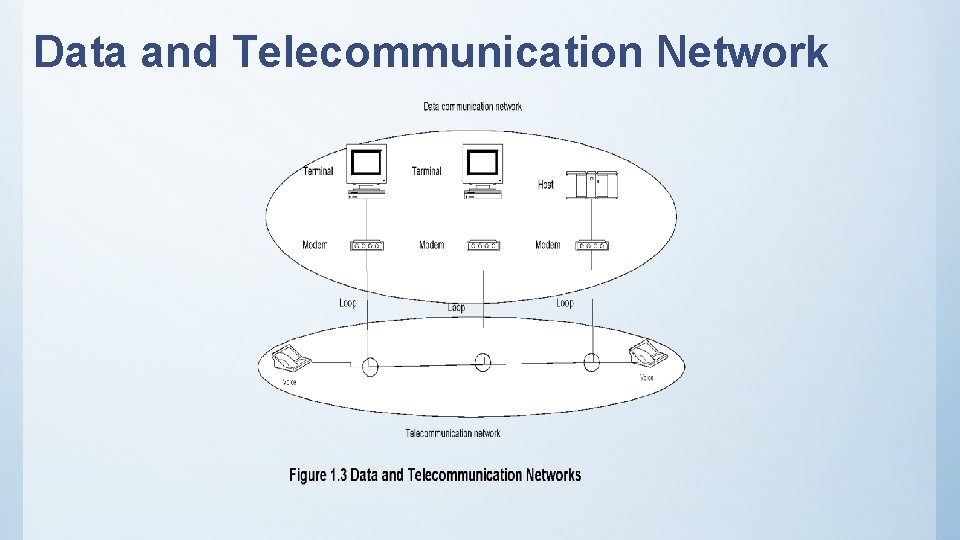
Data and Telecommunication Network
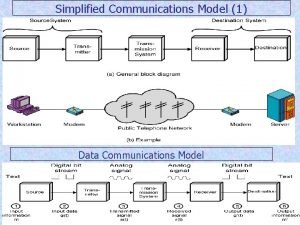
Data and Telecommunication Network- cont. Notes: • Computer data is carried over long distance by telephone (telecommunication network). • Output of telephone is analog and output of computers is digital. • Modem is used to “modulate” and “demodulate” computer data to analog format and back. • Clear distinction between the two networks is getting fuzzier with modern multimedia networks
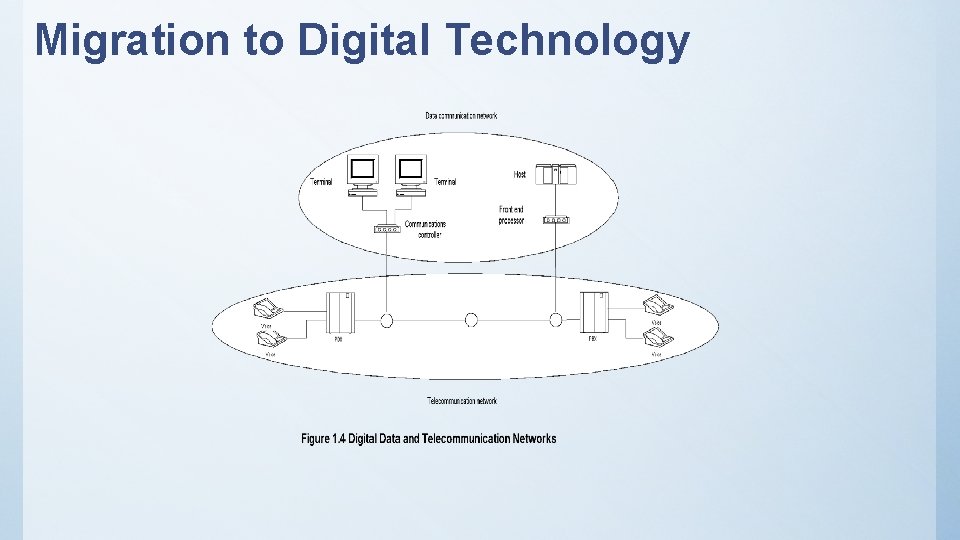
Migration to Digital Technology
Migration to Digital Technologycont. Notes: • Analog transmission migrated to digital transmission. • Analog sources converted to digital signals. • CPE (Customer Premises equipment) included digital PBX (Private Branch Exchanges). • Analog bandwidth hierarchy migrated to synchronous digital hierarchy.
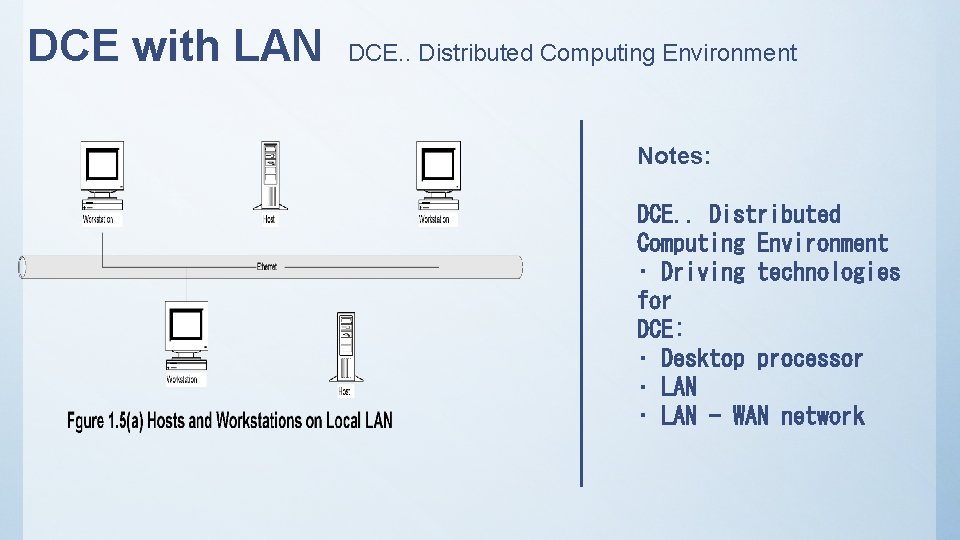
DCE with LAN DCE. . Distributed Computing Environment Notes: DCE. . Distributed Computing Environment • Driving technologies for DCE: • Desktop processor • LAN - WAN network
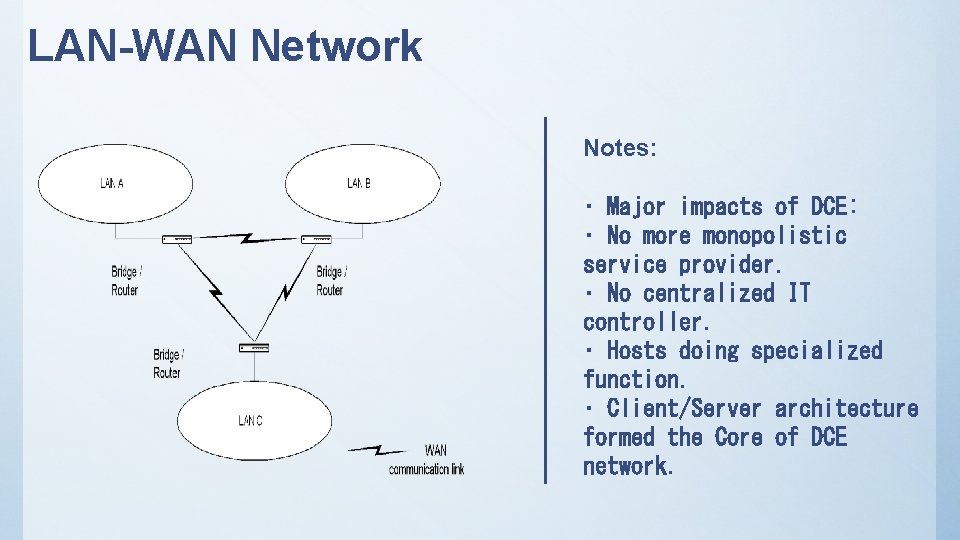
LAN-WAN Network Notes: • Major impacts of DCE: • No more monopolistic service provider. • No centralized IT controller. • Hosts doing specialized function. • Client/Server architecture formed the Core of DCE network.
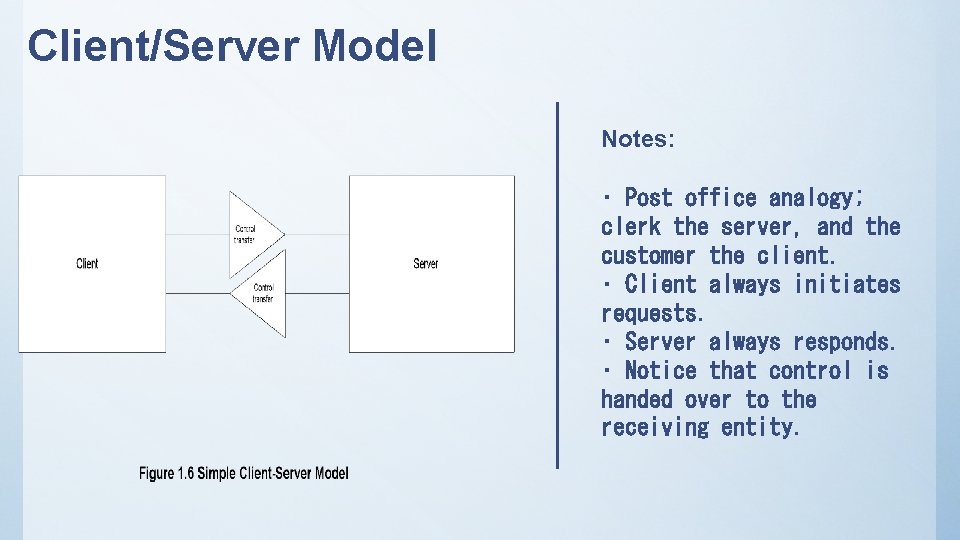
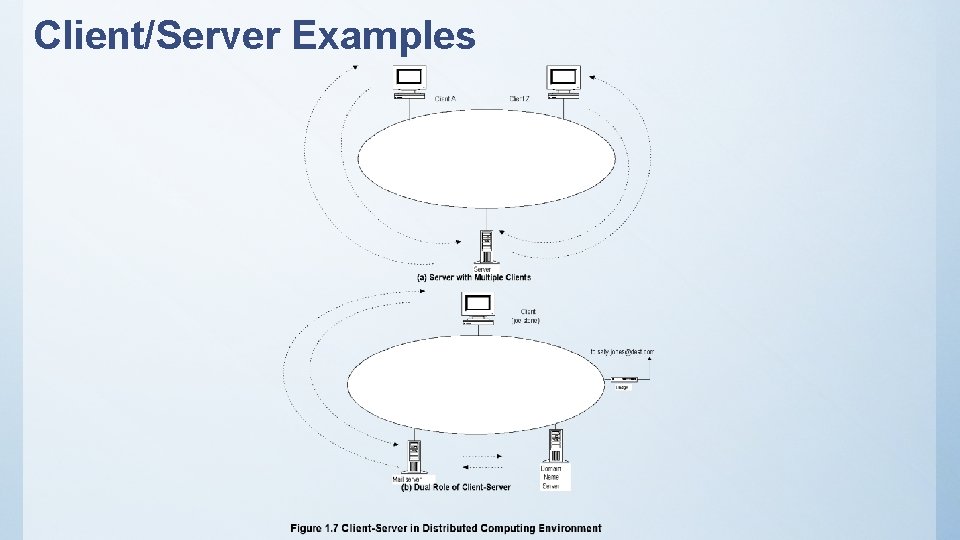
Client/Server Model Notes: • Post office analogy; clerk the server, and the customer the client. • Client always initiates requests. • Server always responds. • Notice that control is handed over to the receiving entity.
Client/Server Examples
TCP/IP Based Networks • TCP/IP is a suite of protocols. • Internet is based on TCP/IP. • IP is Internet protocol at the network layer level. • TCP is connection-oriented transport protocol and ensures end-to-end connection. • UDP is connectionless transport protocol and provides datagram service. • Internet email and much of the network mgmt. messages are based on UDP/IP. • ICMP part of TCP/IP suite.
TCP/IP Based Networks • TCP/IP is a suite of protocols • Internet is based on TCP/IP • IP is Internet protocol at the network layer level • TCP is connection-oriented transport protocol and ensures end -to-end connection • UDP is connectionless transport protocol and provides datagram service • Internet email and much of the network mgmt. messages are based on UDP/IP • ICMP part of TCP/IP suite
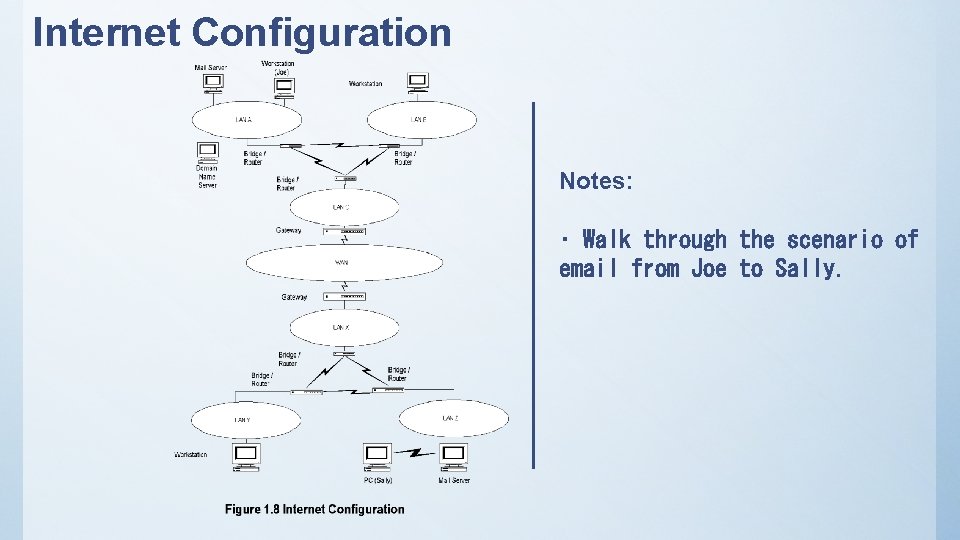
Internet Configuration Notes: • Walk through the scenario of email from Joe to Sally.
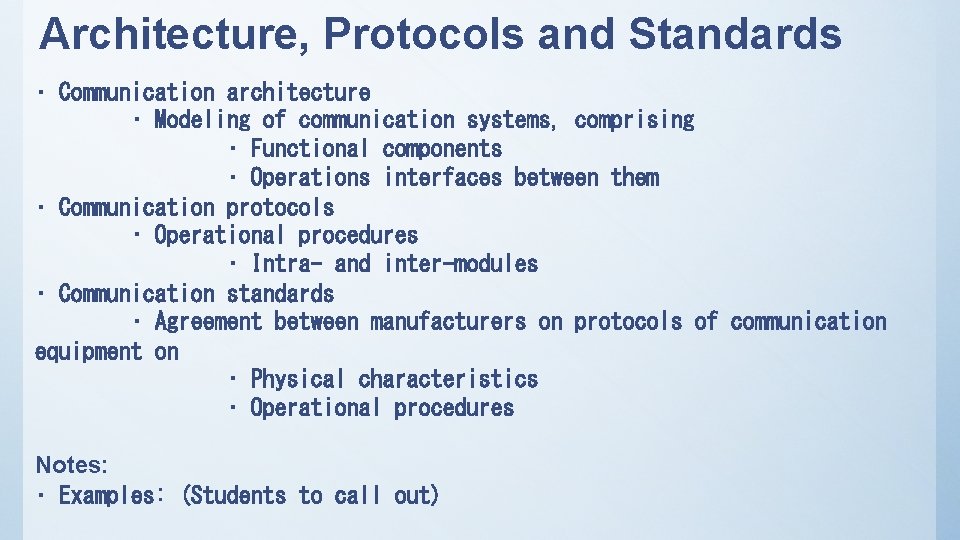
Architecture, Protocols and Standards • Communication architecture • Modeling of communication systems, comprising • Functional components • Operations interfaces between them • Communication protocols • Operational procedures • Intra- and inter-modules • Communication standards • Agreement between manufacturers on protocols of communication equipment on • Physical characteristics • Operational procedures Notes: • Examples: (Students to call out)
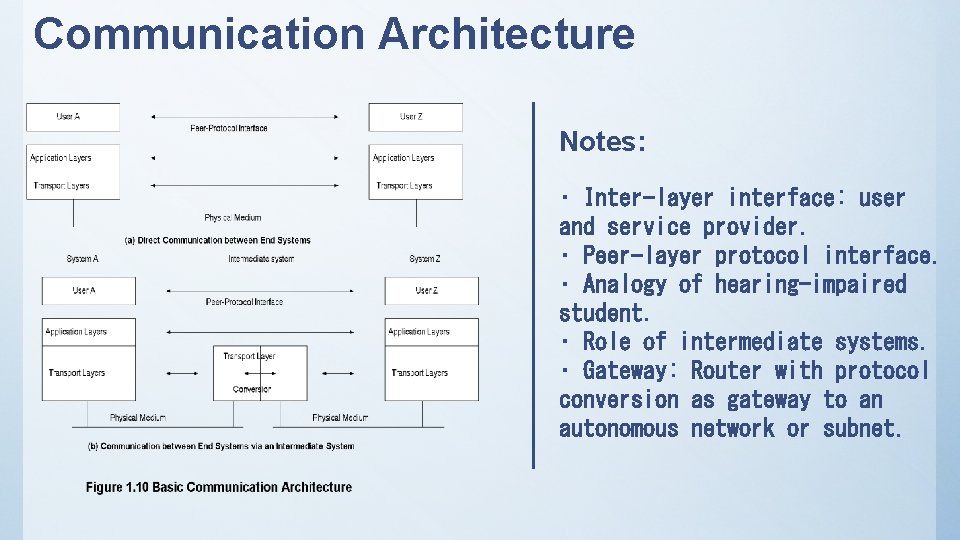
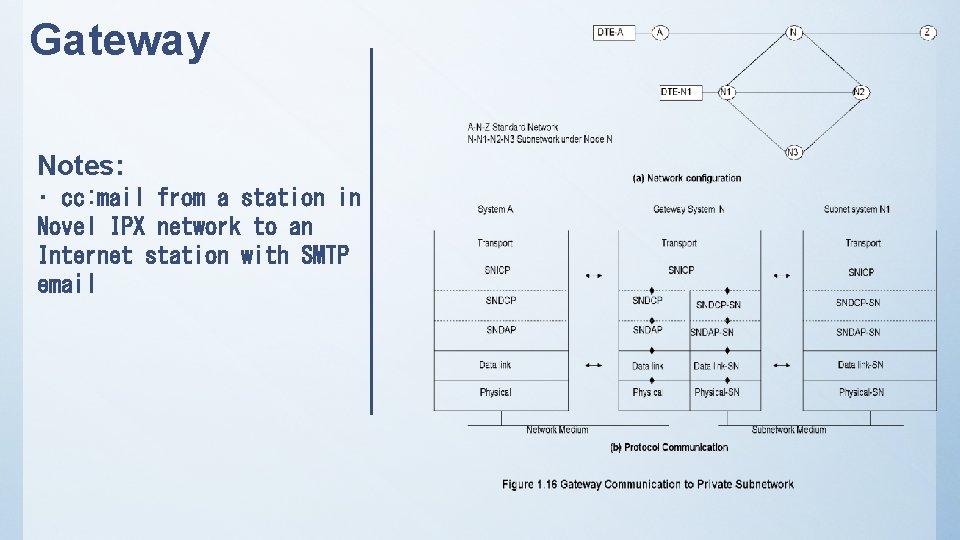
Communication Architecture Notes: • Inter-layer interface: user and service provider. • Peer-layer protocol interface. • Analogy of hearing-impaired student. • Role of intermediate systems. • Gateway: Router with protocol conversion as gateway to an autonomous network or subnet.
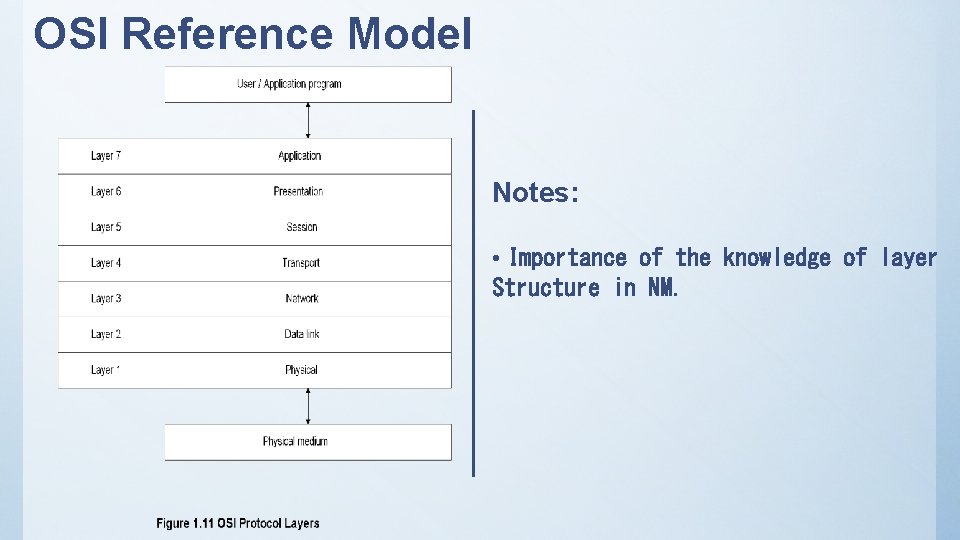
OSI Reference Model Notes: • Importance of the knowledge of layer Structure in NM.
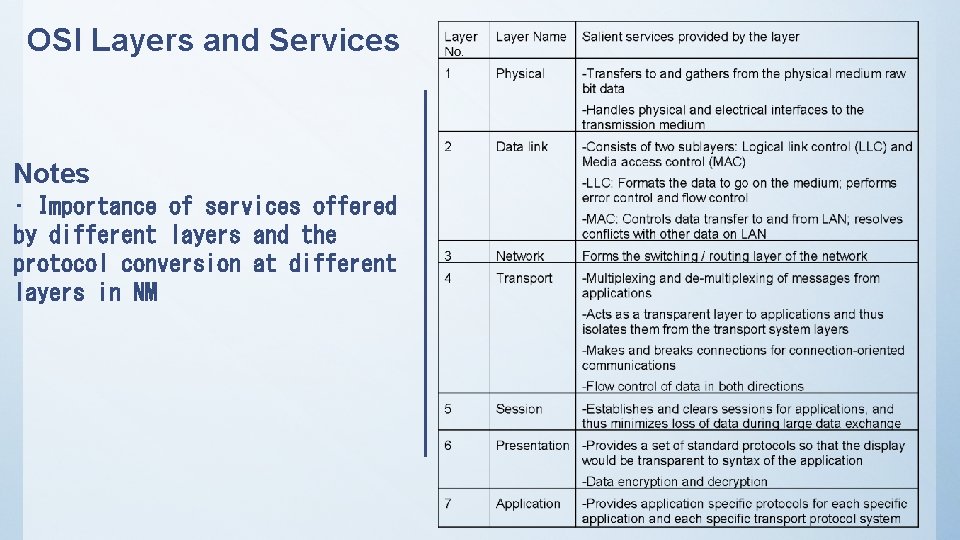
OSI Layers and Services Notes • Importance of services offered by different layers and the protocol conversion at different layers in NM
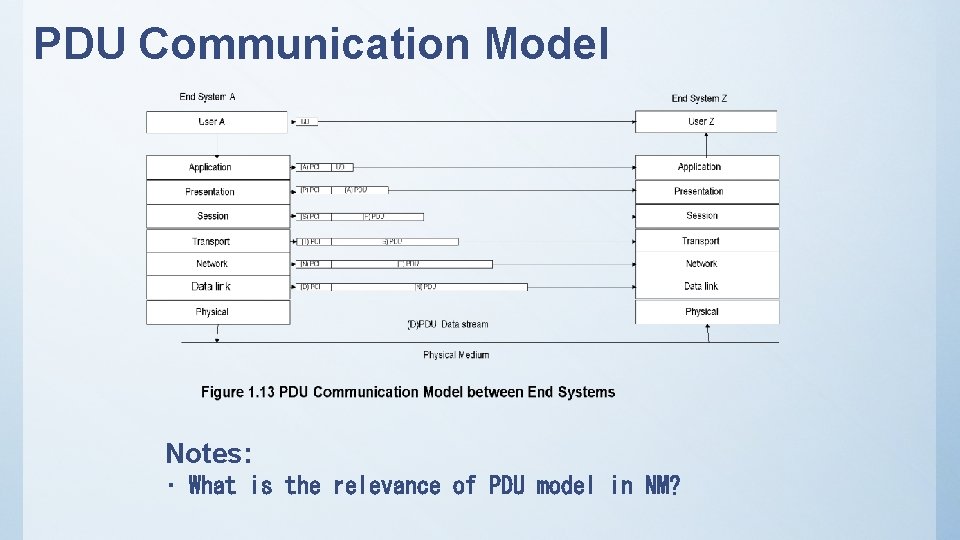
PDU Communication Model Notes: • What is the relevance of PDU model in NM?
Gateway Notes: • cc: mail from a station in Novel IPX network to an Internet station with SMTP email
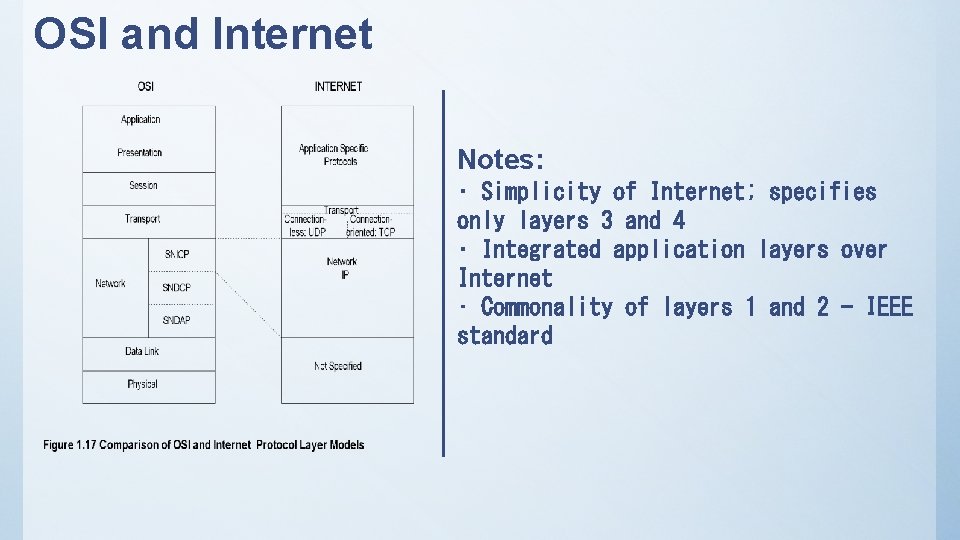
OSI and Internet Notes: • Simplicity of Internet; specifies only layers 3 and 4 • Integrated application layers over Internet • Commonality of layers 1 and 2 - IEEE standard
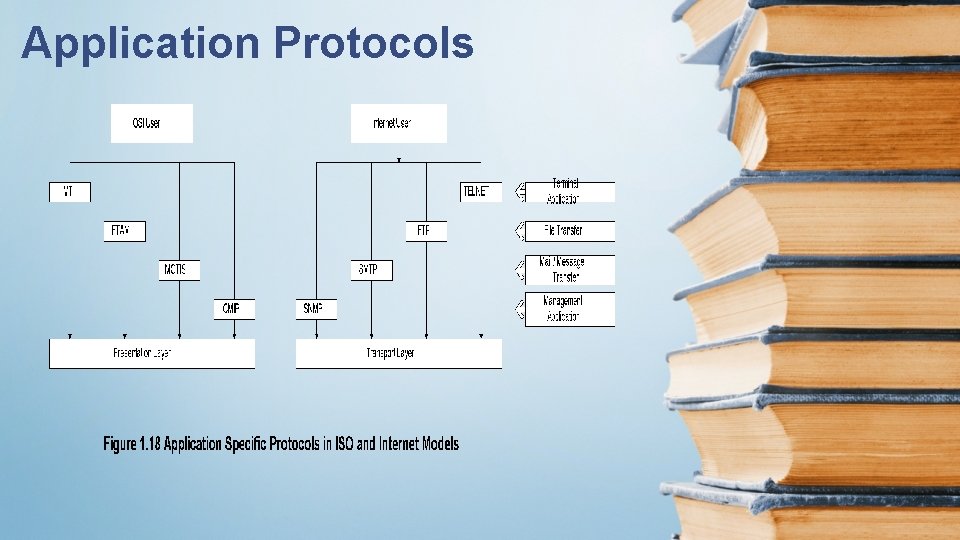
Application Protocols
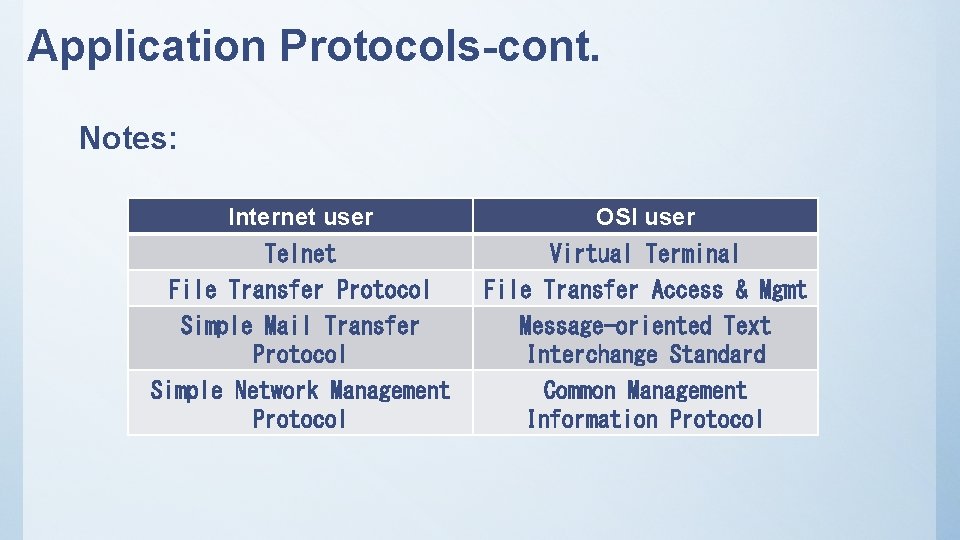
Application Protocols-cont. Notes: Internet user OSI user Telnet File Transfer Protocol Simple Mail Transfer Protocol Virtual Terminal File Transfer Access & Mgmt Message-oriented Text Interchange Standard Simple Network Management Protocol Common Management Information Protocol
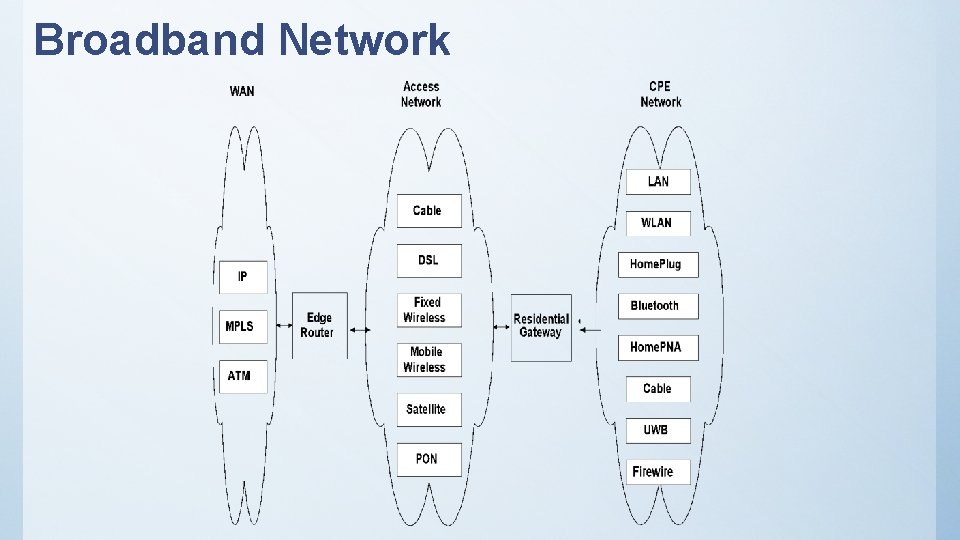
Broadband Network
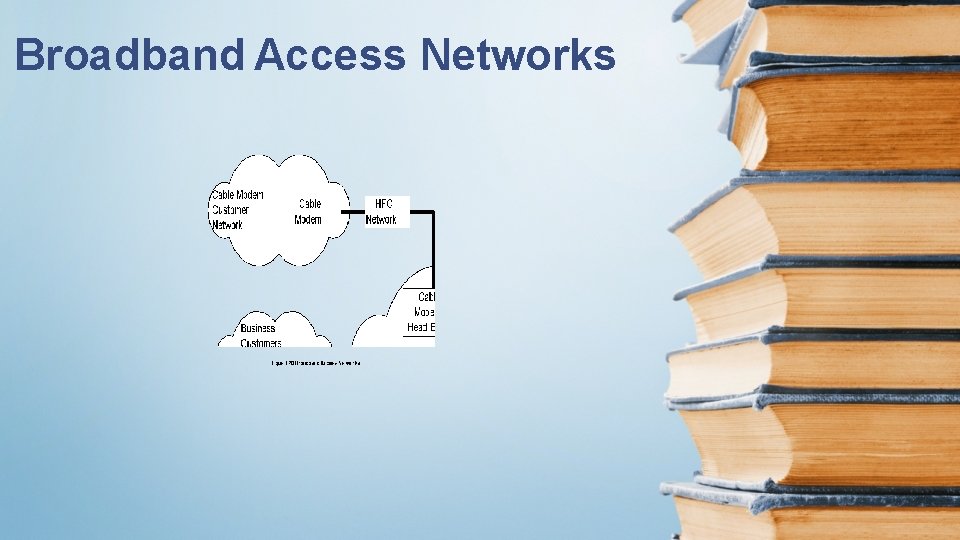
Broadband Access Networks
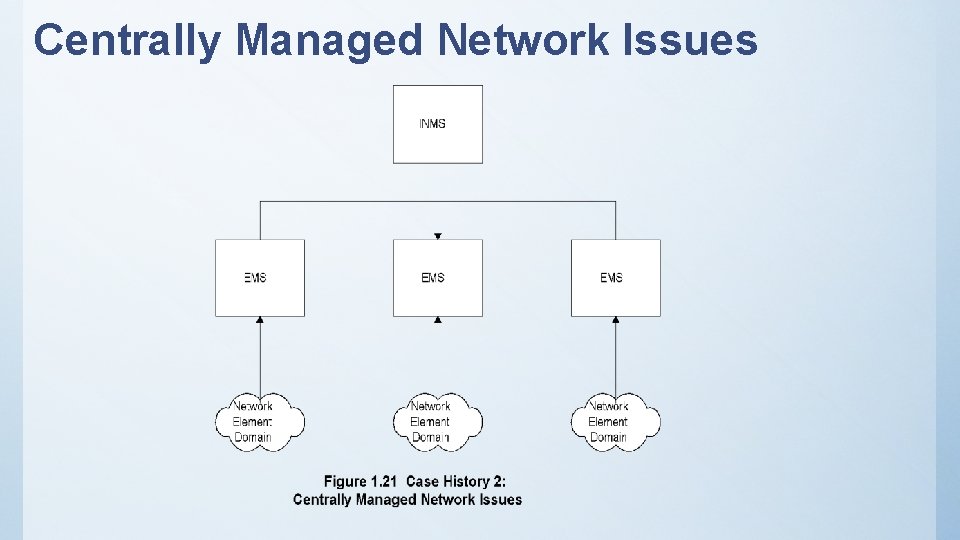
Centrally Managed Network Issues
Some Common Network Problems: • • • Loss of connectivity Duplicate IP address Intermittent problems Network configuration issues Non-problems Performance problems
Challenges of IT Managers: • • • Reliability Non-real time problems Rapid technological advance Managing client/server environment Scalability Troubleshooting tools and systems Trouble prediction Standardization of operations - NMS helps Centralized management vs. “sneaker-net”
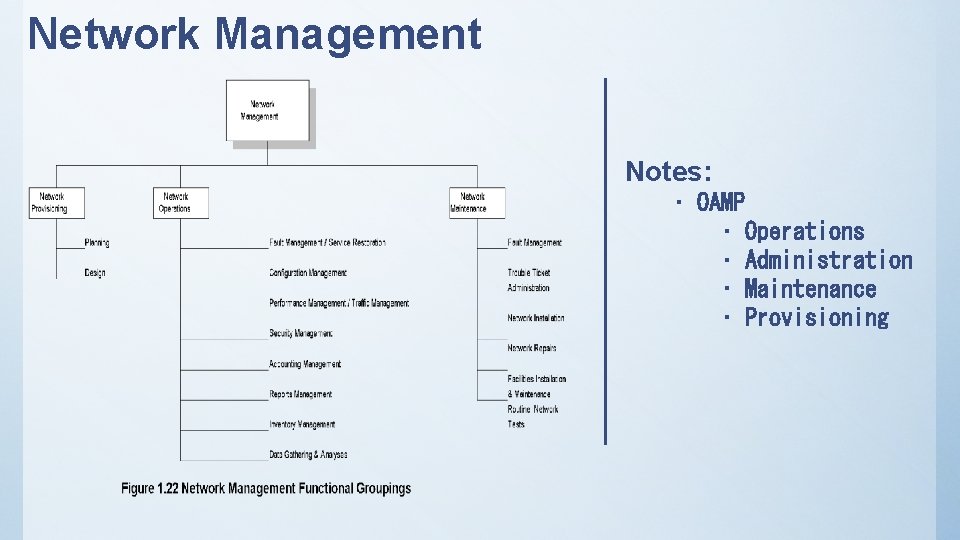
Network Management Notes: • OAMP • Operations • Administration • Maintenance • Provisioning
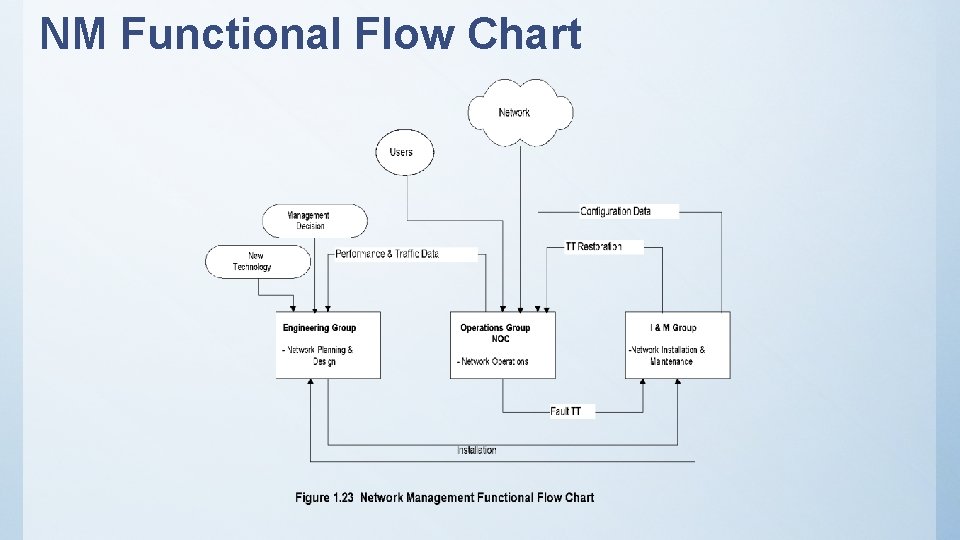
NM Functional Flow Chart
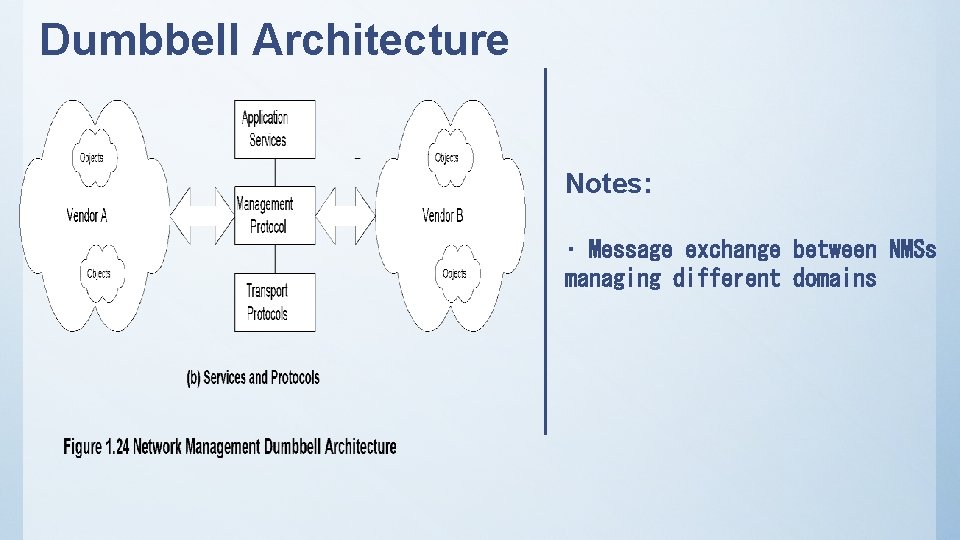
Dumbbell Architecture Notes: • Message exchange between NMSs managing different domains
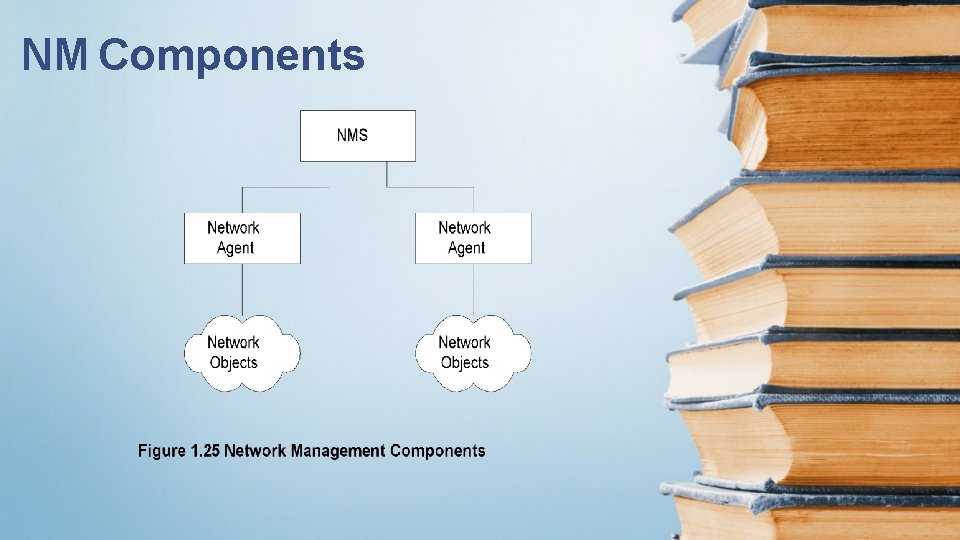
NM Components
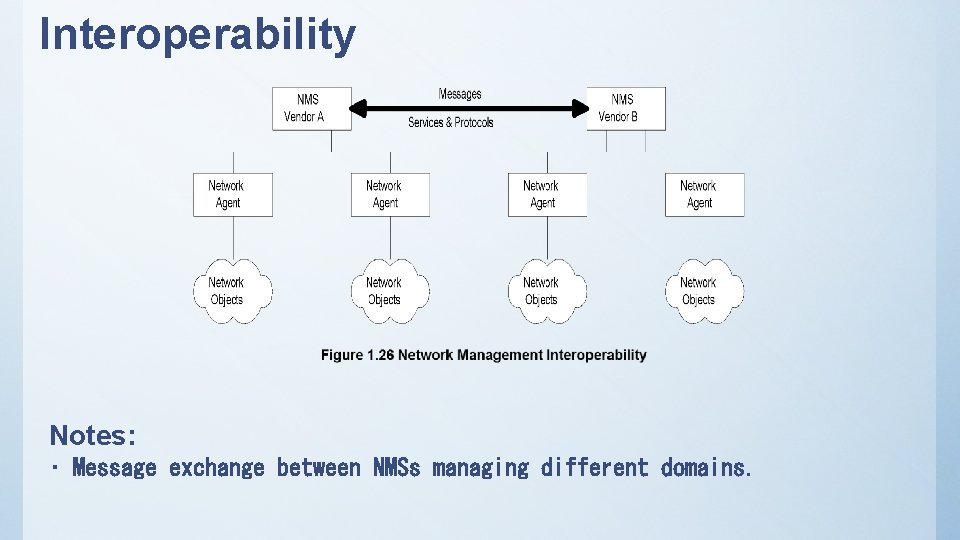
Interoperability Notes: • Message exchange between NMSs managing different domains.
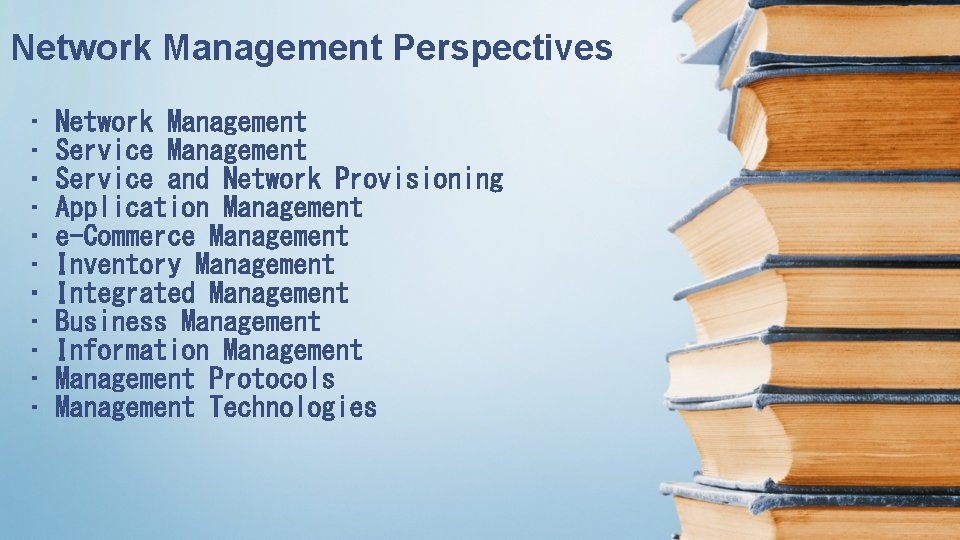
Network Management Perspectives • • • Network Management Service and Network Provisioning Application Management e-Commerce Management Inventory Management Integrated Management Business Management Information Management Protocols Management Technologies
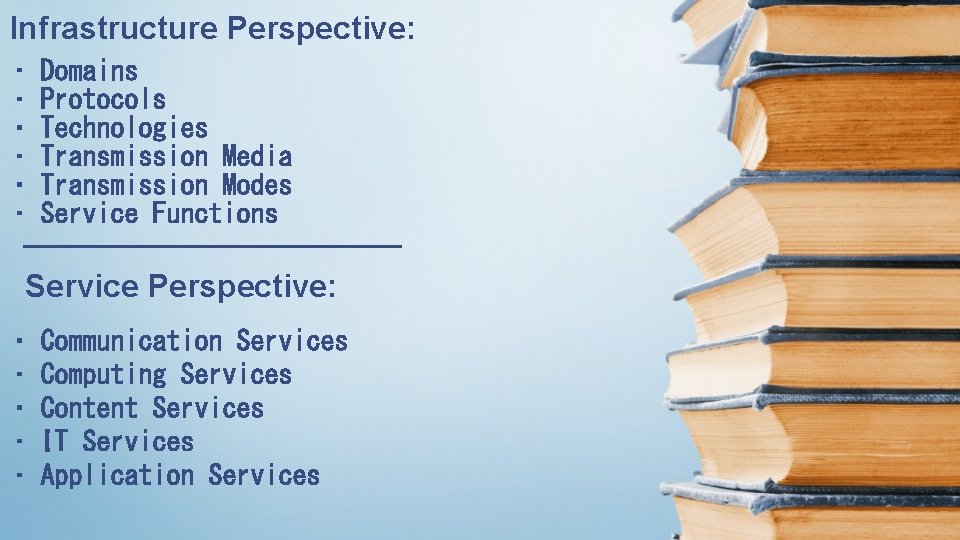
Infrastructure Perspective: • • • Domains Protocols Technologies Transmission Media Transmission Modes Service Functions Service Perspective: • • • Communication Services Computing Services Content Services IT Services Application Services
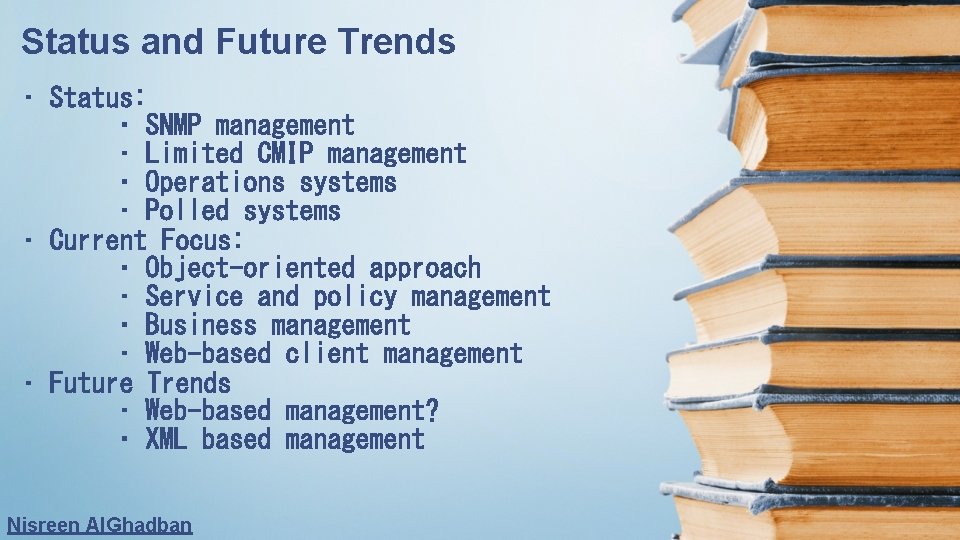
Status and Future Trends • Status: • SNMP management • Limited CMIP management • Operations systems • Polled systems • Current Focus: • Object-oriented approach • Service and policy management • Business management • Web-based client management • Future Trends • Web-based management? • XML based management Nisreen Al. Ghadban