CFD2011 03 GTK NA62Micro channel Parametric study using


- Slides: 18
CFD-2011 -03 -GTK NA-62(Micro channel) Parametric study using Empirical Results June 30 th 2011 Bdg 298 Enrico Da Riva, Vinod Singh Rao Enrico Da Riva , V. Rao 30 th June 2011 1
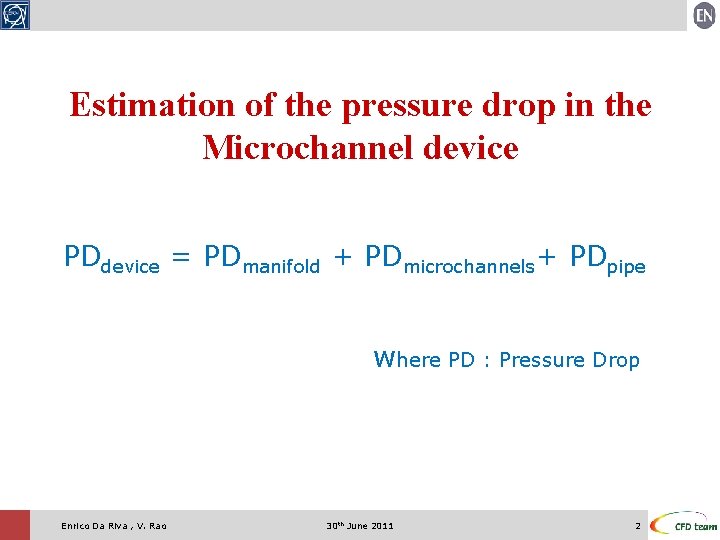
Estimation of the pressure drop in the Microchannel device PDdevice = PDmanifold + PDmicrochannels+ PDpipe where PD : Pressure Drop Enrico Da Riva , V. Rao 30 th June 2011 2
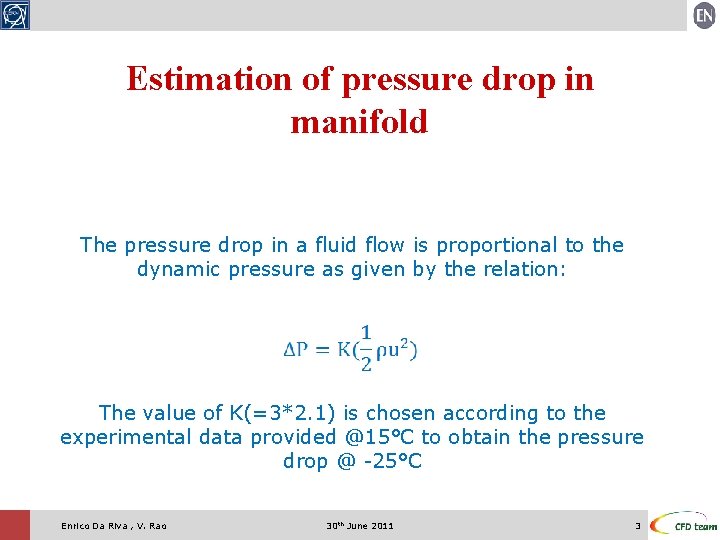
Estimation of pressure drop in manifold The pressure drop in a fluid flow is proportional to the dynamic pressure as given by the relation: The value of K(=3*2. 1) is chosen according to the experimental data provided @15°C to obtain the pressure drop @ -25°C Enrico Da Riva , V. Rao 30 th June 2011 3
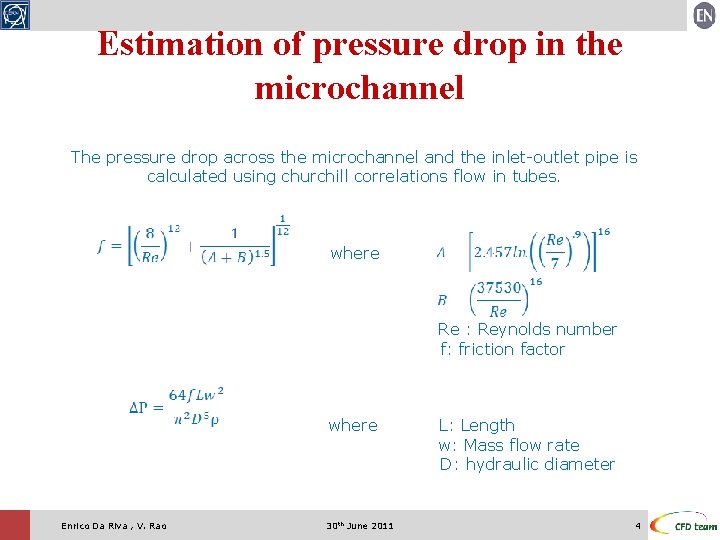
Estimation of pressure drop in the microchannel The pressure drop across the microchannel and the inlet-outlet pipe is calculated using churchill correlations flow in tubes. where Re : Reynolds number f: friction factor where Enrico Da Riva , V. Rao 30 th June 2011 L: Length w: Mass flow rate D: hydraulic diameter 4
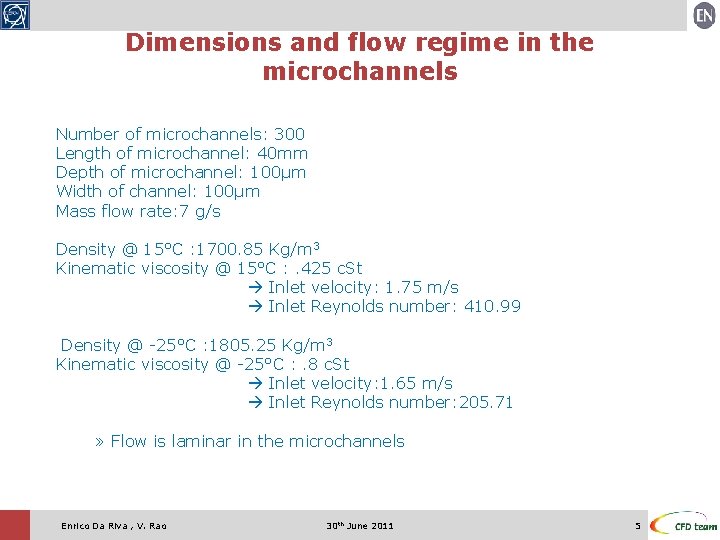
Dimensions and flow regime in the microchannels Number of microchannels: 300 Length of microchannel: 40 mm Depth of microchannel: 100µm Width of channel: 100µm Mass flow rate: 7 g/s Density @ 15°C : 1700. 85 Kg/m 3 Kinematic viscosity @ 15°C : . 425 c. St Inlet velocity: 1. 75 m/s Inlet Reynolds number: 410. 99 Density @ -25°C : 1805. 25 Kg/m 3 Kinematic viscosity @ -25°C : . 8 c. St Inlet velocity: 1. 65 m/s Inlet Reynolds number: 205. 71 » Flow is laminar in the microchannels Enrico Da Riva , V. Rao 30 th June 2011 5
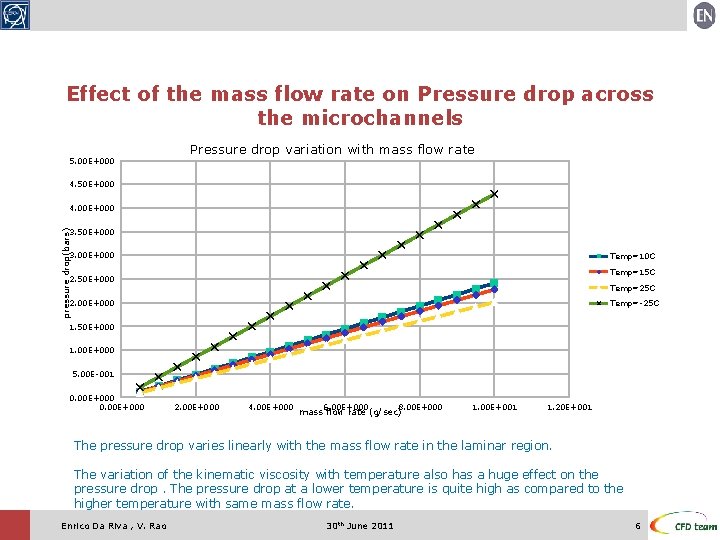
Effect of the mass flow rate on Pressure drop across the microchannels 5. 00 E+000 Pressure drop variation with mass flow rate 4. 50 E+000 4. 00 E+000 pressure drop(bars) 3. 50 E+000 3. 00 E+000 Temp=10 C Temp=15 C 2. 50 E+000 Temp=25 C 2. 00 E+000 Temp=-25 C 1. 50 E+000 1. 00 E+000 5. 00 E-001 0. 00 E+000 2. 00 E+000 4. 00 E+000 6. 00 E+000 8. 00 E+000 mass flow rate (g/sec) 1. 00 E+001 1. 20 E+001 The pressure drop varies linearly with the mass flow rate in the laminar region. The variation of the kinematic viscosity with temperature also has a huge effect on the pressure drop. The pressure drop at a lower temperature is quite high as compared to the higher temperature with same mass flow rate. Enrico Da Riva , V. Rao 30 th June 2011 6
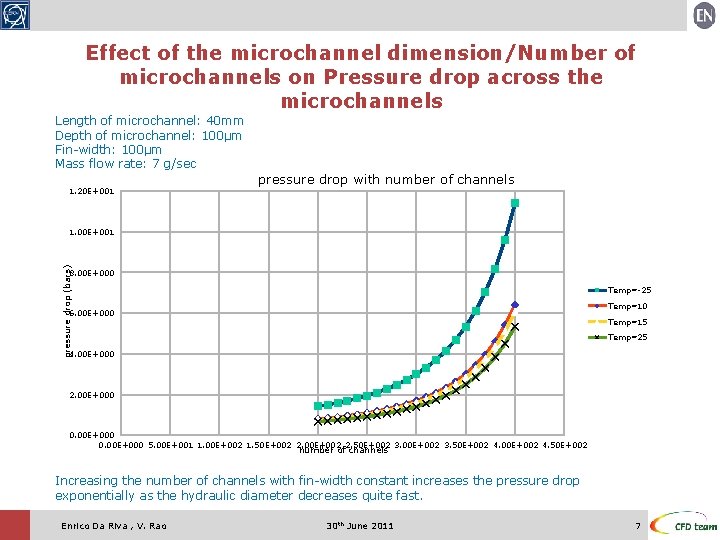
Effect of the microchannel dimension/Number of microchannels on Pressure drop across the microchannels Length of microchannel: 40 mm Depth of microchannel: 100µm Fin-width: 100µm Mass flow rate: 7 g/sec 1. 20 E+001 pressure drop with number of channels pressure drop (bars) 1. 00 E+001 8. 00 E+000 Temp=-25 Temp=10 6. 00 E+000 Temp=15 Temp=25 4. 00 E+000 2. 00 E+000 0. 00 E+000 5. 00 E+001 1. 00 E+002 1. 50 E+002 2. 00 E+002 2. 50 E+002 3. 00 E+002 3. 50 E+002 4. 00 E+002 4. 50 E+002 number of channels Increasing the number of channels with fin-width constant increases the pressure drop exponentially as the hydraulic diameter decreases quite fast. Enrico Da Riva , V. Rao 30 th June 2011 7
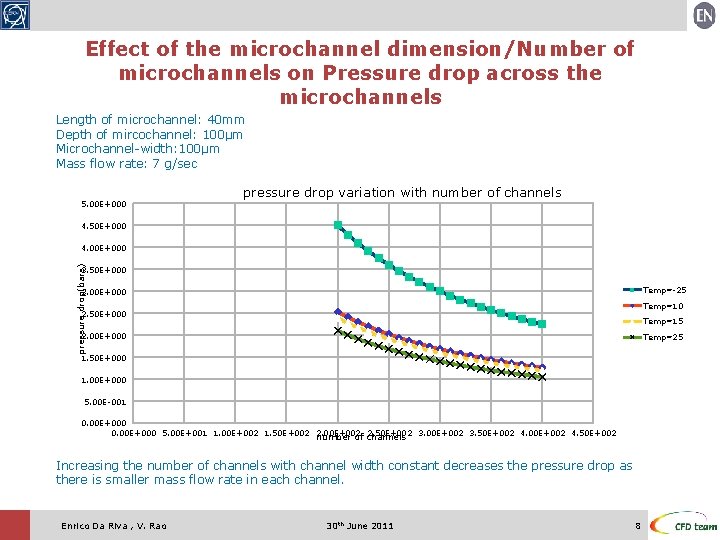
Effect of the microchannel dimension/Number of microchannels on Pressure drop across the microchannels Length of microchannel: 40 mm Depth of mircochannel: 100µm Microchannel-width: 100µm Mass flow rate: 7 g/sec 5. 00 E+000 pressure drop variation with number of channels 4. 50 E+000 pressure drop(bars) 4. 00 E+000 3. 50 E+000 Temp=-25 3. 00 E+000 Temp=10 2. 50 E+000 Temp=15 2. 00 E+000 Temp=25 1. 50 E+000 1. 00 E+000 5. 00 E-001 0. 00 E+000 5. 00 E+001 1. 00 E+002 1. 50 E+002 2. 00 E+002 2. 50 E+002 3. 00 E+002 3. 50 E+002 4. 00 E+002 4. 50 E+002 number of channels Increasing the number of channels with channel width constant decreases the pressure drop as there is smaller mass flow rate in each channel. Enrico Da Riva , V. Rao 30 th June 2011 8
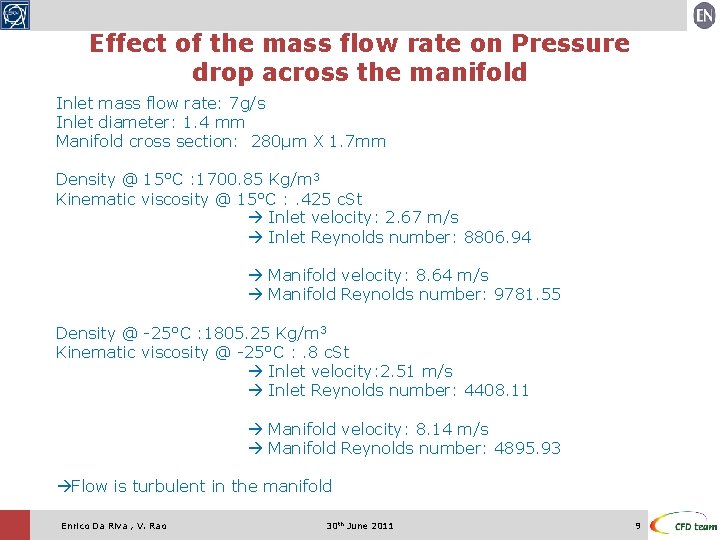
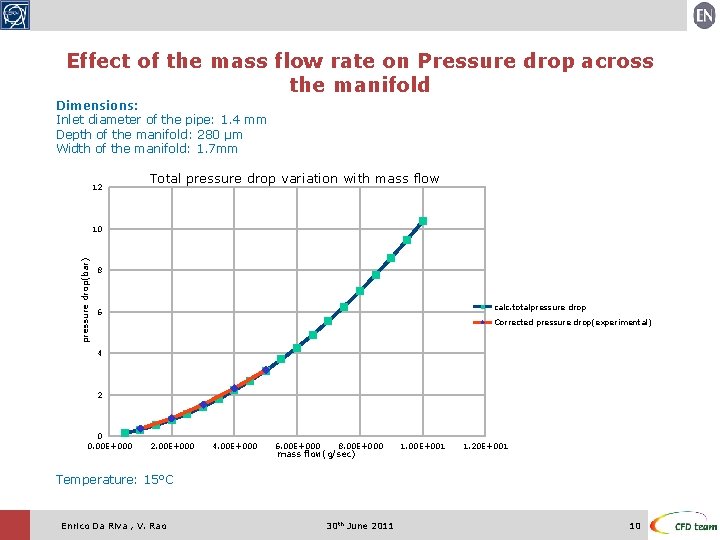
Effect of the mass flow rate on Pressure drop across the manifold Inlet mass flow rate: 7 g/s Inlet diameter: 1. 4 mm Manifold cross section: 280µm X 1. 7 mm Density @ 15°C : 1700. 85 Kg/m 3 Kinematic viscosity @ 15°C : . 425 c. St Inlet velocity: 2. 67 m/s Inlet Reynolds number: 8806. 94 Manifold velocity: 8. 64 m/s Manifold Reynolds number: 9781. 55 Density @ -25°C : 1805. 25 Kg/m 3 Kinematic viscosity @ -25°C : . 8 c. St Inlet velocity: 2. 51 m/s Inlet Reynolds number: 4408. 11 Manifold velocity: 8. 14 m/s Manifold Reynolds number: 4895. 93 Flow is turbulent in the manifold Enrico Da Riva , V. Rao 30 th June 2011 9
Effect of the mass flow rate on Pressure drop across the manifold Dimensions: Inlet diameter of the pipe: 1. 4 mm Depth of the manifold: 280 µm Width of the manifold: 1. 7 mm 12 Total pressure drop variation with mass flow pressure drop(bar) 10 8 calc. totalpressure drop 6 Corrected pressure drop(experimental) 4 2 0 0. 00 E+000 2. 00 E+000 4. 00 E+000 6. 00 E+000 8. 00 E+000 mass flow(g/sec) 1. 00 E+001 1. 20 E+001 Temperature: 15°C Enrico Da Riva , V. Rao 30 th June 2011 10
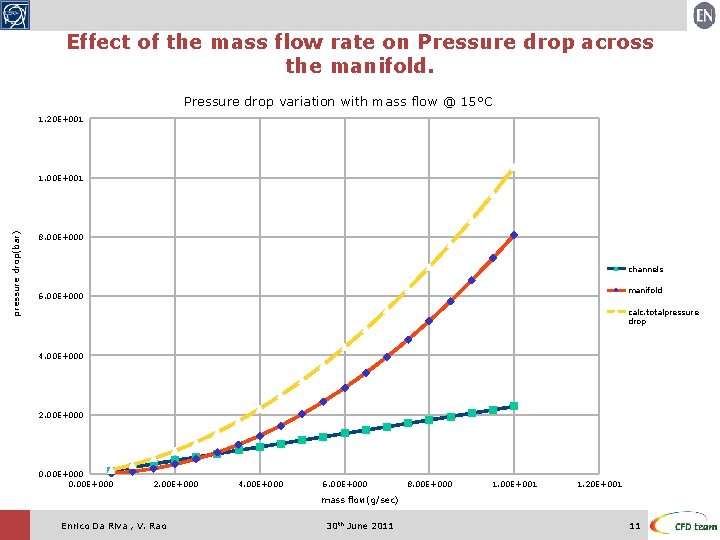
Effect of the mass flow rate on Pressure drop across the manifold. Pressure drop variation with mass flow @ 15°C 1. 20 E+001 pressure drop(bar) 1. 00 E+001 8. 00 E+000 channels manifold 6. 00 E+000 calc. totalpressure drop 4. 00 E+000 2. 00 E+000 0. 00 E+000 2. 00 E+000 4. 00 E+000 6. 00 E+000 8. 00 E+000 1. 00 E+001 1. 20 E+001 mass flow(g/sec) Enrico Da Riva , V. Rao 30 th June 2011 11
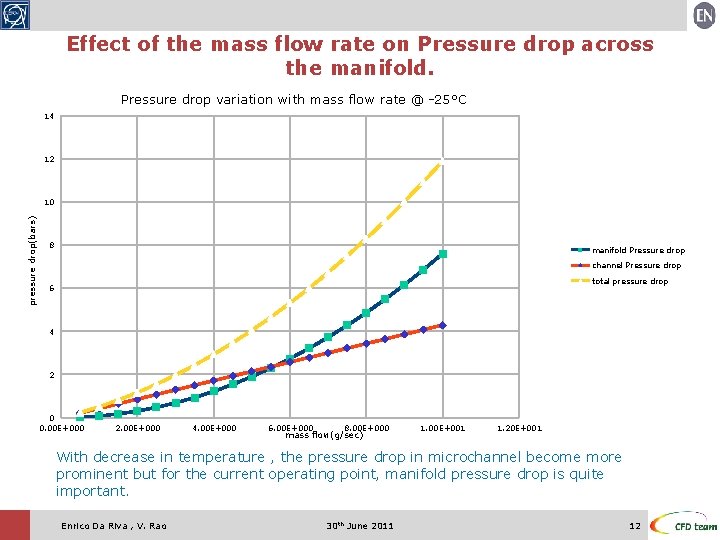
Effect of the mass flow rate on Pressure drop across the manifold. Pressure drop variation with mass flow rate @ -25°C 14 12 pressure drop(bars) 10 8 manifold Pressure drop channel Pressure drop total pressure drop 6 4 2 0 0. 00 E+000 2. 00 E+000 4. 00 E+000 6. 00 E+000 8. 00 E+000 mass flow(g/sec) 1. 00 E+001 1. 20 E+001 With decrease in temperature , the pressure drop in microchannel become more prominent but for the current operating point, manifold pressure drop is quite important. Enrico Da Riva , V. Rao 30 th June 2011 12
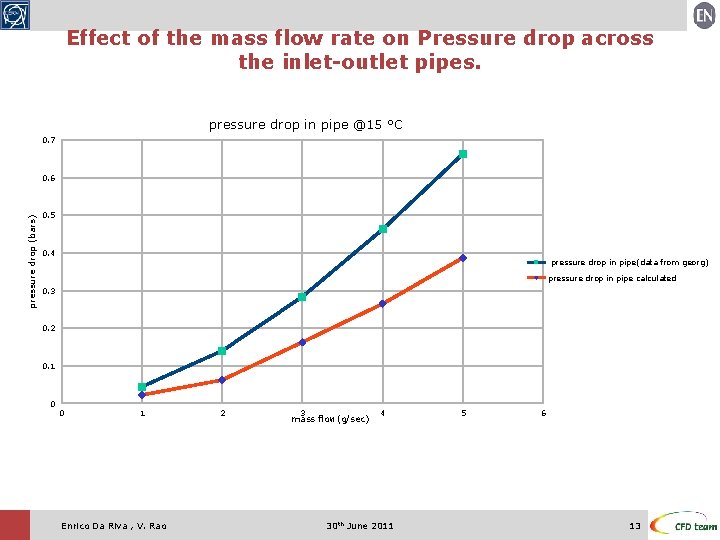
Effect of the mass flow rate on Pressure drop across the inlet-outlet pipes. pressure drop in pipe @15 °C 0. 7 pressure drop (bars) 0. 6 0. 5 0. 4 pressure drop in pipe(data from georg) pressure drop in pipe calculated 0. 3 0. 2 0. 1 0 0 1 Enrico Da Riva , V. Rao 2 3 mass flow(g/sec) 4 30 th June 2011 5 6 13
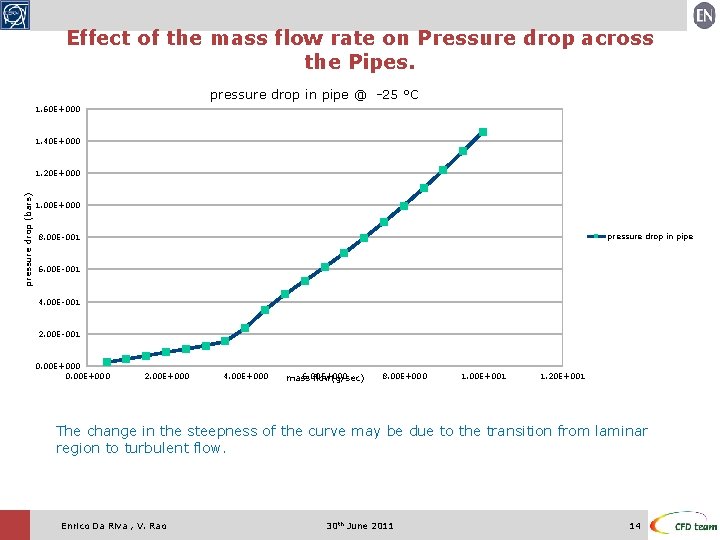
Effect of the mass flow rate on Pressure drop across the Pipes. pressure drop in pipe @ -25 °C 1. 60 E+000 1. 40 E+000 pressure drop (bars) 1. 20 E+000 1. 00 E+000 pressure drop in pipe 8. 00 E-001 6. 00 E-001 4. 00 E-001 2. 00 E-001 0. 00 E+000 2. 00 E+000 4. 00 E+000 6. 00 E+000 mass flow(g/sec) 8. 00 E+000 1. 00 E+001 1. 20 E+001 The change in the steepness of the curve may be due to the transition from laminar region to turbulent flow. Enrico Da Riva , V. Rao 30 th June 2011 14
Conclusions & Suggestions 1. ) The pressure drop in the manifold would be dominant at the design temperature and design mass flow rate. 2. ) The problem is due to the small cross section of the manifold. 3. ) Before looking at the microchannels, we must work on the manifold. 4. ) Temperature has a strong influence on the pressure drop in the microchannel, but this is not so important with the present design since the dominant pressure drop is in the manifold. 5. ) Using multiple inlet-outlet system to reduce pressure drop in the manifold. Enrico Da Riva , V. Rao 30 th June 2011 15
Pressure drop with dual inlet-outlet Working fluid perflourohexane @Temperature -25 °C Mass flow: 7 g/s or 2*3. 5 g/s Manifold velocity: 4. 07 m/s Inlet velocity: 1. 25 m/s Manifold Reynolds number: 2447 Inlet Reynolds number: 2204 Enrico Da Riva , V. Rao 30 th June 2011 16
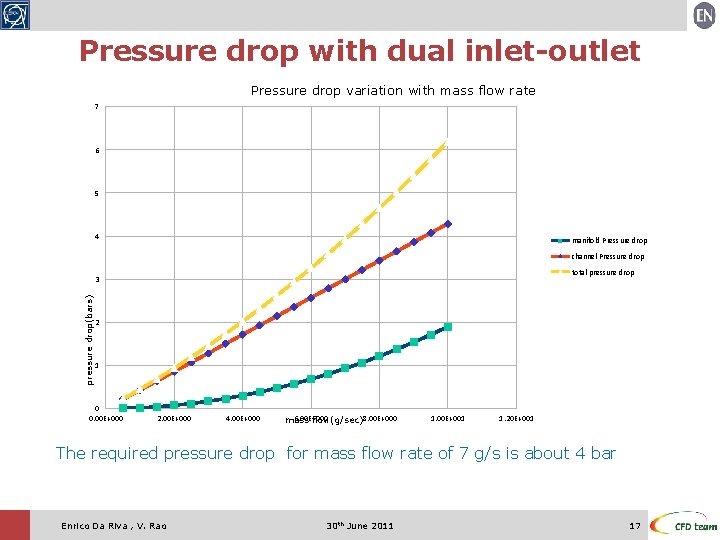
Pressure drop with dual inlet-outlet Pressure drop variation with mass flow rate 7 6 5 4 manifold Pressure drop channel Pressure drop total pressure drop(bars) 3 2 1 0 0. 00 E+000 2. 00 E+000 4. 00 E+000 6. 00 E+000 mass flow(g/sec)8. 00 E+000 1. 00 E+001 1. 20 E+001 The required pressure drop for mass flow rate of 7 g/s is about 4 bar Enrico Da Riva , V. Rao 30 th June 2011 17
Heat transfer coefficient For laminar flow Nusselt number : 3. 2 Hydraulic diameter of channels : 100 µm Thermal conductivity of Perflourohexane @ -25 °C: . 06275 W/(m-k) Heat transfer coefficient (Perflourohexane): 2008 W/(m 2 k) Enrico Da Riva , V. Rao 30 th June 2011 18