Categorical aspects of Locale Theory Prepared for a
- Slides: 18
Categorical aspects of Locale Theory Prepared for a University of Birmingham Seminar 16 th November 2007 By Christopher Townsend
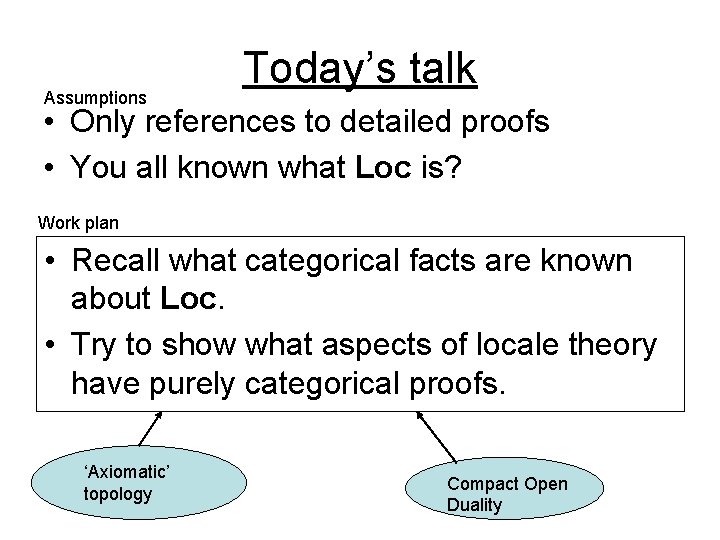
Assumptions Today’s talk • Only references to detailed proofs • You all known what Loc is? Work plan • Recall what categorical facts are known about Loc. • Try to show what aspects of locale theory have purely categorical proofs. ‘Axiomatic’ topology Compact Open Duality
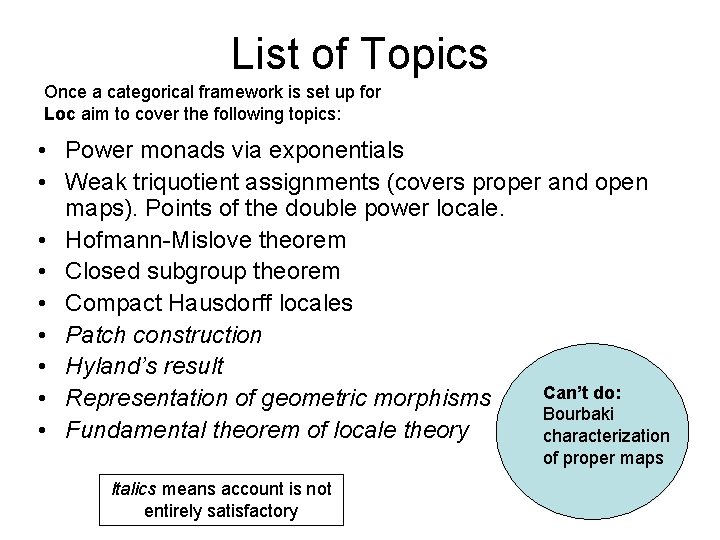
List of Topics Once a categorical framework is set up for Loc aim to cover the following topics: • Power monads via exponentials • Weak triquotient assignments (covers proper and open maps). Points of the double power locale. • Hofmann-Mislove theorem • Closed subgroup theorem • Compact Hausdorff locales • Patch construction • Hyland’s result Can’t do: • Representation of geometric morphisms Bourbaki • Fundamental theorem of locale theory characterization of proper maps Italics means account is not entirely satisfactory
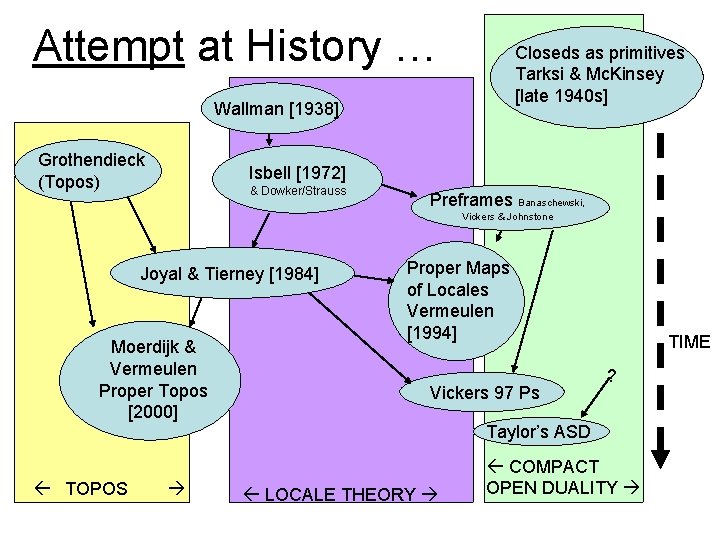
Attempt at History … Closeds as primitives Tarksi & Mc. Kinsey [late 1940 s] Wallman [1938] Grothendieck (Topos) Isbell [1972] & Dowker/Strauss Preframes Banaschewski, Vickers & Johnstone Joyal & Tierney [1984] Moerdijk & Vermeulen Proper Topos [2000] Proper Maps of Locales Vermeulen [1994] Vickers 97 Ps TIME ? Taylor’s ASD TOPOS LOCALE THEORY COMPACT OPEN DUALITY
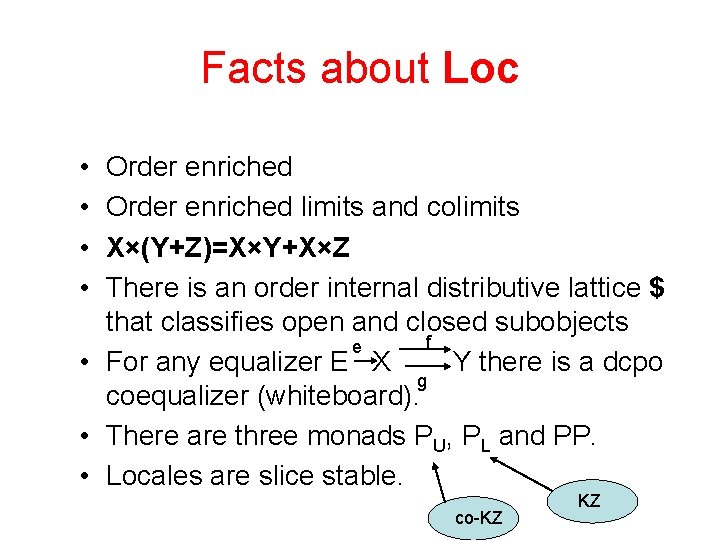
Facts about Loc • • Order enriched limits and colimits X×(Y+Z)=X×Y+X×Z There is an order internal distributive lattice $ that classifies open and closed subobjects f e • For any equalizer E X Y there is a dcpo g coequalizer (whiteboard). • There are three monads PU, PL and PP. • Locales are slice stable. co-KZ KZ
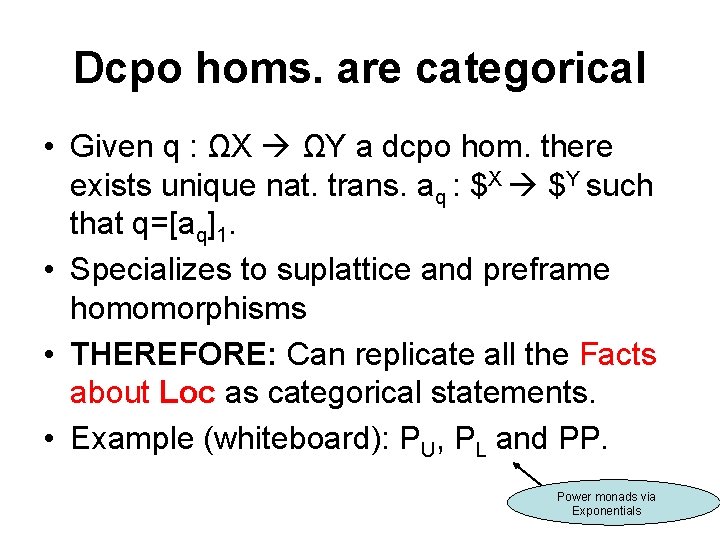
Dcpo homs. are categorical • Given q : ΩX ΩY a dcpo hom. there exists unique nat. trans. aq : $X $Y such that q=[aq]1. • Specializes to suplattice and preframe homomorphisms • THEREFORE: Can replicate all the Facts about Loc as categorical statements. • Example (whiteboard): PU, PL and PP. Power monads via Exponentials
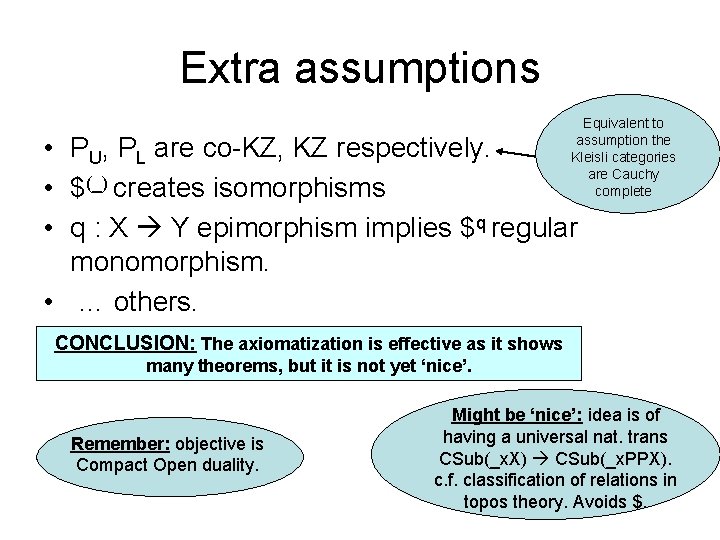
Extra assumptions Equivalent to assumption the Kleisli categories are Cauchy complete • PU, PL are co-KZ, KZ respectively. • $(_) creates isomorphisms • q : X Y epimorphism implies $q regular monomorphism. • … others. CONCLUSION: The axiomatization is effective as it shows many theorems, but it is not yet ‘nice’. Remember: objective is Compact Open duality. Might be ‘nice’: idea is of having a universal nat. trans CSub(_x. X) CSub(_x. PPX). c. f. classification of relations in topos theory. Avoids $.
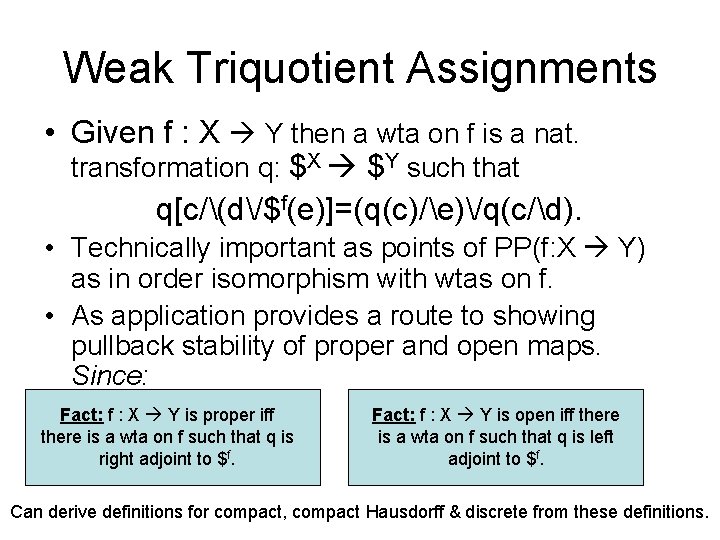
Weak Triquotient Assignments • Given f : X Y then a wta on f is a nat. transformation q: $X $Y such that q[c/(d/$f(e)]=(q(c)/e)/q(c/d). • Technically important as points of PP(f: X Y) as in order isomorphism with wtas on f. • As application provides a route to showing pullback stability of proper and open maps. Since: Fact: f : X Y is proper iff there is a wta on f such that q is right adjoint to $f. Fact: f : X Y is open iff there is a wta on f such that q is left adjoint to $f. Can derive definitions for compact, compact Hausdorff & discrete from these definitions.
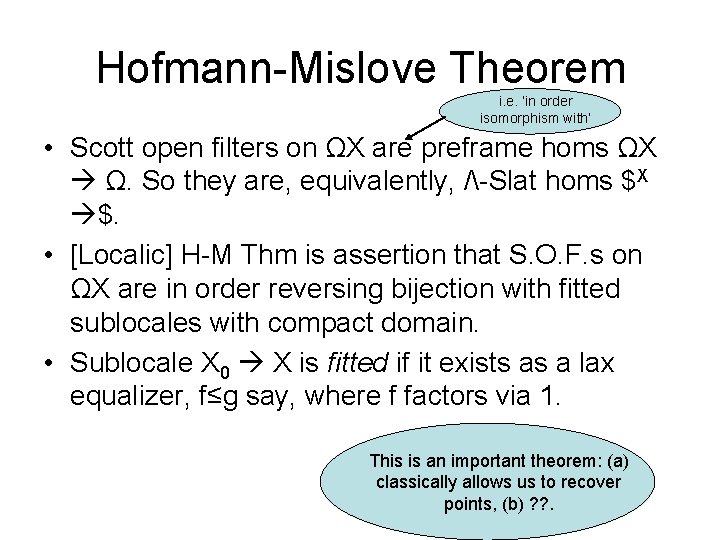
Hofmann-Mislove Theorem i. e. ‘in order isomorphism with’ • Scott open filters on ΩX are preframe homs ΩX Ω. So they are, equivalently, /-Slat homs $X $. • [Localic] H-M Thm is assertion that S. O. F. s on ΩX are in order reversing bijection with fitted sublocales with compact domain. • Sublocale X 0 X is fitted if it exists as a lax equalizer, f≤g say, where f factors via 1. This is an important theorem: (a) classically allows us to recover points, (b) ? ? .
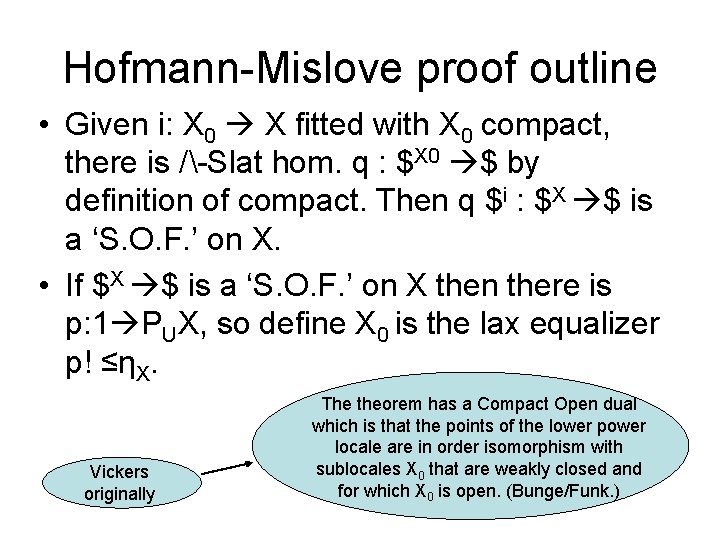
Hofmann-Mislove proof outline • Given i: X 0 X fitted with X 0 compact, there is /-Slat hom. q : $X 0 $ by definition of compact. Then q $i : $X $ is a ‘S. O. F. ’ on X. • If $X $ is a ‘S. O. F. ’ on X then there is p: 1 PUX, so define X 0 is the lax equalizer p! ≤ηX. Vickers originally The theorem has a Compact Open dual which is that the points of the lower power locale are in order isomorphism with sublocales X 0 that are weakly closed and for which X 0 is open. (Bunge/Funk. )
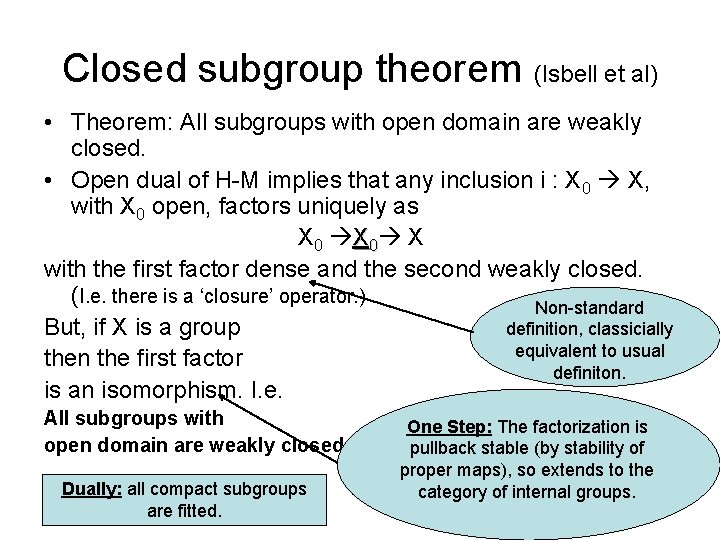
Closed subgroup theorem (Isbell et al) • Theorem: All subgroups with open domain are weakly closed. • Open dual of H-M implies that any inclusion i : X 0 X, with X 0 open, factors uniquely as X 0 X with the first factor dense and the second weakly closed. (I. e. there is a ‘closure’ operator. ) Non-standard But, if X is a group definition, classicially equivalent to usual then the first factor definiton. is an isomorphism. I. e. All subgroups with open domain are weakly closed Dually: all compact subgroups are fitted. One Step: The factorization is pullback stable (by stability of proper maps), so extends to the category of internal groups.
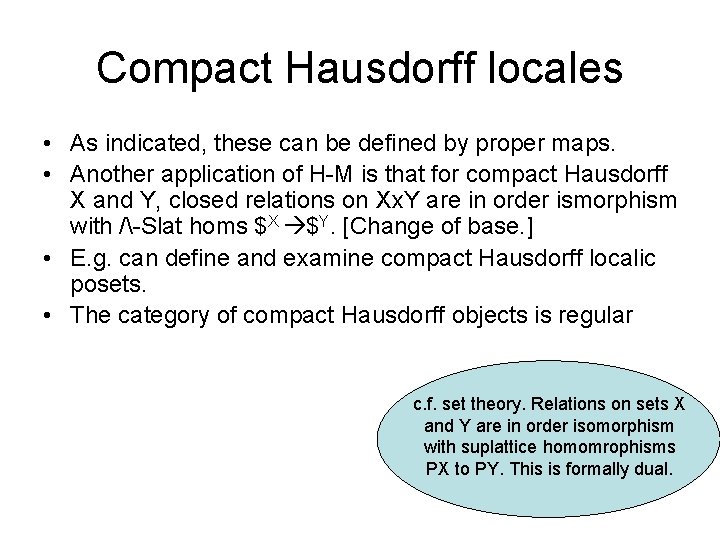
Compact Hausdorff locales • As indicated, these can be defined by proper maps. • Another application of H-M is that for compact Hausdorff X and Y, closed relations on Xx. Y are in order ismorphism with /-Slat homs $X $Y. [Change of base. ] • E. g. can define and examine compact Hausdorff localic posets. • The category of compact Hausdorff objects is regular c. f. set theory. Relations on sets X and Y are in order isomorphism with suplattice homomrophisms PX to PY. This is formally dual.
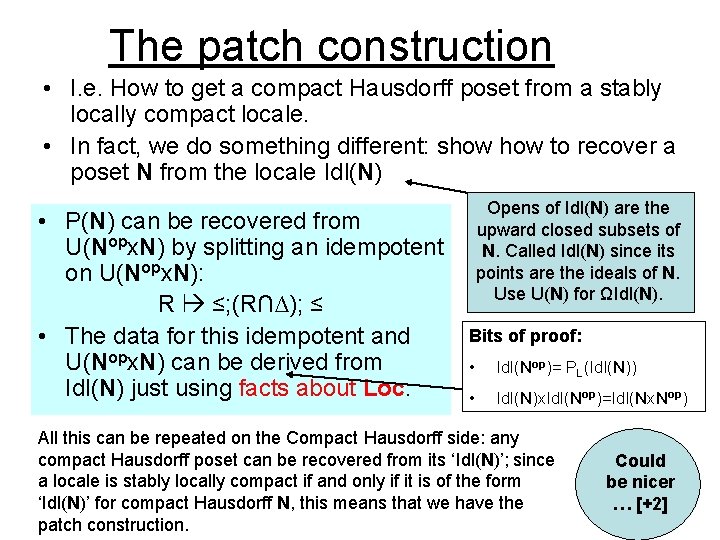
The patch construction • I. e. How to get a compact Hausdorff poset from a stably locally compact locale. • In fact, we do something different: show to recover a poset N from the locale Idl(N) • P(N) can be recovered from U(Nopx. N) by splitting an idempotent on U(Nopx. N): R ≤; (R∩∆); ≤ • The data for this idempotent and U(Nopx. N) can be derived from Idl(N) just using facts about Loc. Opens of Idl(N) are the upward closed subsets of N. Called Idl(N) since its points are the ideals of N. Use U(N) for ΩIdl(N). Bits of proof: • Idl(Nop)= PL(Idl(N)) • Idl(N)x. Idl(Nop)=Idl(Nx. Nop) All this can be repeated on the Compact Hausdorff side: any compact Hausdorff poset can be recovered from its ‘Idl(N)’; since a locale is stably locally compact if and only if it is of the form ‘Idl(N)’ for compact Hausdorff N, this means that we have the patch construction. Could be nicer … [+2]
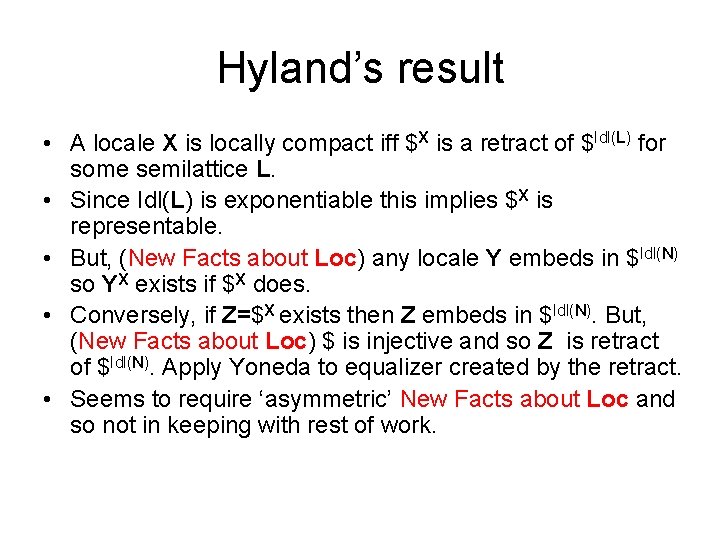
Hyland’s result • A locale X is locally compact iff $X is a retract of $Idl(L) for some semilattice L. • Since Idl(L) is exponentiable this implies $X is representable. • But, (New Facts about Loc) any locale Y embeds in $Idl(N) so YX exists if $X does. • Conversely, if Z=$X exists then Z embeds in $Idl(N). But, (New Facts about Loc) $ is injective and so Z is retract of $Idl(N). Apply Yoneda to equalizer created by the retract. • Seems to require ‘asymmetric’ New Facts about Loc and so not in keeping with rest of work.
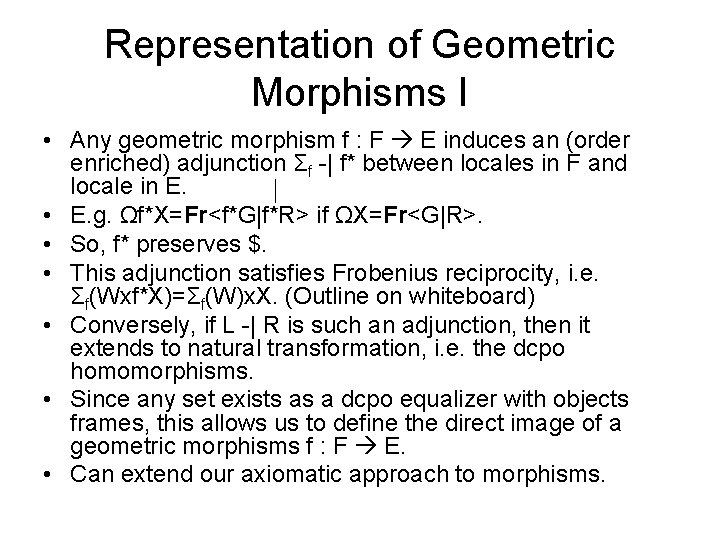
Representation of Geometric Morphisms I • Any geometric morphism f : F E induces an (order enriched) adjunction Σf -| f* between locales in F and locale in E. • E. g. Ωf*X=Fr<f*G|f*R> if ΩX=Fr<G|R>. • So, f* preserves $. • This adjunction satisfies Frobenius reciprocity, i. e. Σf(Wxf*X)=Σf(W)x. X. (Outline on whiteboard) • Conversely, if L -| R is such an adjunction, then it extends to natural transformation, i. e. the dcpo homomorphisms. • Since any set exists as a dcpo equalizer with objects frames, this allows us to define the direct image of a geometric morphisms f : F E. • Can extend our axiomatic approach to morphisms.
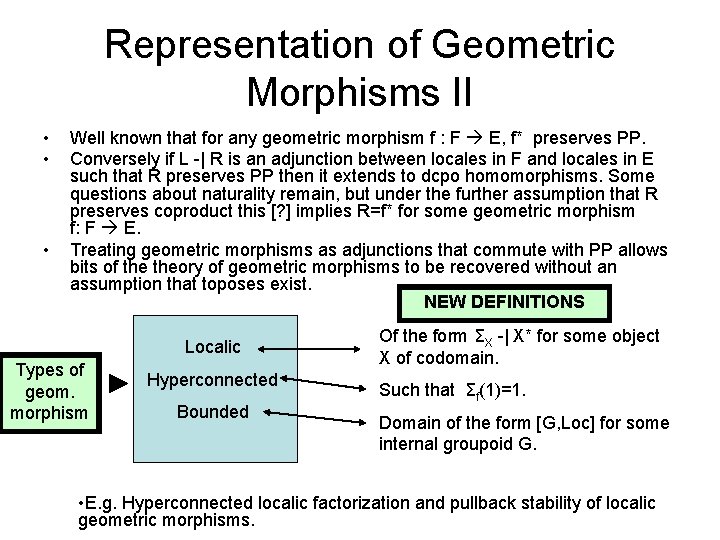
Representation of Geometric Morphisms II • • • Well known that for any geometric morphism f : F E, f* preserves PP. Conversely if L -| R is an adjunction between locales in F and locales in E such that R preserves PP then it extends to dcpo homomorphisms. Some questions about naturality remain, but under the further assumption that R preserves coproduct this [? ] implies R=f* for some geometric morphism f: F E. Treating geometric morphisms as adjunctions that commute with PP allows bits of theory of geometric morphisms to be recovered without an assumption that toposes exist. NEW DEFINITIONS Localic Types of geom. morphism Hyperconnected Bounded Of the form ΣX -| X* for some object X of codomain. Such that Σf(1)=1. Domain of the form [G, Loc] for some internal groupoid G. • E. g. Hyperconnected localic factorization and pullback stability of localic geometric morphisms.
Fundemental Theorem of Locale Theory • In fact, most of the axioms are slice stable.
Summary: Help! • Can we make the axiomatization nicer? – Via a universal natural transformation? – Models other than Loc to prove independence of axioms. (There are some easy ones: e. g. distributive or pullback preserves coproduct? ) – Firm up ‘fundamental theorem of locale theory’ • What is the right characterization of stably locally compact? (And, by implication, of locales of the form Idl(P)? ) • Bourbaki characterization of proper maps. • Representation of geometric morphisms: – Finish proof on characterization in terms of PP – Proof of stability of proper and open geometric morphisms using representation – Stability of axiomiatization under taking G-equivarent sheaves for internal groupoids G.