Car Fun Play a counting game Each person
- Slides: 40
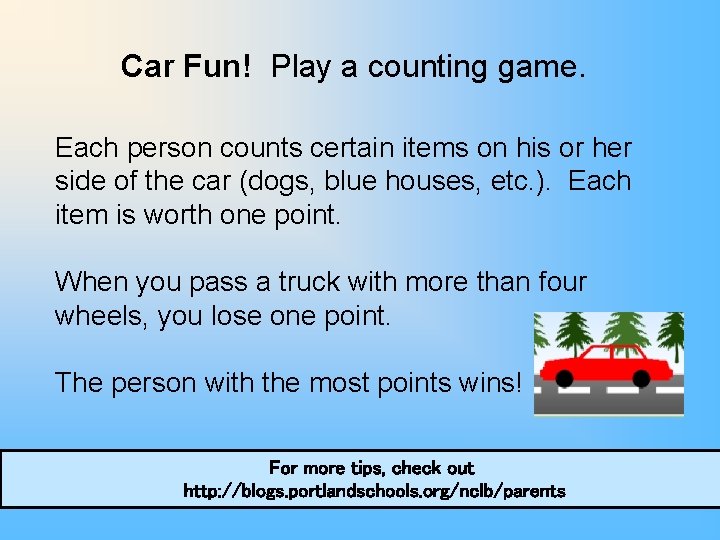
Car Fun! Play a counting game. Each person counts certain items on his or her side of the car (dogs, blue houses, etc. ). Each item is worth one point. When you pass a truck with more than four wheels, you lose one point. The person with the most points wins! For more tips, check out http: //blogs. portlandschools. org/nclb/parents
Math in the Kitchen When cooking, ask your child to help with: • measuring ingredients, like water & butter • multiplying, such as doubling a recipe • estimating how long it will take to prepare the meal For more tips, check out http: //blogs. portlandschools. org/nclb/parents
Shopper’s Helper When grocery shopping, you can help your child practice: • Creating a budget • Estimating the cost of buying more than one item (such as 2 loaves of bread) • Adding and subtracting, when you add or remove items from the cart For more tips, check out http: //blogs. portlandschools. org/nclb/parents
Math on the Road The next time you travel, look at a map with your child. Point out your home and where you are going. Discuss the map scale. Estimate how long it will take you to get there. For more tips, check out http: //blogs. portlandschools. org/nclb/parents
Fast Math Facts Help your child practice math facts by writing 0 -9 on index cards. Play games with the cards. See who can: • build the biggest number • build the smallest number • multiply the fastest For more tips, check out http: //blogs. portlandschools. org/nclb/parents
Math at the Table When setting the table, ask your child to count the pieces of silverware, plates, or glasses. Your child can practice multiplying by using the number of people who will be eating at the table. For more tips, check out http: //blogs. portlandschools. org/nclb/parents
A Shape Walk Take a shape walk with your child, in the house or outdoors. What shapes do you see? What kind of angles do you see? For more tips, check out http: //blogs. portlandschools. org/nclb/parents
Traveling Math When traveling, ask your child to help calculate the number of miles you will go. When buying gas, ask your child to estimate the cost or the number of gallons. For more tips, check out http: //blogs. portlandschools. org/nclb/parents
Sorting through Math You can help your child practice sorting with items around the house. • socks • buttons • bottle caps • cans • pens or pencils For more tips, check out http: //blogs. portlandschools. org/nclb/parents
Math around the Clock Help your child learn time. Ask your child to: • read analog clocks (not digital) • estimate how much time it takes to do a task, and then check it For more tips, check out http: //blogs. portlandschools. org/nclb/parents
Reading is Daily! Ask your child to read to you every day: 10 minutes for grades K-2 15 -20 minutes for grades 3 -5 …until he or she is a fluent, independent reader. For more tips, check out http: //blogs. portlandschools. org/nclb/parents
Reading Together Take turns reading out loud with your child. First he or she reads a page, then you do. Together, talk about what you have read. For more tips, check out http: //blogs. portlandschools. org/nclb/parents
Reading Tip If your child loses his/her place frequently, have him/her hold an index card under the lines of text. For more tips, check out http: //blogs. portlandschools. org/nclb/parents
Word Help If your child is stuck on a word, help by saying: • • “What's the beginning sound? " “Skip it and read on, then come back. ” “Look at the picture. " “Think about what is happening in the story. " For more tips, check out http: //blogs. portlandschools. org/nclb/parents
Reading Begins at Home To help your child practice reading and writing, keep the following at home: paper crayons pencils magnetic letters picture books alphabet books rhyming books alphabet games For more tips, check out http: //blogs. portlandschools. org/nclb/parents
Fun with Words • Play games by thinking of words that rhyme, or start with the same letter sound. • Have your child clap the number of syllables in a word, or the number of words in a sentence. For more tips, check out http: //blogs. portlandschools. org/nclb/parents
Fun with Words Pretend with your child that a word is a rubber band that you can stretch out slowly as you say all the sounds. For more tips, check out http: //blogs. portlandschools. org/nclb/parents
Reading through Art Ask your child to draw a picture about the book you are reading together. Create a special space in your home that is just for reading, writing, and drawing. For more tips, check out http: //blogs. portlandschools. org/nclb/parents
Making Connections Ask your child, “What does this story remind you of? ” That can help children relate the story to their own experiences or other stories they have read. For more tips, check out http: //blogs. portlandschools. org/nclb/parents
Asking Questions Ask your child about books she/he reads: • What characters do you like or dislike? Why? • What are your favorite parts? • What surprised you about the story? For more tips, check out http: //blogs. portlandschools. org/nclb/parents
The 5 -Finger Rule When helping your child choose books, ask him or her to read the first two pages and raise one finger for every unknown word. If five fingers go up, choose another book. For more tips, check out http: //blogs. portlandschools. org/nclb/parents
Developing Young Readers When you go to the grocery store, name the items you put in your cart. Talk about their size and color. Describe the red and crunchy apple, or the round and juicy orange. For more tips, check out http: //blogs. portlandschools. org/nclb/parents
Reading is Everywhere There are opportunities for reading everywhere—and not just from a book. • A menu tells you what food you can get. • Signs tell us where the bus stops. • Directions tell us how to build a toy. For more tips, check out http: //blogs. portlandschools. org/nclb/parents
Reading is Everywhere Help your child practice reading and writing with everyday activities and items: shopping food labels pin-up board newspapers telephone book street directories maps For more tips, check out http: //blogs. portlandschools. org/nclb/parents
Telling Stories Tell your child about themselves and the people they love. Share stories about: • the day they were born • how you chose their name • stories of holiday time • special memories • funny moments For more tips, check out http: //blogs. portlandschools. org/nclb/parents
Reading is not Just Books There are many ways your child can read, even without a book. • collecting baseball cards • putting together models • following a sports team in the newspaper For more tips, check out http: //blogs. portlandschools. org/nclb/parents
Over and Over It can be helpful for children to read the same story over and over. They can learn new words and strengthen their understanding of the story. For more tips, check out http: //blogs. portlandschools. org/nclb/parents
Finding Time to Read Feeling crunched for time? A bedtime story is a great way to read with your child. It helps calm them before bed, and can be a fun routine for you both. For more tips, check out http: //blogs. portlandschools. org/nclb/parents
Reading for the Whole Family Plan a regular quiet time when everyone in the family reads something of interest newspapers, books, comics, etc. Share what you read. Talk about the story, the words and the book. For more tips, check out http: //blogs. portlandschools. org/nclb/parents
Take Note! Exchange short notes with your kids about: • love • lunch • pick-up times • things you’re doing • chores…. It will help them practice reading and writing. For more tips, check out http: //blogs. portlandschools. org/nclb/parents
Sharing Ideas When talking about a story, listen to your child’s ideas and opinions. If it is their thinking, don’t correct them. Instead, ask for clarification: “Really! Why do you think that? ” For more tips, check out http: //blogs. portlandschools. org/nclb/parents
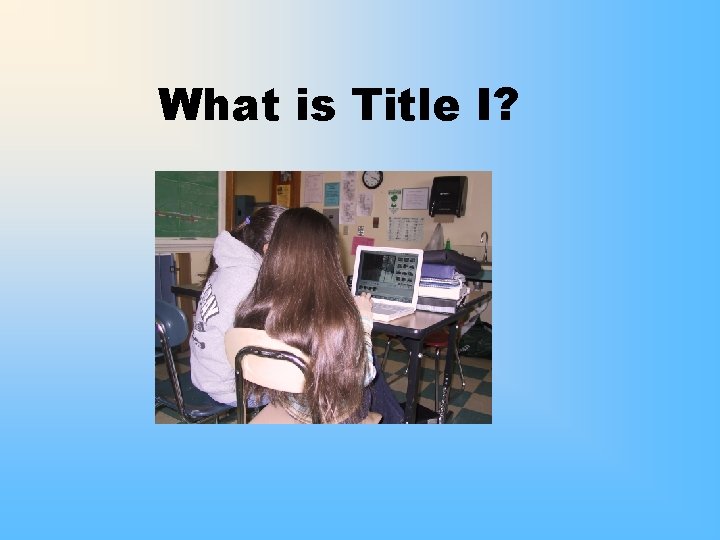
What is Title I?
Title I is a federal program that provides extra funding to eligible schools and districts. This support is meant to help students to meet the State performance standards. For more tips, check out http: //blogs. portlandschools. org/nclb/parents
How do schools become eligible to receive Title 1?
A school is eligible to receive Title I money if the percentage of its students who receive free lunch is higher than the district’s average. In Portland, elementary schools are the Title I focus. For more tips, check out http: //blogs. portlandschools. org/nclb/parents
Which of the Portland Public Schools receive Title I funds?
Nathan Clifford and Presumpscot Elementary Schools have programs providing extra services to select groups of students. Typically, those programs are in reading and math. This is called a Targeted Assistance model. For more tips, check out http: //blogs. portlandschools. org/nclb/parents
Reiche, Riverton, East End Community School and King Middle School may use Title I funds to upgrade and support the school’s entire program of teaching and learning. This is called a Schoolwide Program model. For more tips, check out http: //blogs. portlandschools. org/nclb/parents
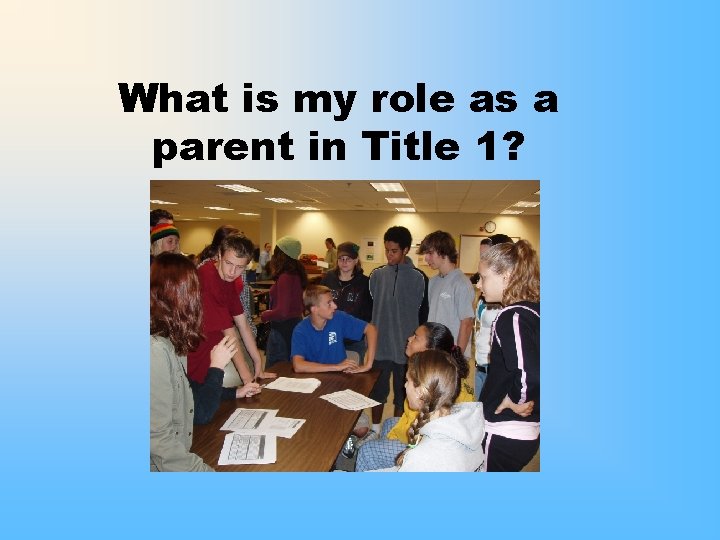
What is my role as a parent in Title 1?
Your involvement is crucial to your child’s success! Each Title I school has a Parent Advisory Council, or PAC. Contact your child’s school to find out how you can help. For more tips, check out http: //blogs. portlandschools. org/nclb/parents