CAP 5415 Computer Vision Fall 2004 Dr Alper
- Slides: 21
CAP 5415 Computer Vision Fall 2004 Dr. Alper Yilmaz Univ. of Central Florida www. cs. ucf. edu/courses/cap 5415/fall 2004 Office: CSB 250 Alper Yilmaz, Fall 2004 UCF
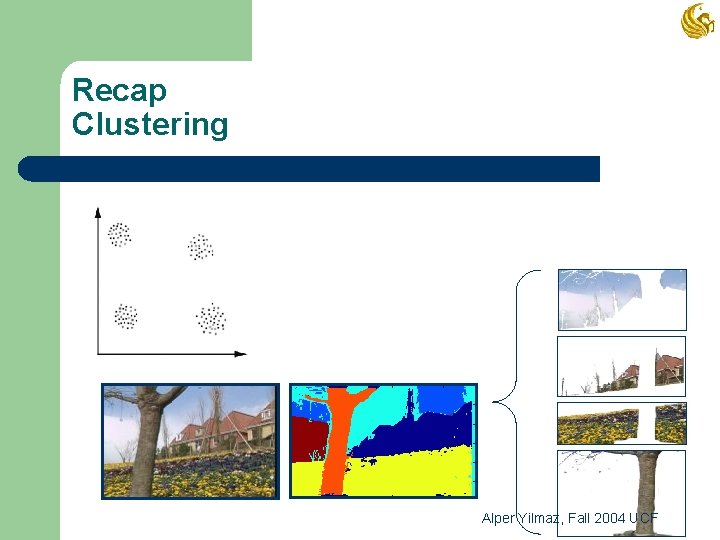
Recap Clustering Alper Yilmaz, Fall 2004 UCF
Recap Similarity Constraints l l Same gray levels. Distance less than threshold Distance to mean less than threshold Small standard deviation within region Alper Yilmaz, Fall 2004 UCF
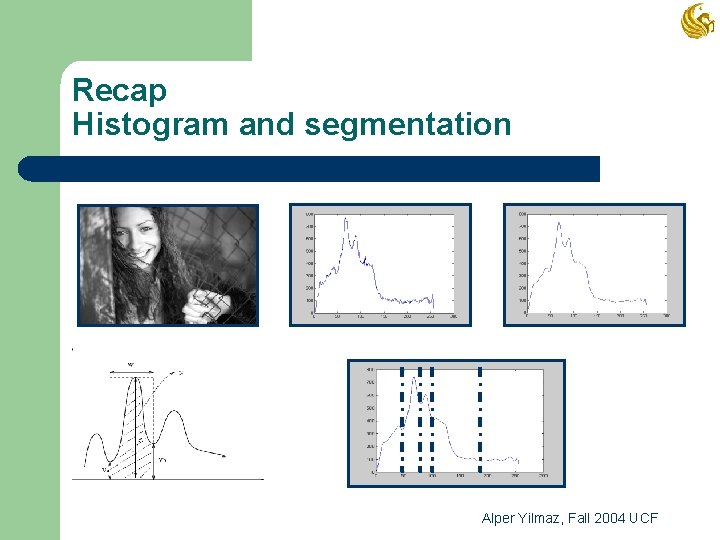
Recap Histogram and segmentation Alper Yilmaz, Fall 2004 UCF
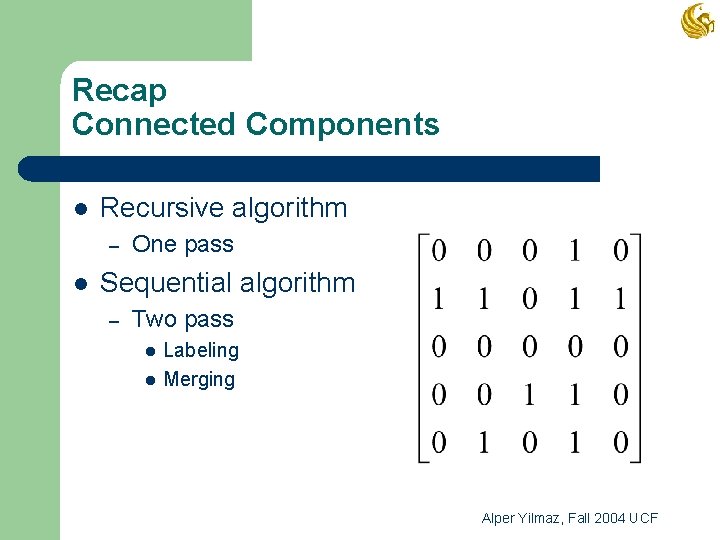
Recap Connected Components l Recursive algorithm – l One pass Sequential algorithm – Two pass l l Labeling Merging Alper Yilmaz, Fall 2004 UCF
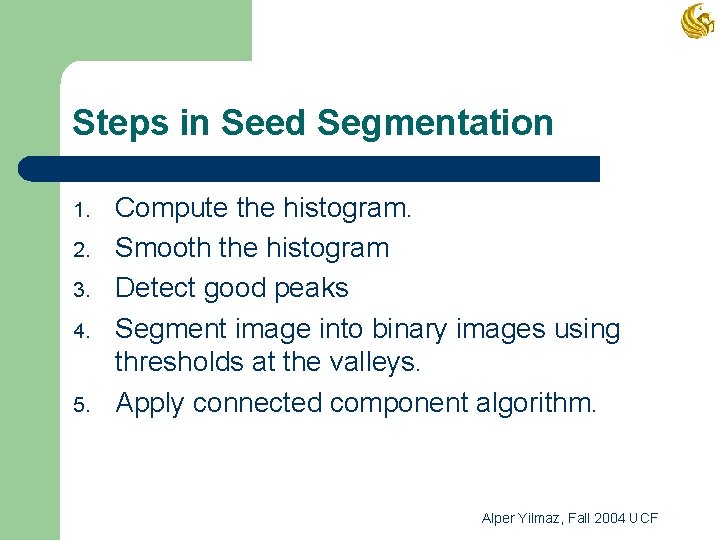
Steps in Seed Segmentation 1. 2. 3. 4. 5. Compute the histogram. Smooth the histogram Detect good peaks Segment image into binary images using thresholds at the valleys. Apply connected component algorithm. Alper Yilmaz, Fall 2004 UCF
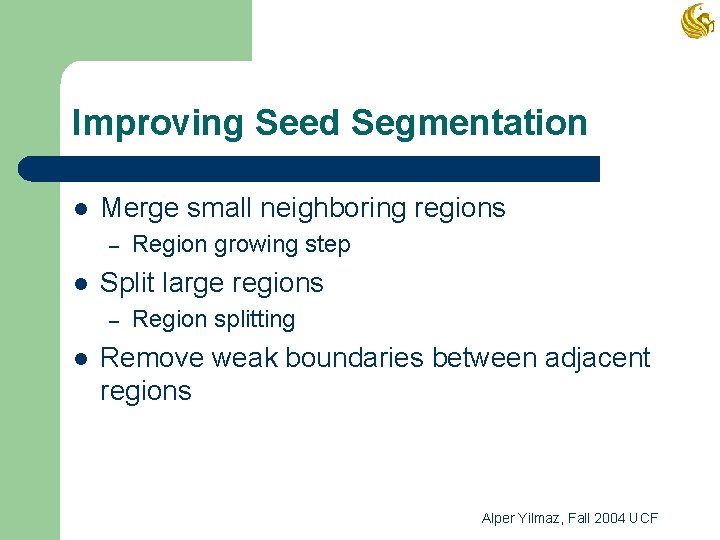
Improving Seed Segmentation l Merge small neighboring regions – l Split large regions – l Region growing step Region splitting Remove weak boundaries between adjacent regions Alper Yilmaz, Fall 2004 UCF
Region Growing l l Seed segmentation (histogram based seg. ) Region splitting and merging Phagocyte algorithm Likelihood ratio test Alper Yilmaz, Fall 2004 UCF
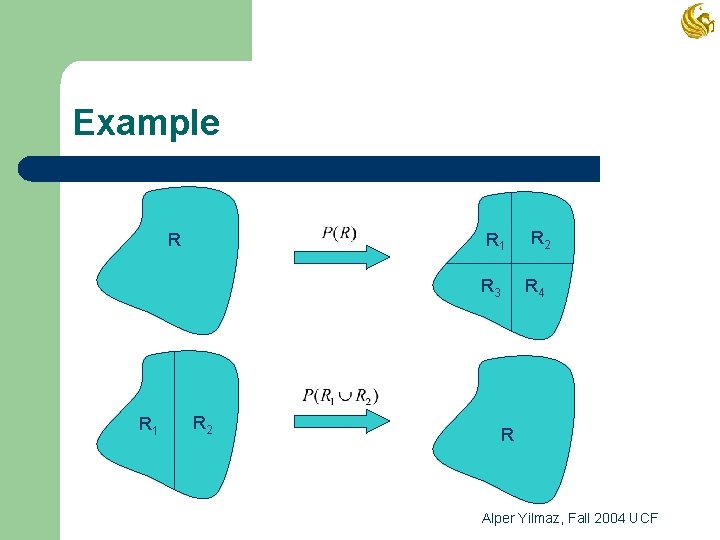
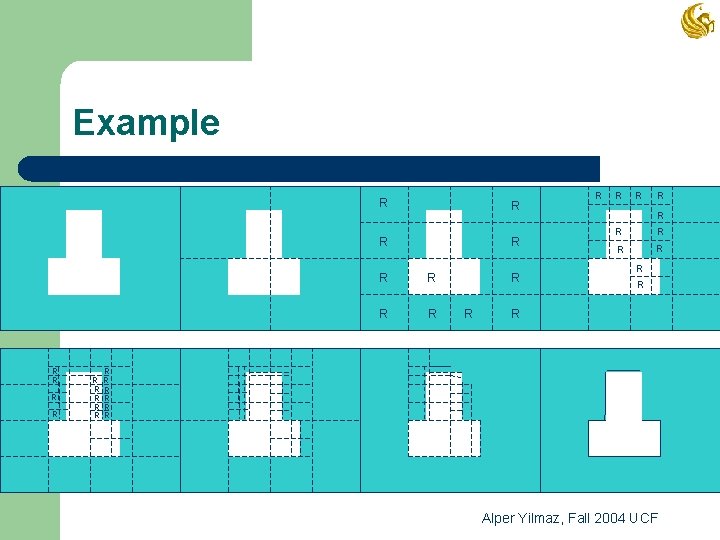
Region Split and Merge l l Splitting: split non uniform region into 4 adjacent regions Merging: merge similar regions Stop when no splitting merging are possible Uniformity/similarity function: P Alper Yilmaz, Fall 2004 UCF
Example R R 1 R 3 R 1 R 2 R 4 R Alper Yilmaz, Fall 2004 UCF
Example R R R R R R R R R R Alper Yilmaz, Fall 2004 UCF
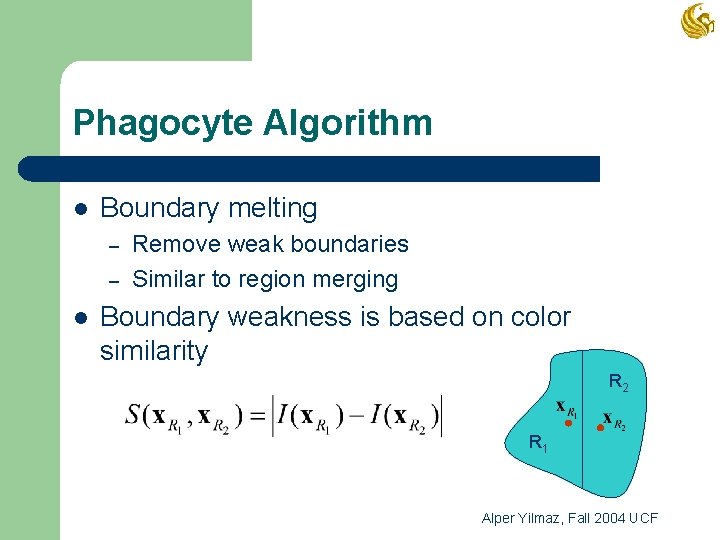
Phagocyte Algorithm l Boundary melting – – l Remove weak boundaries Similar to region merging Boundary weakness is based on color similarity R 2 R 1 Alper Yilmaz, Fall 2004 UCF
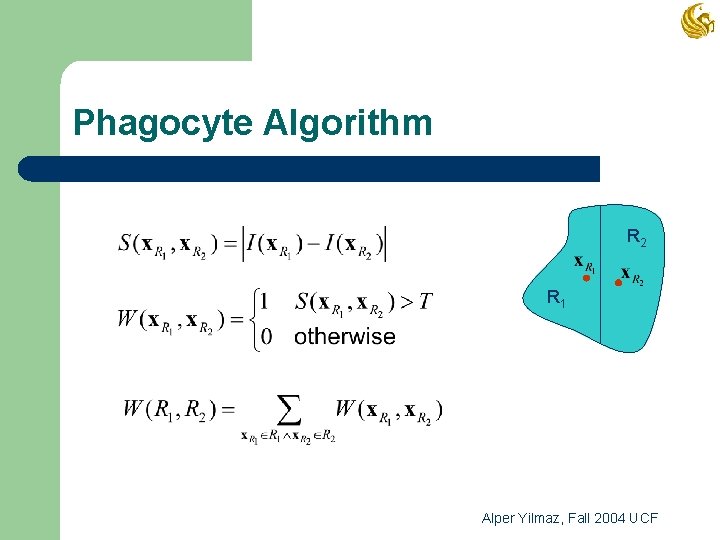
Phagocyte Algorithm R 2 R 1 Alper Yilmaz, Fall 2004 UCF
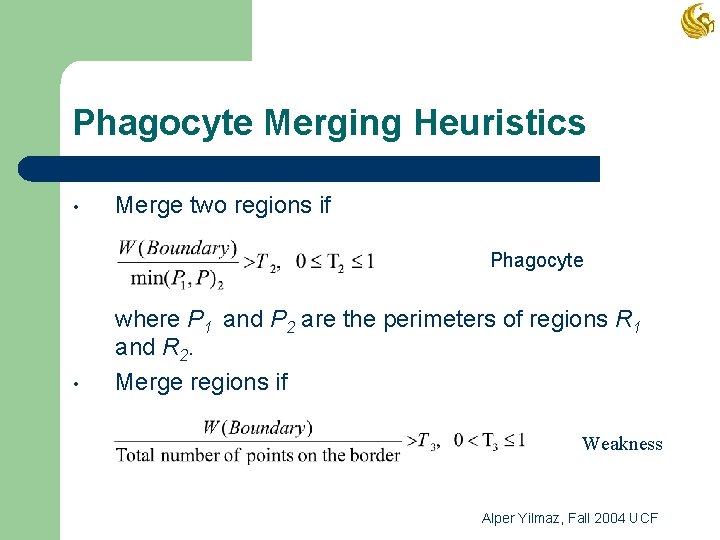
Phagocyte Merging Heuristics • Merge two regions if Phagocyte • where P 1 and P 2 are the perimeters of regions R 1 and R 2. Merge regions if Weakness Alper Yilmaz, Fall 2004 UCF
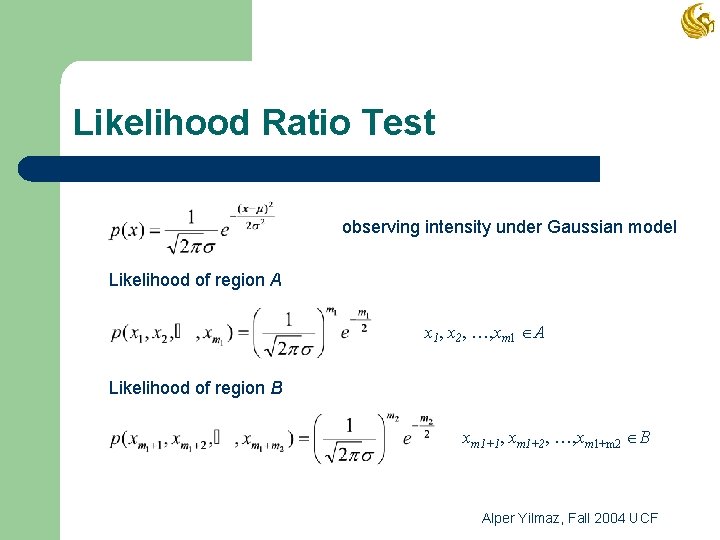
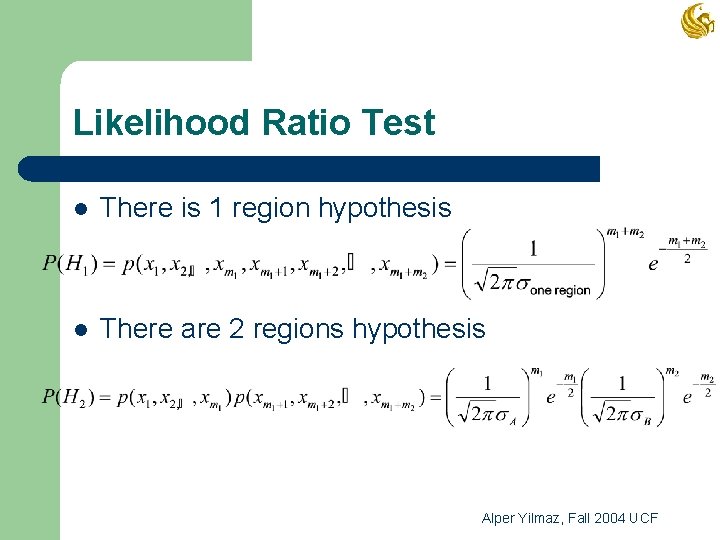
Likelihood Ratio Test l Two region hypothesis – – l There is only one region There are indeed two regions Intensity at every pixel is independent – – Joint probability Gaussian distribution Alper Yilmaz, Fall 2004 UCF
Likelihood Ratio Test observing intensity under Gaussian model Likelihood of region A x 1, x 2, …, xm 1 A Likelihood of region B xm 1+1, xm 1+2, …, xm 1+m 2 B Alper Yilmaz, Fall 2004 UCF
Likelihood Ratio Test l There is 1 region hypothesis l There are 2 regions hypothesis Alper Yilmaz, Fall 2004 UCF
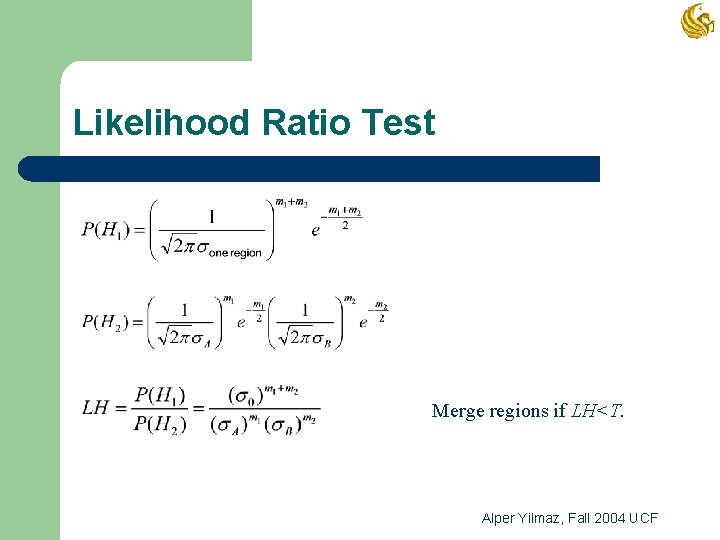
Likelihood Ratio Test Merge regions if LH<T. Alper Yilmaz, Fall 2004 UCF
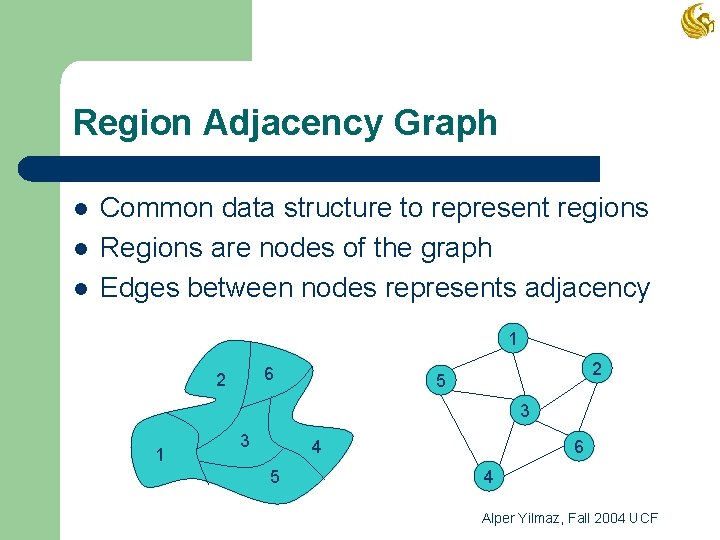
Region Adjacency Graph l l l Common data structure to represent regions Regions are nodes of the graph Edges between nodes represents adjacency 1 6 2 2 5 3 1 3 6 4 5 4 Alper Yilmaz, Fall 2004 UCF
Region Growing Methods l l Different algorithms have different number of thresholds How much merging is required – l Stopping criterion Though simple, seed segmentation succeed by region growing is usually successful Alper Yilmaz, Fall 2004 UCF
Difference Between Segmentation and Edge Detection l Closed boundary – – l Local or global – – l Edges are computed in the locality Segmentation is global Increasing feature vector dimensionality – – l Edges are usually open Segmentation provides closed boundaries Does not drastically improve edge detection Improves segmentation (motion, texture information etc. ) Boundary position – – Localized in edge detection Usually not localized (recent advancements use locality as well) l Especially contour based segmentation Alper Yilmaz, Fall 2004 UCF