Awake My Soul 2 Nephi 3 5 2



- Slides: 49
Awake My Soul 2 Nephi 3 -5
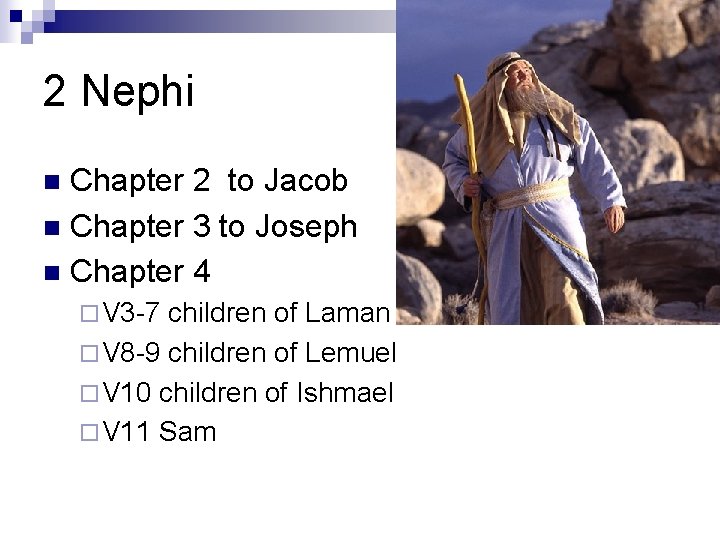
2 Nephi Chapter 2 to Jacob n Chapter 3 to Joseph n Chapter 4 n ¨ V 3 -7 children of Laman ¨ V 8 -9 children of Lemuel ¨ V 10 children of Ishmael ¨ V 11 Sam
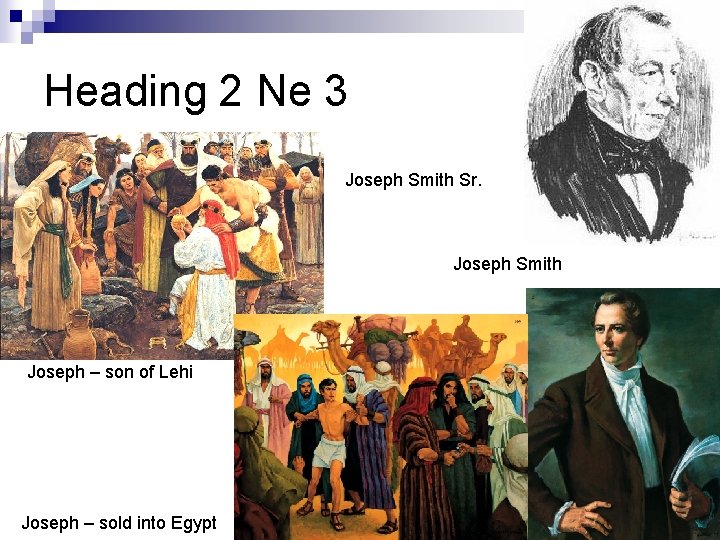
Heading 2 Ne 3 Joseph Smith Sr. Joseph Smith Joseph – son of Lehi Joseph – sold into Egypt
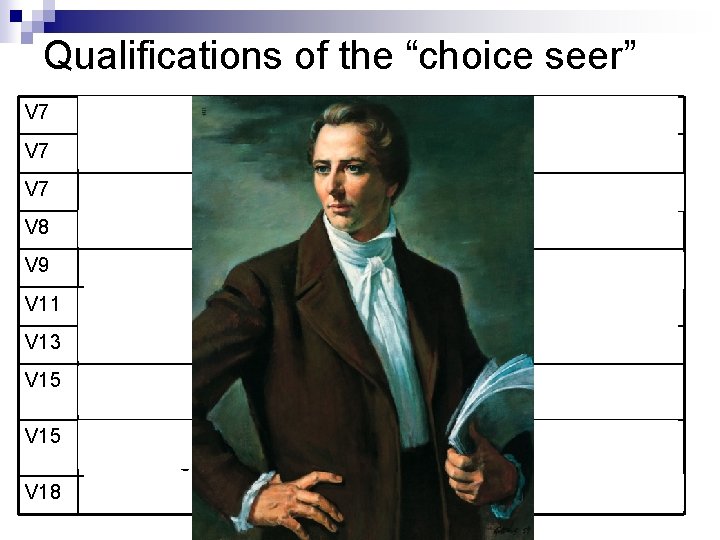
Qualifications of the “choice seer” V 7 He will be of the lineage of Joseph V 7 He will be highly esteemed by the descendants of Joseph V 7 He will do a work of “great worth” for the descendants of Joseph V 8 He will do no other work than that which the Lord commands him V 9 He will be great “like unto Moses” V 11 He will bring forth the word of the Lord unto Joseph’s descendants V 13 “…out of weakness he shall be made strong” V 15 “…his name shall be called after me; and it shall be after the name of his father” V 15 He will be like the ancient Joseph, through the power of the Lord he will bring his people to salvation V 18 He will write the writing of the fruit of Joseph’s loins
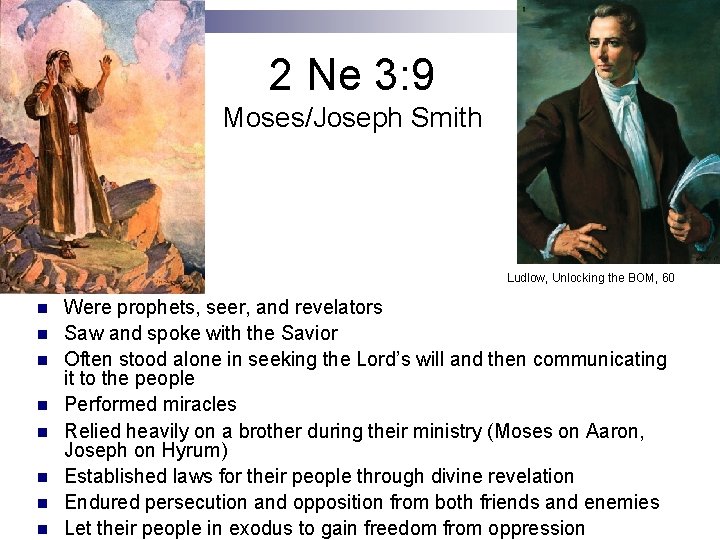
2 Ne 3: 9 Moses/Joseph Smith Ludlow, Unlocking the BOM, 60 n n n n Were prophets, seer, and revelators Saw and spoke with the Savior Often stood alone in seeking the Lord’s will and then communicating it to the people Performed miracles Relied heavily on a brother during their ministry (Moses on Aaron, Joseph on Hyrum) Established laws for their people through divine revelation Endured persecution and opposition from both friends and enemies Let their people in exodus to gain freedom from oppression
n Why were the covenants that Joseph of Egypt made with the Lord important to Lehi’s family? (See 2 Nephi 3: 4– 5; Jacob 2: 25; see also Genesis 45: 7. )
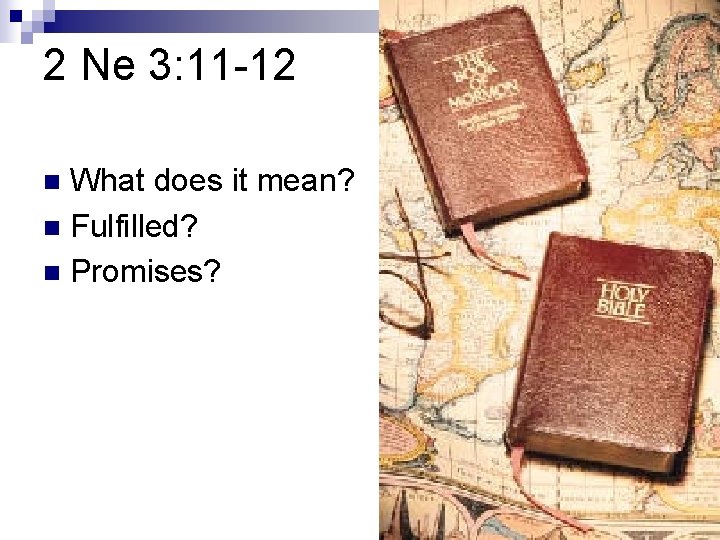
2 Ne 3: 11 -12 What does it mean? n Fulfilled? n Promises? n
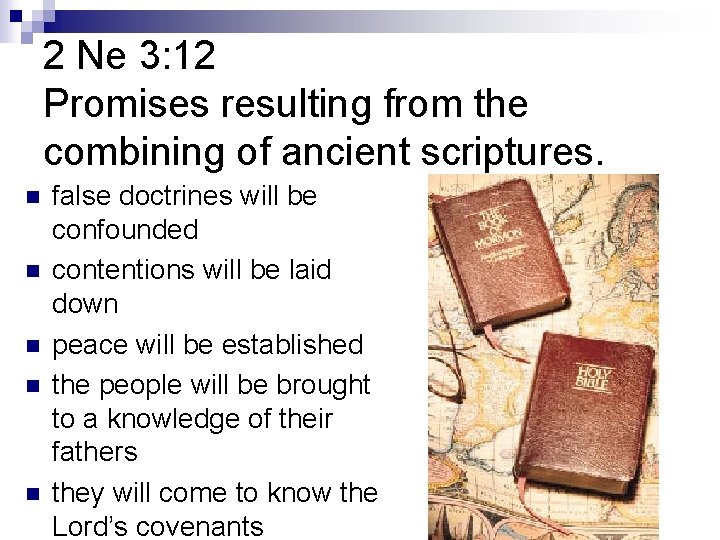
2 Ne 3: 12 Promises resulting from the combining of ancient scriptures. n n n false doctrines will be confounded contentions will be laid down peace will be established the people will be brought to a knowledge of their fathers they will come to know the Lord’s covenants
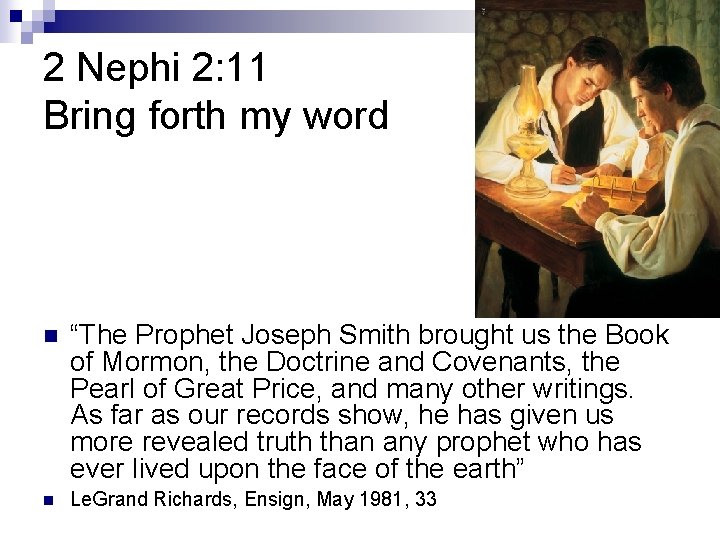
2 Nephi 2: 11 Bring forth my word n “The Prophet Joseph Smith brought us the Book of Mormon, the Doctrine and Covenants, the Pearl of Great Price, and many other writings. As far as our records show, he has given us more revealed truth than any prophet who has ever lived upon the face of the earth” n Le. Grand Richards, Ensign, May 1981, 33
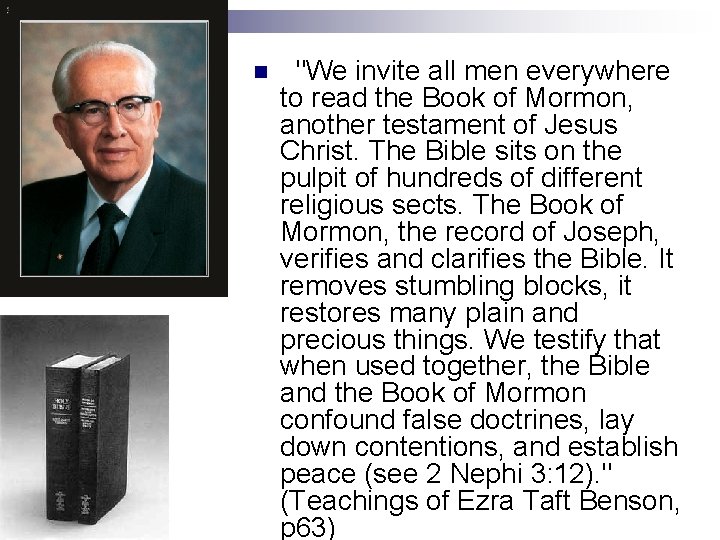
n "We invite all men everywhere to read the Book of Mormon, another testament of Jesus Christ. The Bible sits on the pulpit of hundreds of different religious sects. The Book of Mormon, the record of Joseph, verifies and clarifies the Bible. It removes stumbling blocks, it restores many plain and precious things. We testify that when used together, the Bible and the Book of Mormon confound false doctrines, lay down contentions, and establish peace (see 2 Nephi 3: 12). " (Teachings of Ezra Taft Benson, p 63)
2 Nephi 4 Chapter 2 to Jacob n Chapter 3 to Joseph n Chapter 4 n ¨ V 3 -7 children of Laman ¨ V 8 -9 children of Lemuel ¨ V 10 children of Ishmael ¨ V 11 Sam
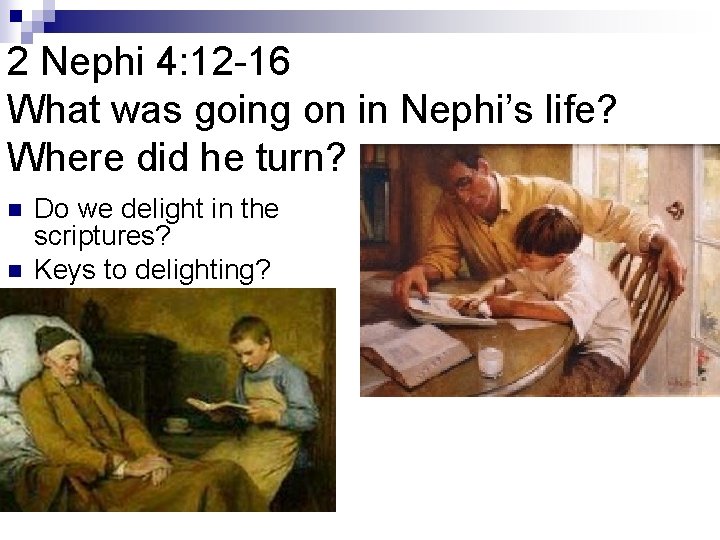
2 Nephi 4: 12 -16 What was going on in Nephi’s life? Where did he turn? n n Do we delight in the scriptures? Keys to delighting?
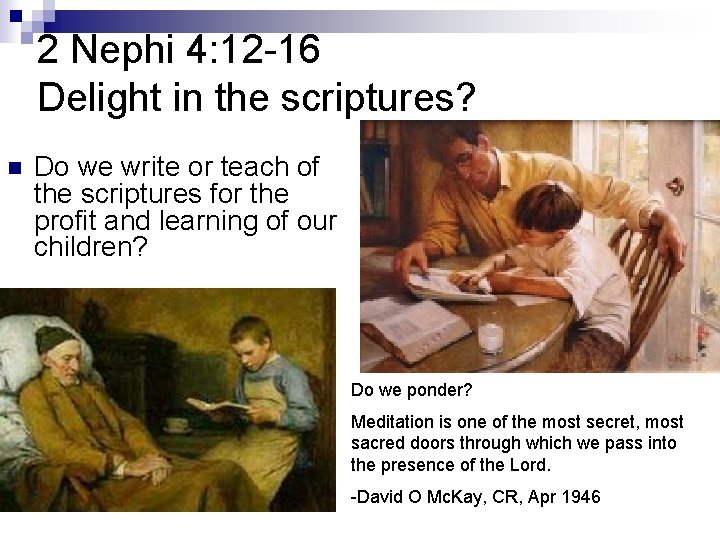
2 Nephi 4: 12 -16 Delight in the scriptures? n Do we write or teach of the scriptures for the profit and learning of our children? Do we ponder? Meditation is one of the most secret, most sacred doors through which we pass into the presence of the Lord. -David O Mc. Kay, CR, Apr 1946
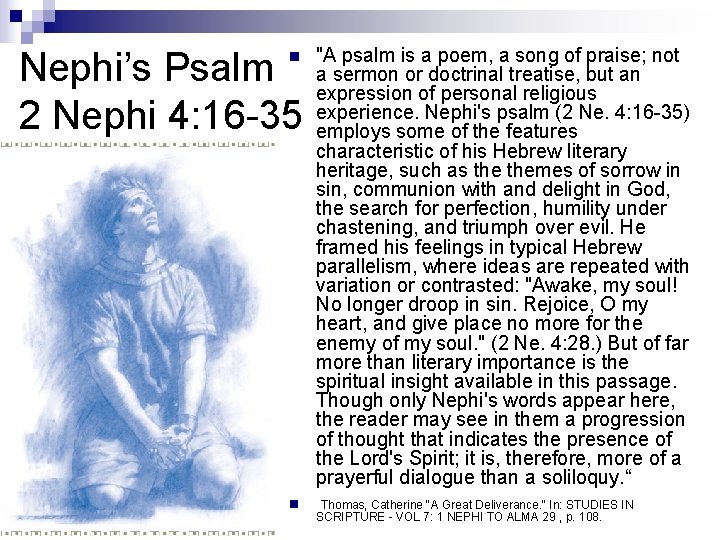
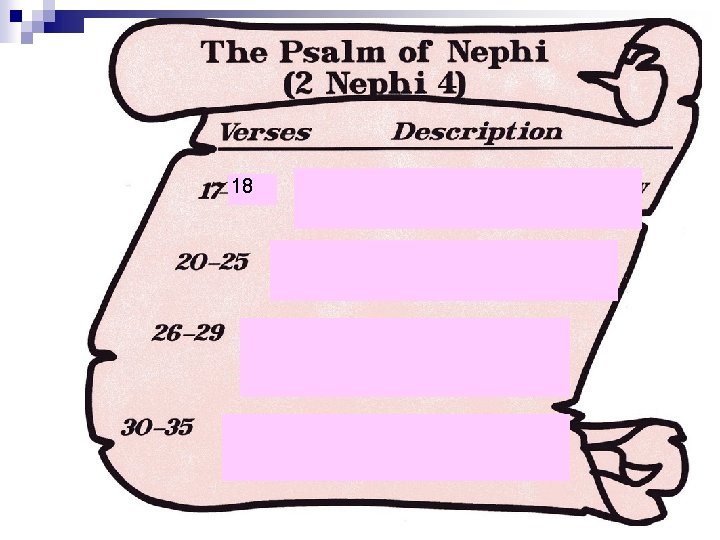
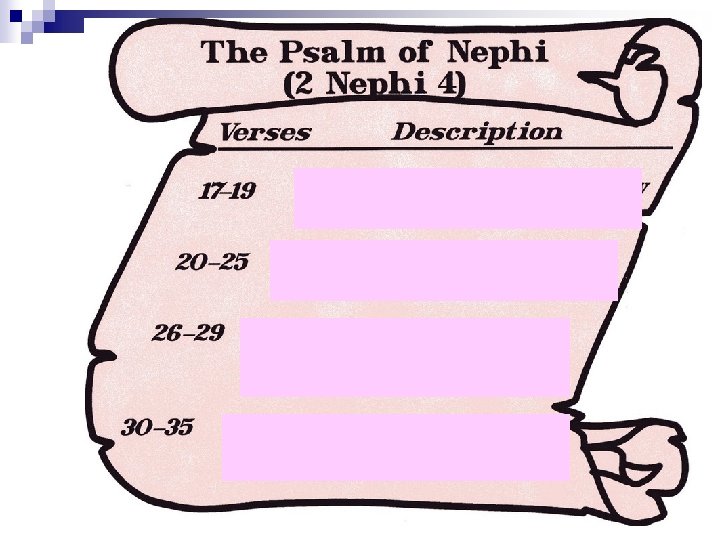
n "A psalm is a poem, a song of praise; not a sermon or doctrinal treatise, but an expression of personal religious experience. Nephi's psalm (2 Ne. 4: 16 -35) employs some of the features characteristic of his Hebrew literary heritage, such as themes of sorrow in sin, communion with and delight in God, the search for perfection, humility under chastening, and triumph over evil. He framed his feelings in typical Hebrew parallelism, where ideas are repeated with variation or contrasted: "Awake, my soul! No longer droop in sin. Rejoice, O my heart, and give place no more for the enemy of my soul. " (2 Ne. 4: 28. ) But of far more than literary importance is the spiritual insight available in this passage. Though only Nephi's words appear here, the reader may see in them a progression of thought that indicates the presence of the Lord's Spirit; it is, therefore, more of a prayerful dialogue than a soliloquy. “ n Thomas, Catherine "A Great Deliverance. " In: STUDIES IN Nephi’s Psalm 2 Nephi 4: 16 -35 SCRIPTURE - VOL 7: 1 NEPHI TO ALMA 29 , p. 108.
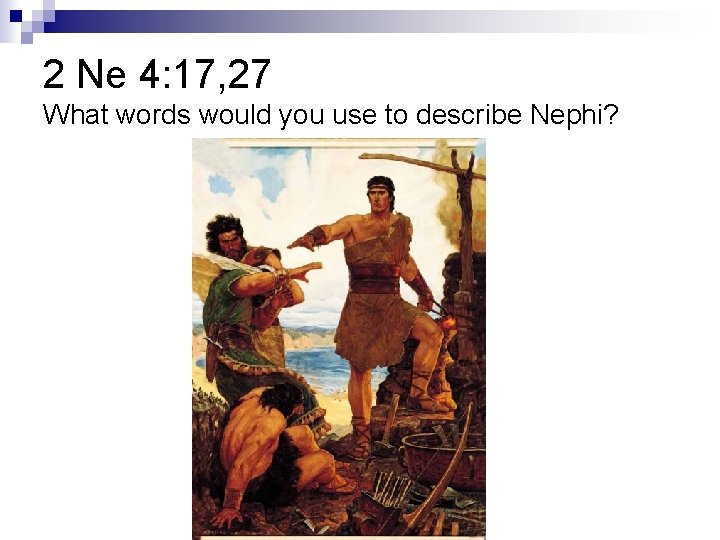
2 Ne 4: 17, 27 What words would you use to describe Nephi?
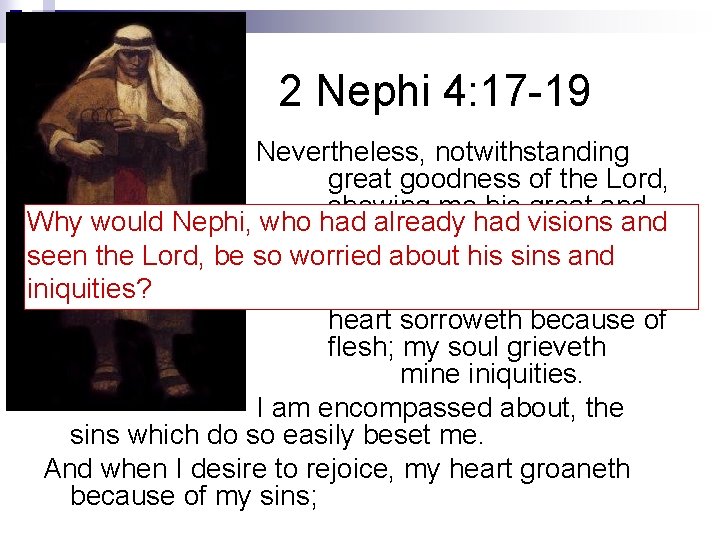
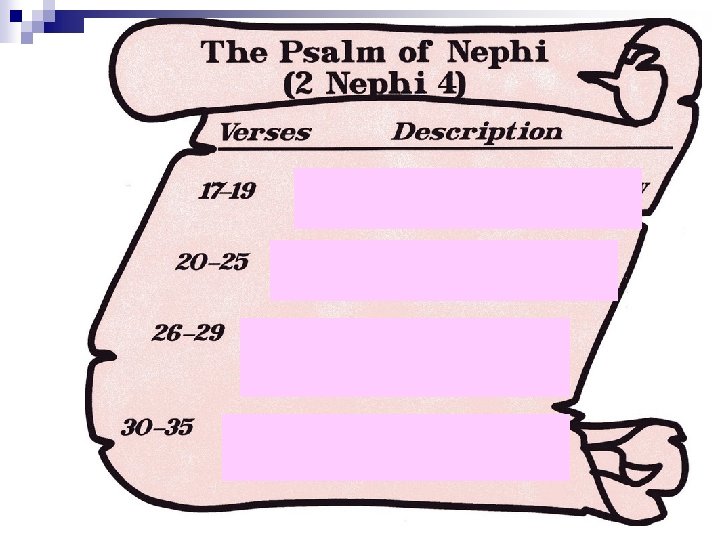
2 Nephi 4: 17 -19 Nevertheless, notwithstanding the great goodness of the Lord, in showing me his great and Why would Nephi, who had already had visions and marvelous works, my heart seen the Lord, be so worried about his sins and exclaimeth: iniquities? O wretched man that I am! Yea, my heart sorroweth because of my flesh; my soul grieveth because of mine iniquities. I am encompassed about, the sins which do so easily beset me. And when I desire to rejoice, my heart groaneth because of my sins;
Humility: the wicked aren’t offended by their sins n "The nearer man approaches perfection , the clearer are his views, and the greater his enjoyments, till he has overcome the evils of his life and lost every desire for sin; and like the ancients, arrives at that point of faith where he is wrapped in the power and glory of his Maker and is caught to dwell with Him" (TPJS, p 51).
1 Ne 10: 6 Why is it important to recognize our fallen nature before God? n n Just as a man does not really desire food until he is hungry, so he does not desire the salvation of Christ until he knows why he needs Christ. No one adequately and properly knows why he needs Christ until he understands and accepts the doctrine of the Fall and its effect upon all mankind. Ezra Taft Benson, Ensign, May 1987, 85
18
2 Ne 4: 19 -25 n How did Nephi find hope despite feeling “encompassed about” by temptation and sin?
How can remembering blessings help you through difficult times?
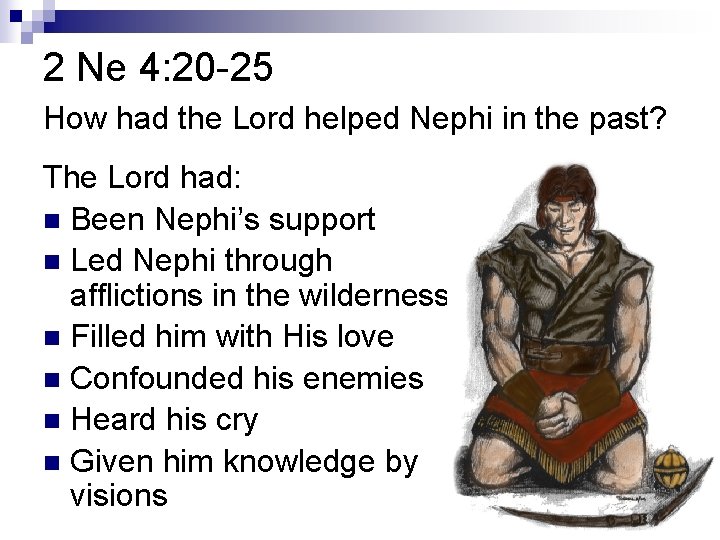
2 Ne 4: 20 -25 How had the Lord helped Nephi in the past? The Lord had: n Been Nephi’s support n Led Nephi through afflictions in the wilderness n Filled him with His love n Confounded his enemies n Heard his cry n Given him knowledge by visions
2 Nephi 4: 26 -30 Window to his weakness… n What was the cause of his distress? n What do these verses teach us about overcoming sorrow and temptation?
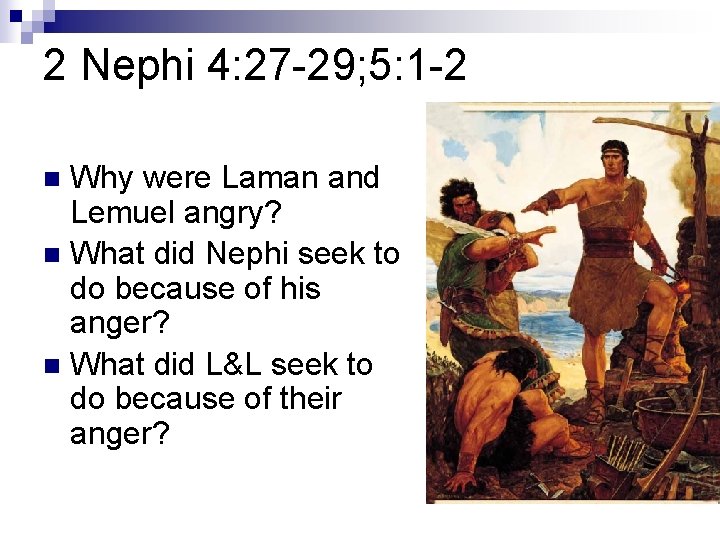
2 Nephi 4: 27 -29; 5: 1 -2 Why were Laman and Lemuel angry? n What did Nephi seek to do because of his anger? n What did L&L seek to do because of their anger? n
2 Nephi 4: 30 -35 What does Nephi plea for? n n n n Redeem my soul Deliver me out of the hands of mine enemies May I shake at the appearance of sin May I walk in the path of the low valley May I be strict in the plain road Encircle me around in the robe of they righteousness Make a way for my escape before my enemies Clear my way
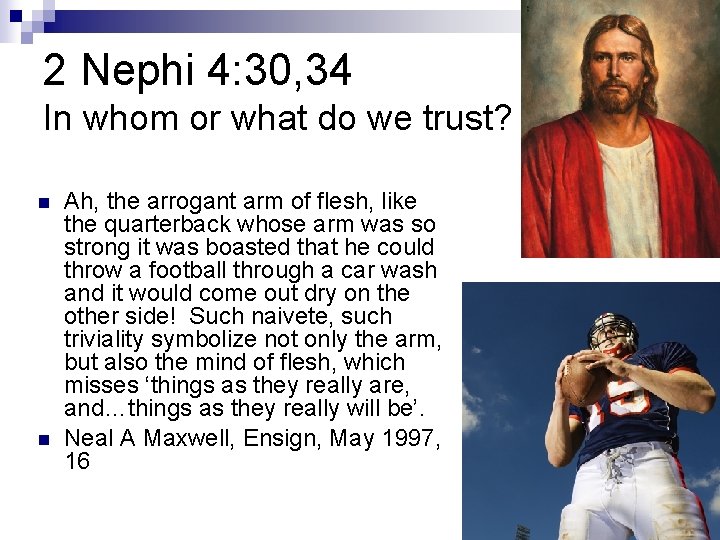
2 Nephi 4: 30, 34 In whom or what do we trust? n n Ah, the arrogant arm of flesh, like the quarterback whose arm was so strong it was boasted that he could throw a football through a car wash and it would come out dry on the other side! Such naivete, such triviality symbolize not only the arm, but also the mind of flesh, which misses ‘things as they really are, and…things as they really will be’. Neal A Maxwell, Ensign, May 1997, 16
2 Nephi 5: 1, 5 Nephi prays for help What is his answer?
If we do not depart from those who would lead us into wickedness, then what the Lord said to Israel may well become true unto us: . . . they shall be [as thorns] in your sides, and their gods shall be a snare unto you. (Judges 2: 3) Depart, I pray you, from the tents of these wicked men, and touch nothing of theirs, lest ye be consumed in all their sins. (Numbers 16: 26) Young Latter-day Saints, shape up! Face up! Take hold of your lives! Take control of your mind, your thoughts! If you have friends that are not a good influence, make changes, even if you face loneliness, even rejection. – Boyd K Packer, (Ensign, Nov. 1999, p. 24) Depart from wicked influences
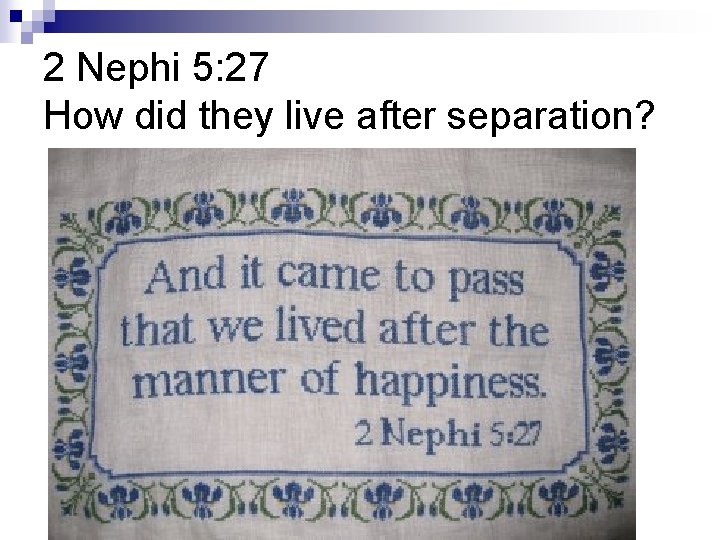
2 Nephi 5: 27 How did they live after separation?
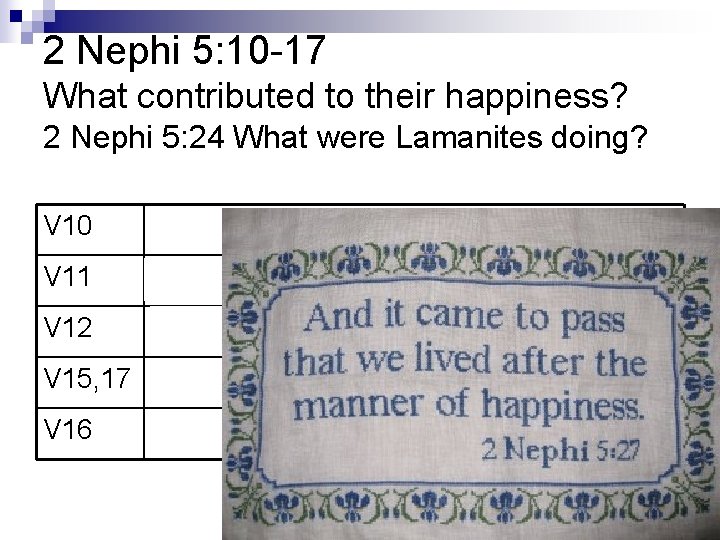
2 Nephi 5: 10 -17 What contributed to their happiness? 2 Nephi 5: 24 What were Lamanites doing? V 10 Kept the commandments V 11 Sow seed and raise flocks V 12 Preserved records V 15, 17 Build and WORK, industrious V 16 Built a temple
2 Nephi 5: 17 Work n n “Cutting trees is more important than thinking about cutting trees or planning to cut trees. We are becoming the world experts in meeting, thinking, planning, and organizing about working the work, but we need to do it. We need to work. While many are sitting and saying and even shouting great swelling words of marginal effectiveness, hard-working Latter-day Saints will always be found diligently doing and delivering potatoes to their neighbors. Contrary to the belief of many, ‘Say’ and ‘Sit’ will never replace ‘Diligently Do. ’…My young friends of the Aaronic Priesthood, say less and do more. Get it done. ” F. David Stanley, Ensign, May 1993, p.
2 Nephi 5: 17 n “There is no substitute under the heavens for productive labor…. Most of us are inherently lazy. We would rather loaf than work…. But it is work that spells the difference in the life of a man or woman. ” n Gordon B. Hinkley, Ensign, Aug. 1992, p. 4
Next Week:
Notes to follow
2 Nephi 4: 31 -33 What did Nephi ask of Heavenly Father in this prayer? n n a. How does the Lord “deliver [us] out of the hands of [our] enemies”? (See 2 Nephi 4: 31, 33. ) b. What does it mean to “shake at the appearance of sin”? (See 2 Nephi 4: 31; Mosiah 5: 2; Alma 13: 12. ) c. What do you think it means to “walk in the path of the low valley” and “be strict in the plain road”? (2 Nephi 4: 32). d. What do you think it means for the Lord to “encircle [us] around in the robe of [His] righteousness”? (2 Nephi 4: 33).
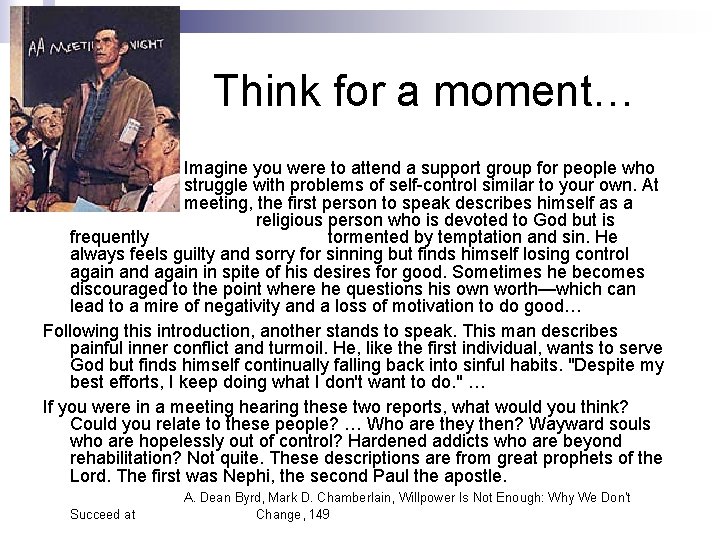
Think for a moment… Imagine you were to attend a support group for people who struggle with problems of self-control similar to your own. At the meeting, the first person to speak describes himself as a religious person who is devoted to God but is frequently tormented by temptation and sin. He always feels guilty and sorry for sinning but finds himself losing control again and again in spite of his desires for good. Sometimes he becomes discouraged to the point where he questions his own worth—which can lead to a mire of negativity and a loss of motivation to do good… Following this introduction, another stands to speak. This man describes painful inner conflict and turmoil. He, like the first individual, wants to serve God but finds himself continually falling back into sinful habits. "Despite my best efforts, I keep doing what I don't want to do. " … If you were in a meeting hearing these two reports, what would you think? Could you relate to these people? … Who are they then? Wayward souls who are hopelessly out of control? Hardened addicts who are beyond rehabilitation? Not quite. These descriptions are from great prophets of the Lord. The first was Nephi, the second Paul the apostle. Succeed at A. Dean Byrd, Mark D. Chamberlain, Willpower Is Not Enough: Why We Don't Change, 149
n President Howard W. Hunter taught: “We need a more peaceful world, growing out of more peaceful families and neighborhoods and communities. To secure and cultivate such peace, ‘we must love others, even our enemies as well as our friends. ’ … We need to extend the hand of friendship. We need to be kinder, more gentle, more forgiving, and slower to anger. We need to love one another with the pure love of Christ. May this be our course and our desire” (in Conference Report, Apr. 1992, 87; or Ensign, May 1992, 63).
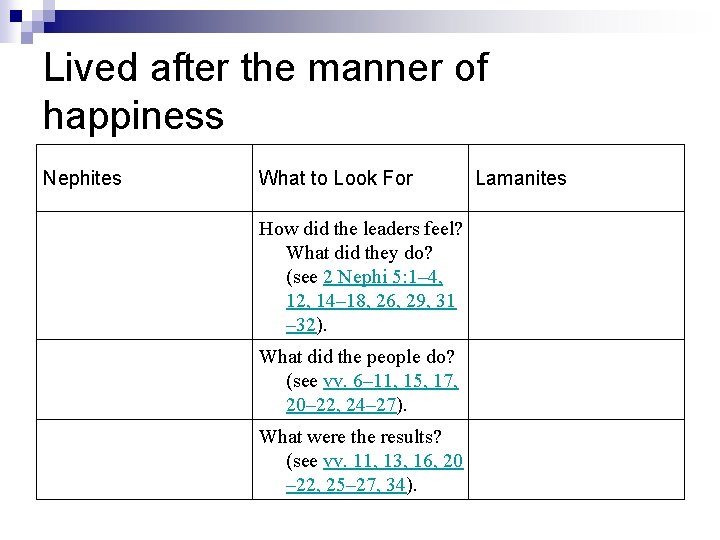
Lived after the manner of happiness Nephites What to Look For Lamanites How did the leaders feel? What did they do? (see 2 Nephi 5: 1– 4, 12, 14– 18, 26, 29, 31 – 32). What did the people do? (see vv. 6– 11, 15, 17, 20– 22, 24– 27). What were the results? (see vv. 11, 13, 16, 20 – 22, 25– 27, 34).
n n The dark skin was placed upon the Lamanites so that they could be distinguished from the Nephites and to keep the two peoples from mixing. The dark skin was a sign of the curse. The curse was the withdrawal of the Spirit of the Lord. Joseph Fielding Smith, Answers to Gospel questions 1: 123 -124
The wickedness of this people caused the spirit of the Lord to be withdrawn, bringing upon themselves a curse…All who live in a state of rebellion are heirs to such a curse. A mark of that curse among the Lamanites was a dark skin. n R. Millet and JF Mc. Conkie, DCBOM, 1: 224 n
n n The dark skin was placed upon the Lamanites so that they could be distinguished from the Nephites and to keep the two peoples from mixing. The dark skin was a sign of the curse. The curse was the withdrawal of the Spirit of the Lord. The dark skin…is no longer considered a sign of the curse. Joseph Fielding Smith, Answers to Gospel questions 1: 123 -124
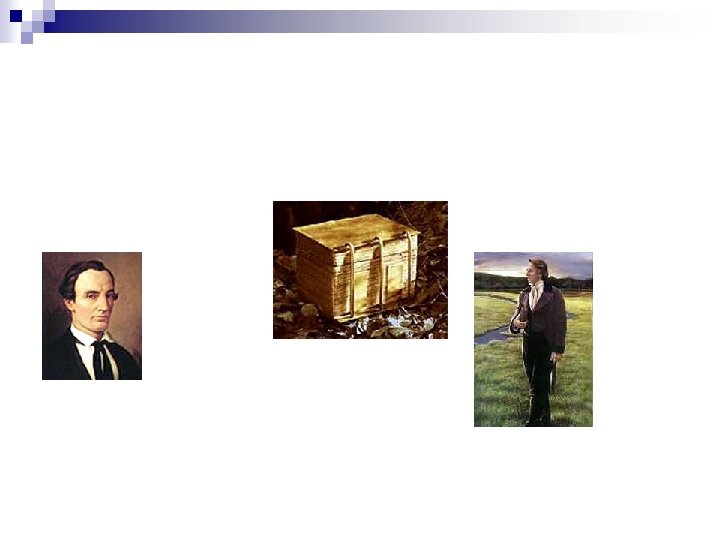
n “It was decreed in the counsels of eternity, long before the foundations of the earth were laid, that he, Joseph Smith, should be the man, in the last dispensation of this world, to bring forth the word of God to the people, and receive the fulness of the keys and power of the Priesthood of the Son of God. The Lord had his eyes upon him, and upon his father’s father, and upon their progenitors clear back to Abraham, and from Abraham to the flood, from the flood to Enoch, and from Enoch to Adam. He has watched that family and that blood as it has circulated from its fountain to the birth of that man. He was fore-ordained in eternity to preside over this last dispensation” (Discourses of Brigham Young, sel. John A. Widtsoe [1941], 108).
n Just as ancient Israel was under proscription from marrying outside the ethnic group, the New World Nephites are also being set up as a separate unit, prohibited from intermarriage (v. 23).
n Nibley further expounds on the cultural meanings of the black/white problem in the Book of Mormon: ¨ "This amazing coincidentia oppositorum is the clash of black and white. With the Arabs, to be white of countenance is to be blessed and to be black of countenance is to be cursed; there are parallel expressions in Hebrew and Egyptian. And what of Lehi's people? It is most significant that the curse against the Lamanites is the very same as that commonly held in the East to blight the sons of Ishmael, who appear to the lightskinned people of the towns as "a dark and loathsome, and a filthy people, full of idleness and all manner of abominations, . . . an idle people, full of mischief and subtlety, " etc. (1 Nephi 12: 23; 2 Nephi 5: 24). . . Which makes the difference between Nephite and Lamanite a cultural, not a racial, one. . . There is nowhere any mention of red skin, incidentally, but only of black (or dark) and white, the terms being used as the Arabs use them. (LEHI IN THE DESERT / THE WORLD OF THE JAREDITES / THERE WERE JAREDITES, Page 71]).
n John L. Sorenson further examines the context of this "skin of blackness: " ¨ "The skin shades of surviving peoples in Book of Mormon lands include a substantial range, from dark brown to virtual white. These colors cover nearly the same range as were found anciently around the Mediterranean coast and in the Near East. It is likely that the objective distinction in skin hue between Nephites and Lamanites was less marked than the subjective difference. The scripture is clear that the Nephites were prejudiced against the Lamanites (Jacob 3: 5; Mosiah 9: 1 -2; Alma 26: 23 -25). That must have influenced how they perceived their enemies. The Nephite description of the Lamanites falls into a pattern known in the Near East. The Sumerian city dwellers in Mesopotamia of the third millennium B. C. viewed the Amorites, Abraham's desert-dwelling relatives, as "dark" savages who lived in tents, ate their food raw, left the dead unburied, and cultivated no crops. Urban Syrians still call the Bedouin nomads "the wild beasts. " The Nephite picture of their relatives, in Jarom 1: 6 and Enos 1: 20, sounds so similar to the Near Eastern epithets that this language probably should be considered a literary formula rather than an objective description, labeling applied to any feared, despised, "backward" people. But all this does not exclude a cultural and biological difference between the two groups. The question is how great the difference was; we may doubt that it was as dramatic as the Nephite recordkeepers made out. " (AN ANCIENT AMERICAN SETTING FOR THE BOOK OF MORMON, Page 89)