3 Nephi 15 18 3 Nephi 15 1
- Slides: 23
3 Nephi 15 -18 3 Nephi 15: 1 -8 Could it be any clearer! The Law of Moses hath an end in me (v. 8). The strict ceremonies, observances and offerings, peculiar to the Law of Moses. Note, it was Jesus Christ who instituted, fulfilled, and announced the fulfillment of the Law of Moses. Fundamental doctrines of the gospel did not change with the fulfilling of the Law of Moses.
The doctrine of the atonement is unchanging, but the procedure for how we remember the atonement changed from sacrifice to sacrament. “Keep in mind that the principles of the gospel of Jesus Christ are divine. Nobody changes the principles and doctrines of the church… But methods change as the inspired direction comes to those who preside at a given time. If you will analyze that the fundamental doctrines of the church are not changing. The only changes are in the methods of teaching that doctrine to meet the circumstances of our time” (Harold B. Lee, Ensign, Jan. 1971, 10).
3 Nephi 15: 9 “Behold, I am the Law, and the Light” (Galations 3: 16) You will not discover the superiority of the gospel over the law of Moses if you think the law of Moses was harder to live than the gospel. The following statement by Elder Neal A. Maxwell helps illustrate this: “One of the ironies which is fostered, at times innocently, in the Church, is the feeling we have that the spirit of the law is superior to the letter of the law because for some reason it seems more permissive or less apt to offend others. The reverse if true. The spirit of the law is superior because it demands more of us than the letter of the law. The spirit of the law insists that we do more than merely comply superficially. It means, too, that we much give attention to the things that matter most and still not leave the others undone” (For the Power is in Them, 46 -47).
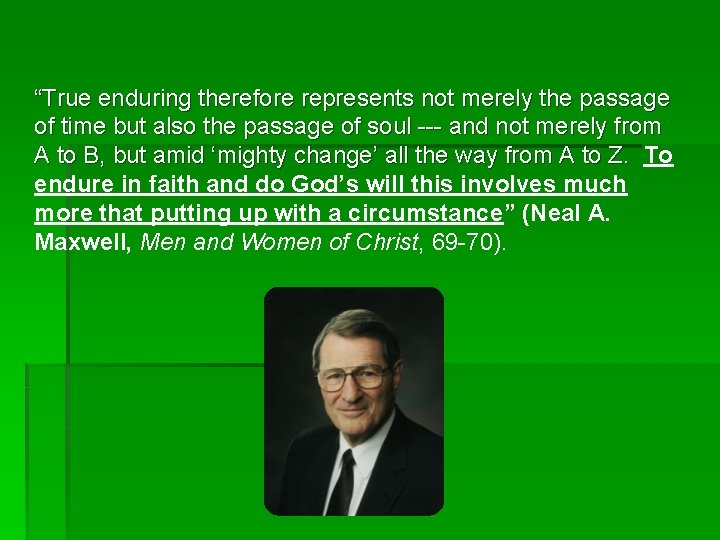
“True enduring therefore represents not merely the passage of time but also the passage of soul --- and not merely from A to B, but amid ‘mighty change’ all the way from A to Z. To endure in faith and do God’s will this involves much more that putting up with a circumstance” (Neal A. Maxwell, Men and Women of Christ, 69 -70).
3 Nephi 15: 16 -21 “Other Sheep” The Nephites are the other sheep of whom He spoke in Jerusalem (John 10: 16). One of the most familiar and beautiful sights of the East is that of the shepherd leading his sheep to the pasture… He depends upon the sheep to follow, and they in turn expect him never to leave them… “… As he is always with them, and so deeply interested in them, the shepherd comes to know his sheep very intimately… One day a missionary, meeting a shepherd on one of the wildest parts of the Lebanon, asked him various questions about his sheep, and among others if he counted them every night. On answering that he did not, he was asked how he knew if they were all there or not. His reply was, ‘Master, if you were to put a cloth over my eyes, and bring me any sheep and only let me put my hands on its face, I could tell in a moment if it was mine or not’” (George M. Mackie, Bible Manners and Customs [n. d. ], 33, 35).
Elder Neal A. Maxwell, speaking about this personal care said: “Jesus is so personal in His shepherding and tutoring!. . . “… Jesus knows and cares for each individual; He watches carefully over the seemingly smallest of things” (That Ye May Believe [1992], 2045).
3 Nephi 16: 1 -3; 17: 4 Who are the “other sheep? ” Did not Jesus visit them (the lost tribes of Israel) after he ministered among the Nephites? . . . Of course he did, in one or many places as suited his purposes. He assembled them together then in exactly the same way he gathered the Nephites in the land of Bountiful so that they too could hear his voice and feel the prints of the nails in his hands and in his feet. Of this there can be no question. And we suppose that he also called twelve apostles and established his kingdom among them even as he did in Jerusalem and in the Americas” (Bruce R. Mc. Conkie, Millennial Messiah, 216).
“He has other worlds or creations and other sons and daughters, perhaps just as good as those dwelling on this planet and they, as well as we, will be visited, and they will be made glad with the countenance of their Lord. Thus he will go, in the time and in the season thereof, from kingdom to kingdom or from world to world” (Orson Pratt, Journal of Discourses, 17: 332). (D&C 88: 51 -61).
3 Nephi 17: 2 “The Gathering” Their difficulty in understanding the gathering seems to have had more to do with their lack of intellectual understanding of the doctrine itself. 3 Nephi 17: 4 -5 3 Nephi 17: 6 -25 v. 6 -9 2 Nephi 29: 11 -14 “The Temple Endowment? ” “How many people was the Savior willing to heal? ”
During his mortal life, Jesus never refused to heal a single person (Matthew 15: 23 -28). Elder Richard G Scott said, “I testify that the Savior will heal you as you choose to obey truth and use your agency according to His counsel” (Ensign, Nov. 1992, 62). Evidently the resurrected Lord appeared to all of the people who were to write these great spiritual witnesses (Three Great Spiritual Witnesses, Ludlow, 271).
Being of good cheer is the proximate preparation for ultimate joy. Being of good cheer --- one day at a time --- precedes that point later on when, if we live righteously, we can justifiably say what Jesus said: “Now behold, my joy is full” (3 Nephi 17: 20) (Neal A. Maxwell, Even As I Am, 98). The gospel glow we see radiating from some --- amid dark difficulties --- comes from illuminated individuals who are “of good cheer!” To be cheerful when others are in despair, to keep the faith when others falter, to be true even when we feel forsaken --all of these are deeply desired outcomes during the deliberate, divine tutorials which God gives to us --- because He loves us Mosiah 3: 19). These learning experiences must not be misread as divine indifference. Instead, such tutorials are a part of the divine unfolding (Neal A. Maxwell, Ensign, Nov. 1982, 67).
3 Nephi 18: 4 -7 “And were filled!” Let us make that sacrament hour one of the most impressive means of coming in contact with God’s spirit (David O. Mc. Kay, 1946). The sacrament is the only ordinance of the gospel that we do for ourselves more than once.
“No more sacred ordinance is administered in the Church of Christ than the administration of the Sacrament” (David O. Mc. Kay, Conference Report, Apr. 1946, 112). Bread and water are the two most basic elements to sustain life. In a similar way, Jesus, who is the “bread of life” (John 6: 35) and the “living water” (Jeremiah 17: 13), is the basic elements to sustain our spiritual life. “Un-baptized children, being without sin, are entitled and expected to partake of the sacrament to prefigure the covenant they will take upon themselves when they arrive at the years of accountability” (Bruce R. Mc. Conkie, Mormon Doctrine, 660).
Commenting on this verse, President George Q. Cannon wrote: “In our Church numerous instances have occurred where… bread and wine (or water) have been partaken of as a meal, and not, as is usual when the Sacrament is passed in our general meetings, in the shape of small pieces of bread and a little sip of water… It seems from this that in partaking of this ordinance they satisfied their appetites-that is, they ate and drank until they were filled. This would be the proper manner to administer this ordinance now if circumstances permitted” (Editorial Thoughts [Passing the Sacrament], ” The Juvenile Instructor 32 [15 January 1897]: 52 -53).
Philo Dibble told Oliver B Huntington of an occasion in 1838 in Far West, Missouri , during which “the Prophet Joseph Smith gave the people a true pattern. A pattern of the true manner of partaking of the sacrament. The people came together in the morning without their breakfast, to the bowery on the Public Square where there was prepared a plenty of good bread and a barrel of wine. The bread and wine was blessed, every person ate bread and drank wine as they wanted all day, when they wanted… No one said ‘less [lets] go and get a drink’ but with solemnity they commemorated the death and sufferings of Jesus… No one was intoxicated during the day” (Diary of Oliver B. Huntington, 1847 -1900, part 2 {Provo, Utah: Brigham Young University Library, 1942], entry of 4 September 1887).
Records indicate that the sacrament was “administered at times when Joseph appointed, after the ancient order; that is, warm bread to break easy was provided, and broken into pieces as large as a fist (School of the Prophets, Oct. 3, 1883).
“The Administration of the Sacrament” B. H. Roberts insisted they (the sacrament prayers) were the most perfect forms of sacred literature to be found. To participate in them is to enter the Holy of Holies of the Atonement (Truth, Way, Light, 39). These prayers spiritualize the physical and physicalize the spiritual. They unite from man’s mortal condition to an eternal family.
Elder Melvin J. Ballard cautions, “We must come… to the sacrament table hungry” (Ballard, Melvin J. Ballard, 132). Some come to the banquet table each week with pitchers, ready to catch and drink every drop of eternal life that is offered. Others come with cups --- and still others with yet smaller receptacles. Jedediah M. Grand observed: “A great many people partake of the Sacrament, and at the same time are thinking, ‘How many teams can I get tomorrow to haul stone? I wonder if that sister has a bonnet like mine, or if I can get one like hers? I wonder if it is going to be a good day tomorrow, or whether it will rain or snow? ’… You can sit in this stand read such thoughts in their faces” (Journal of Discourses, 2: 277).
I imagine that if we could see the heavenly barometer that reads and records the secret thoughts of each person during this holy ordinance, we would have a pretty good measure of the spirituality of that person (Tad R. Callister, The Infinite Atonement, 288). Each week a feast is served at sacrament meeting. Speakers, music, and prayers are integral parts of this meeting, but they are not the main course. The music might be discordant, the speakers monotonous --- and yet those who come to the sacrament table hungry still can be filled. Any man or woman who comes to sacrament meeting hungering and thirsting for spiritual food will find refreshment and nourishment for his or her soul.
Elder Marion G. Romney recalled it being said of President Wilford Woodruff “that while the sacrament was being passed, his lips could be observed in silent motion as he repeated to himself over and over again, ‘I do remember thee, I do remember thee’” (Marion G. Romney, “Reverence, ” 3). Elder Guifford Neilson of the 70 told us at Stake Conference that President Nelson told him he could ask him any question he wanted. He asked, “what do you think about during the Sacrament? ” His reply was “only Him!”
Gerald Lund shared the account he read of climbing instructor, Alan Czenkusch. “Belaying has brought Czenkusch his best and worst moment in climbing. Czenkusch once fell from a high precipice, yanking out three mechanical supports and pulling his belayer off a ledge. He was stopped, upside down, ten feet from the ground when his spread-eagled belayer arrested the fall with the strength of his outstretched arms. “’Don saved my life, ’ says Czenkusch. ‘How do you respond to a guy like that? Give him a used climbing rope for a Christmas present? No, you remember him. You always remember him’” (Lund, Jesus Christ, 45). As Brother Lund observed, “Those very words are the words of the sacrament covenant (Lund, Jesus Christ, 45).
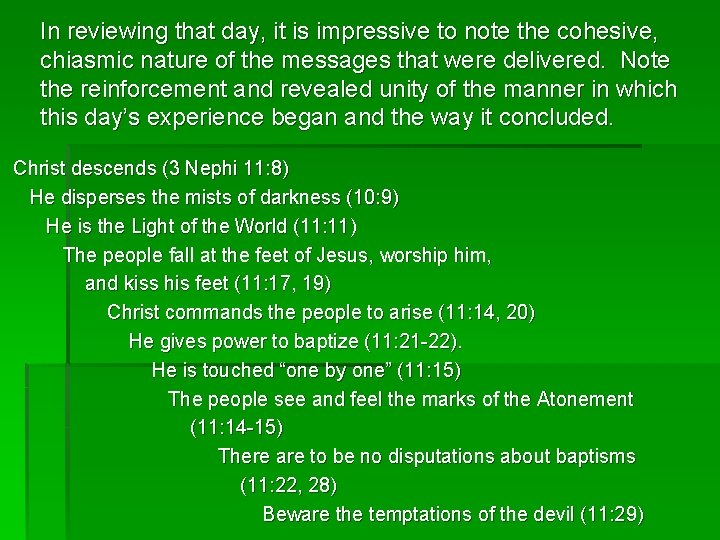
In reviewing that day, it is impressive to note the cohesive, chiasmic nature of the messages that were delivered. Note the reinforcement and revealed unity of the manner in which this day’s experience began and the way it concluded. Christ descends (3 Nephi 11: 8) He disperses the mists of darkness (10: 9) He is the Light of the World (11: 11) The people fall at the feet of Jesus, worship him, and kiss his feet (11: 17, 19) Christ commands the people to arise (11: 14, 20) He gives power to baptize (11: 21 -22). He is touched “one by one” (11: 15) The people see and feel the marks of the Atonement (11: 14 -15) There are to be no disputations about baptisms (11: 22, 28) Beware the temptations of the devil (11: 29)
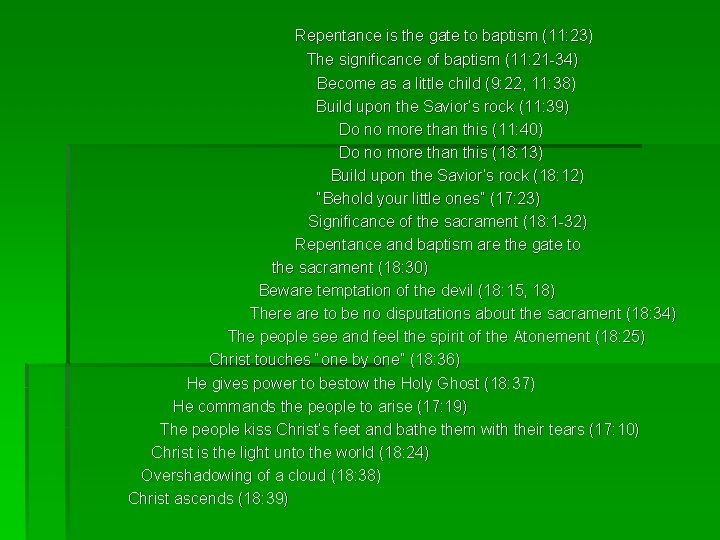
Repentance is the gate to baptism (11: 23) The significance of baptism (11: 21 -34) Become as a little child (9: 22, 11: 38) Build upon the Savior’s rock (11: 39) Do no more than this (11: 40) Do no more than this (18: 13) Build upon the Savior’s rock (18: 12) “Behold your little ones” (17: 23) Significance of the sacrament (18: 1 -32) Repentance and baptism are the gate to the sacrament (18: 30) Beware temptation of the devil (18: 15, 18) There are to be no disputations about the sacrament (18: 34) The people see and feel the spirit of the Atonement (18: 25) Christ touches “one by one” (18: 36) He gives power to bestow the Holy Ghost (18: 37) He commands the people to arise (17: 19) The people kiss Christ’s feet and bathe them with their tears (17: 10) Christ is the light unto the world (18: 24) Overshadowing of a cloud (18: 38) Christ ascends (18: 39)