Attraction Intimacy Liking Loving Others Motivation n Need
- Slides: 17
Attraction & Intimacy: Liking & Loving Others
Motivation n Need to belong: motivation to bond with others in relationships that provide ongoing, positive interactions. n Humans are by nature social beings – Spend time, money, & resources to connect with other people
Interpersonal Attraction n Our attitudes about other people, ranging from like to dislike. n Attraction hinges on emotions or feelings – Intensity: weakness or strength of the emotion – Direction: whether the emotion is positive or negative
Friendships: The Beginning n Proximity: nearness or functional distance of others – Guided by frequency of crossing paths – Availability of others – Anticipating liking or expecting that someone will be pleasant & compatible – Mere exposure
Physical Attractiveness n Appearance does matter – Predicts how frequently how often women date, more so then men. n Matching phenomenon: choose partners who are a “good match” in attractiveness n Physical-attractiveness stereotype n Who is attractive?
Relationships n Similarity vs. complementarity – Likeness begets liking – Completing what is missing in the other n Liking those who like us – Attribution & ingratiation (flattery to serve self) – Self-esteem & attraction: “on the rebound” – Gaining another’s esteem
Reward Theory of Attraction n We like those whose behavior is rewarding to us or whom we associate with rewarding events. – – n Liking because of how you feel around the other person. Liking by association: individuals remind us of someone. Explanations of research – Proximity-Closer makes gaining rewards of interaction less costly in effort – Attractiveness- Other desirable traits assumed and benefit by association with them – Similarity – Validates our self concept and we feel mutuality – Mutuality – Being liked and loved is rewarding
Maintaining Close Relationships n Equity: outcomes people receive from a relationship are proportional to what they contribute to it. – Equitable relationships are more content & satisfied. – Reality of contribution vs. Perceived contribution
Maintaining Close Relationships n Self-disclosure: revealing intimate aspects of oneself to others. n When do we disclose? – When distressed – Securely attached – Reciprocated by another – To skilled “openers” who listen
Ending Relationships n Usually when comparing unsatisfying relationships to imagined relationships. – Individuals remain married when both partners do not attend to alternative partners. n Who divorces? – Individualists who expect more passion & personal fulfillment in a marriage
Ending Relationships n Risk of divorce depends on who married whom: – Married before age 20 – Grew up in unstable homes – Dated for a short time – Poorly educated or dissimilar education levels – Unstable income – Cohabitated before marriage
Ending Relationships n Detachment process – Constructive § Loyalty (Passive): await improvement § Voice: seek to improve relationship – Destructive § Neglect (Passive): ignore the partner § Exit: end the relationship
Love: What is love? n Passionate Love: state of intense longing for union with another – Absorbed in one another – Feel ecstatic at attaining partner’s love – Disconsolate on losing it n Theory of Passionate Love: based on arousal & how we interpret arousal
Love: What is love? n Companionate Love: affection we feel for those with whom our lives are deeply intertwined. – Lower key than passionate love – Based on deep, affectionate attraction – Great deal in common – Care about one another’s well-being – Mutual liking & respect
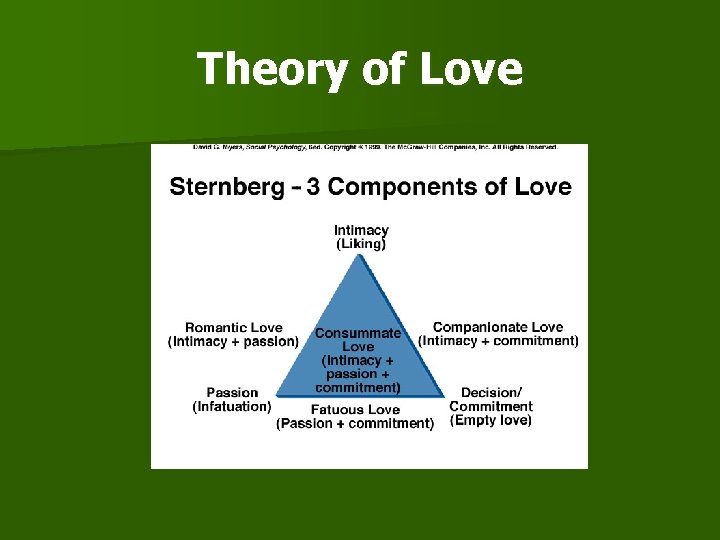
Love: What is love? n Triangular Model of Love: each love relationship contains three basic components, present in varying degrees for different couples. n Intimacy, passion, & commitment n Developed by Sternberg
Love: Triangular Model n Intimacy: closeness two people feel & the strength of the bond holding them together. n Passion: based on romance, physical attraction & sexual intimacy. n Commitment: cognitive factors, committed to maintaining the relationship.
Theory of Love