Assessment of cognitive functioning and potential Dr Maretha
- Slides: 32
Assessment of cognitive functioning and potential Dr. Maretha Prinsloo Copyright : Cognadev UK Ltd Discovering Talent and Potential
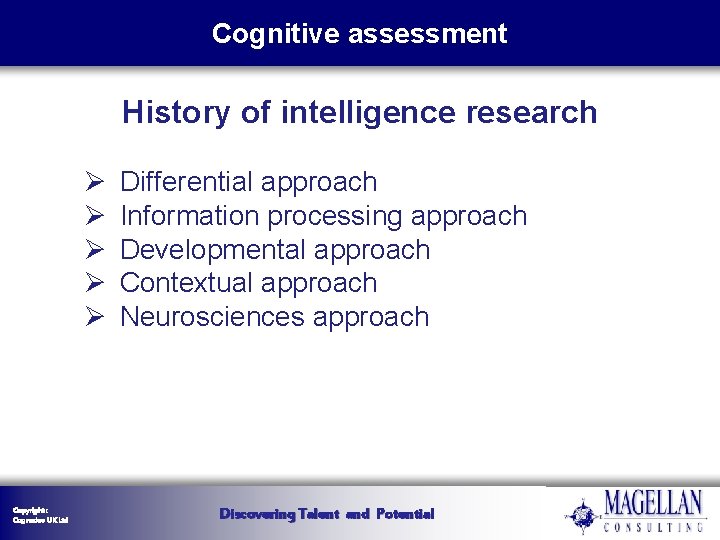
Cognitive assessment History of intelligence research Ø Ø Ø Copyright : Cognadev UK Ltd Differential approach Information processing approach Developmental approach Contextual approach Neurosciences approach Discovering Talent and Potential
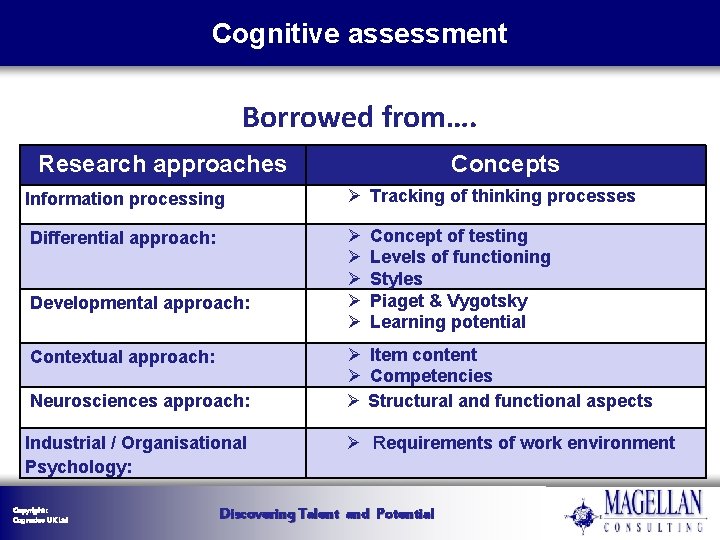
Cognitive assessment Borrowed from…. Research approaches Concepts Information processing Ø Tracking of thinking processes Differential approach: Ø Ø Ø Developmental approach: Contextual approach: Neurosciences approach: Industrial / Organisational Psychology: Copyright : Cognadev UK Ltd Concept of testing Levels of functioning Styles Piaget & Vygotsky Learning potential Ø Item content Ø Competencies Ø Structural and functional aspects Ø Requirements of work environment Discovering Talent and Potential
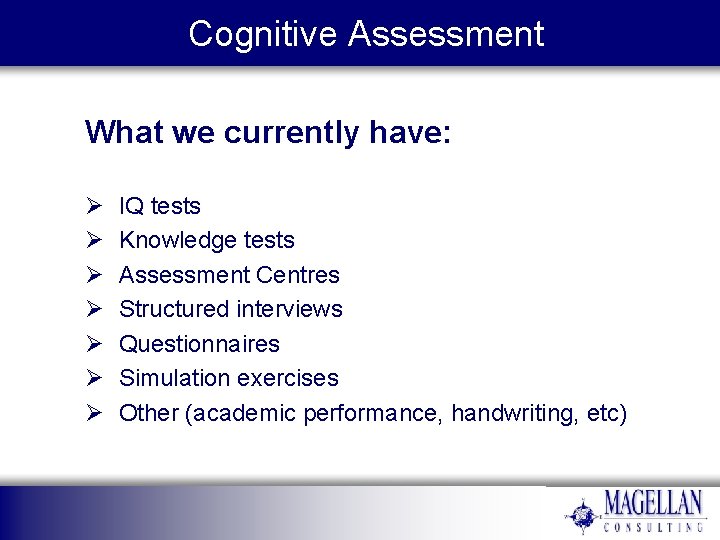
Cognitive Assessment What we currently have: Ø Ø Ø Ø IQ tests Knowledge tests Assessment Centres Structured interviews Questionnaires Simulation exercises Other (academic performance, handwriting, etc)
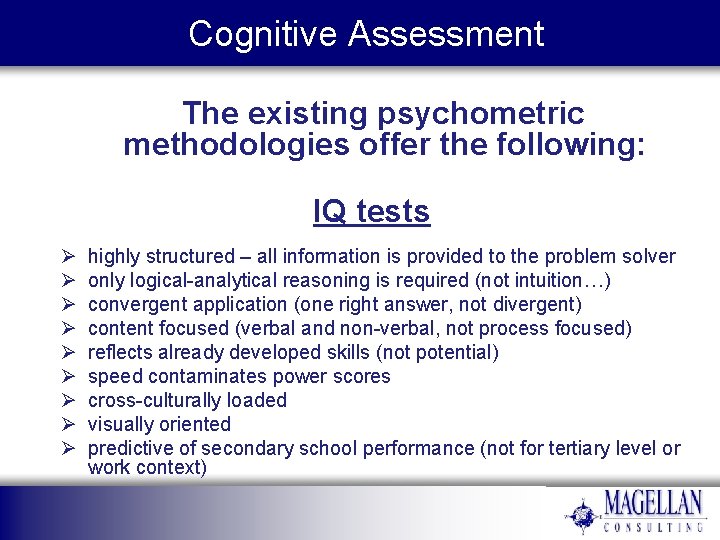
Cognitive Assessment The existing psychometric methodologies offer the following: IQ tests Ø Ø Ø Ø Ø highly structured – all information is provided to the problem solver only logical-analytical reasoning is required (not intuition…) convergent application (one right answer, not divergent) content focused (verbal and non-verbal, not process focused) reflects already developed skills (not potential) speed contaminates power scores cross-culturally loaded visually oriented predictive of secondary school performance (not for tertiary level or work context)
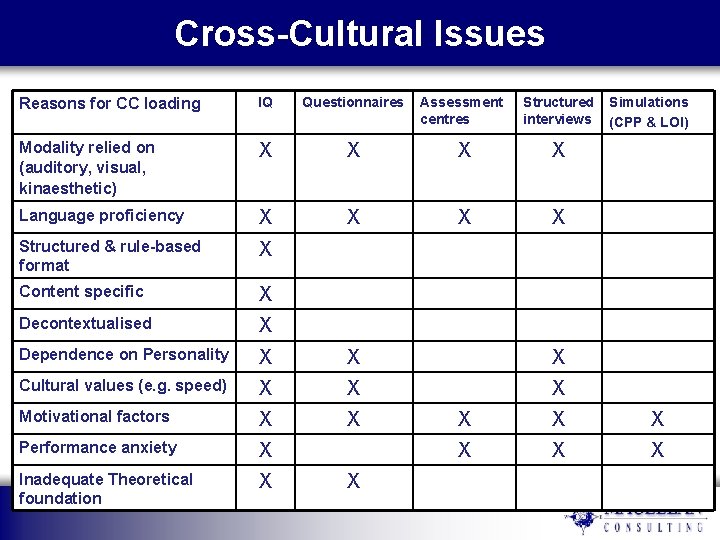
Cross-Cultural Issues Reasons for CC loading IQ Questionnaires Assessment centres Structured interviews Modality relied on (auditory, visual, kinaesthetic) X X Language proficiency X X Structured & rule-based format X Content specific X Decontextualised X Dependence on Personality X X X Cultural values (e. g. speed) X X X Motivational factors X X Performance anxiety X Inadequate Theoretical foundation X X Simulations (CPP & LOI) X X X
Cognitive Assessment Theoretical model
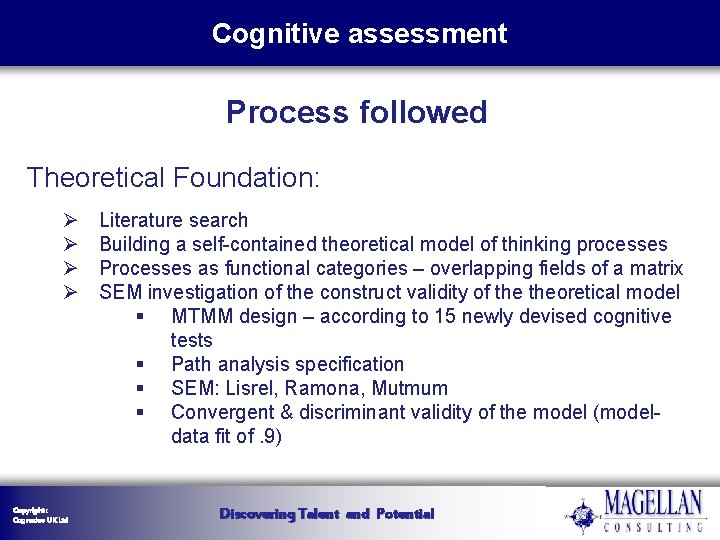
Cognitive assessment Process followed Theoretical Foundation: Ø Ø Copyright : Cognadev UK Ltd Literature search Building a self-contained theoretical model of thinking processes Processes as functional categories – overlapping fields of a matrix SEM investigation of the construct validity of theoretical model § MTMM design – according to 15 newly devised cognitive tests § Path analysis specification § SEM: Lisrel, Ramona, Mutmum § Convergent & discriminant validity of the model (modeldata fit of. 9) Discovering Talent and Potential
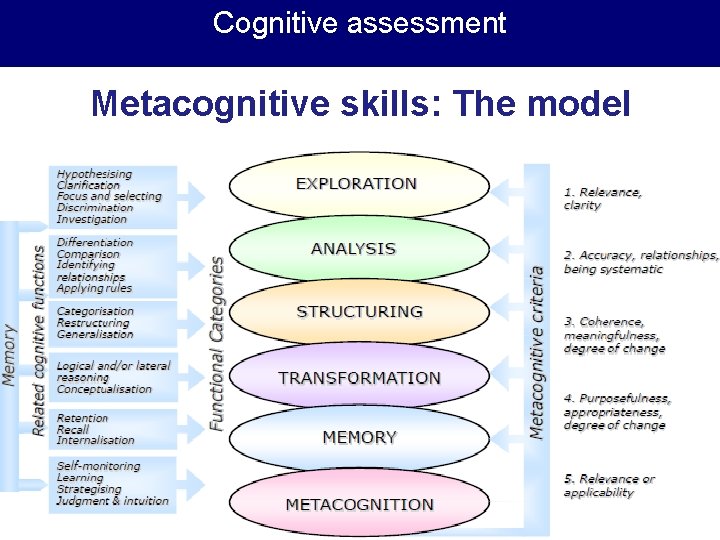
Cognitive assessment Metacognitive skills: The model Copyright : Cognadev UK Ltd Discovering Talent and Potential
Cognitive Assessment Methodology
Cognitive assessment The tools Ø Cognitive Process Profile (CPP) Ø Learning Orientation Index (LOI) Copyright : Cognadev UK Ltd Discovering Talent and Potential
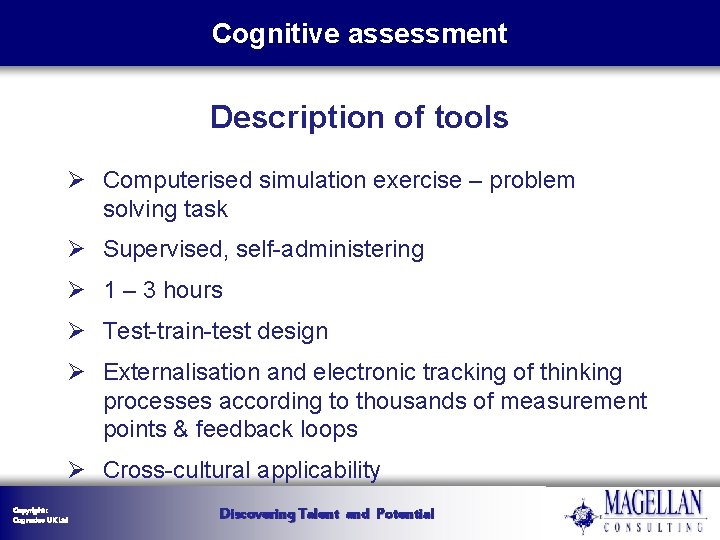
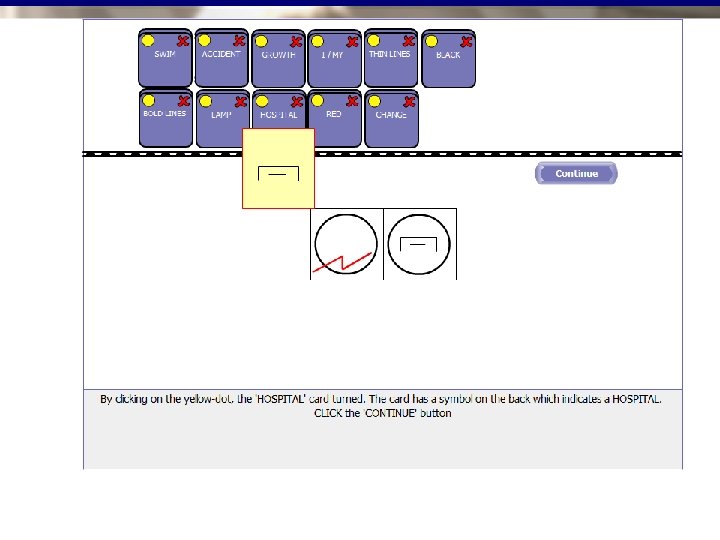
Cognitive assessment Description of tools Ø Computerised simulation exercise – problem solving task Ø Supervised, self-administering Ø 1 – 3 hours Ø Test-train-test design Ø Externalisation and electronic tracking of thinking processes according to thousands of measurement points & feedback loops Ø Cross-cultural applicability Copyright : Cognadev UK Ltd Discovering Talent and Potential
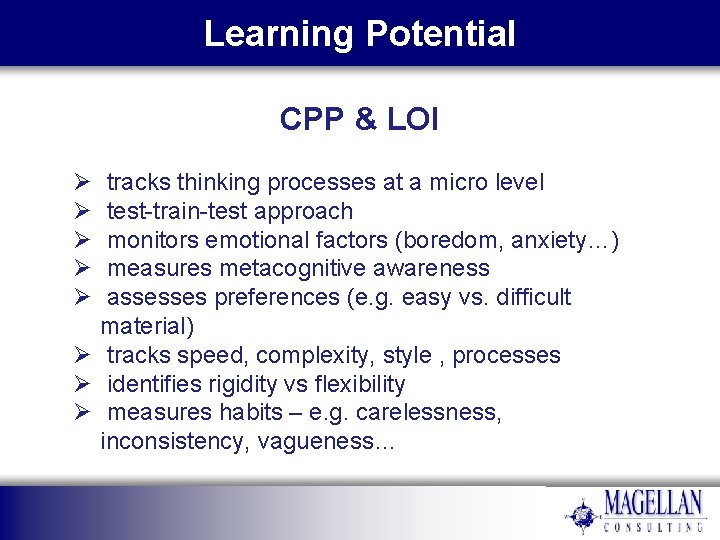
Learning Potential CPP & LOI Ø Ø Ø tracks thinking processes at a micro level test-train-test approach monitors emotional factors (boredom, anxiety…) measures metacognitive awareness assesses preferences (e. g. easy vs. difficult material) Ø tracks speed, complexity, style , processes Ø identifies rigidity vs flexibility Ø measures habits – e. g. carelessness, inconsistency, vagueness…
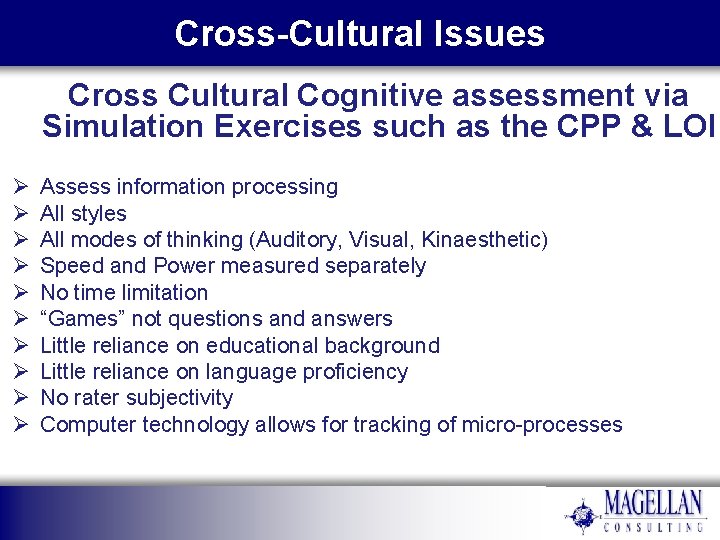
Cross-Cultural Issues Cross Cultural Cognitive assessment via Simulation Exercises such as the CPP & LOI Ø Ø Ø Ø Ø Assess information processing All styles All modes of thinking (Auditory, Visual, Kinaesthetic) Speed and Power measured separately No time limitation “Games” not questions and answers Little reliance on educational background Little reliance on language proficiency No rater subjectivity Computer technology allows for tracking of micro-processes
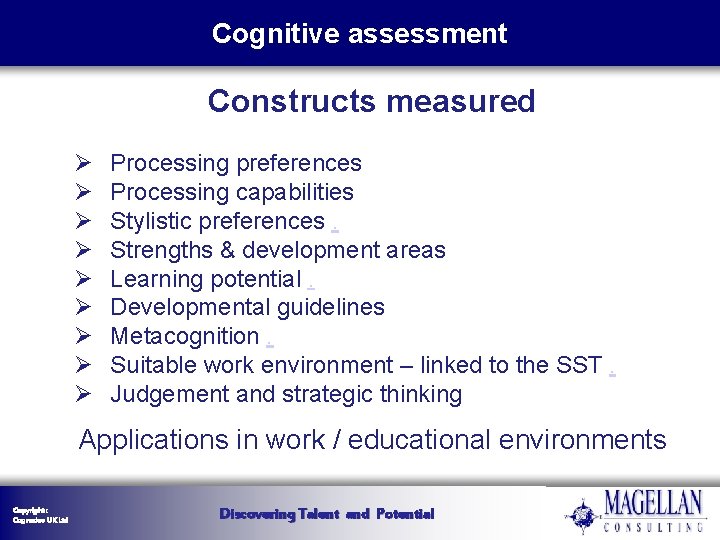
Cognitive assessment Constructs measured Ø Ø Ø Ø Ø Processing preferences Processing capabilities Stylistic preferences. Strengths & development areas Learning potential. Developmental guidelines Metacognition. Suitable work environment – linked to the SST. Judgement and strategic thinking Applications in work / educational environments Copyright : Cognadev UK Ltd Discovering Talent and Potential
Cognitive assessment Cognitive Process Profile (CPP) Copyright : Cognadev UK Ltd Discovering Talent and Potential
Methodology used Copyright : Cognadev UK Ltd Discovering Talent and Potential
Cognitive assessment CPP constructs measured Copyright : Cognadev UK Ltd Discovering Talent and Potential
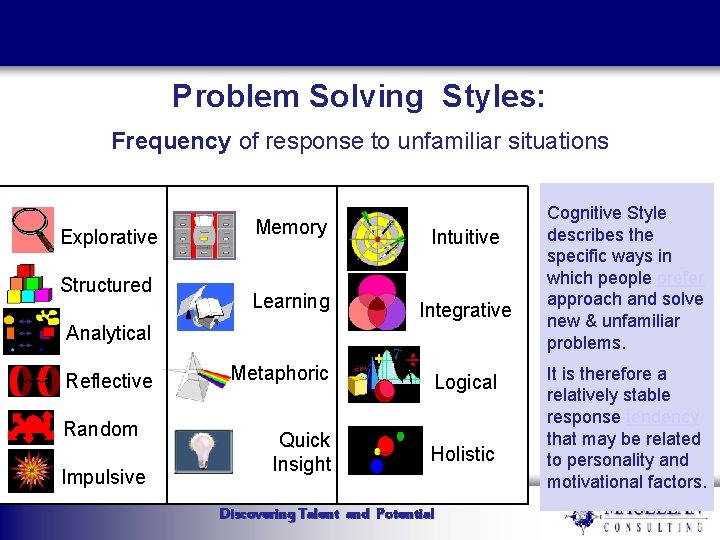
Problem Solving Styles: Frequency of response to unfamiliar situations Explorative Structured Memory Learning Intuitive Integrative Analytical Reflective Random Impulsive Metaphoric Logical Quick Insight Holistic Discovering Talent and Potential Cognitive Style describes the specific ways in which people prefer approach and solve new & unfamiliar problems. It is therefore a relatively stable response tendency that may be related to personality and motivational factors.
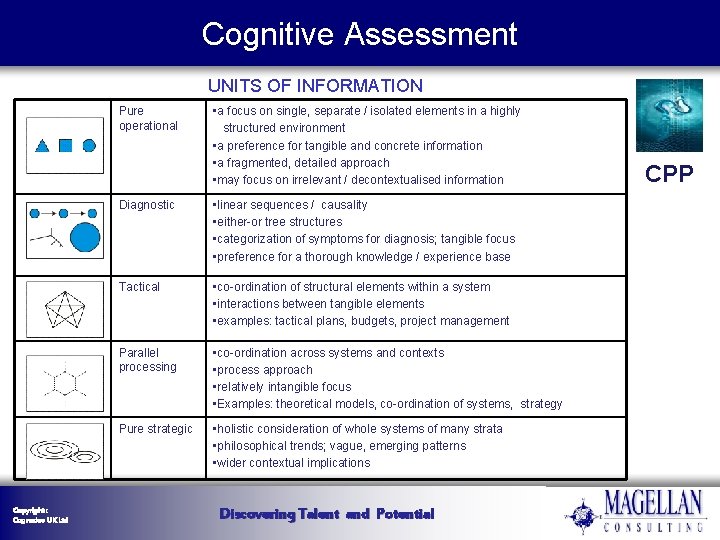
Cognitive Assessment UNITS OF INFORMATION Pure operational Copyright : Cognadev UK Ltd • a focus on single, separate / isolated elements in a highly structured environment • a preference for tangible and concrete information • a fragmented, detailed approach • may focus on irrelevant / decontextualised information Diagnostic • linear sequences / causality • either-or tree structures • categorization of symptoms for diagnosis; tangible focus • preference for a thorough knowledge / experience base Tactical • co-ordination of structural elements within a system • interactions between tangible elements • examples: tactical plans, budgets, project management Parallel processing • co-ordination across systems and contexts • process approach • relatively intangible focus • Examples: theoretical models, co-ordination of systems, strategy Pure strategic • holistic consideration of whole systems of many strata • philosophical trends; vague, emerging patterns • wider contextual implications Discovering Talent and Potential CPP
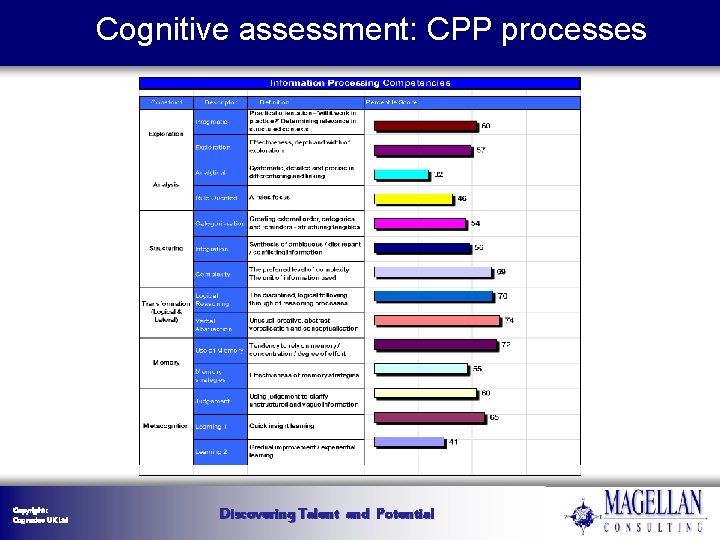
Cognitive assessment: CPP processes Copyright : Cognadev UK Ltd Discovering Talent and Potential
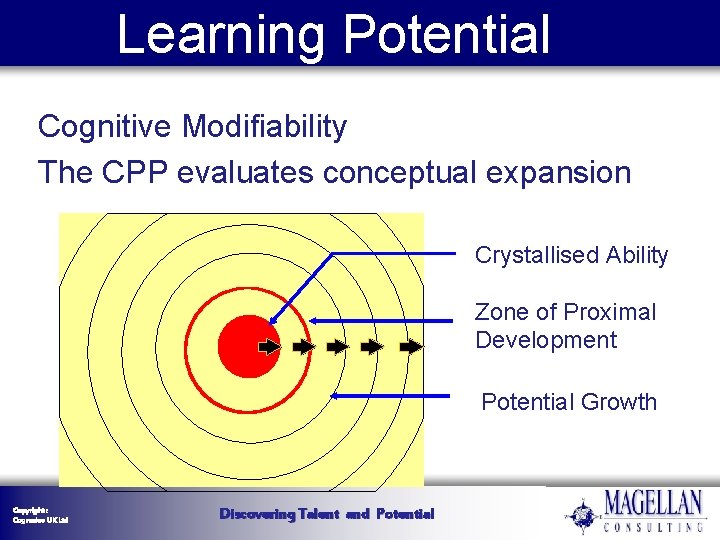
Learning Potential Cognitive Modifiability The CPP evaluates conceptual expansion Crystallised Ability Zone of Proximal Development Potential Growth Copyright : Cognadev UK Ltd Discovering Talent and Potential
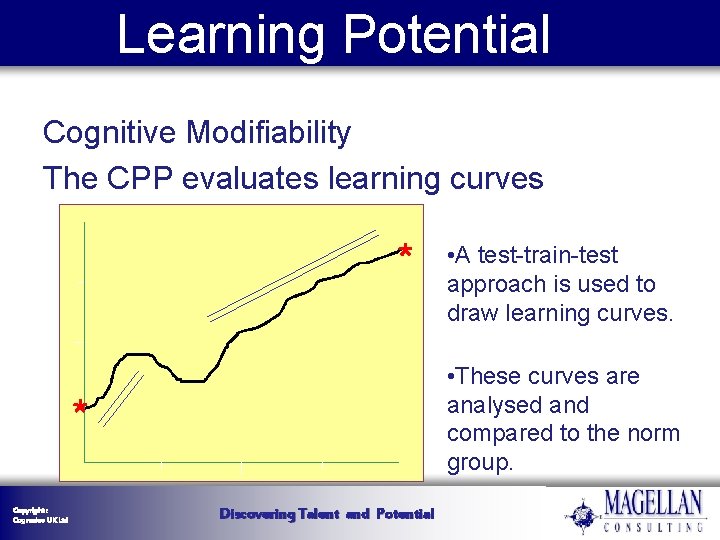
Learning Potential Cognitive Modifiability The CPP evaluates learning curves • A test-train-test approach is used to draw learning curves. • These curves are analysed and compared to the norm group. Copyright : Cognadev UK Ltd Discovering Talent and Potential
Learning Potential Cognitive Modifiability The CPP evaluates theoretically based issues üConsistency üEasy vs. difficult üThinking strategies used üOverall profile üNature vs. nurture üMetacognitive awareness Copyright : Cognadev UK Ltd Discovering Talent and Potential
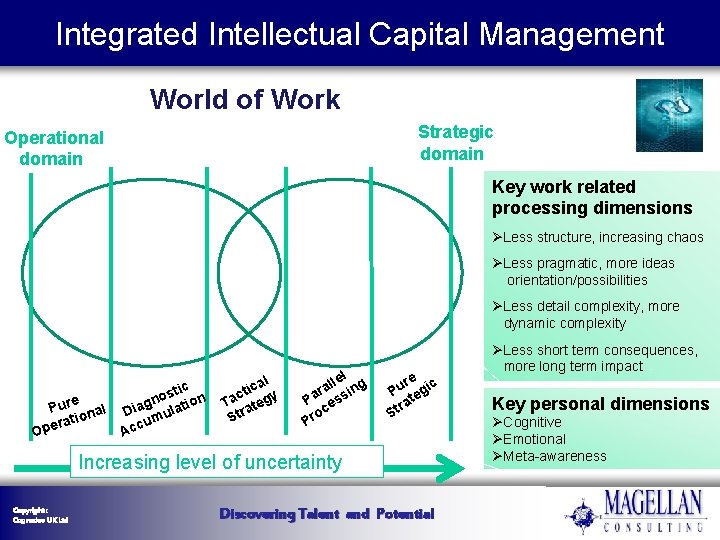
Integrated Intellectual Capital Management World of Work Strategic domain Operational domain Key work related processing dimensions ØLess structure, increasing chaos ØLess pragmatic, more ideas orientation/possibilities ØLess detail complexity, more dynamic complexity e Pur nal ratio e p O stic n o n io g Dia mulat cu Ac l ca i t c Ta ategy Str l lle ng a r i Pa ess oc Pr re ic u P teg ra St Increasing level of uncertainty Copyright : Cognadev UK Ltd Discovering Talent and Potential ØLess short term consequences, more long term impact Key personal dimensions ØCognitive ØEmotional ØMeta-awareness
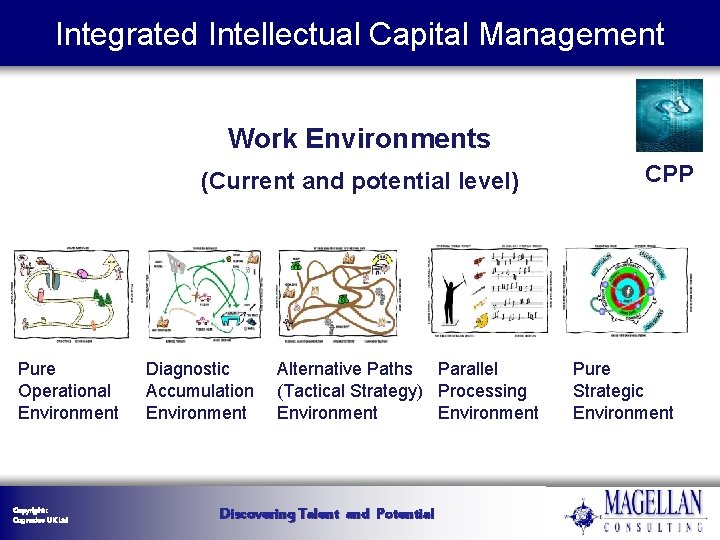
Integrated Intellectual Capital Management Work Environments (Current and potential level) Pure Operational Environment Copyright : Cognadev UK Ltd Diagnostic Accumulation Environment Alternative Paths Parallel (Tactical Strategy) Processing Environment Discovering Talent and Potential CPP Pure Strategic Environment
Cognitive assessment Learning Orientation Index (LOI) Copyright : Cognadev UK Ltd Discovering Talent and Potential
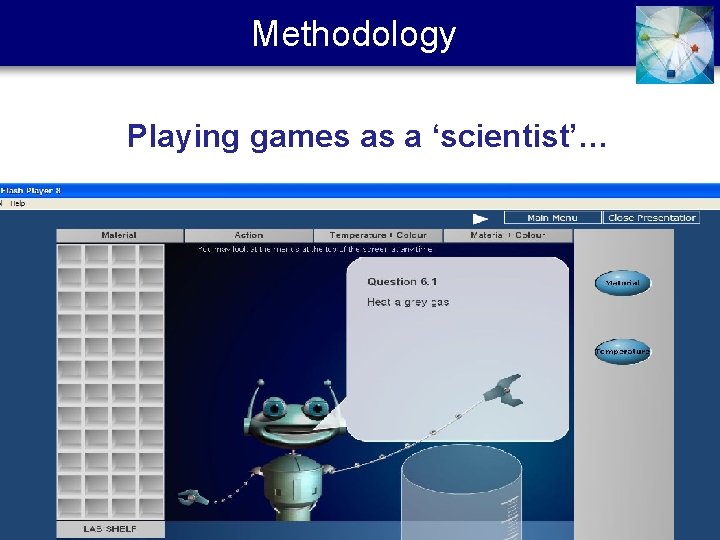
Methodology Playing games as a ‘scientist’… Copyright : Cognadev UK Ltd Discovering Talent and Potential
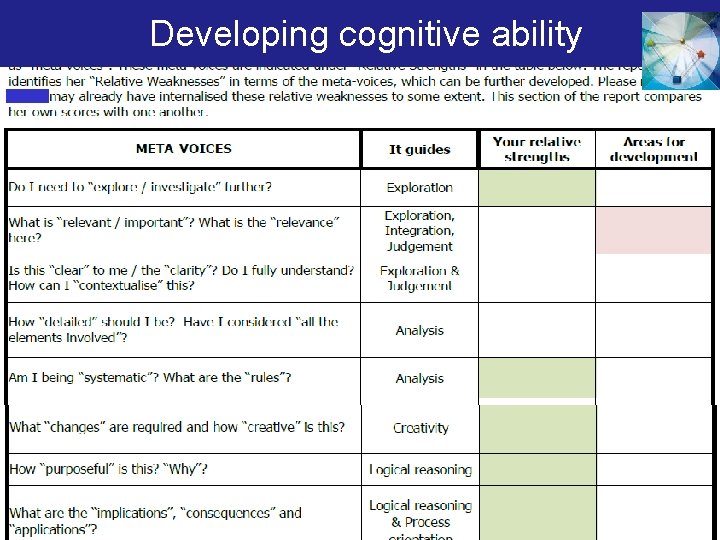
Developing cognitive ability Broad Study Fields Copyright : Cognadev UK Ltd Discovering Talent and Potential
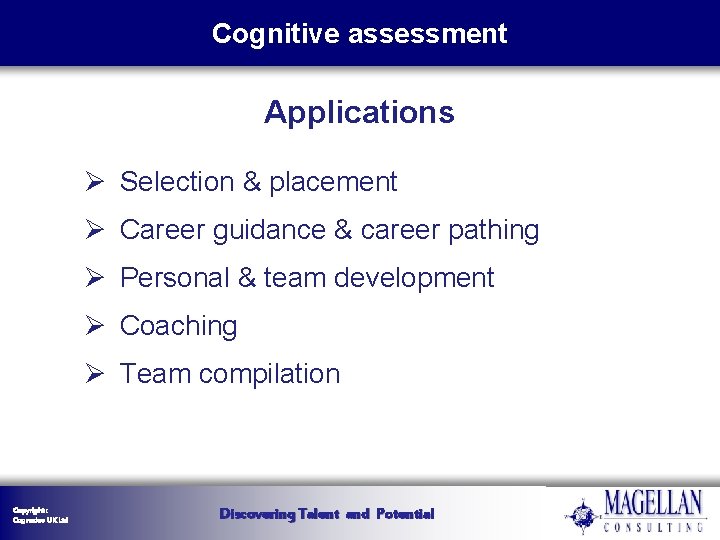
Cognitive assessment Applications Ø Selection & placement Ø Career guidance & career pathing Ø Personal & team development Ø Coaching Ø Team compilation Copyright : Cognadev UK Ltd Discovering Talent and Potential
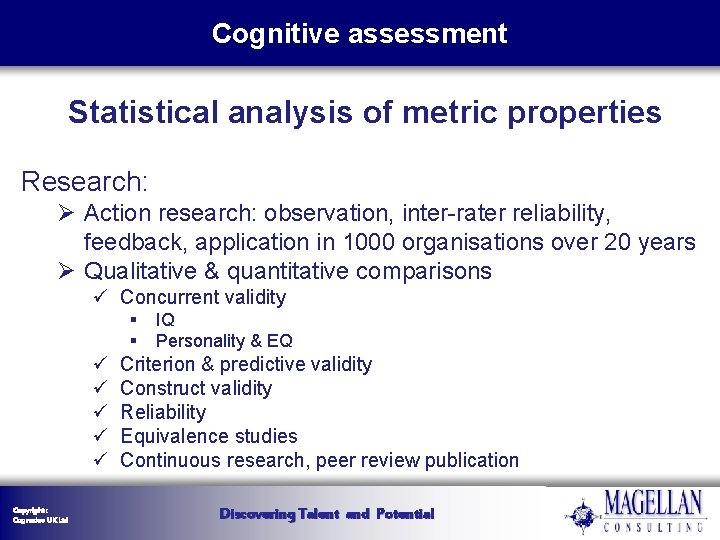
Cognitive assessment Statistical analysis of metric properties Research: Ø Action research: observation, inter-rater reliability, feedback, application in 1000 organisations over 20 years Ø Qualitative & quantitative comparisons ü Concurrent validity § § ü ü ü Copyright : Cognadev UK Ltd IQ Personality & EQ Criterion & predictive validity Construct validity Reliability Equivalence studies Continuous research, peer review publication Discovering Talent and Potential
Thank you for your valuable time 011 – 884 0878 www. cognadev. com Copyright : Cognadev UK Ltd Discovering Talent and Potential