Arthur Krigsman MD Stephen Walker Ph D AutismAssociated




- Slides: 25
Arthur Krigsman, MD Stephen Walker Ph. D. Autism-Associated Enterocolitis Treatment Study SYNCHRONY Pleasanton, CA November 2019 www. autismgi. com (718) 327 -2200 x 202 www. facebook. com/arthur. krigsman
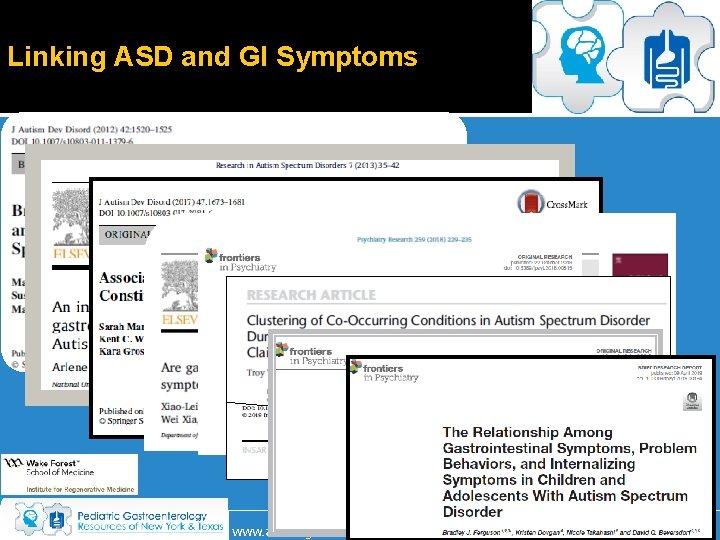
Linking ASD and GI Symptoms www. autismgi. com (718) 327 -2200 x 202 www. facebook. com/arthur. krigsman
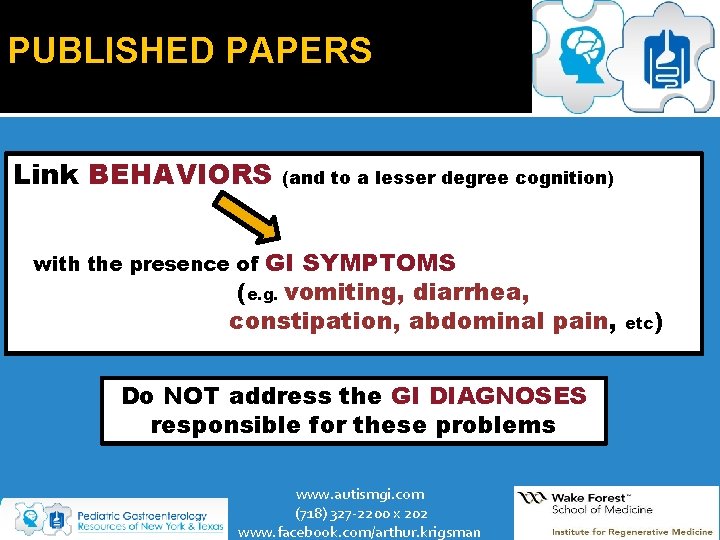
PUBLISHED PAPERS Link BEHAVIORS (and to a lesser degree cognition) GI SYMPTOMS (e. g. vomiting, diarrhea, constipation, abdominal pain, with the presence of Do NOT address the GI DIAGNOSES responsible for these problems www. autismgi. com (718) 327 -2200 x 202 www. facebook. com/arthur. krigsman etc)
AUTISM-ASSOCIATED ENTEROCOLITIS (ASD-EC) Autism-Associated Enterocolitis is present in 70 -75% of ASD children with specific GI symptoms (Krigsman, Boris 2010) Autism-Associated Enterocolitis is an autoimmune disease, NOT a food allergy or result of dysbiotic flora. www. autismgi. com (718) 327 -2200 x 202 www. facebook. com/arthur. krigsman
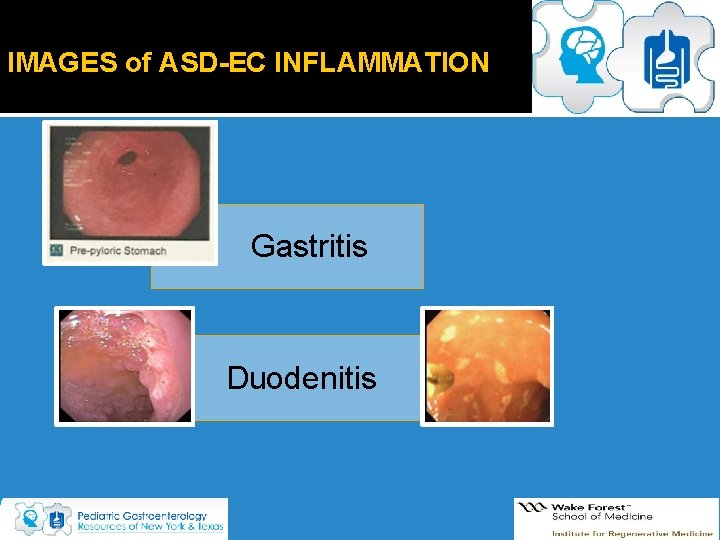
IMAGES of ASD-EC INFLAMMATION Gastritis Duodenitis
IMAGES of ASD-EC INFLAMMATION Colitis Enteritis Ileitis
OBSERVED SYMPTOMS of ASD-ENTEROCOLITIS STOOL DESCRIPTORS (e. g. frequency, texture, color, odor, volume) INTERNALIZING BEHAVIORS heightened anxiety depression, rigid compulsions, poor sleep BOWEL MOVEMENT DESCRIPTORS (straining, contorting, pain, multiple attempts) EXTERNALIZING BEHAVIORS aggression, self-injury, extremes of behavior hyperactivity, irritability PHYSICAL GI SIGNS (abdominal distention, muscle mass deficiency growth delay) COGNITIVE, SOCIAL, and/or LANGUAGE DELAYS
QUESTION: Does treating the ASD inflammatory bowel disease help E Y ! ! S a) the GI symptoms? b) cognition and behavior? No published study has yet addressed these questions
IMPACT: Proof that treatment of ASD-enterocolitis results in improvement in both GI symptoms and core ASD deficits would provide an additional intervention to improve the lives of affected children and families
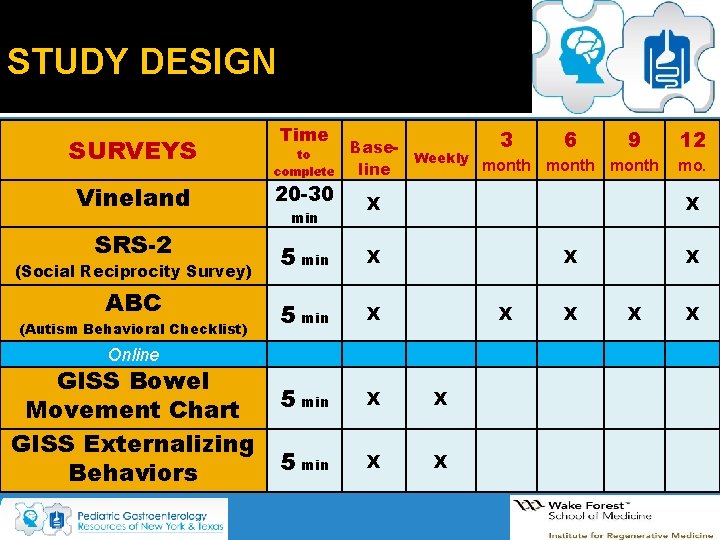
STUDY DESIGN SURVEYS Vineland SRS-2 (Social Reciprocity Survey) ABC (Autism Behavioral Checklist) Time to complete 20 -30 min 3 6 9 Base. Weekly month line X mo. X 5 min X X X X Online GISS Bowel Movement Chart GISS Externalizing Behaviors 12 X X
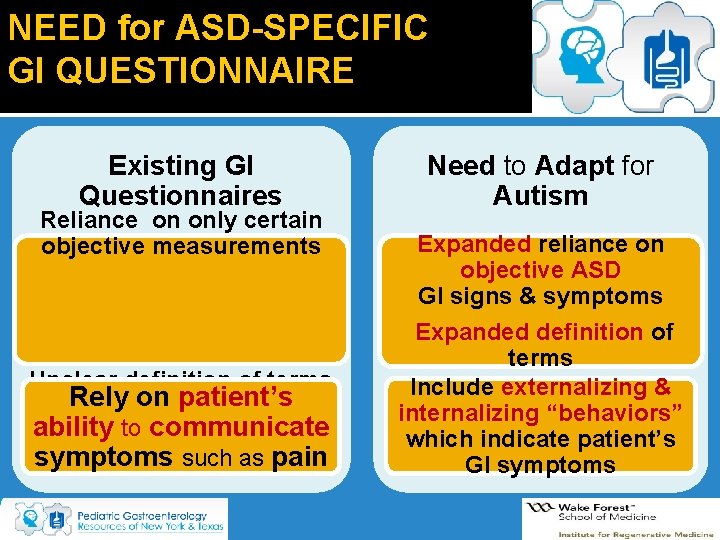
NEED for ASD-SPECIFIC GI QUESTIONNAIRE Existing GI Questionnaires Reliance on only certain objective measurements Unclear definition of terms Rely on patient’s ability to communicate symptoms such as pain Need to Adapt for Autism Expanded reliance on objective ASD GI signs & symptoms Expanded definition of terms Include externalizing & internalizing “behaviors” which indicate patient’s GI symptoms
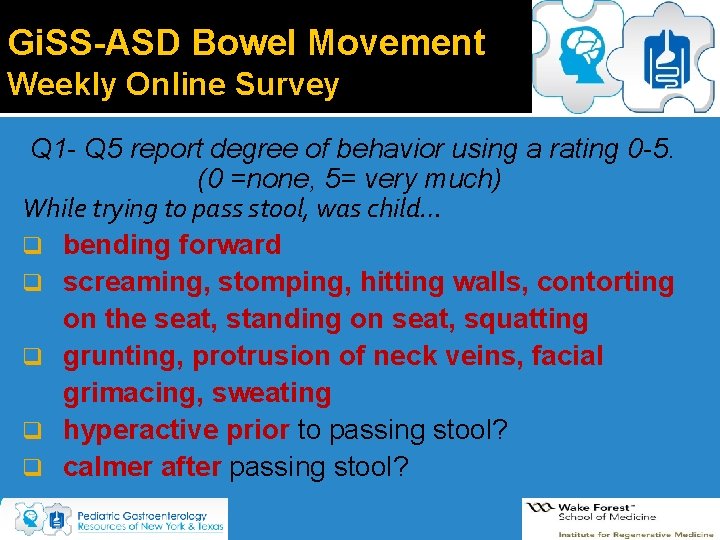
Gi. SS-ASD Bowel Movement Weekly Online Survey Q 1 - Q 5 report degree of behavior using a rating 0 -5. (0 =none, 5= very much) While trying to pass stool, was child… q bending forward q screaming, stomping, hitting walls, contorting on the seat, standing on seat, squatting q grunting, protrusion of neck veins, facial grimacing, sweating q hyperactive prior to passing stool? q calmer after passing stool?
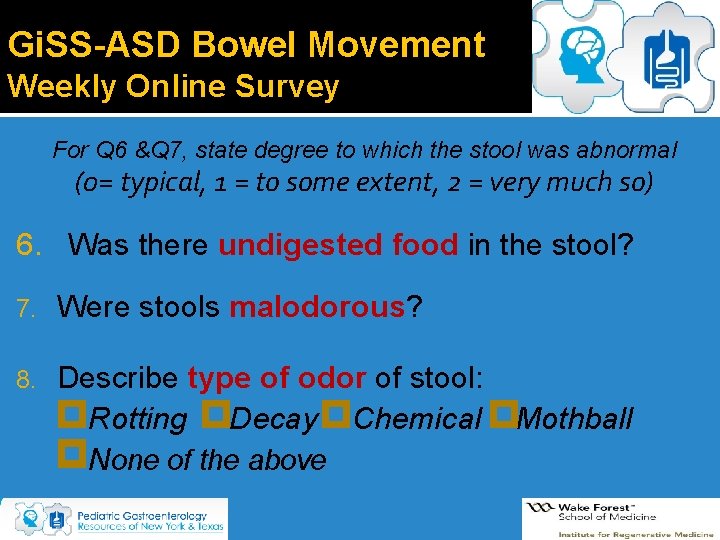
Gi. SS-ASD Bowel Movement Weekly Online Survey For Q 6 &Q 7, state degree to which the stool was abnormal (0= typical, 1 = to some extent, 2 = very much so) 6. Was there undigested food in the stool? 7. Were stools malodorous? 8. Describe type of odor of stool: Rotting Decay Chemical None of the above Mothball
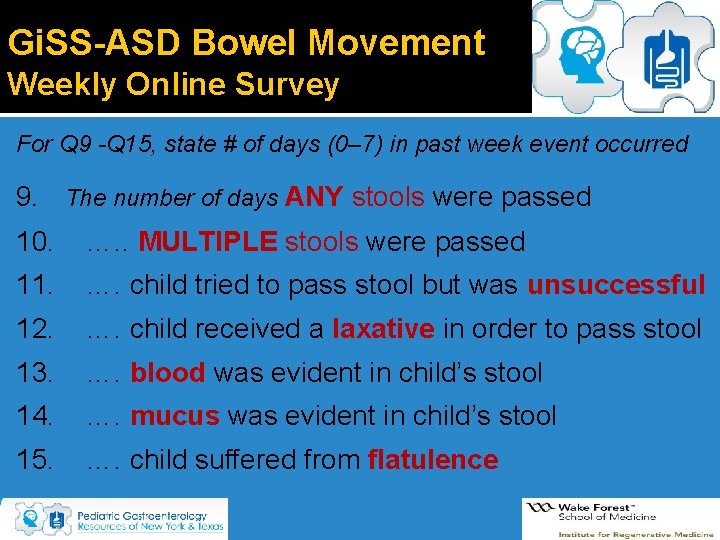
Gi. SS-ASD Bowel Movement Weekly Online Survey For Q 9 -Q 15, state # of days (0– 7) in past week event occurred 9. The number of days ANY stools were passed 10. …. . MULTIPLE stools were passed 11. …. child tried to pass stool but was unsuccessful 12. …. child received a laxative in order to pass stool 13. …. blood was evident in child’s stool 14. …. mucus was evident in child’s stool 15. …. child suffered from flatulence
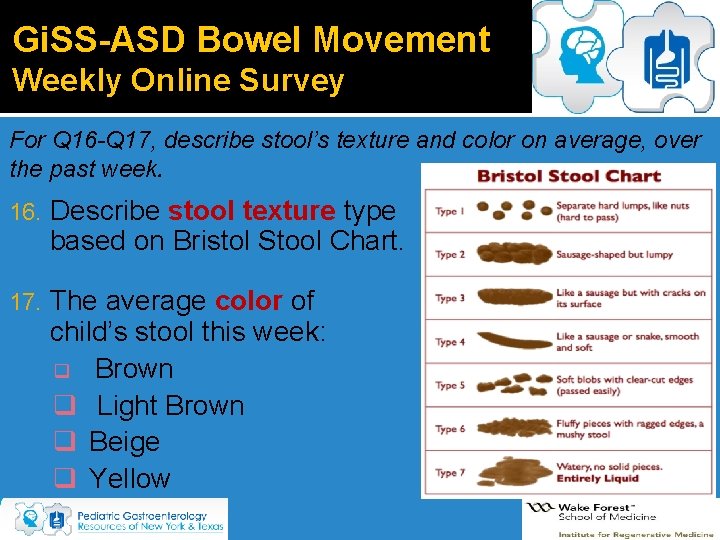
Gi. SS-ASD Bowel Movement Weekly Online Survey For Q 16 -Q 17, describe stool’s texture and color on average, over the past week. 16. Describe stool texture type based on Bristol Stool Chart. 17. The average color of child’s stool this week: q Brown q Light Brown q Beige q Yellow
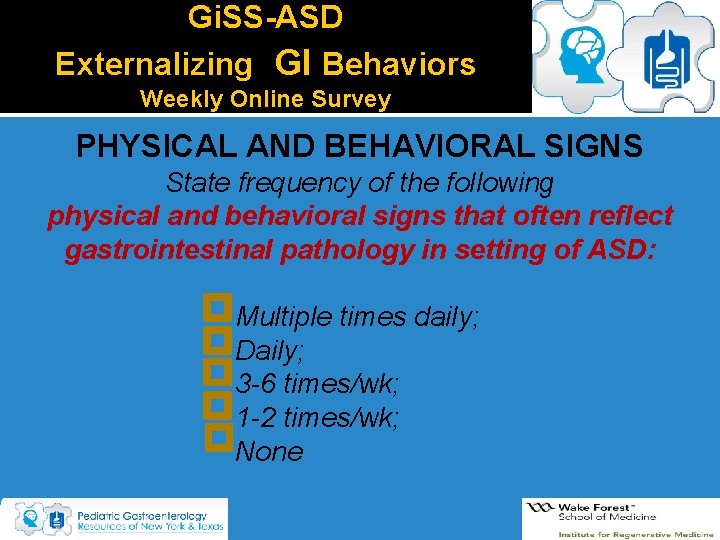
Gi. SS-ASD Externalizing GI Behaviors Weekly Online Survey PHYSICAL AND BEHAVIORAL SIGNS State frequency of the following physical and behavioral signs that often reflect gastrointestinal pathology in setting of ASD: Multiple times daily; Daily; 3 -6 times/wk; 1 -2 times/wk; None
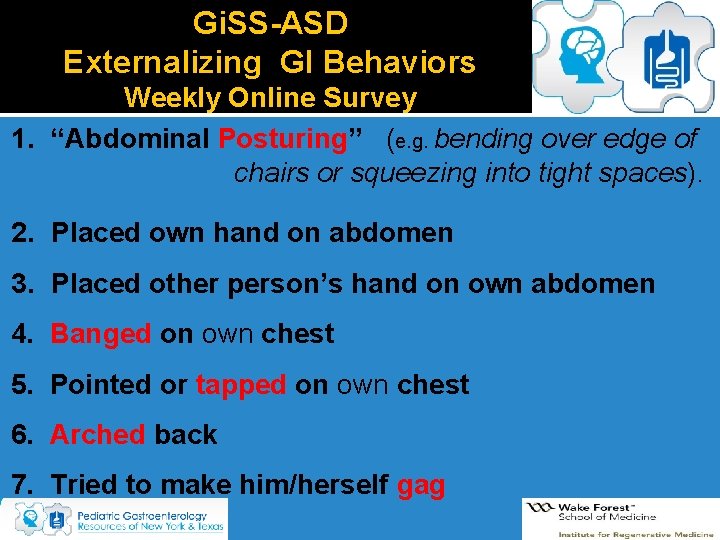
Gi. SS-ASD Externalizing GI Behaviors Weekly Online Survey 1. “Abdominal Posturing” (e. g. bending over edge of chairs or squeezing into tight spaces). 2. Placed own hand on abdomen 3. Placed other person’s hand on own abdomen 4. Banged on own chest 5. Pointed or tapped on own chest 6. Arched back 7. Tried to make him/herself gag
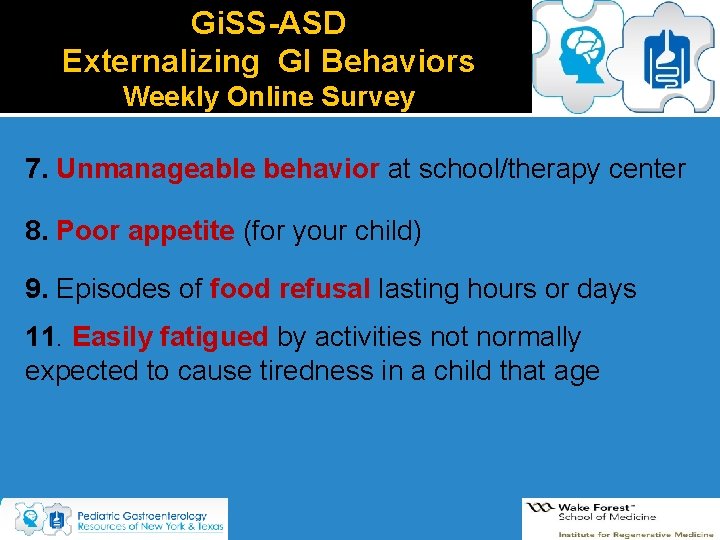
Gi. SS-ASD Externalizing GI Behaviors Weekly Online Survey 7. Unmanageable behavior at school/therapy center 8. Poor appetite (for your child) 9. Episodes of food refusal lasting hours or days 11. Easily fatigued by activities not normally expected to cause tiredness in a child that age
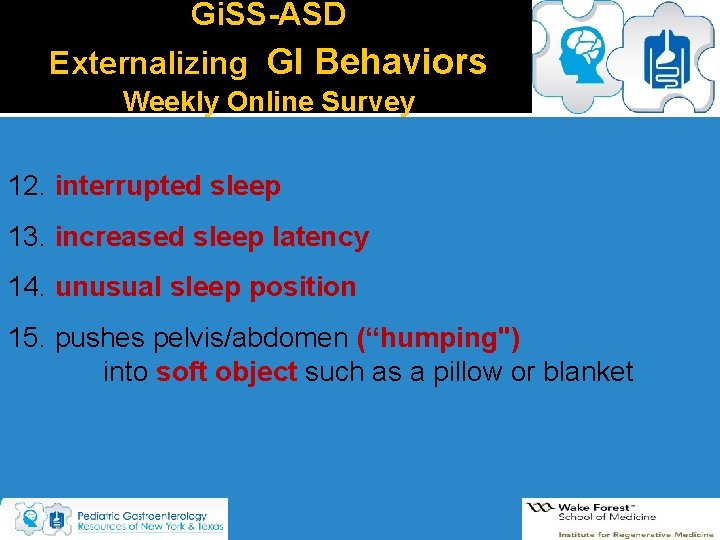
Gi. SS-ASD Externalizing GI Behaviors Weekly Online Survey 12. interrupted sleep 13. increased sleep latency 14. unusual sleep position 15. pushes pelvis/abdomen (“humping") into soft object such as a pillow or blanket
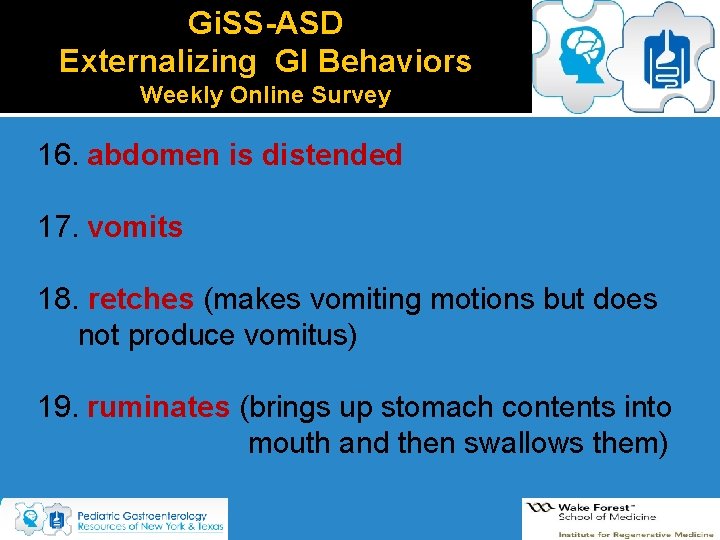
Gi. SS-ASD Externalizing GI Behaviors Weekly Online Survey 16. abdomen is distended 17. vomits 18. retches (makes vomiting motions but does not produce vomitus) 19. ruminates (brings up stomach contents into mouth and then swallows them)
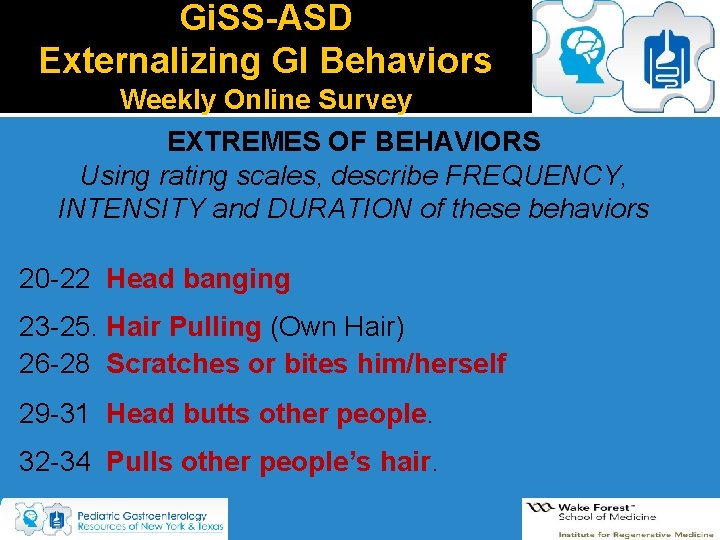
Gi. SS-ASD Externalizing GI Behaviors Weekly Online Survey EXTREMES OF BEHAVIORS Using rating scales, describe FREQUENCY, INTENSITY and DURATION of these behaviors 20 -22 Head banging 23 -25. Hair Pulling (Own Hair) 26 -28 Scratches or bites him/herself 29 -31 Head butts other people. 32 -34 Pulls other people’s hair.
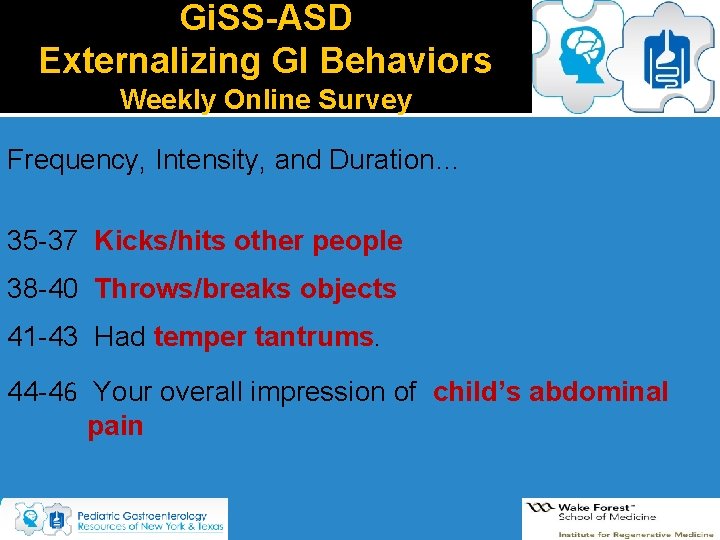
Gi. SS-ASD Externalizing GI Behaviors Weekly Online Survey Frequency, Intensity, and Duration… 35 -37 Kicks/hits other people 38 -40 Throws/breaks objects 41 -43 Had temper tantrums. 44 -46 Your overall impression of child’s abdominal pain
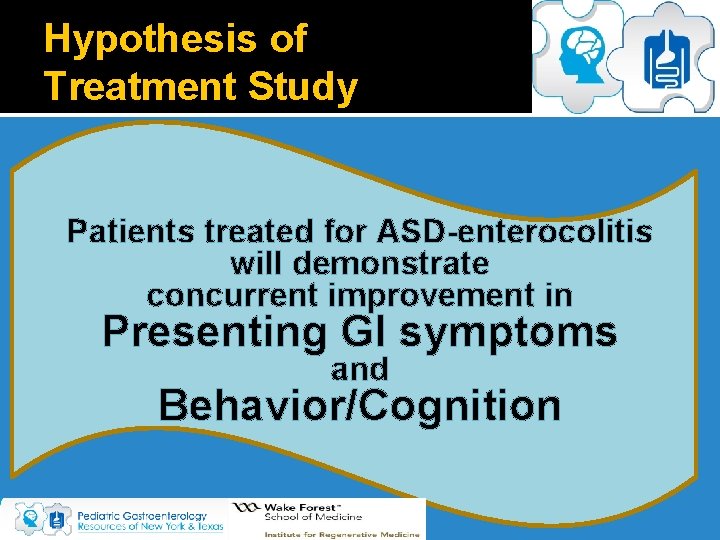
Hypothesis of Treatment Study Patients treated for ASD-enterocolitis will demonstrate concurrent improvement in Presenting GI symptoms and Behavior/Cognition
Secondary Study Outcomes Concurrent improvement in : stool/bowel movement domains and core ASD symptoms would indicate treatment of the bowel disease is also a treatment for ASD. stool/bowel movement domains and externalizing behaviors would validate those “behaviors” as true GI symptoms
At the completion of this 3 year study, the following questions will be answered: 1. Does treating ASD-EC with anti-inflammatory drugs improve the presenting GI symptoms? 2. Does treating ASD-EC with anti-inflammatory drugs improve the baseline degree of ASD developmental delay? 3. Will there be a correlation between the degree of GI symptom improvement and the degree of cognitive-behavioral improvement? 4. Will “externalizing behaviors” prove to in fact be behavioral manifestations of GI disease? (i. e. GI symptoms). 5. Will there be a change in molecular markers associated with treatment of the GI disease and, if so, will they predict degree of improvement in cognition/behavior? 6. Will any improvements seen as a result of GI treatment persist if patients choose to discontinue the treatment after completion of the study at one year? www. autismgi. com (718) 327 -2200 x 202 www. facebook. com/arthur. krigsman