
Society Culture and Reform 1820 1860 APUSH LECTURE







- Slides: 40
Society, Culture, and Reform, 1820 -1860 APUSH: LECTURE 3 E MRS. KRAY
Antebellum America, 1820 -1860 Several historic reform movements began during the Jacksonian era and in the following decades The enthusiasm for reform had many historic sources Puritan sense of mission “city upon a hill” Enlightenment belief in human goodness Politics of Jacksonian democracy Changing relationships between men and women, among social classes, and among ethnic groups as a result of the Industrial Revolution The 2 nd Great Awakening*
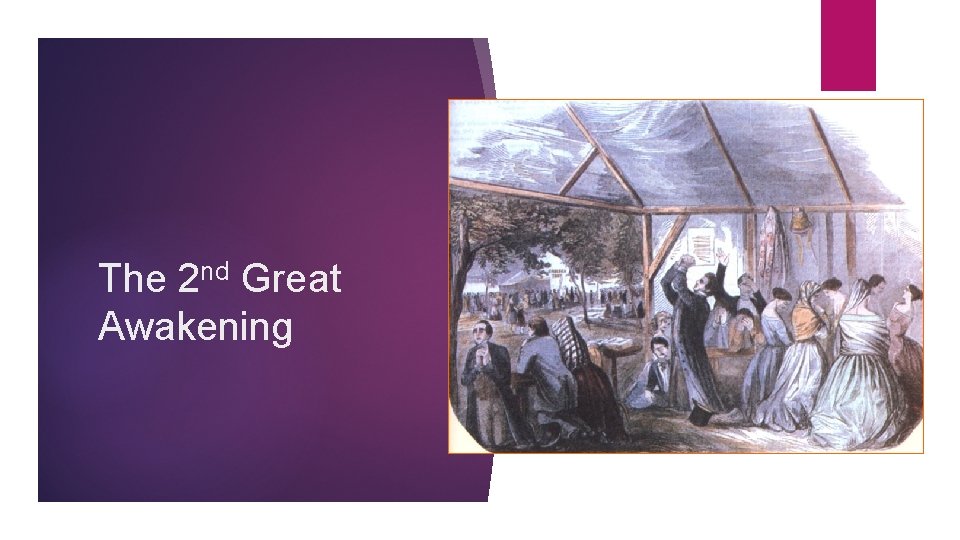
The 2 nd Great Awakening
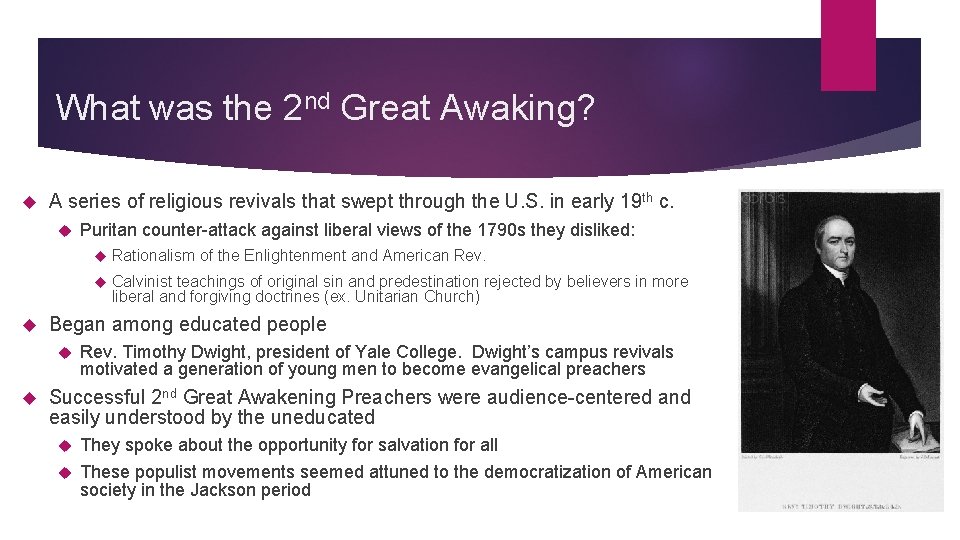
What was the 2 nd Great Awaking? A series of religious revivals that swept through the U. S. in early 19 th c. Rationalism of the Enlightenment and American Rev. Calvinist teachings of original sin and predestination rejected by believers in more liberal and forgiving doctrines (ex. Unitarian Church) Began among educated people Puritan counter-attack against liberal views of the 1790 s they disliked: Rev. Timothy Dwight, president of Yale College. Dwight’s campus revivals motivated a generation of young men to become evangelical preachers Successful 2 nd Great Awakening Preachers were audience-centered and easily understood by the uneducated They spoke about the opportunity for salvation for all These populist movements seemed attuned to the democratization of American society in the Jackson period
Revivalism in New York 1823: Presbyterian minister Charles G. Finney started a series of revivals in upstate New York where many New Englanders had settled Didn’t deliver sermons based on rational argument; appealed to people’s emotions and fear of damnation Preached that every individual could be saved through faith and hard work – ideas that strongly appealed to the rising middle class Because of Finney’s influence western New York became nicknamed the “burned-over district” b/c of its frequent “hell-and-brimstone” revivals “The ranges of tents, the fires, reflecting light…; the candles and lamps illuminating the encampment; hundreds moving to and fro…; the preaching, praying, singing, and shouting, … like the sound of many waters, was enough to swallow up all the powers of contemplation. ” -- Description of a Finney Revival Meeting
Baptists and Methodists In the South and on the advancing western frontier, Baptist and Methodist circuit preachers, such as Peter Cartwright, would travel from one location to another and attract thousands to hear their dramatic preaching at outdoor revivals and camp meetings These preachers activated the faith of many people who had never belonged to a church By 1850, the Baptists and Methodists were the largest Protestant denominations in the country
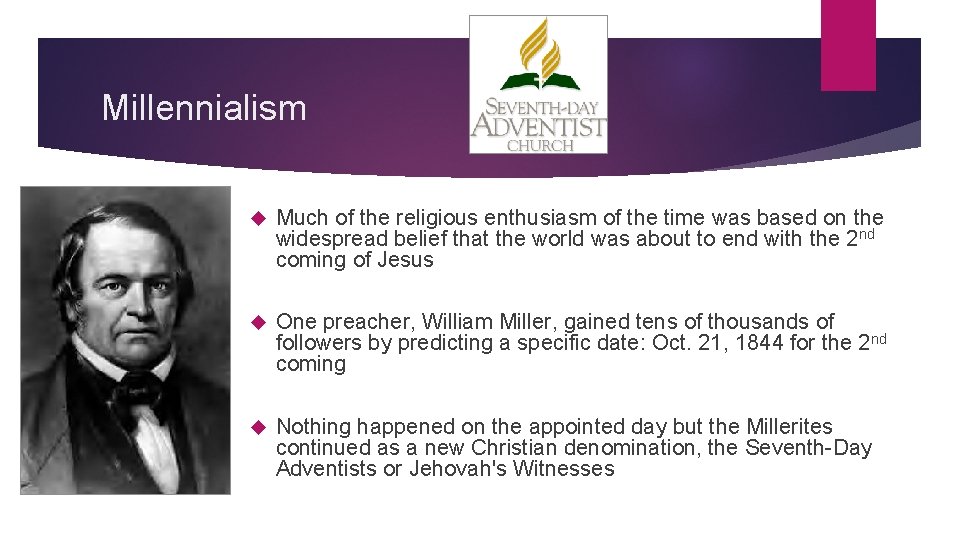
Millennialism Much of the religious enthusiasm of the time was based on the widespread belief that the world was about to end with the 2 nd coming of Jesus One preacher, William Miller, gained tens of thousands of followers by predicting a specific date: Oct. 21, 1844 for the 2 nd coming Nothing happened on the appointed day but the Millerites continued as a new Christian denomination, the Seventh-Day Adventists or Jehovah's Witnesses
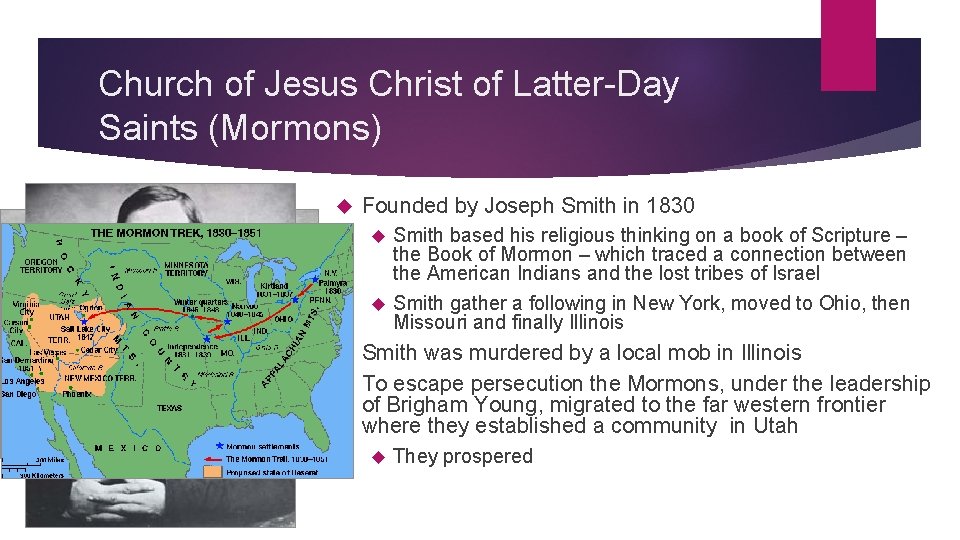
Church of Jesus Christ of Latter-Day Saints (Mormons) Founded by Joseph Smith in 1830 Smith based his religious thinking on a book of Scripture – the Book of Mormon – which traced a connection between the American Indians and the lost tribes of Israel Smith gather a following in New York, moved to Ohio, then Missouri and finally Illinois Smith was murdered by a local mob in Illinois To escape persecution the Mormons, under the leadership of Brigham Young, migrated to the far western frontier where they established a community in Utah They prospered
Culture: Ideas, the Arts, and Literature IN EUROPE, DURING THE EARLY 19 TH C, ARTISTS AND WRITERS SHIFTED AWAY FROM THE ENLIGHTENMENT EMPHASIS ON BALANCE, ORDER, AND REASON, AND TOWARD ROMANTICISM EMPHASIZED INTUITION, FEELINGS, INDIVIDUAL ACTS OF HEROISM, AND THE STUDY OF NATURE. ROMANTICISM WAS EXPRESSED IN THE U. S. BY THE TRANSCENDENTALISTS
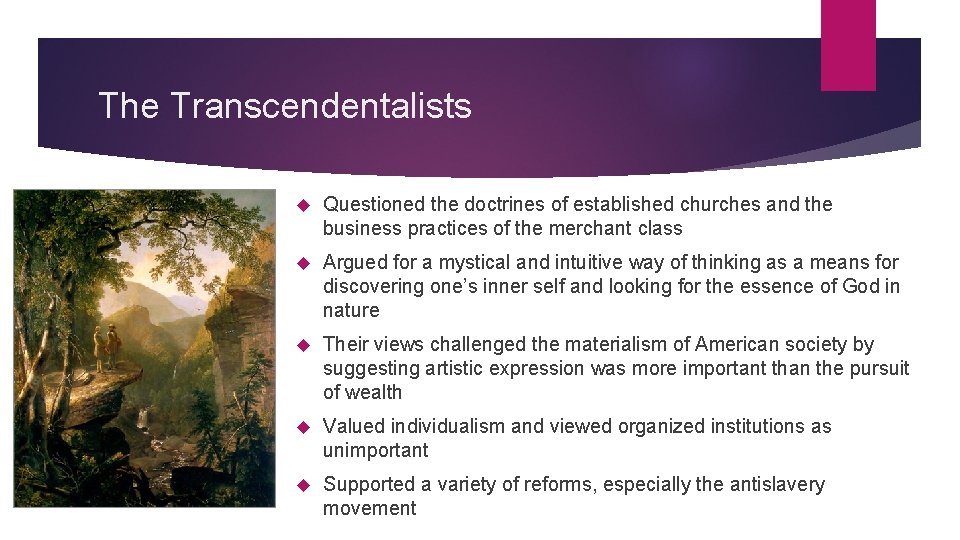
The Transcendentalists Questioned the doctrines of established churches and the business practices of the merchant class Argued for a mystical and intuitive way of thinking as a means for discovering one’s inner self and looking for the essence of God in nature Their views challenged the materialism of American society by suggesting artistic expression was more important than the pursuit of wealth Valued individualism and viewed organized institutions as unimportant Supported a variety of reforms, especially the antislavery movement
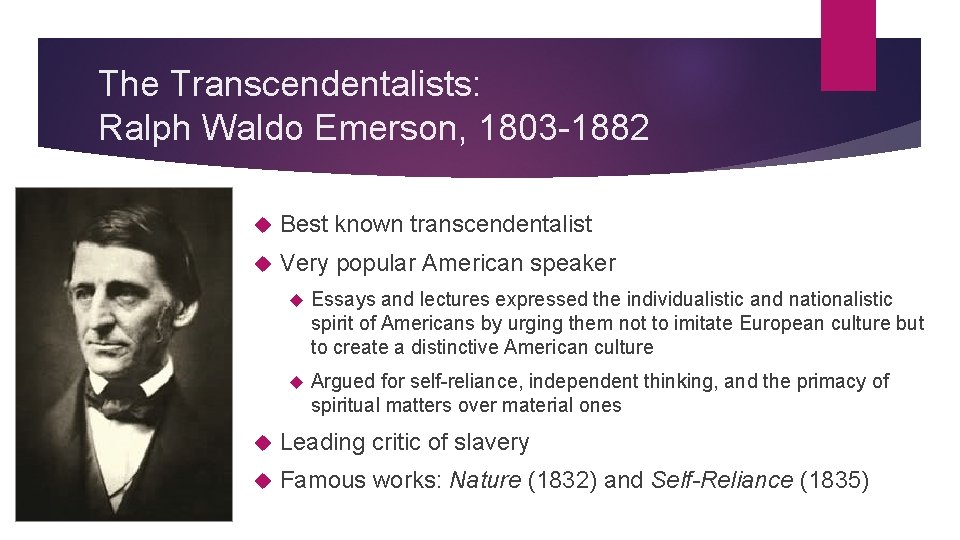
The Transcendentalists: Ralph Waldo Emerson, 1803 -1882 Best known transcendentalist Very popular American speaker Essays and lectures expressed the individualistic and nationalistic spirit of Americans by urging them not to imitate European culture but to create a distinctive American culture Argued for self-reliance, independent thinking, and the primacy of spiritual matters over material ones Leading critic of slavery Famous works: Nature (1832) and Self-Reliance (1835)
The Transcendentalists: Henry David Thoreau, 1817 -1862 Remembered as a pioneer ecologist and conservationist Walden, 1854 Tested his transcendentalist philosophy by living in the woods for 2 years Used observations of nature to discover essential truths about life and the universe On Civil Disobedience, 1849 Presented a argument for disobeying unjust laws and accepting penalty (nonviolent civil disobedience) Refused to pay a tax that would support the U. S. war with Mexico; spent a night in jail Would inspire nonviolent movements of Gandhi in India and MLK Jr. in U. S.
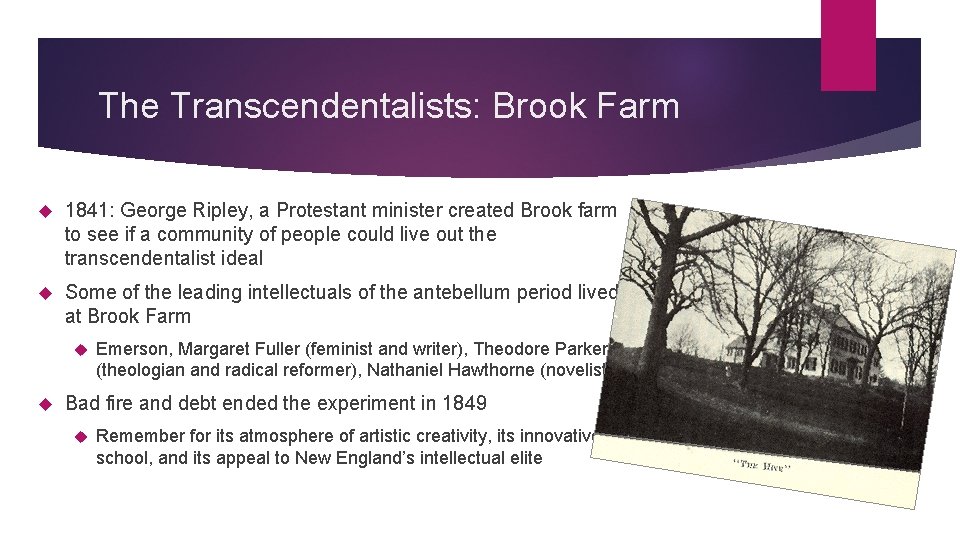
The Transcendentalists: Brook Farm 1841: George Ripley, a Protestant minister created Brook farm to see if a community of people could live out the transcendentalist ideal Some of the leading intellectuals of the antebellum period lived at Brook Farm Emerson, Margaret Fuller (feminist and writer), Theodore Parker (theologian and radical reformer), Nathaniel Hawthorne (novelist) Bad fire and debt ended the experiment in 1849 Remember for its atmosphere of artistic creativity, its innovative school, and its appeal to New England’s intellectual elite
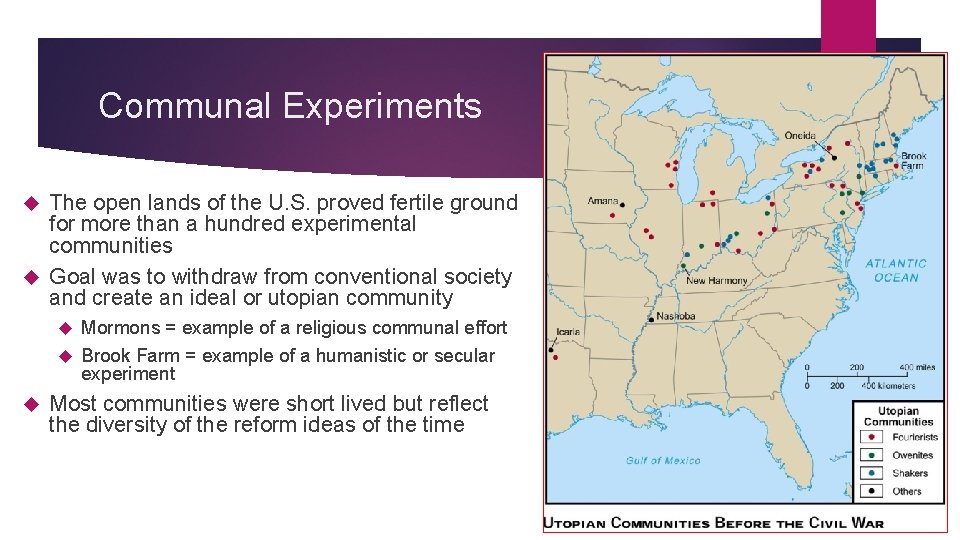
Communal Experiments The open lands of the U. S. proved fertile ground for more than a hundred experimental communities Goal was to withdraw from conventional society and create an ideal or utopian community Mormons = example of a religious communal effort Brook Farm = example of a humanistic or secular experiment Most communities were short lived but reflect the diversity of the reform ideas of the time
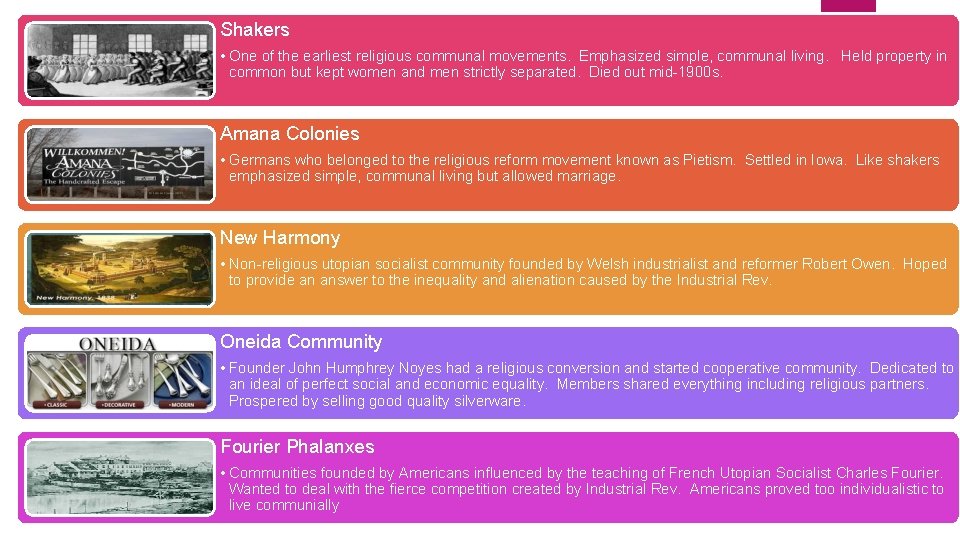
Shakers • One of the earliest religious communal movements. Emphasized simple, communal living. Held property in common but kept women and men strictly separated. Died out mid-1900 s. Amana Colonies • Germans who belonged to the religious reform movement known as Pietism. Settled in Iowa. Like shakers emphasized simple, communal living but allowed marriage. New Harmony • Non-religious utopian socialist community founded by Welsh industrialist and reformer Robert Owen. Hoped to provide an answer to the inequality and alienation caused by the Industrial Rev. Oneida Community • Founder John Humphrey Noyes had a religious conversion and started cooperative community. Dedicated to an ideal of perfect social and economic equality. Members shared everything including religious partners. Prospered by selling good quality silverware. Fourier Phalanxes • Communities founded by Americans influenced by the teaching of French Utopian Socialist Charles Fourier. Wanted to deal with the fierce competition created by Industrial Rev. Americans proved too individualistic to live communially
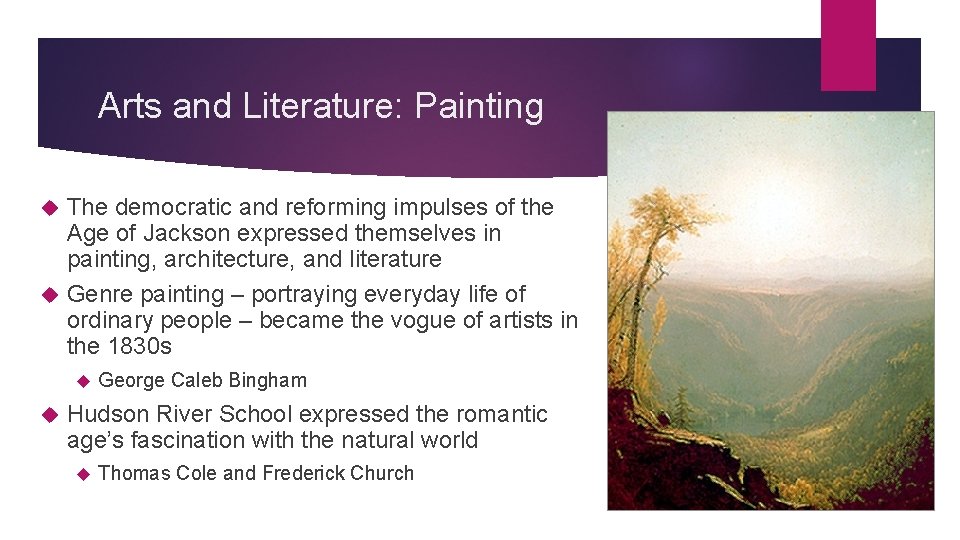
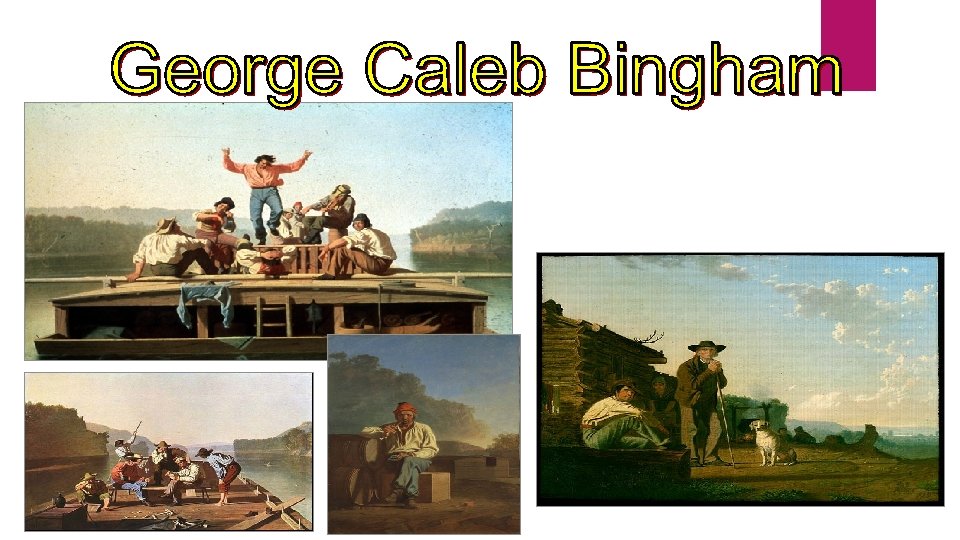
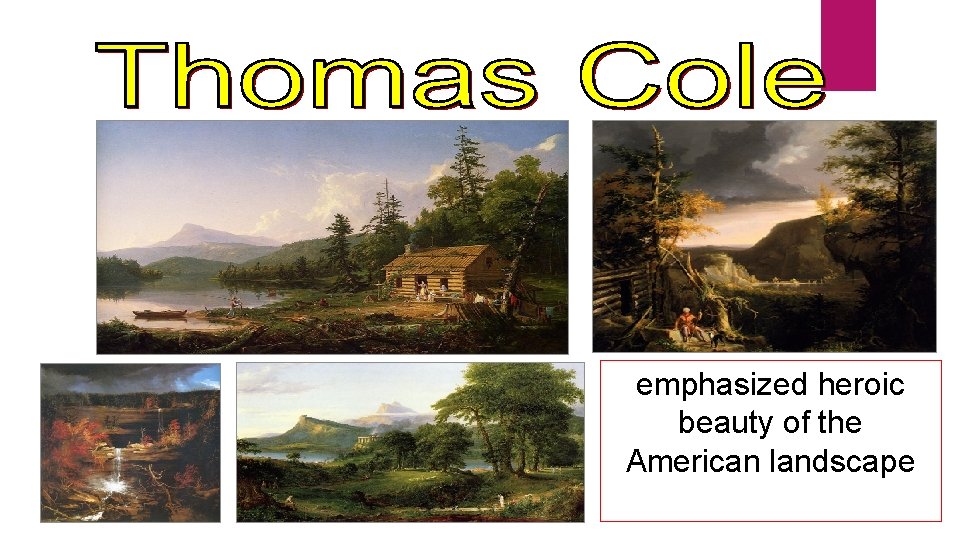
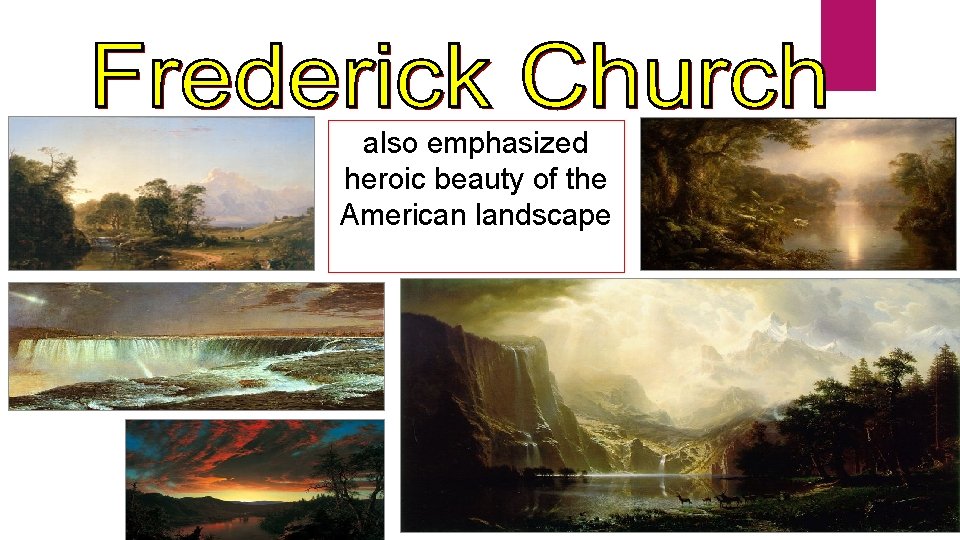
Arts and Literature: Painting The democratic and reforming impulses of the Age of Jackson expressed themselves in painting, architecture, and literature Genre painting – portraying everyday life of ordinary people – became the vogue of artists in the 1830 s George Caleb Bingham Hudson River School expressed the romantic age’s fascination with the natural world Thomas Cole and Frederick Church
emphasized heroic beauty of the American landscape
also emphasized heroic beauty of the American landscape
Arts and Literature: Architecture Inspired by the democracy of classical Athens, American architects adapted Greek styles to glorify the democratic spirit of the republic Columned facades like those of ancient Greek temples graced the entryways of public buildings, banks, hotels, and even some private homes
Arts and Literature: Writing In addition to the transcendentalist authors, other writers helped to create a literature that was distinctly American Partly as a result of the War of 1812, the American people became more nationalistic and eager to read works of American writers about American themes Washington Irving and James Fenimore Cooper wrote fiction using American settings Nathaniel Hawthorne questioned the intolerance and conformity in American life Herman Melville’s Moby Dick reflected theological and cultural conflicts of the era Important poets: Walt Whitman and Edgar Allen Poe
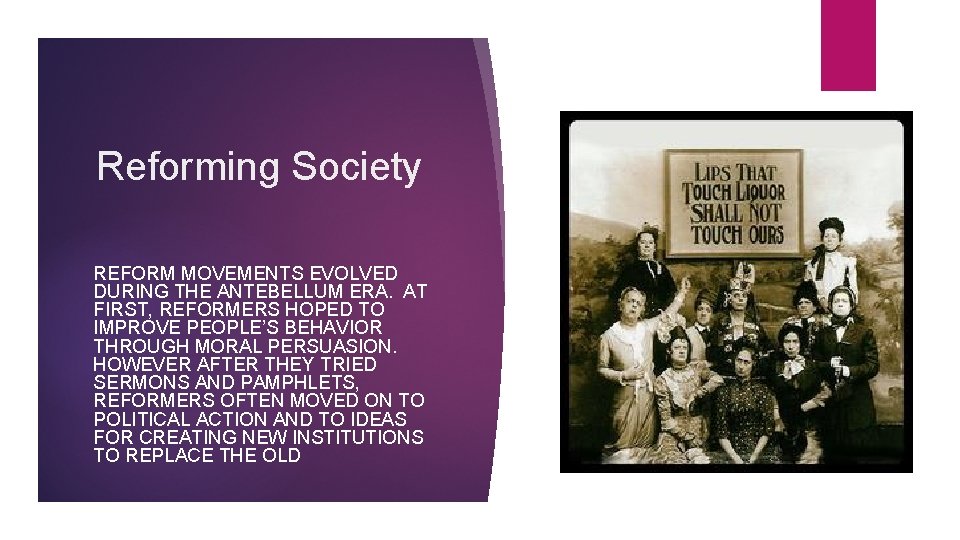
Reforming Society REFORM MOVEMENTS EVOLVED DURING THE ANTEBELLUM ERA. AT FIRST, REFORMERS HOPED TO IMPROVE PEOPLE’S BEHAVIOR THROUGH MORAL PERSUASION. HOWEVER AFTER THEY TRIED SERMONS AND PAMPHLETS, REFORMERS OFTEN MOVED ON TO POLITICAL ACTION AND TO IDEAS FOR CREATING NEW INSTITUTIONS TO REPLACE THE OLD
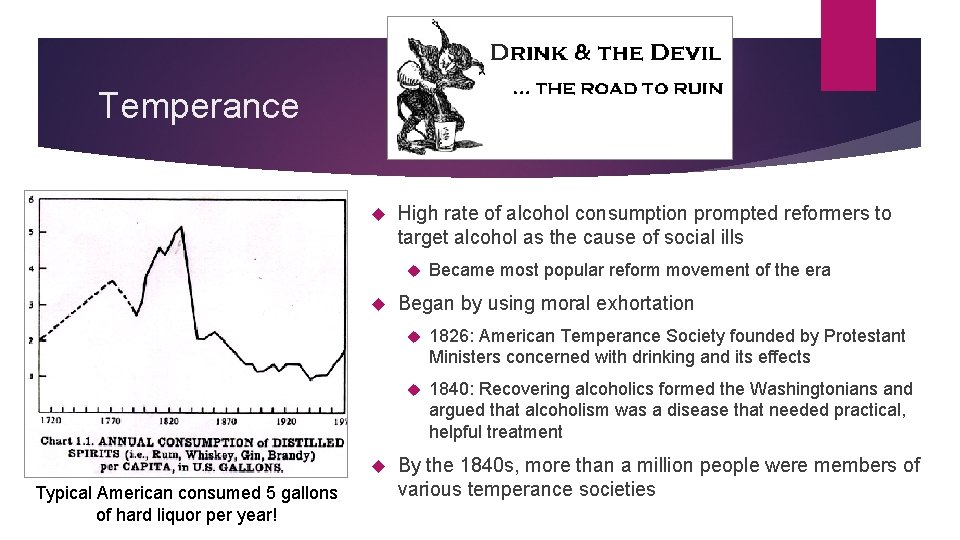
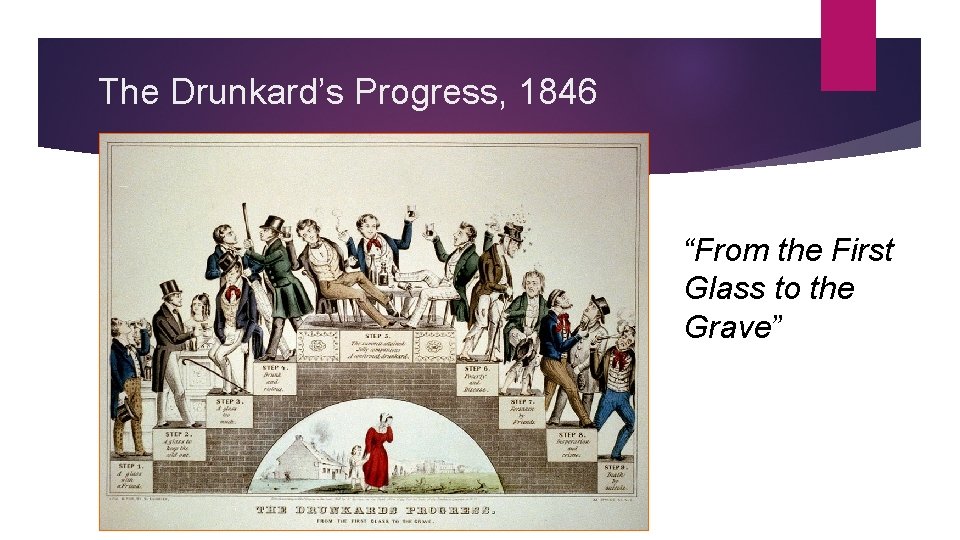
Temperance High rate of alcohol consumption prompted reformers to target alcohol as the cause of social ills Typical American consumed 5 gallons of hard liquor per year! Became most popular reform movement of the era Began by using moral exhortation 1826: American Temperance Society founded by Protestant Ministers concerned with drinking and its effects 1840: Recovering alcoholics formed the Washingtonians and argued that alcoholism was a disease that needed practical, helpful treatment By the 1840 s, more than a million people were members of various temperance societies
The Drunkard’s Progress, 1846 “From the First Glass to the Grave”
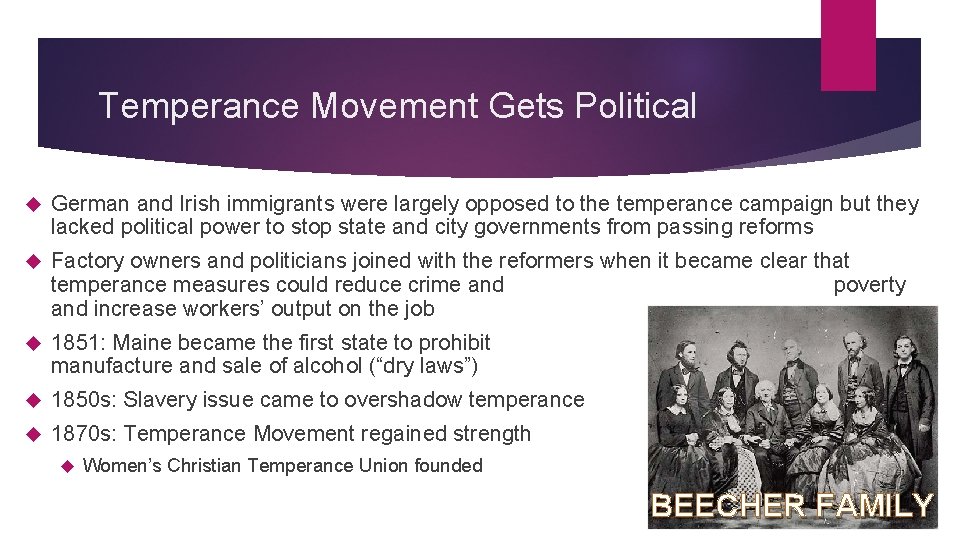
Temperance Movement Gets Political German and Irish immigrants were largely opposed to the temperance campaign but they lacked political power to stop state and city governments from passing reforms Factory owners and politicians joined with the reformers when it became clear that temperance measures could reduce crime and poverty and increase workers’ output on the job 1851: Maine became the first state to prohibit manufacture and sale of alcohol (“dry laws”) 1850 s: Slavery issue came to overshadow temperance 1870 s: Temperance Movement regained strength Women’s Christian Temperance Union founded BEECHER FAMILY
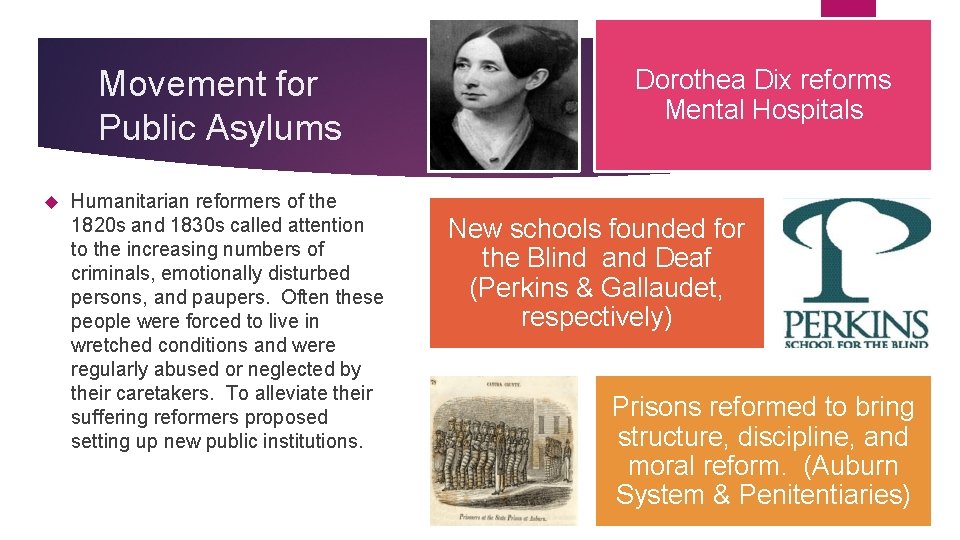
Movement for Public Asylums Humanitarian reformers of the 1820 s and 1830 s called attention to the increasing numbers of criminals, emotionally disturbed persons, and paupers. Often these people were forced to live in wretched conditions and were regularly abused or neglected by their caretakers. To alleviate their suffering reformers proposed setting up new public institutions. Dorothea Dix reforms Mental Hospitals New schools founded for the Blind and Deaf (Perkins & Gallaudet, respectively) Prisons reformed to bring structure, discipline, and moral reform. (Auburn System & Penitentiaries)
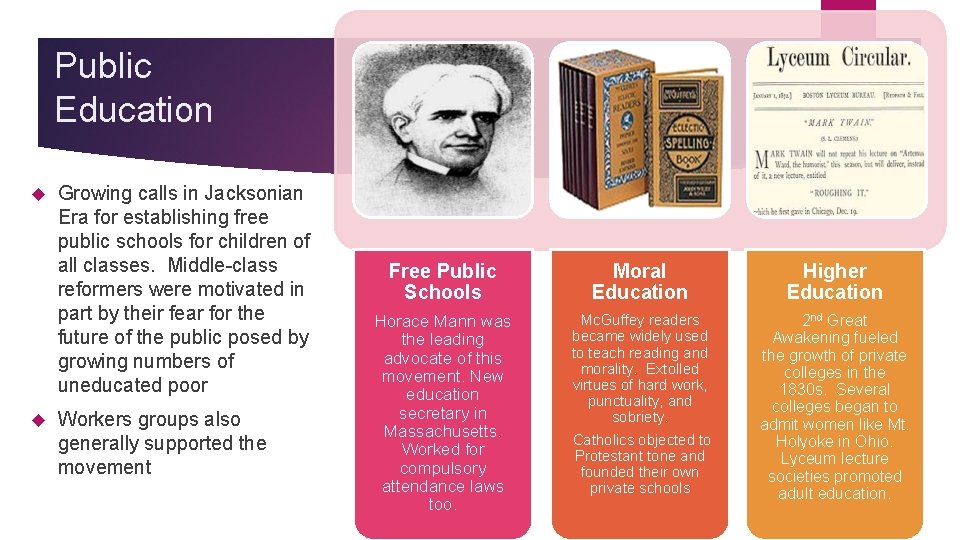
Public Education Growing calls in Jacksonian Era for establishing free public schools for children of all classes. Middle-class reformers were motivated in part by their fear for the future of the public posed by growing numbers of uneducated poor Workers groups also generally supported the movement Free Public Schools Moral Education Higher Education Horace Mann was the leading advocate of this movement. New education secretary in Massachusetts. Worked for compulsory attendance laws too. Mc. Guffey readers became widely used to teach reading and morality. Extolled virtues of hard work, punctuality, and sobriety. Catholics objected to Protestant tone and founded their own private schools 2 nd Great Awakening fueled the growth of private colleges in the 1830 s. Several colleges began to admit women like Mt. Holyoke in Ohio. Lyceum lecture societies promoted adult education.
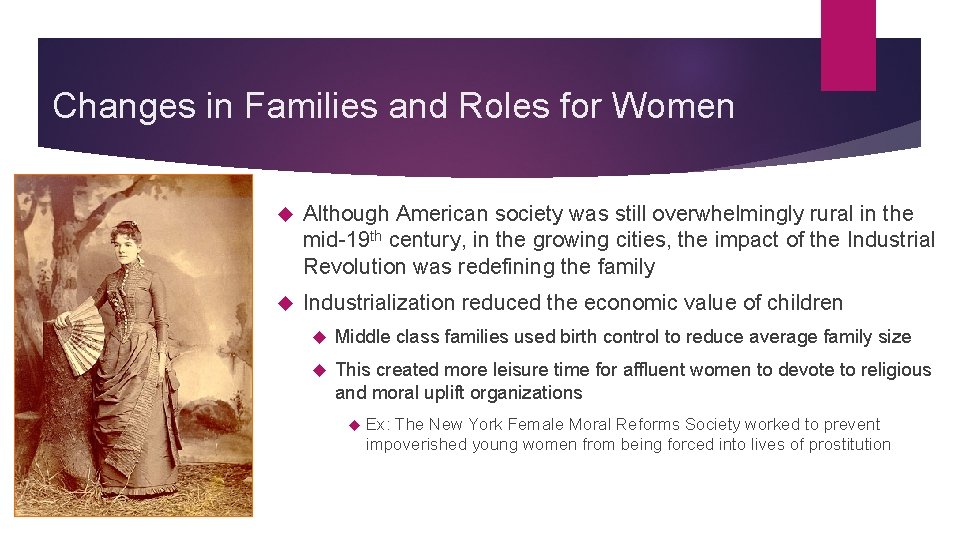
Changes in Families and Roles for Women Although American society was still overwhelmingly rural in the mid-19 th century, in the growing cities, the impact of the Industrial Revolution was redefining the family Industrialization reduced the economic value of children Middle class families used birth control to reduce average family size This created more leisure time for affluent women to devote to religious and moral uplift organizations Ex: The New York Female Moral Reforms Society worked to prevent impoverished young women from being forced into lives of prostitution
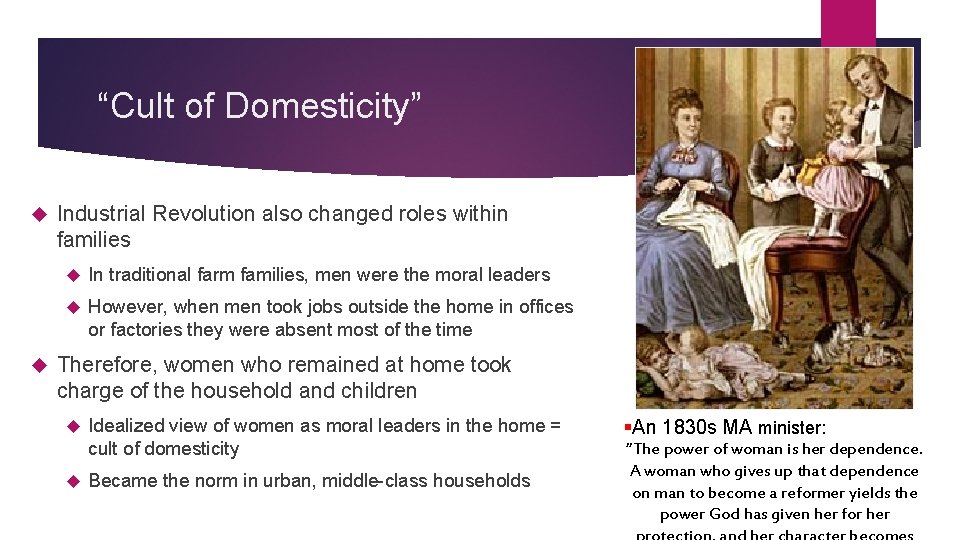
“Cult of Domesticity” Industrial Revolution also changed roles within families In traditional farm families, men were the moral leaders However, when men took jobs outside the home in offices or factories they were absent most of the time Therefore, women who remained at home took charge of the household and children Idealized view of women as moral leaders in the home = cult of domesticity Became the norm in urban, middle-class households §An 1830 s MA minister: “The power of woman is her dependence. A woman who gives up that dependence on man to become a reformer yields the power God has given her for her
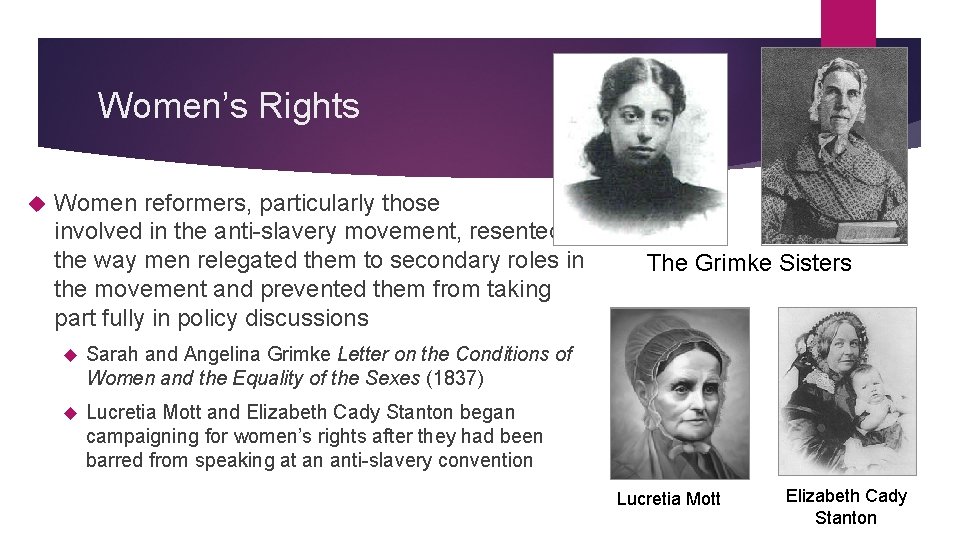
Women’s Rights Women reformers, particularly those involved in the anti-slavery movement, resented the way men relegated them to secondary roles in the movement and prevented them from taking part fully in policy discussions Sarah and Angelina Grimke Letter on the Conditions of Women and the Equality of the Sexes (1837) Lucretia Mott and Elizabeth Cady Stanton began campaigning for women’s rights after they had been barred from speaking at an anti-slavery convention The Grimke Sisters Lucretia Mott Elizabeth Cady Stanton
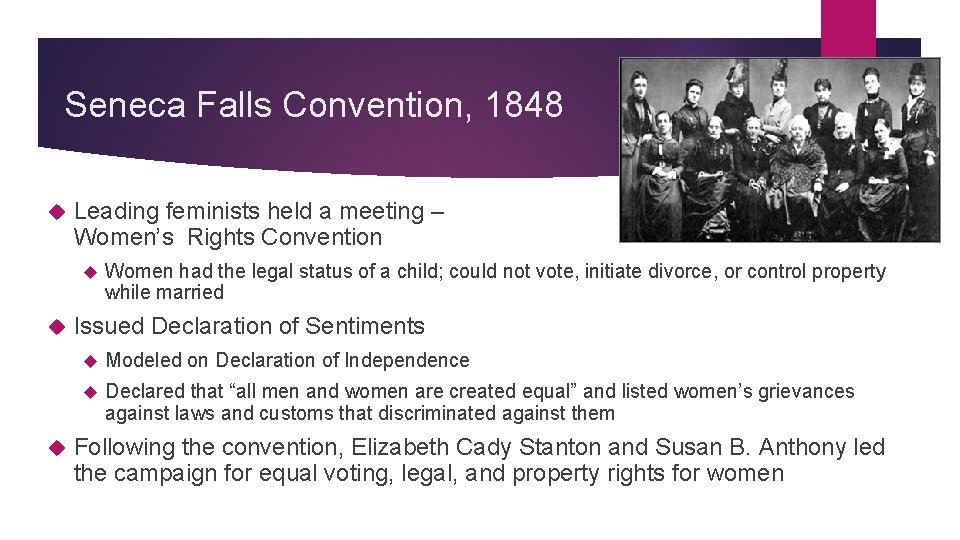
Seneca Falls Convention, 1848 Leading feminists held a meeting – Women’s Rights Convention 1 st Women had the legal status of a child; could not vote, initiate divorce, or control property while married Issued Declaration of Sentiments Modeled on Declaration of Independence Declared that “all men and women are created equal” and listed women’s grievances against laws and customs that discriminated against them Following the convention, Elizabeth Cady Stanton and Susan B. Anthony led the campaign for equal voting, legal, and property rights for women
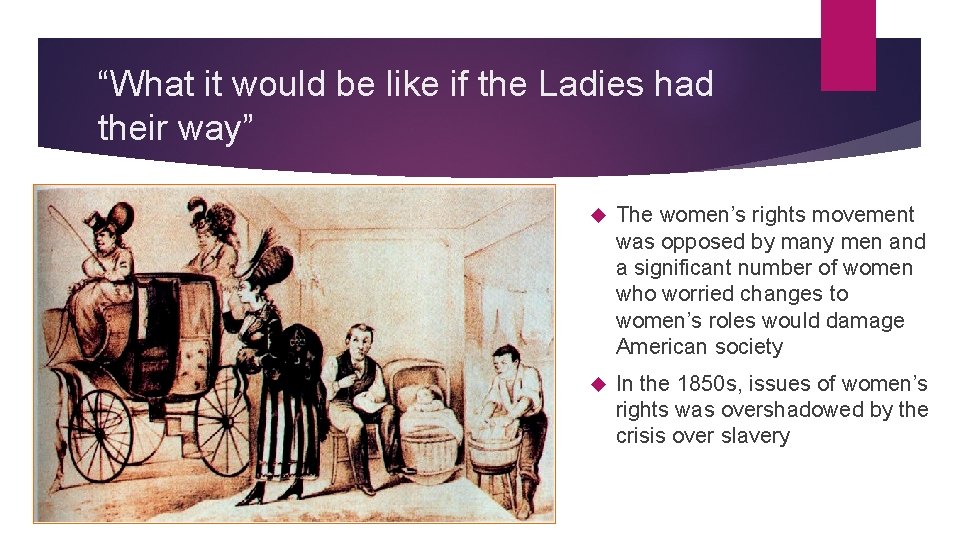
“What it would be like if the Ladies had their way” The women’s rights movement was opposed by many men and a significant number of women who worried changes to women’s roles would damage American society In the 1850 s, issues of women’s rights was overshadowed by the crisis over slavery
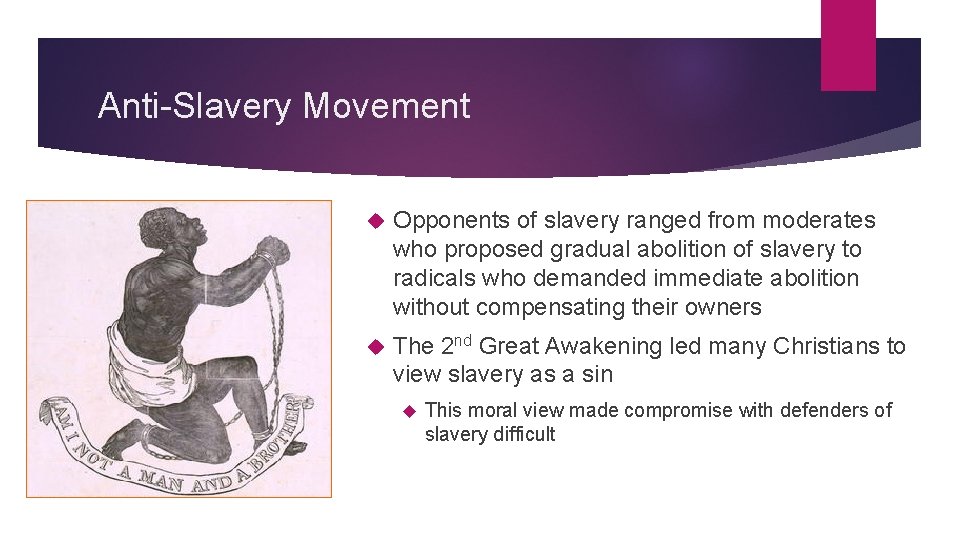
Anti-Slavery Movement Opponents of slavery ranged from moderates who proposed gradual abolition of slavery to radicals who demanded immediate abolition without compensating their owners The 2 nd Great Awakening led many Christians to view slavery as a sin This moral view made compromise with defenders of slavery difficult
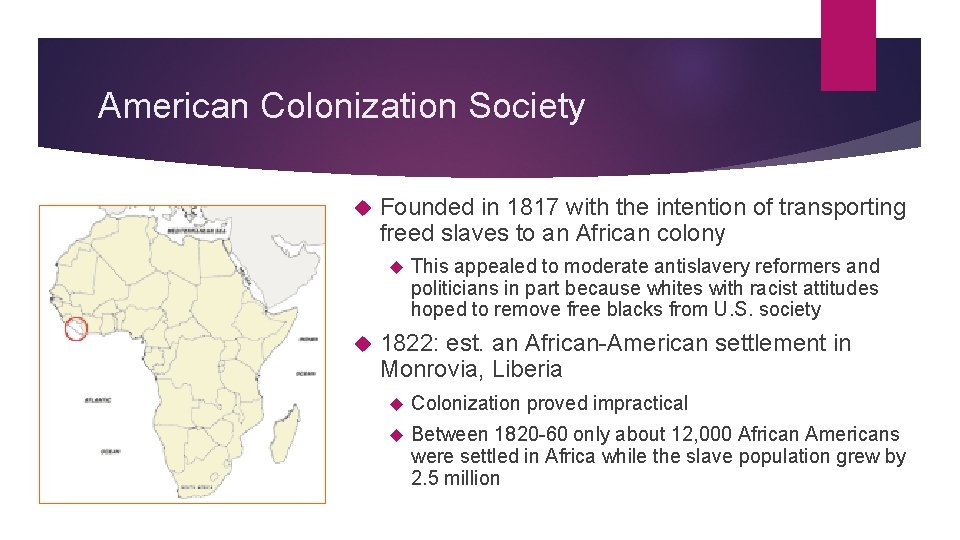
American Colonization Society Founded in 1817 with the intention of transporting freed slaves to an African colony This appealed to moderate antislavery reformers and politicians in part because whites with racist attitudes hoped to remove free blacks from U. S. society 1822: est. an African-American settlement in Monrovia, Liberia Colonization proved impractical Between 1820 -60 only about 12, 000 African Americans were settled in Africa while the slave population grew by 2. 5 million
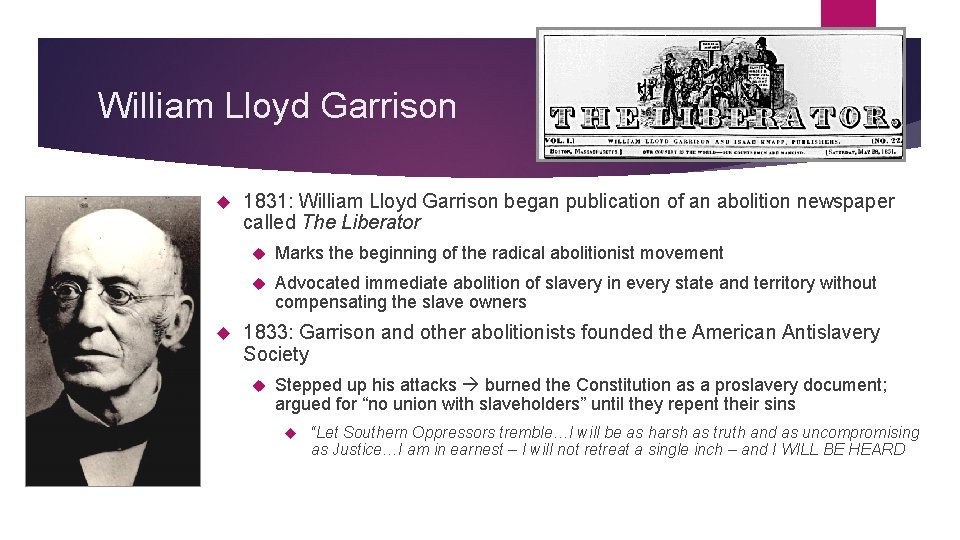
William Lloyd Garrison 1831: William Lloyd Garrison began publication of an abolition newspaper called The Liberator Marks the beginning of the radical abolitionist movement Advocated immediate abolition of slavery in every state and territory without compensating the slave owners 1833: Garrison and other abolitionists founded the American Antislavery Society Stepped up his attacks burned the Constitution as a proslavery document; argued for “no union with slaveholders” until they repent their sins “Let Southern Oppressors tremble…I will be as harsh as truth and as uncompromising as Justice…I am in earnest – I will not retreat a single inch – and I WILL BE HEARD
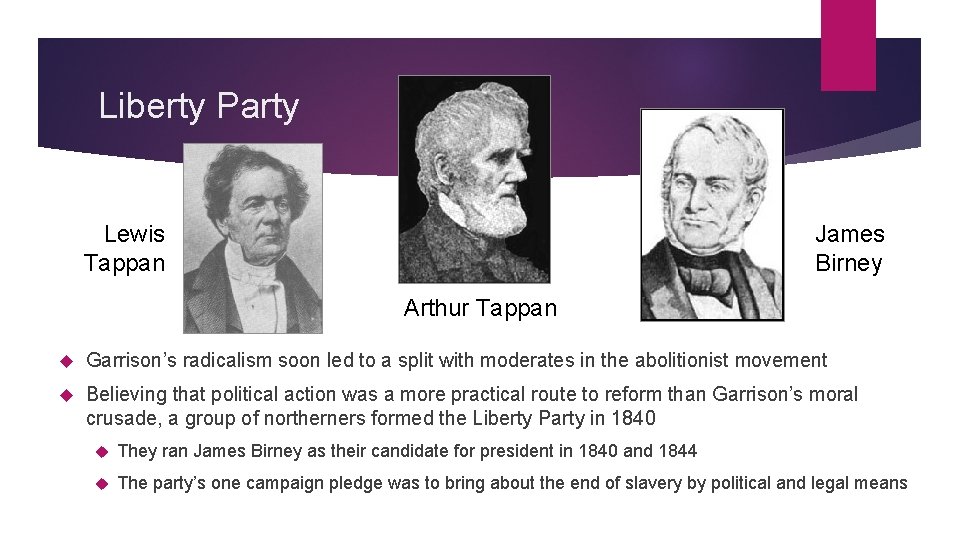
Liberty Party James Birney Lewis Tappan Arthur Tappan Garrison’s radicalism soon led to a split with moderates in the abolitionist movement Believing that political action was a more practical route to reform than Garrison’s moral crusade, a group of northerners formed the Liberty Party in 1840 They ran James Birney as their candidate for president in 1840 and 1844 The party’s one campaign pledge was to bring about the end of slavery by political and legal means
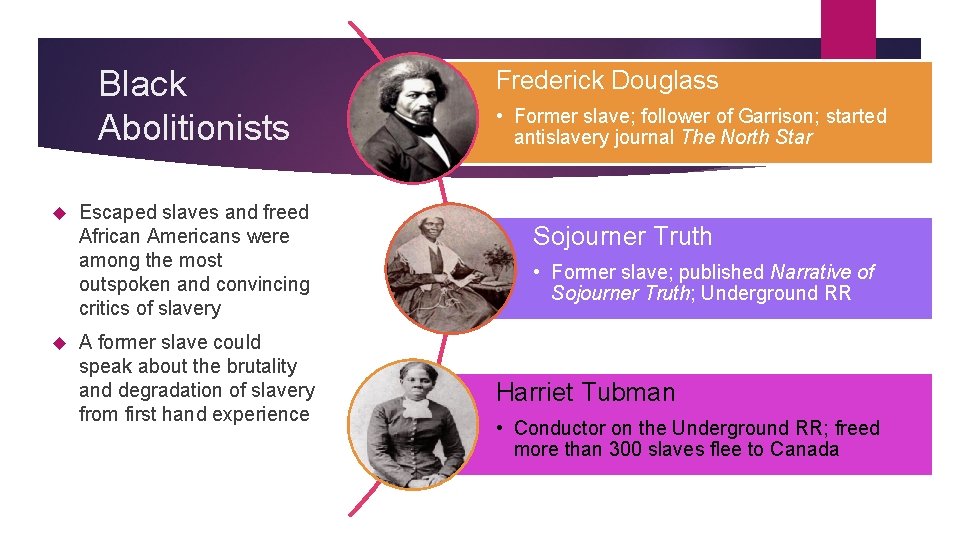
Black Abolitionists Escaped slaves and freed African Americans were among the most outspoken and convincing critics of slavery A former slave could speak about the brutality and degradation of slavery from first hand experience Frederick Douglass • Former slave; follower of Garrison; started antislavery journal The North Star Sojourner Truth • Former slave; published Narrative of Sojourner Truth; Underground RR Harriet Tubman • Conductor on the Underground RR; freed more than 300 slaves flee to Canada
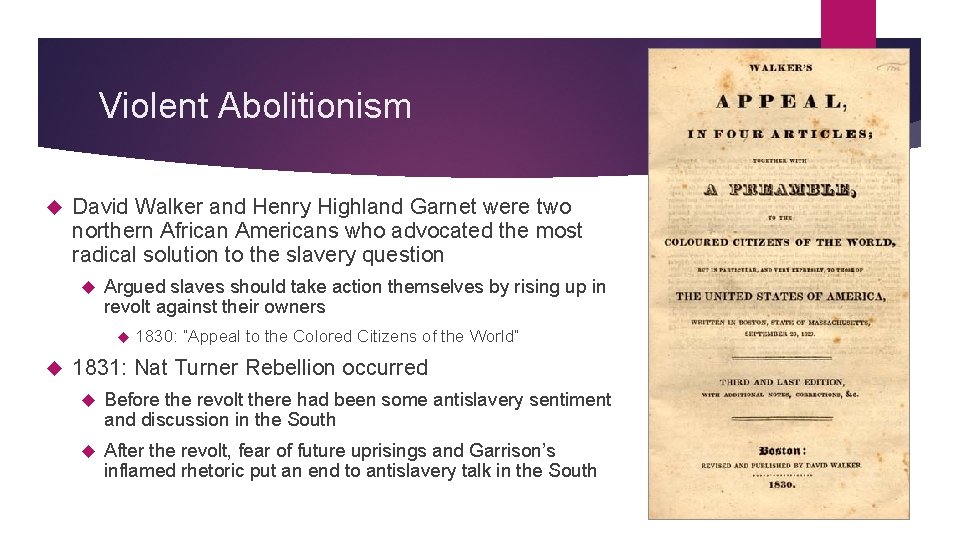
Violent Abolitionism David Walker and Henry Highland Garnet were two northern African Americans who advocated the most radical solution to the slavery question Argued slaves should take action themselves by rising up in revolt against their owners 1830: “Appeal to the Colored Citizens of the World” 1831: Nat Turner Rebellion occurred Before the revolt there had been some antislavery sentiment and discussion in the South After the revolt, fear of future uprisings and Garrison’s inflamed rhetoric put an end to antislavery talk in the South
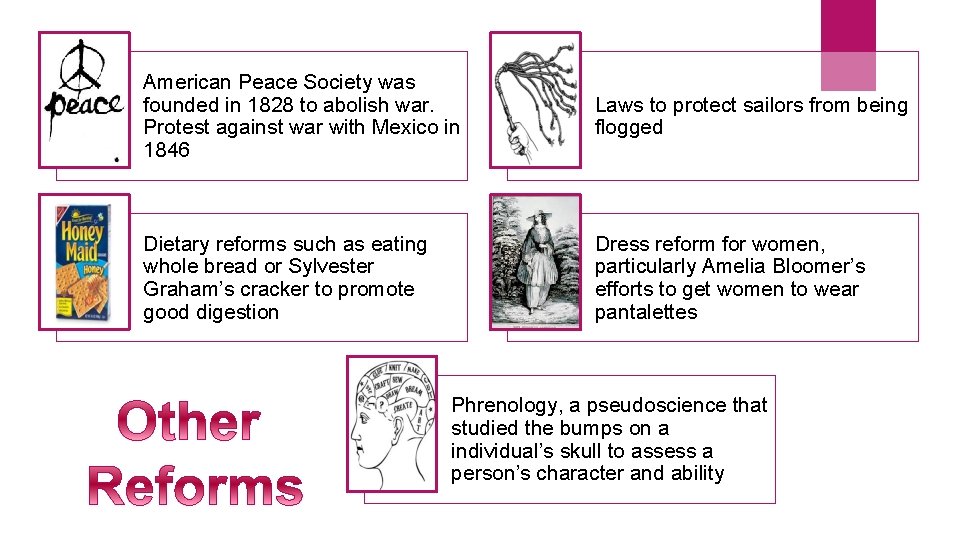
American Peace Society was founded in 1828 to abolish war. Protest against war with Mexico in 1846 Laws to protect sailors from being flogged Dietary reforms such as eating whole bread or Sylvester Graham’s cracker to promote good digestion Dress reform for women, particularly Amelia Bloomer’s efforts to get women to wear pantalettes Phrenology, a pseudoscience that studied the bumps on a individual’s skull to assess a person’s character and ability
Southern Reaction to Reform The antebellum reform movement was largely found in the northern and western states with little impact in the South While “modernizers” worked to perfect society in the North, southerners were more committed to tradition and slow to support public education and humanitarian reforms They were alarmed to see northern reformers join forces to support antislavery movements Increasingly Southerners viewed social reform as a northern threat against the southern way of life