
AUGMENTED REALITY Arthur Lockman Ethan Prihar Phil Baumann

AUGMENTED REALITY Arthur Lockman, Ethan Prihar, Phil Baumann, Robert Mc. Kenna
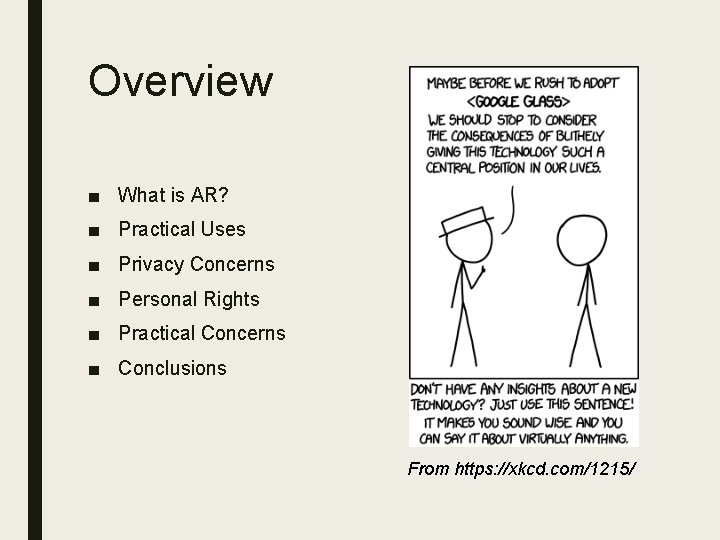
Overview ■ What is AR? ■ Practical Uses ■ Privacy Concerns ■ Personal Rights ■ Practical Concerns ■ Conclusions From https: //xkcd. com/1215/
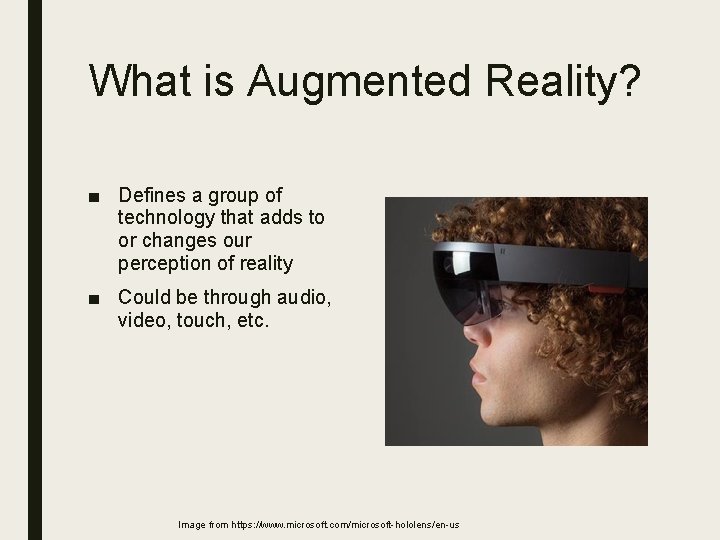
What is Augmented Reality? ■ Defines a group of technology that adds to or changes our perception of reality ■ Could be through audio, video, touch, etc. Image from https: //www. microsoft. com/microsoft-hololens/en-us
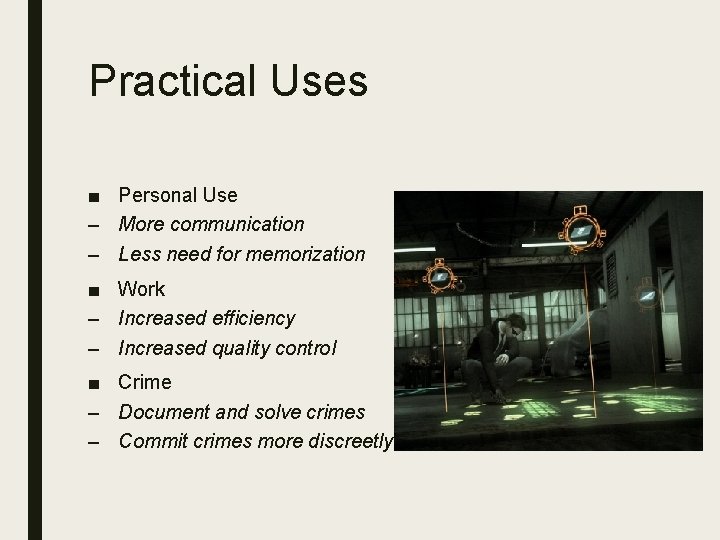
Practical Uses ■ Personal Use – More communication – Less need for memorization ■ Work – Increased efficiency – Increased quality control ■ Crime – Document and solve crimes – Commit crimes more discreetly
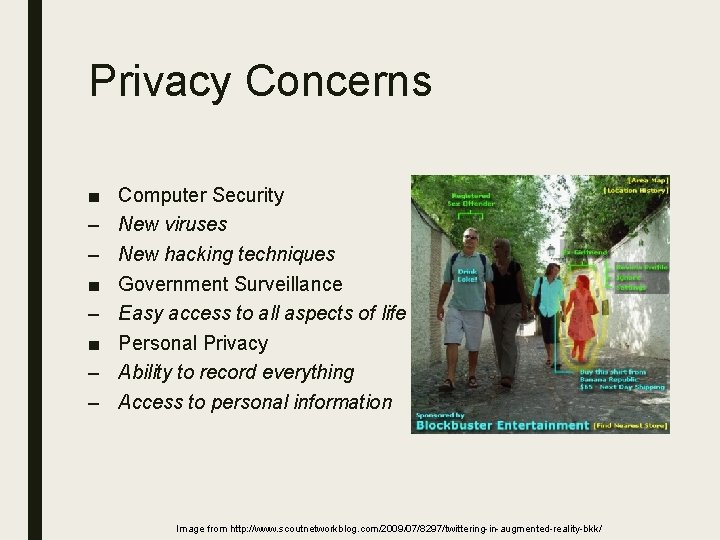
Privacy Concerns ■ – – Computer Security New viruses New hacking techniques Government Surveillance Easy access to all aspects of life Personal Privacy Ability to record everything Access to personal information Image from http: //www. scoutnetworkblog. com/2009/07/8297/twittering-in-augmented-reality-bkk/
Freedom of Speech ■ With the Integration of AR in society, freedom of speech could be limited. – The NSA has been known to track individual’s social habits on Facebook. [2] – Integration of AR opens a new means in which a government can monitor speech. – If this were to become a norm, individuals may have to censor themselves for fear of who may be watching.

Personal Rights ■ AR integration may also help protect personal rights – Contextual data may become a popular new form of sharing experiences. – Real Time data sharing would increase between users. – Using Location tracking technology, Real time, contextual data and news can allow for a new level of information sharing.
Professional Ethics ■ Employee Privacy – Companies have been known to monitor data on equipment used by Employees[ 3]. – This includes email, word documents, and cellular exchanges. – Company owned AR may allow companies to view what the user is viewing.
Practical Concerns ■ Software Reliability – AR headsets run software that could show incorrect objects in a user’s view – Would require extremely vigorous testing ■ Intellectual Property – AR headsets usually have cameras – Companies may be uncomfortable with employees wearing headsets around sensitive projects [1]
Conclusion ■ 1 -5 years – Low rate of adoption – in development – Used primarily for entertainment ■ – – – 7 years+ Large rates of adoption Divergent views of reality Decreased privacy Targeted to replace smartphones/tablets [6] Enormous market, $150 billion [6]

References ■ [1] Condliffe, Jamie. "Google Glass Is Now Banned From Movie Theaters Across the U. S. " Gizmodo, 30 Oct. 2014. Web. 22 Apr. 2015. <http: //gizmodo. com/google-glass-is-nowbanned-from-movie-theaters-across-t-1652672187>. ■ [2] Simpson, David, and Pamela Brown. "NSA Mines Facebook, including Americans' Profiles - CNN. com. " CNN. Cable News Network, 30 Sept. 2013. Web. 23 Apr. 2015. <http: //www. cnn. com/2013/09/30/us/nsa-social-networks/>. ■ [3] Derene, Glenn. “Is Your Boss Spying on You? Inside New Workplace Surveillance. ” Popular Mechanics. N. p. , n. d. Web. 20 Apr. 2015 ■ [4] "Mobile Technology Fact Sheet. " Pew Research Centers Internet American Life Project RSS. Pew Research Center, 27 Dec. 2013. Web. 23 Apr. 2015. ■ [5] Lee, Kevin. "Coming Soon: Augmented Reality Goggles for Crime Scene Investigations. " Tech. Hive. N. p. , 1 Feb. 2012. Web. 23 Apr. 2015. ■ [6] Gaudiosi, John. "How Augmented Reality and Virtual Reality Will Generate $150 Billion in Revenue By 2020. " How Augmented Reality and Virtual Reality Will Generate 150 Billion in Revenue By 2020 Comments. Fortune, 25 Apr. 2015. Web. 26 Apr. 2015. <http: //fortune. com/2015/04/25/augmented-reality-virtual-reality/>.
- Slides: 11