Annex E Comprehensive Condom Programs Strategic Operational Plan

- Slides: 19
Annex E: Comprehensive Condom Programs Strategic Operational Plan Template Prepared by Mann Global Health to accompany other strategic operational plan guidance developed with funding from the Bill & Melinda Gates Foundation March 2020
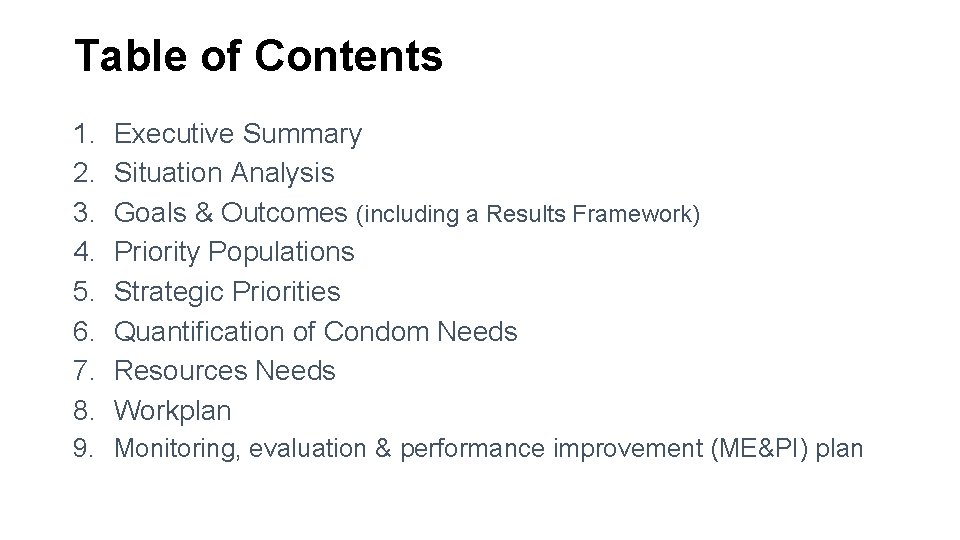
Table of Contents 1. 2. 3. 4. 5. 6. 7. 8. Executive Summary Situation Analysis Goals & Outcomes (including a Results Framework) Priority Populations Strategic Priorities Quantification of Condom Needs Resources Needs Workplan 9. Monitoring, evaluation & performance improvement (ME&PI) plan
1. Executive Summary 1 page or 2 slides • Rationale: Why is a Strategic Operational Plan for condoms needed now and how does it fit into the country’s broader health plans? • Brief description of the planning process • Summarize: o High-level goals o Strategic priorities and the key barriers and constraints they address o Resource needs
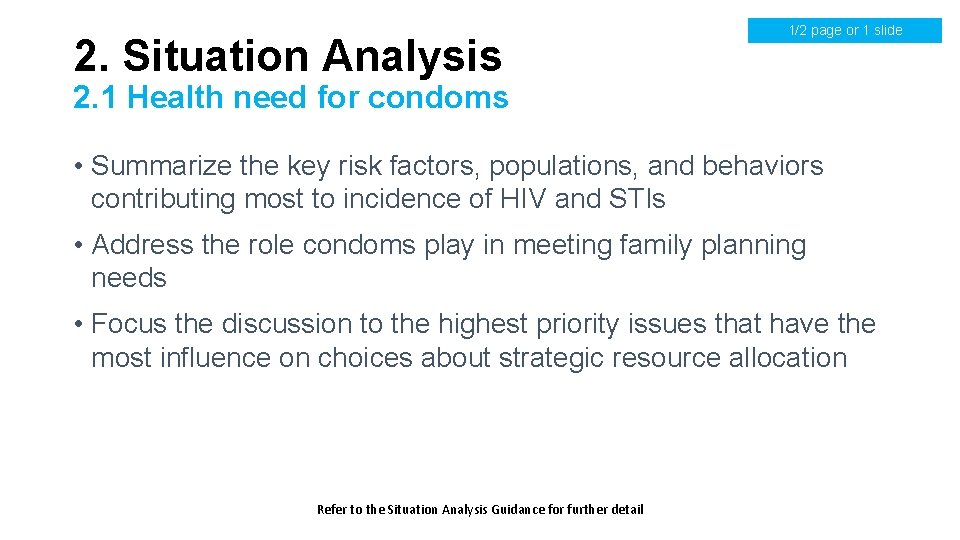
2. Situation Analysis 1/2 page or 1 slide 2. 1 Health need for condoms • Summarize the key risk factors, populations, and behaviors contributing most to incidence of HIV and STIs • Address the role condoms play in meeting family planning needs • Focus the discussion to the highest priority issues that have the most influence on choices about strategic resource allocation Refer to the Situation Analysis Guidance for further detail
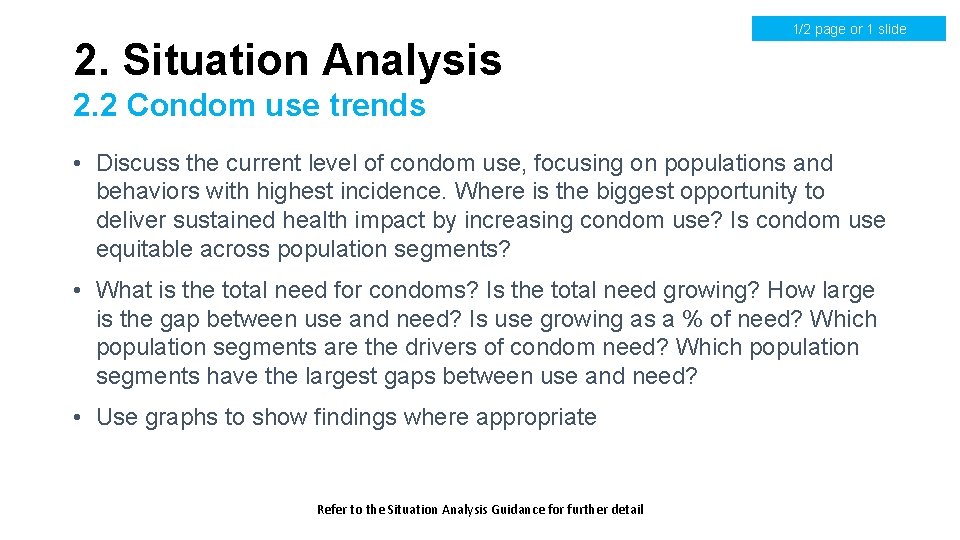
2. Situation Analysis 1/2 page or 1 slide 2. 2 Condom use trends • Discuss the current level of condom use, focusing on populations and behaviors with highest incidence. Where is the biggest opportunity to deliver sustained health impact by increasing condom use? Is condom use equitable across population segments? • What is the total need for condoms? Is the total need growing? How large is the gap between use and need? Is use growing as a % of need? Which population segments are the drivers of condom need? Which population segments have the largest gaps between use and need? • Use graphs to show findings where appropriate Refer to the Situation Analysis Guidance for further detail
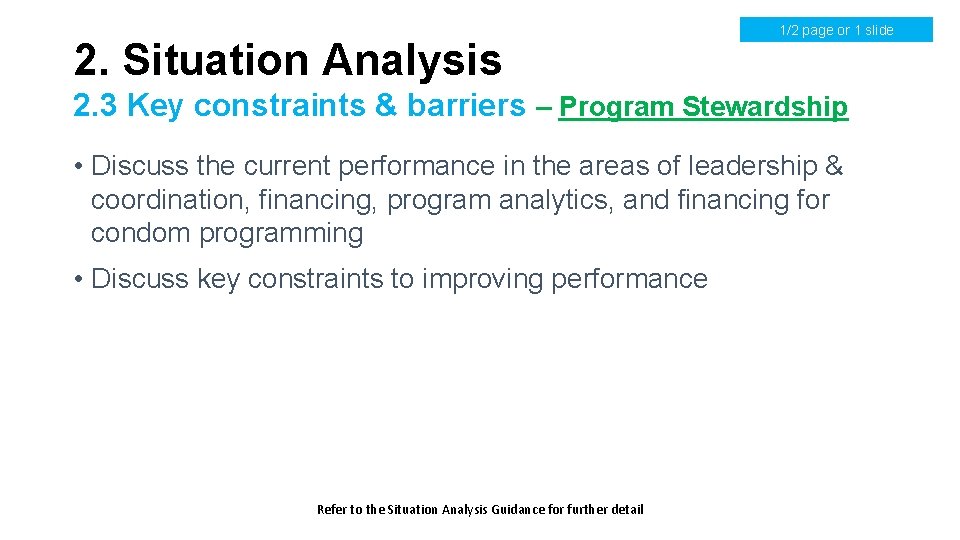
2. Situation Analysis 1/2 page or 1 slide 2. 3 Key constraints & barriers – Program Stewardship • Discuss the current performance in the areas of leadership & coordination, financing, program analytics, and financing for condom programming • Discuss key constraints to improving performance Refer to the Situation Analysis Guidance for further detail
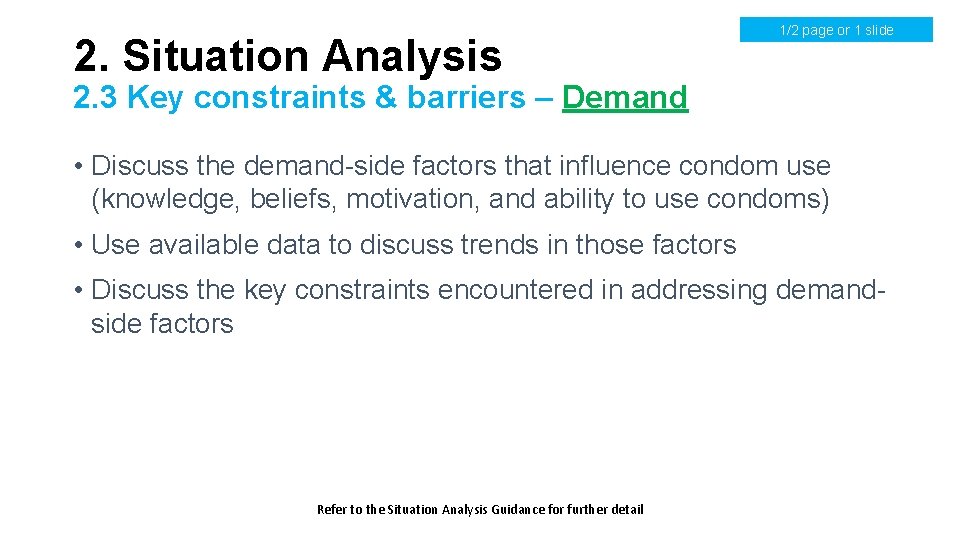
2. Situation Analysis 1/2 page or 1 slide 2. 3 Key constraints & barriers – Demand • Discuss the demand-side factors that influence condom use (knowledge, beliefs, motivation, and ability to use condoms) • Use available data to discuss trends in those factors • Discuss the key constraints encountered in addressing demandside factors Refer to the Situation Analysis Guidance for further detail
2. Situation Analysis 1 page or 2 slides 2. 3 Key constraints & barriers – Supply • Discuss the supply-side factors that influence access to and availability of condoms • Use available data on quantities distributed, distribution channels, social marketing sales, and commercial sales • Discuss the key constraints encountered in addressing supplyside factors Refer to the Situation Analysis Guidance for further detail
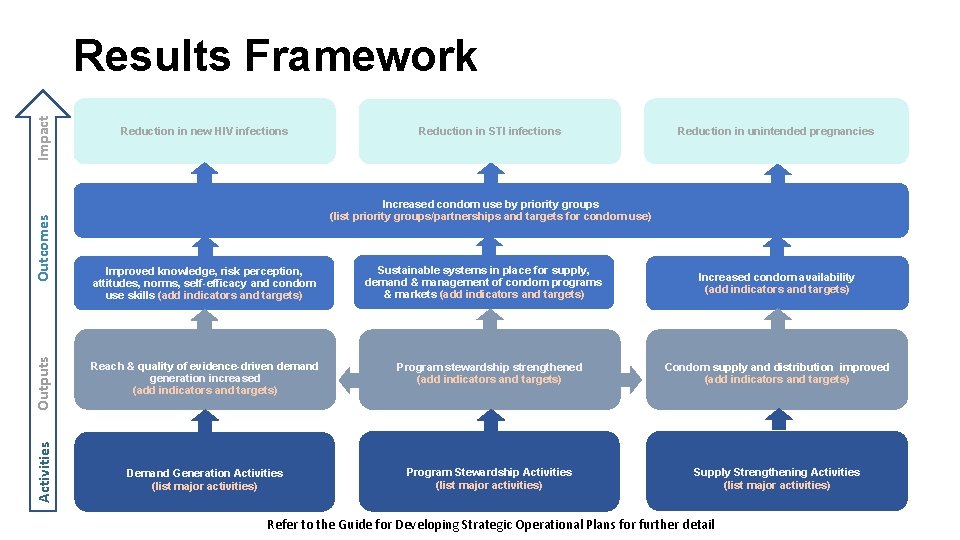
3. Goals & outcomes 1 page or 2 slides plus the Results Framework • Provide a narrative summary of the key goals and outcomes of the plan • The narrative should explain the logic of the Results Framework • Complete the Results Framework (see next slide) drawing on standard indicators from the ME&PI plan guidance Refer to the Guide for Developing Strategic Operational Plans for further detail
Activities Outputs Outcomes Impact Results Framework Reduction in new HIV infections Reduction in STI infections Reduction in unintended pregnancies Increased condom use by priority groups (list priority groups/partnerships and targets for condom use) Improved knowledge, risk perception, attitudes, norms, self-efficacy and condom use skills (add indicators and targets) Sustainable systems in place for supply, demand & management of condom programs & markets (add indicators and targets) Increased condom availability (add indicators and targets) Reach & quality of evidence-driven demand generation increased (add indicators and targets) Program stewardship strengthened (add indicators and targets) Condom supply and distribution improved (add indicators and targets) Demand Generation Activities (list major activities) Program Stewardship Activities (list major activities) Supply Strengthening Activities (list major activities) Refer to the Guide for Developing Strategic Operational Plans for further detail
4. Priority Populations 1 page or 1 slide • Discuss the prioritization of populations within the context of the plan (e. g. , factors such as HIV or STI incidence, size of the population, and current levels of condom use) • Explain the rationale to focus resources on a few priority populations (i. e. , not all populations can be priorities) Refer to the Guide for Developing Strategic Operational Plans for further detail
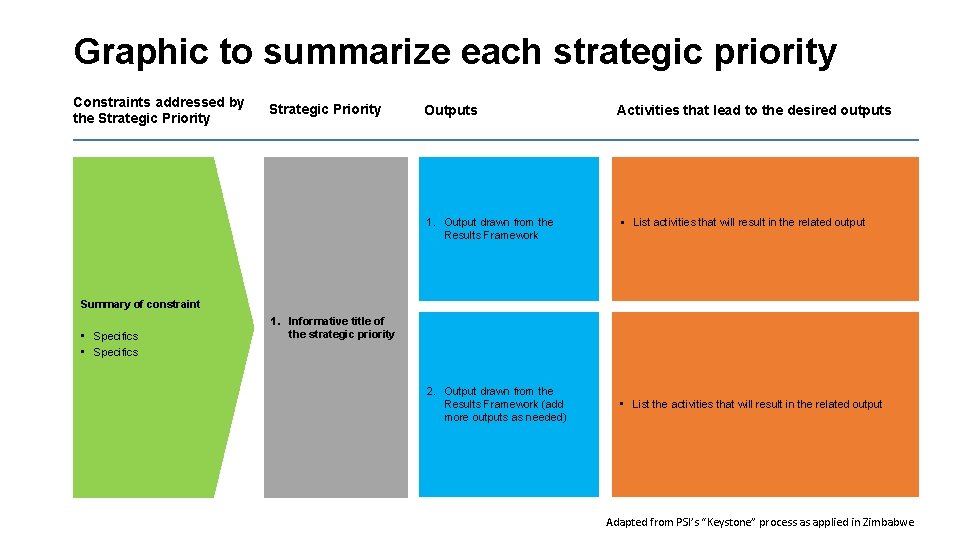
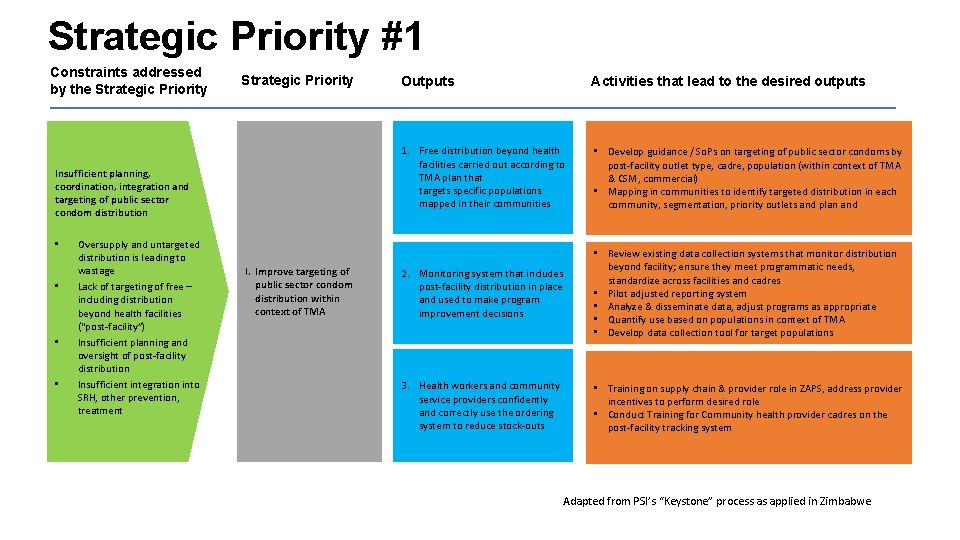
5. Strategic Priorities 1 page or 1 slide per Strategic Priority • Describe each strategic priority separately (4 to 5 total) • Include the key constraints and barriers to sustainable condom use that the priority addresses (i. e. , the rationale for the strategic priority) • Include the measurable objectives and outputs for each strategic priority • Include a high-level list of activities to achieve the objective • Refer to the next two slides for an illustrative example of summarizing a strategic priority Refer to the Guide for Developing Strategic Operational Plans for further detail
Graphic to summarize each strategic priority Constraints addressed by the Strategic Priority Outputs Activities that lead to the desired outputs 1. Output drawn from the Results Framework § List activities that will result in the related output Summary of constraint • Specifics 1. Informative title of the strategic priority 2. Output drawn from the Results Framework (add more outputs as needed) • List the activities that will result in the related output Adapted from PSI’s “Keystone” process as applied in Zimbabwe
Strategic Priority #1 Constraints addressed by the Strategic Priority Insufficient planning, coordination, integration and targeting of public sector condom distribution • • Oversupply and untargeted distribution is leading to wastage Lack of targeting of free – including distribution beyond health facilities (“post-facility”) Insufficient planning and oversight of post-facility distribution Insufficient integration into SRH, other prevention, treatment I. Improve targeting of public sector condom distribution within context of TMA Outputs Activities that lead to the desired outputs 1. Free distribution beyond health facilities carried out according to TMA plan that targets specific populations mapped in their communities • Develop guidance / So. Ps on targeting of public sector condoms by post-facility outlet type, cadre, population (within context of TMA & CSM, commercial) • Mapping in communities to identify targeted distribution in each community, segmentation, priority outlets and plan and 2. Monitoring system that includes post-facility distribution in place and used to make program improvement decisions • Review existing data collection systems that monitor distribution beyond facility; ensure they meet programmatic needs, standardize across facilities and cadres • Pilot adjusted reporting system • Analyze & disseminate data, adjust programs as appropriate • Quantify use based on populations in context of TMA • Develop data collection tool for target populations 3. Health workers and community service providers confidently and correctly use the ordering system to reduce stock-outs • Training on supply chain & provider role in ZAPS, address provider incentives to perform desired role • Conduct Training for Community health provider cadres on the post-facility tracking system Adapted from PSI’s “Keystone” process as applied in Zimbabwe
6. Quantification of Condom Needs 1 page or 1 slide per Strategic Priority • Present the outputs from the Condom Needs Estimation Tool • Base the estimation on the Results Framework (i. e. , use the tool to calculate condom needs based on targeted changes in condom use – NOT on meeting full theoretical need) • Graphs may be helpful here (the Tool will produce some automatically) For further guidance: https: //hivpreventioncoalition. unaids. org/resource/condom-needs-and-resource-requirement-estimation-tool/
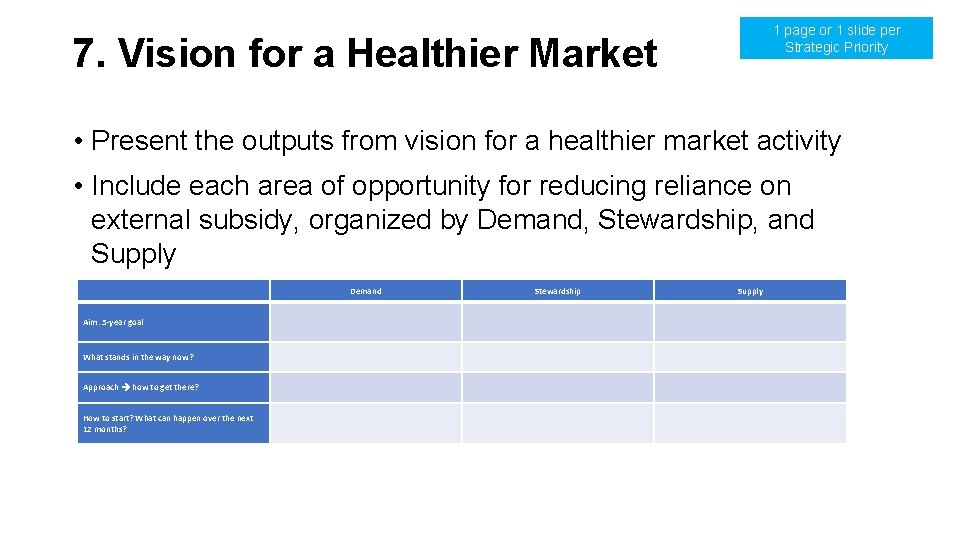
1 page or 1 slide per Strategic Priority 7. Vision for a Healthier Market • Present the outputs from vision for a healthier market activity • Include each area of opportunity for reducing reliance on external subsidy, organized by Demand, Stewardship, and Supply Demand Stewardship Supply Aim: 5 -year goal What stands in the way now? Approach how to get there? How to start? What can happen over the next 12 months?
8. Resource Needs 1/2 page or 1 slide Available resources & estimated needs • Discuss the resources needed to implement the plan • Present the total resources needed by year for each strategic initiative • Present the resources separated by the key areas of: Program Stewardship, Demand, and Supply • Discuss the resources currently available and plans to mobilize further resources (including domestic resources) Refer to the Guide for Developing Strategic Operational Plans for further detail
9. Workplan • Present the workplan for the strategy • Include major milestones • Assign responsibilities for major activities • Can be an annex in table format Separate Table
10. ME & PI Plan 1/2 page or 1 slide • Discuss the routine systems and surveys that will be used to collect, analyze, and report progress toward the plan’s activities, outputs, outcomes, and goals • Describe how the M&E data will be used for performance improvement (PI) Refer to the Guide for Developing Strategic Operational Plans for further detail