
IMPLEMENTIN G STRATEGIES MANAGEMEN T AND OPERATIONS ISSUES
- Slides: 26
IMPLEMENTIN G STRATEGIES: MANAGEMEN T AND OPERATIONS ISSUES Chapter Seven Copyright © 2015 Pearson Education, Inc 7 -1
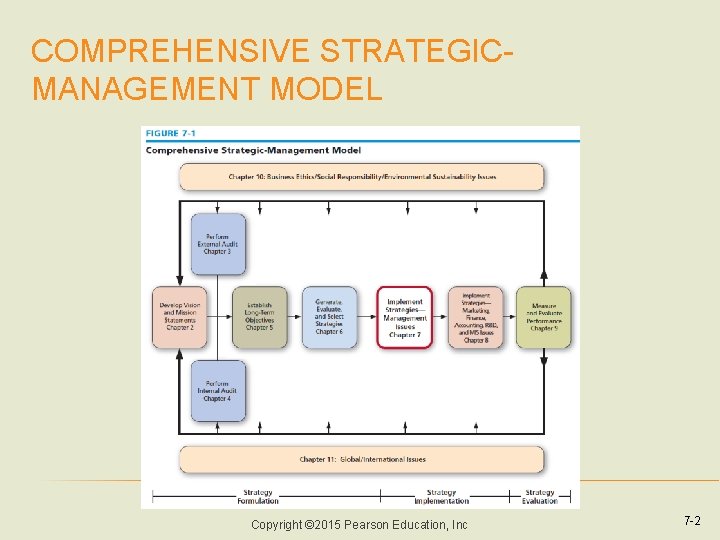
COMPREHENSIVE STRATEGICMANAGEMENT MODEL Copyright © 2015 Pearson Education, Inc 7 -2
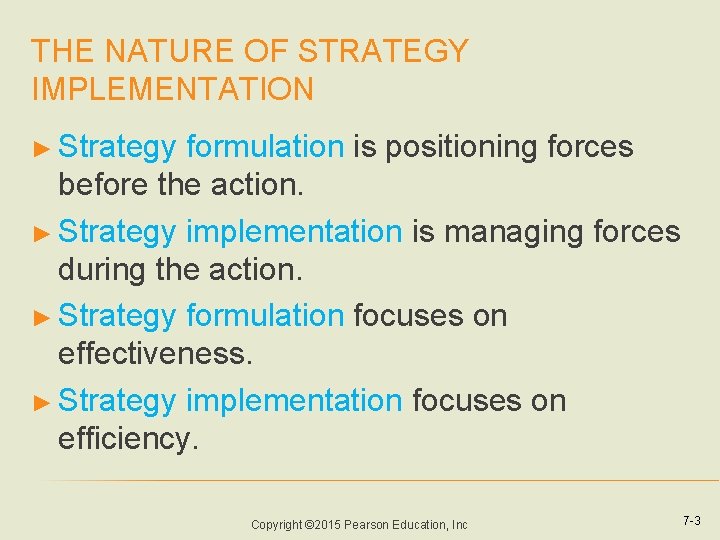
THE NATURE OF STRATEGY IMPLEMENTATION ► Strategy formulation is positioning forces before the action. ► Strategy implementation is managing forces during the action. ► Strategy formulation focuses on effectiveness. ► Strategy implementation focuses on efficiency. Copyright © 2015 Pearson Education, Inc 7 -3
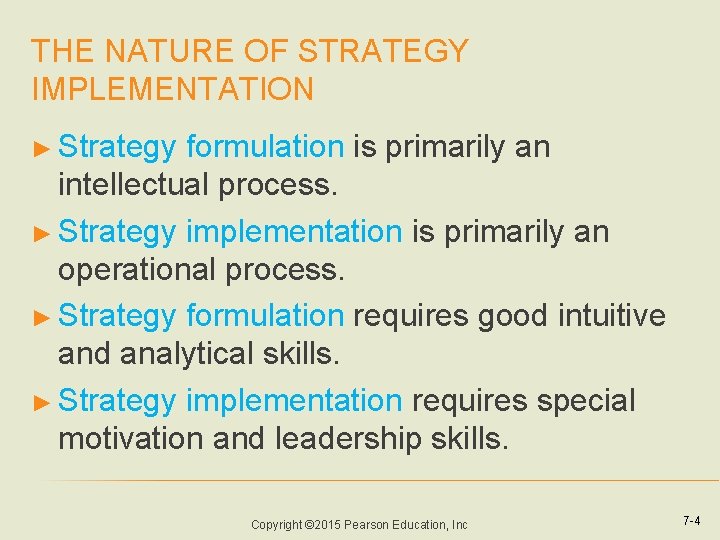
THE NATURE OF STRATEGY IMPLEMENTATION ► Strategy formulation is primarily an intellectual process. ► Strategy implementation is primarily an operational process. ► Strategy formulation requires good intuitive and analytical skills. ► Strategy implementation requires special motivation and leadership skills. Copyright © 2015 Pearson Education, Inc 7 -4
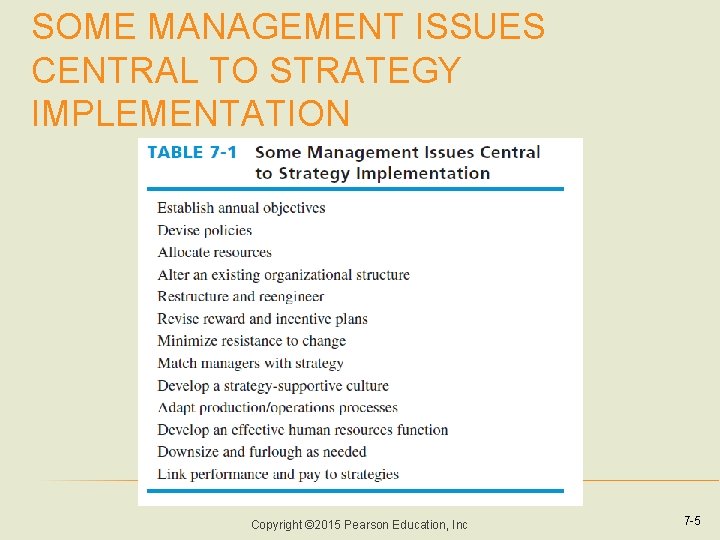
SOME MANAGEMENT ISSUES CENTRAL TO STRATEGY IMPLEMENTATION Copyright © 2015 Pearson Education, Inc 7 -5
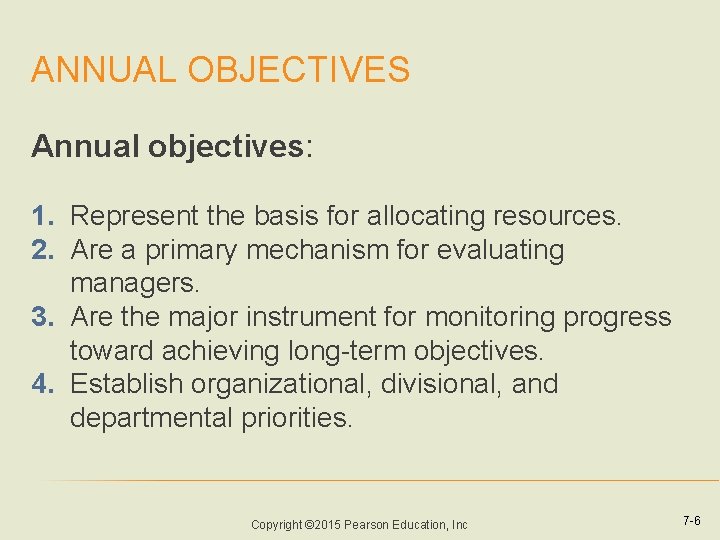
ANNUAL OBJECTIVES Annual objectives: 1. Represent the basis for allocating resources. 2. Are a primary mechanism for evaluating managers. 3. Are the major instrument for monitoring progress toward achieving long-term objectives. 4. Establish organizational, divisional, and departmental priorities. Copyright © 2015 Pearson Education, Inc 7 -6
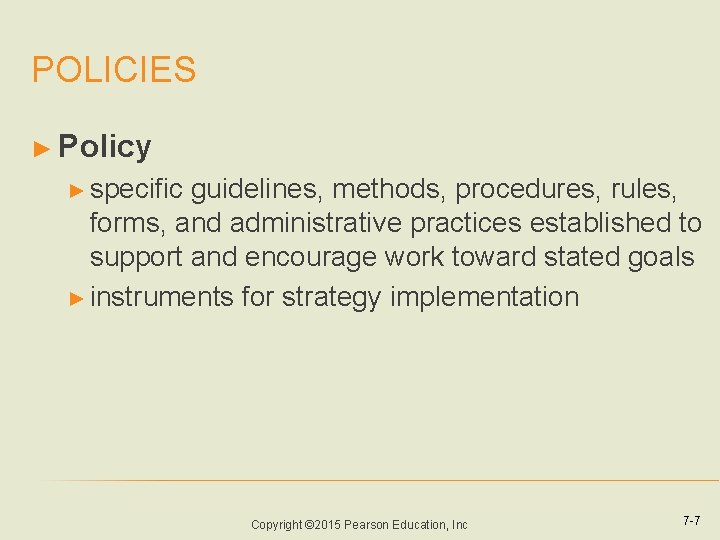
POLICIES ► Policy ► specific guidelines, methods, procedures, rules, forms, and administrative practices established to support and encourage work toward stated goals ► instruments for strategy implementation Copyright © 2015 Pearson Education, Inc 7 -7
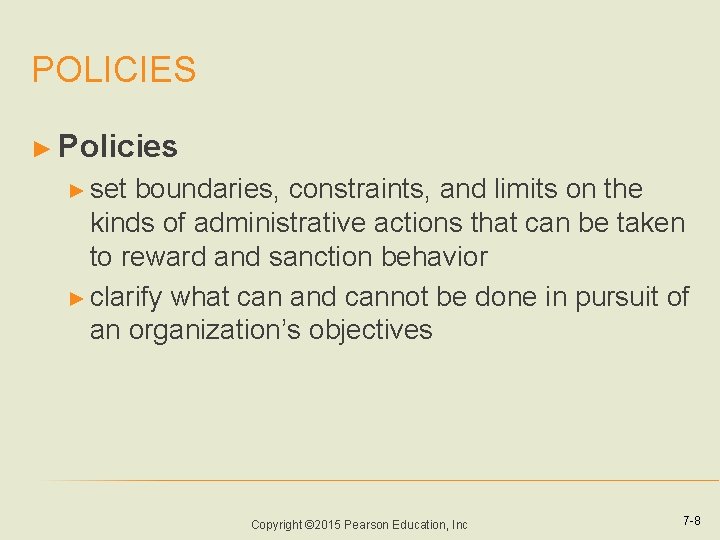
POLICIES ► Policies ► set boundaries, constraints, and limits on the kinds of administrative actions that can be taken to reward and sanction behavior ► clarify what can and cannot be done in pursuit of an organization’s objectives Copyright © 2015 Pearson Education, Inc 7 -8
RESOURCE ALLOCATION ► Resource allocation ► central management activity that allows for strategy execution ► often based on political or personal factors ► Strategic management enables resources to be allocated according to priorities established by annual objectives Copyright © 2015 Pearson Education, Inc 7 -9
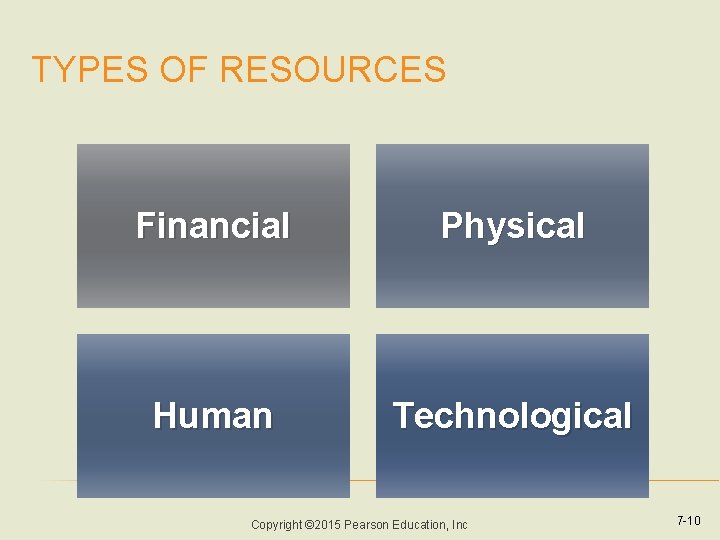
TYPES OF RESOURCES Financial Physical Human Technological Copyright © 2015 Pearson Education, Inc 7 -10
MATCHING STRUCTURE WITH STRATEGY ► Structure largely dictates how objectives and policies will be established ► Structure dictates how resources will be allocated Copyright © 2015 Pearson Education, Inc 7 -11
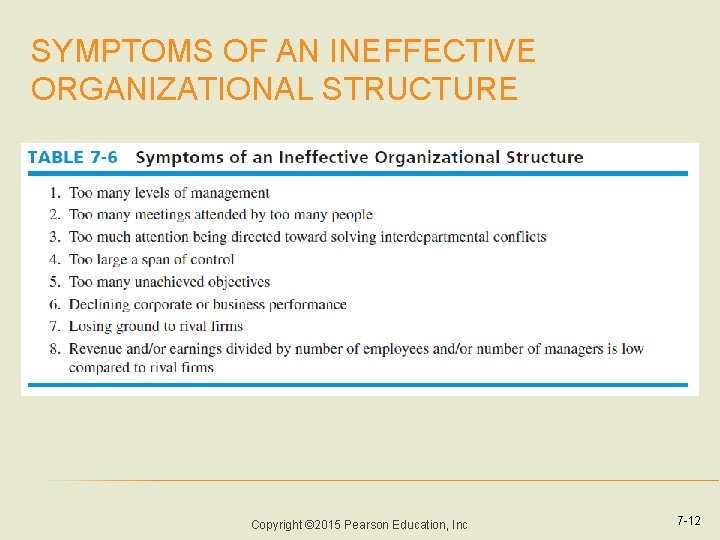
SYMPTOMS OF AN INEFFECTIVE ORGANIZATIONAL STRUCTURE Copyright © 2015 Pearson Education, Inc 7 -12
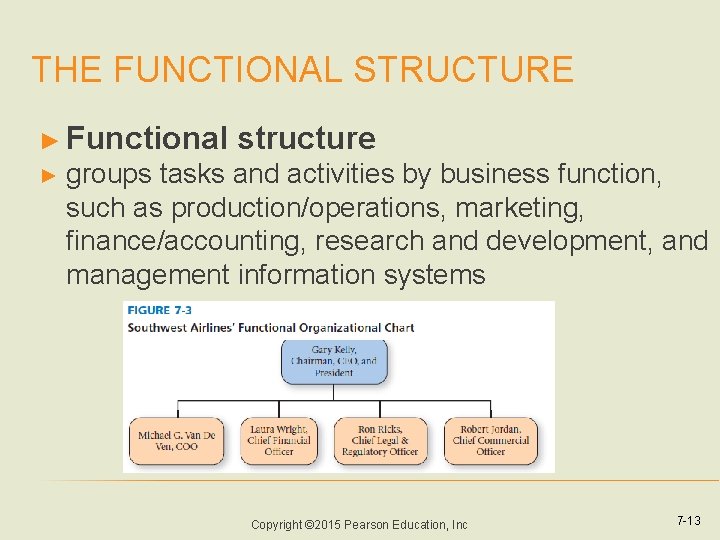
THE FUNCTIONAL STRUCTURE ► Functional ► structure groups tasks and activities by business function, such as production/operations, marketing, finance/accounting, research and development, and management information systems Copyright © 2015 Pearson Education, Inc 7 -13
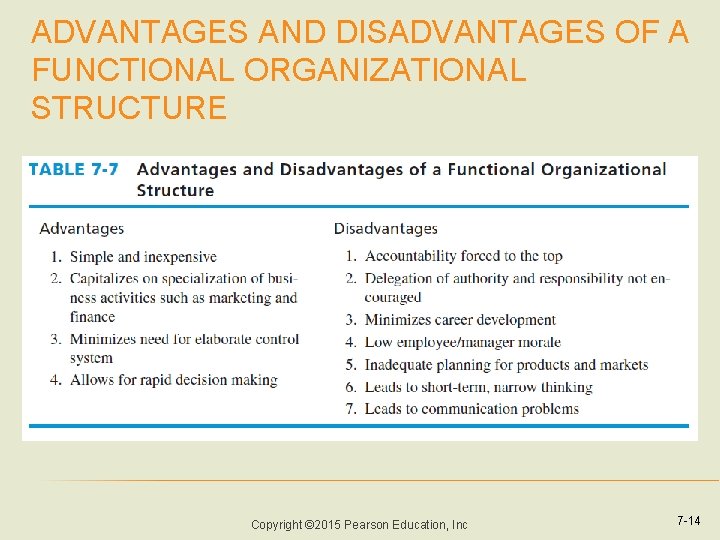
ADVANTAGES AND DISADVANTAGES OF A FUNCTIONAL ORGANIZATIONAL STRUCTURE Copyright © 2015 Pearson Education, Inc 7 -14
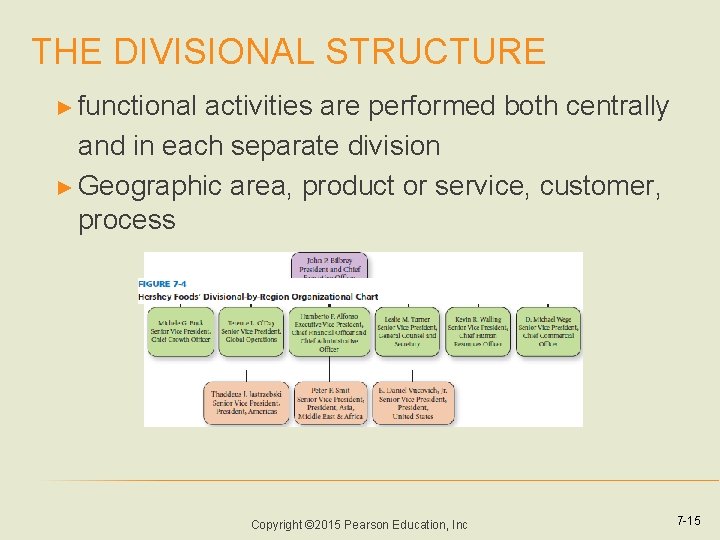
THE DIVISIONAL STRUCTURE ► functional activities are performed both centrally and in each separate division ► Geographic area, product or service, customer, process Copyright © 2015 Pearson Education, Inc 7 -15
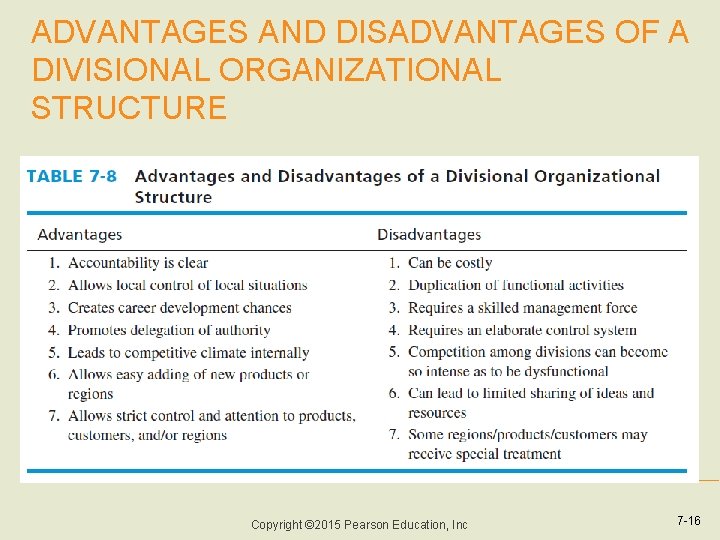
ADVANTAGES AND DISADVANTAGES OF A DIVISIONAL ORGANIZATIONAL STRUCTURE Copyright © 2015 Pearson Education, Inc 7 -16
THE STRATEGIC BUSINESS UNIT (SBU) STRUCTURE ► SBU structure ► groups similar divisions into strategic business units and delegates authority and responsibility for each unit to a senior executive who reports directly to the chief executive officer ► can facilitate strategy implementation by improving coordination between similar divisions and channeling accountability to distinct business units Copyright © 2015 Pearson Education, Inc 7 -17
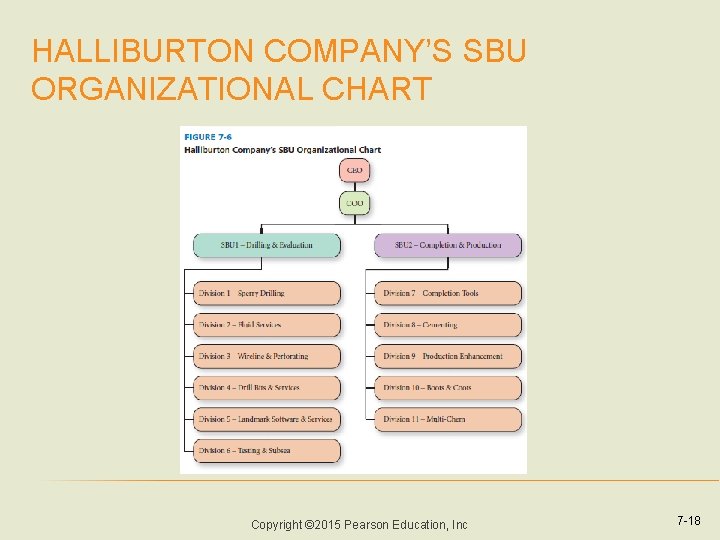
HALLIBURTON COMPANY’S SBU ORGANIZATIONAL CHART Copyright © 2015 Pearson Education, Inc 7 -18
THE MATRIX STRUCTURE ► Matrix structure ► most complex of all designs because it depends upon both vertical and horizontal flows of authority and communication Copyright © 2015 Pearson Education, Inc 7 -19
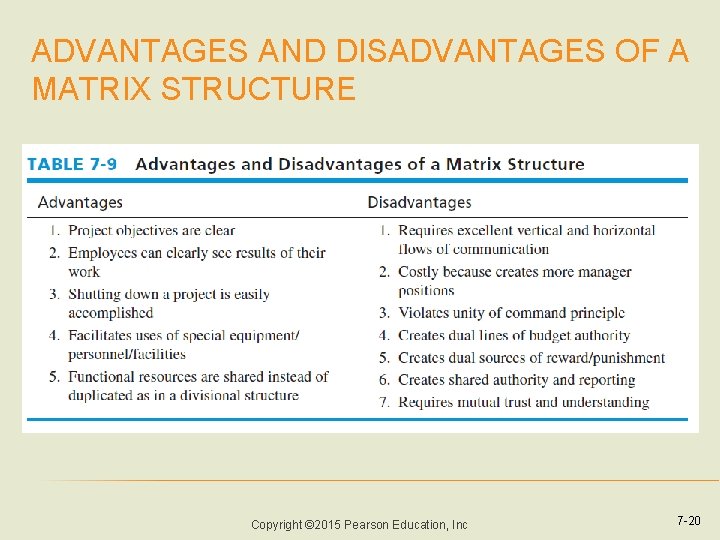
ADVANTAGES AND DISADVANTAGES OF A MATRIX STRUCTURE Copyright © 2015 Pearson Education, Inc 7 -20
RESTRUCTURING ► Restructuring ► involves reducing the size of the firm in terms of number of employees, number of divisions or units, and number of hierarchical levels in the firm’s organizational structure ► also called downsizing, rightsizing, or delayering Copyright © 2015 Pearson Education, Inc 7 -21
REENGINEERING ► Reengineering ► involves reconfiguring or redesigning work, jobs, and processes for the purpose of improving cost, quality, service, and speed ► also called process management, process innovation, or process redesign Copyright © 2015 Pearson Education, Inc 7 -22
MANAGING RESISTANCE TO CHANGE ► Force change strategy ► involves giving orders and enforcing those orders ► Educative change strategy ► one that presents information to convince people of the need for change ► Self-interest change strategy ► one that attempts to convince individuals that the change is to their personal advantage Copyright © 2015 Pearson Education, Inc 7 -23
CREATING A STRATEGY-SUPPORTIVE CULTURE 1. Formal statements of organizational philosophy, charters, creeds, materials used for recruitment and selection, and socialization 2. Designing of physical spaces, facades, buildings 3. Deliberate role modeling, teaching, and coaching by leaders 4. Explicit reward and status system, promotion criteria 5. Stories, legends, myths, and parables about key people and events Copyright © 2015 Pearson Education, Inc 7 -24
CREATING A STRATEGY-SUPPORTIVE CULTURE 6. What leaders pay attention to, measure, and control 7. Leader reactions to critical incidents and organizational crises 8. How the organization is designed and structured 9. Organizational systems and procedures 10. Criteria used for recruitment, selection, promotion, leveling off, retirement, and “excommunication” of people Copyright © 2015 Pearson Education, Inc 7 -25
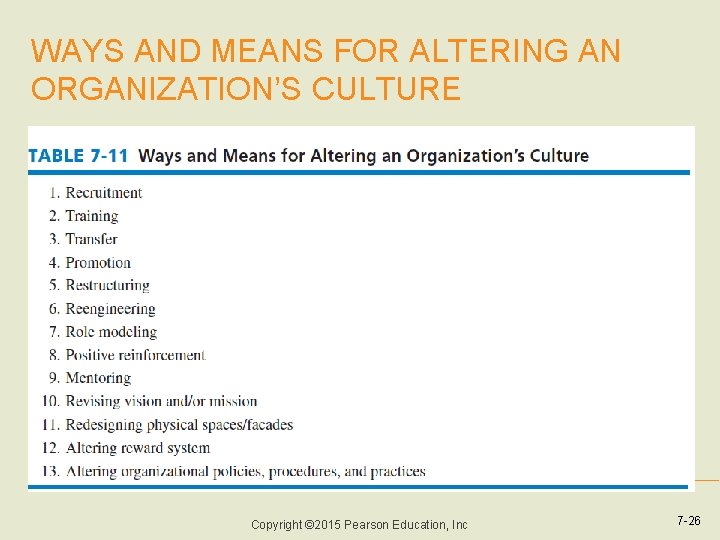
WAYS AND MEANS FOR ALTERING AN ORGANIZATION’S CULTURE Copyright © 2015 Pearson Education, Inc 7 -26