All dolphins and whales are grouped together in








- Slides: 10
• All dolphins and whales are grouped together in the scientific order Cecacea. • This large order of approximately 80 living species is divided into three suborders: the toothed whales or Odontoceti (killer whales, dolphins, porpoises, beluga whales, narwhals, beaked whales, and sperm whales). • The baleen whales or Mysticeti (blue whales, humpback whales, gray whales, and right whales). • The Archaeoceti (a group of fossil whales, now extinct).
• Next to humans, killer whales are the most widely distributed mammal. • Killer whales inhabit all oceans of the world but are most numerous in the Arctic, the Antarctic, and areas of cold water. • In addition to cold water areas, killer whales also have been seen in warm water areas such as Hawaii, Australia, the Galapagos Islands, the Bahamas, and the Gulf of Mexico.
• Killer whales have an acute sense of hearing, and the auditory cortex of the brain is well developed. • The average hearing range for humans is about 0. 02 to 17 k. Hz, but killer whales have responded to tones within the frequency range of about 0. 5 to 125 k. Hz. • High frequency sounds in the range of 50 k. Hz and above appear to be received effectively by the lower jaw. • Most sound reception, or hearing, probably takes place through the lower jaw.
• Fishes, squids, seals, sea lions, walruses, birds, sea turtles, otters, penguins, polar bears, reptiles, and even a moose have all been found in the stomach of killer whales. • In the Antarctic, killer whales eat about 67% fishes, 27% marine mammals, and 6% squids. • Adult killer whales eat approximately 3% to 4% of their body weight in food per day; fully weaned calves can eat up to approximately 10% of their body weight during growth periods.
• Studies of killer whales in marine zoological facilities suggest that females become sexually mature when they reach 4. 6 to 4. 9 m (15 -16 ft. ) at about 6 to 10 years. • Males usually become sexually mature when they reach about 5. 5 to 6. 1 m (18 -20 ft. ), at about 10 to 13 years. • Killer whales are considered polygamous as they tend to mate with any number of partners. • Breeding may occur in any season, but it is most common in the summer.
• A female may bear a calf every three to five years although a decade may pass before some have another successful birth. • In the Pacific Northwest calving is thought to be bi-modally seasonal, with most births occurring in the spring and fall. • The light areas of some young killer whales may be creamy white to pale orange rather than white. • In the first few days after birth the dorsal fin and tail flukes are flexible but gradually stiffen.
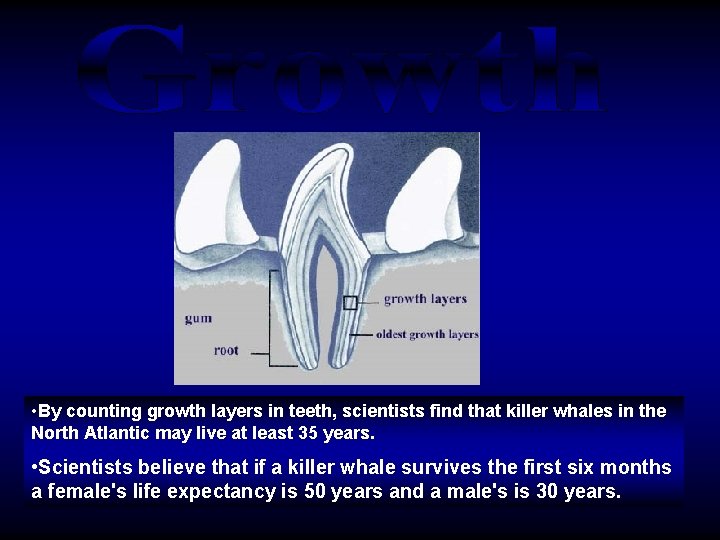
• By counting growth layers in teeth, scientists find that killer whales in the North Atlantic may live at least 35 years. • Scientists believe that if a killer whale survives the first six months a female's life expectancy is 50 years and a male's is 30 years.
• A killer whale breathes through a single blowhole on the dorsal surface of its head. • The whale holds its breath while below the water. It opens its blowhole and begins to exhale just before reaching the surface of the water. • A killer whale breathes through a single blowhole. It inhales and closes the muscular flap before diving. • At the surface the whale quickly inhales and closes its muscular flap covering its blowhole. The blowhole is relaxed in a closed position to open the blowhole a killer whale contracts the muscular flap.
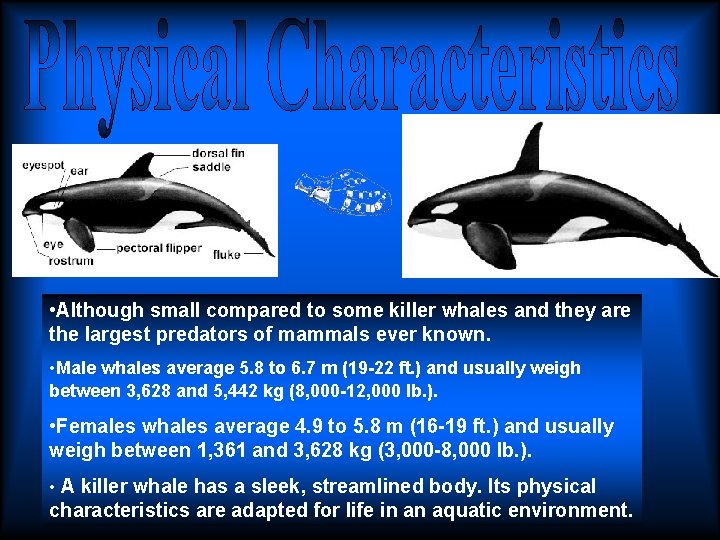
• Although small compared to some killer whales and they are the largest predators of mammals ever known. • Male whales average 5. 8 to 6. 7 m (19 -22 ft. ) and usually weigh between 3, 628 and 5, 442 kg (8, 000 -12, 000 lb. ). • Females whales average 4. 9 to 5. 8 m (16 -19 ft. ) and usually weigh between 1, 361 and 3, 628 kg (3, 000 -8, 000 lb. ). • A killer whale has a sleek, streamlined body. Its physical characteristics are adapted for life in an aquatic environment.