Acid Dissociation Constant Dissociation Constants n For a


- Slides: 14
Acid Dissociation Constant
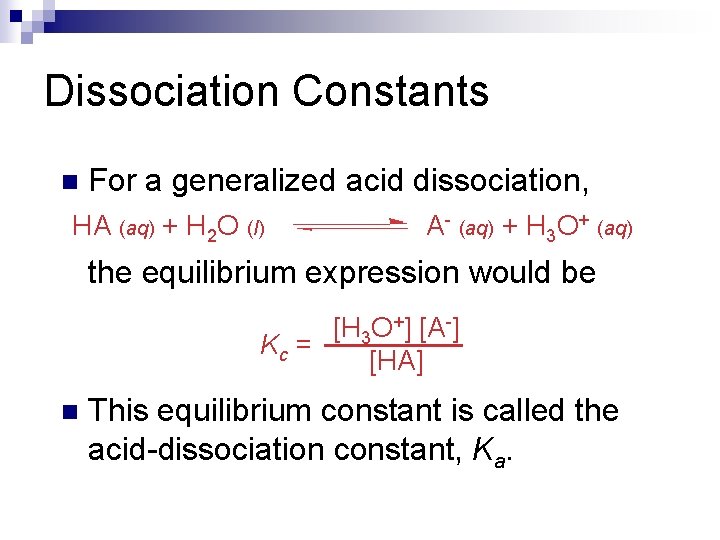
Dissociation Constants n For a generalized acid dissociation, HA (aq) + H 2 O (l) A- (aq) + H 3 O+ (aq) the equilibrium expression would be [H 3 O+] [A-] Kc = [HA] n This equilibrium constant is called the acid-dissociation constant, Ka.
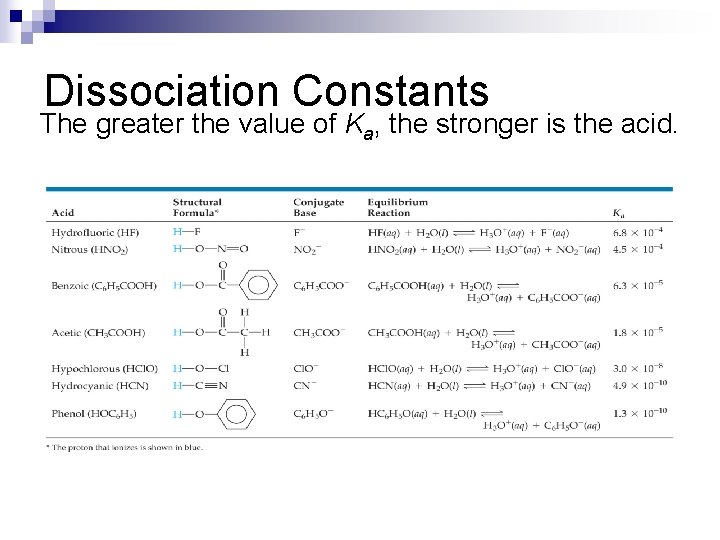
Dissociation Constants The greater the value of Ka, the stronger is the acid.
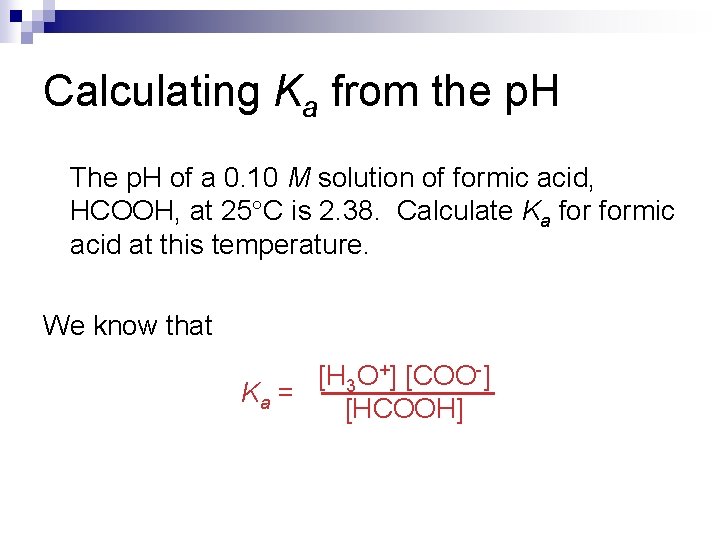
Calculating Ka from the p. H The p. H of a 0. 10 M solution of formic acid, HCOOH, at 25 C is 2. 38. Calculate Ka formic acid at this temperature. We know that [H 3 O+] [COO-] Ka = [HCOOH]
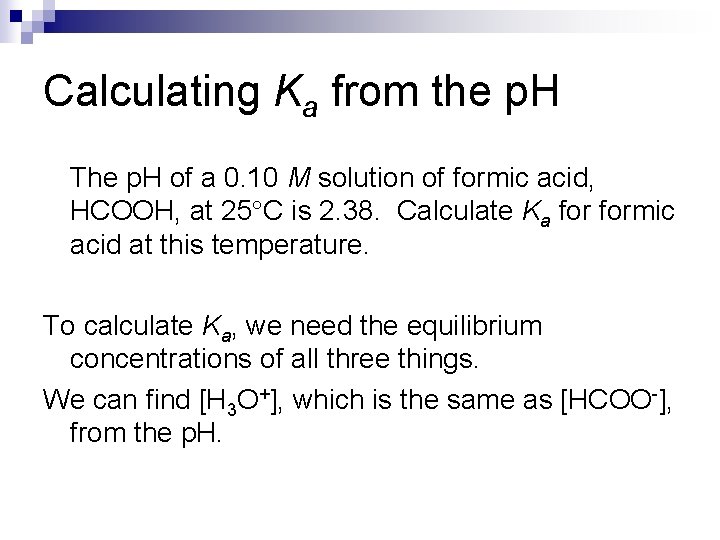
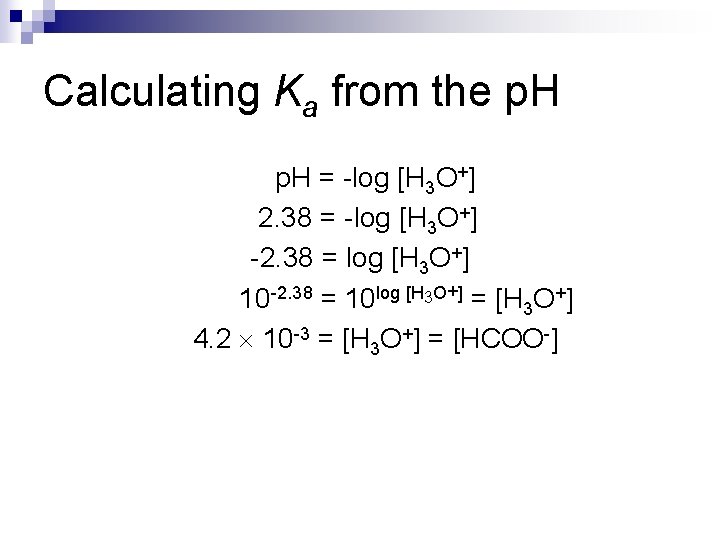
Calculating Ka from the p. H The p. H of a 0. 10 M solution of formic acid, HCOOH, at 25 C is 2. 38. Calculate Ka formic acid at this temperature. To calculate Ka, we need the equilibrium concentrations of all three things. We can find [H 3 O+], which is the same as [HCOO-], from the p. H.
Calculating Ka from the p. H = -log [H 3 O+] 2. 38 = -log [H 3 O+] -2. 38 = log [H 3 O+] 10 -2. 38 = 10 log [H 3 O+] = [H 3 O+] 4. 2 10 -3 = [H 3 O+] = [HCOO-]
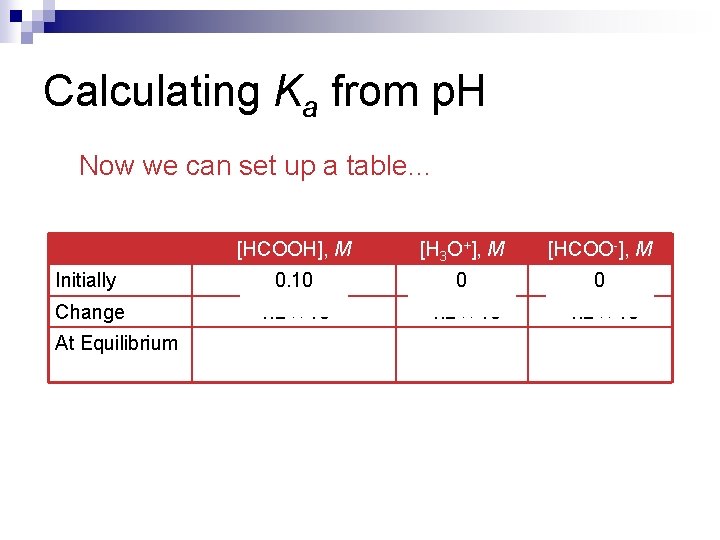
Calculating Ka from p. H Now we can set up a table… [HCOOH], M [H 3 O+], M [HCOO-], M Initially 0. 10 0 0 Change - 4. 2 10 -3 + 4. 2 10 -3 0. 10 - 4. 2 10 -3 = 0. 0958 = 0. 10 4. 2 10 -3 At Equilibrium
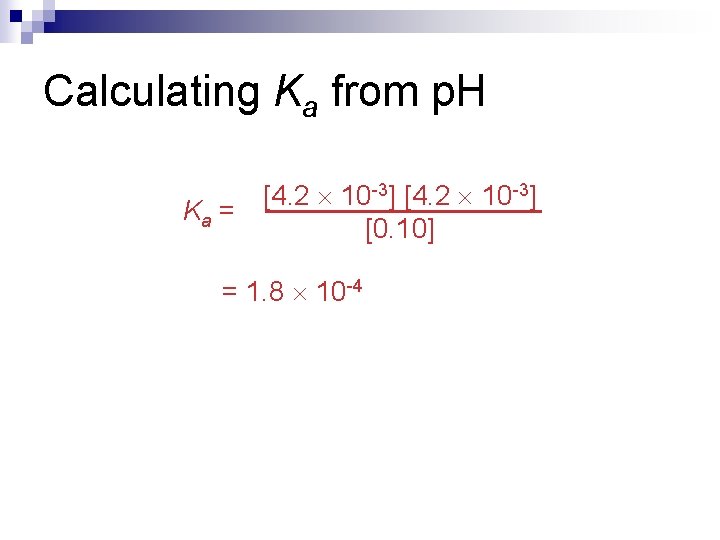
Calculating Ka from p. H [4. 2 10 -3] Ka = [0. 10] = 1. 8 10 -4
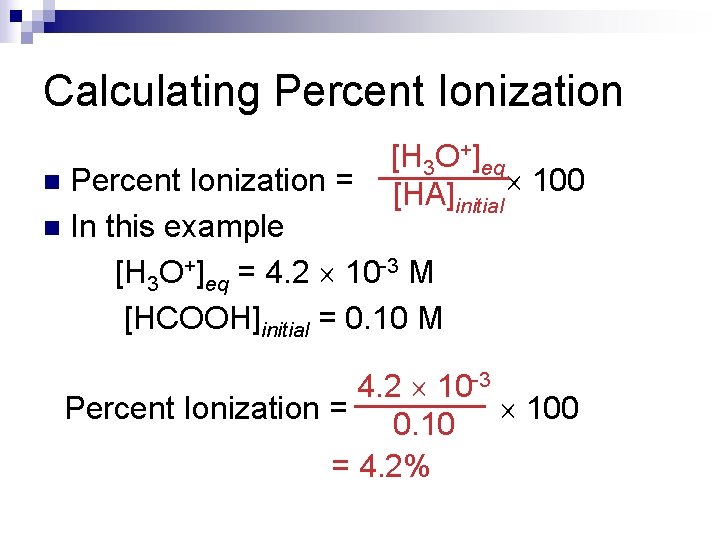
Calculating Percent Ionization [H 3 O+]eq 100 [HA]initial Percent Ionization = n In this example [H 3 O+]eq = 4. 2 10 -3 M [HCOOH]initial = 0. 10 M n 4. 2 10 -3 Percent Ionization = 100 0. 10 = 4. 2%
Calculating p. H from Ka Calculate the p. H of a 0. 30 M solution of acetic acid, HC 2 H 3 O 2, at 25 C. HC 2 H 3 O 2 (aq) + H 2 O (l) H 3 O+ (aq) + C 2 H 3 O 2 - (aq) Ka for acetic acid at 25 C is 1. 8 10 -5.
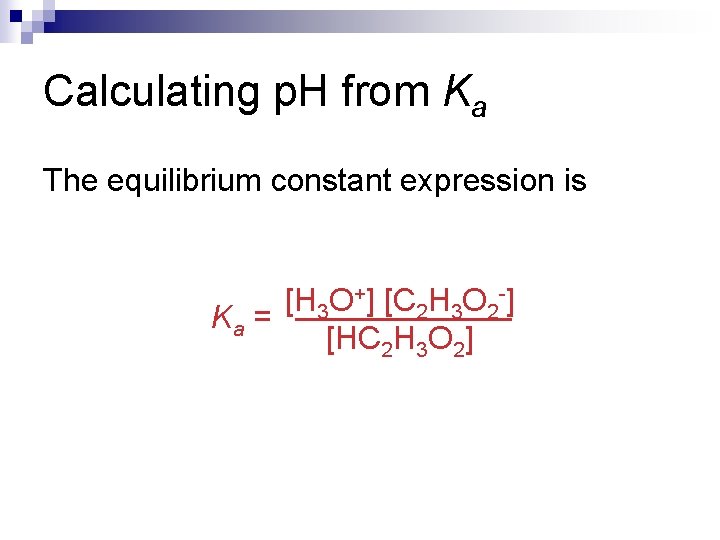
Calculating p. H from Ka The equilibrium constant expression is [H 3 O+] [C 2 H 3 O 2 -] Ka = [HC 2 H 3 O 2]
Calculating p. H from Ka We next set up a table… [C 2 H 3 O 2], M [H 3 O+], M [C 2 H 3 O 2 -], M Initially 0. 30 0 0 Change -x +x +x 0. 30 - x 0. 30 x x At Equilibrium We are assuming that x will be very small compared to 0. 30 and can, therefore, be ignored.
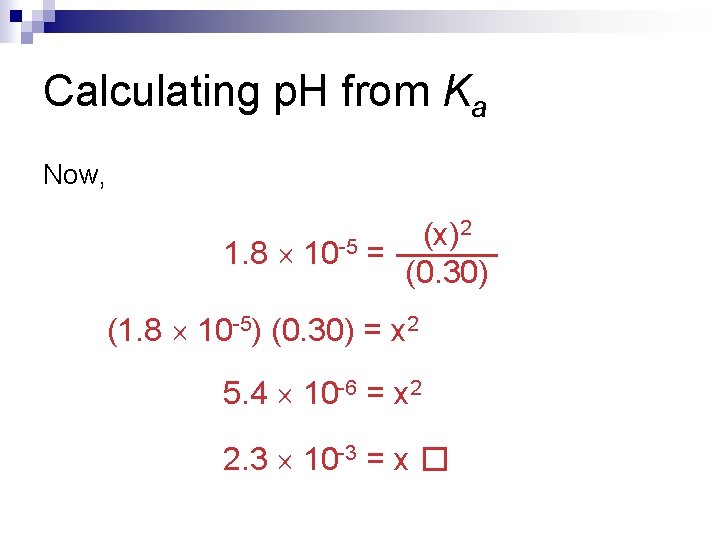
Calculating p. H from Ka Now, 2 (x) 1. 8 10 -5 = (0. 30) (1. 8 10 -5) (0. 30) = x 2 5. 4 10 -6 = x 2 2. 3 10 -3 = x �
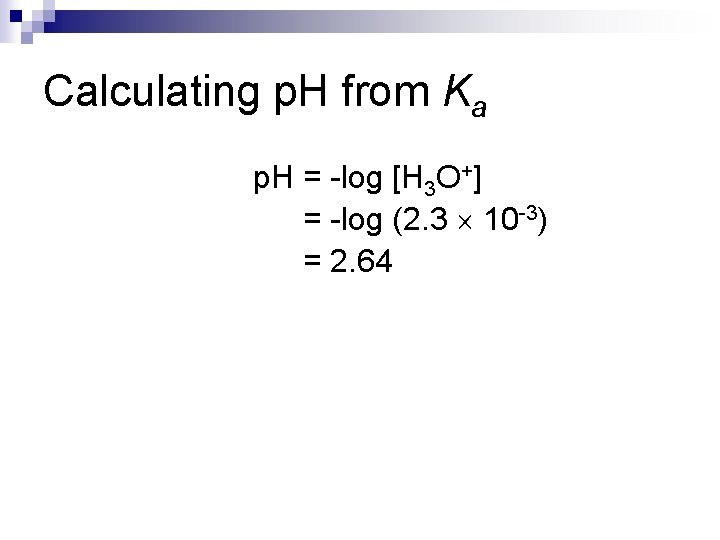
Calculating p. H from Ka p. H = -log [H 3 O+] p. H = -log (2. 3 10 -3) p. H = 2. 64