
Accuracy and Precision Accuracy O Accuracy how closely
- Slides: 9
Accuracy and Precision
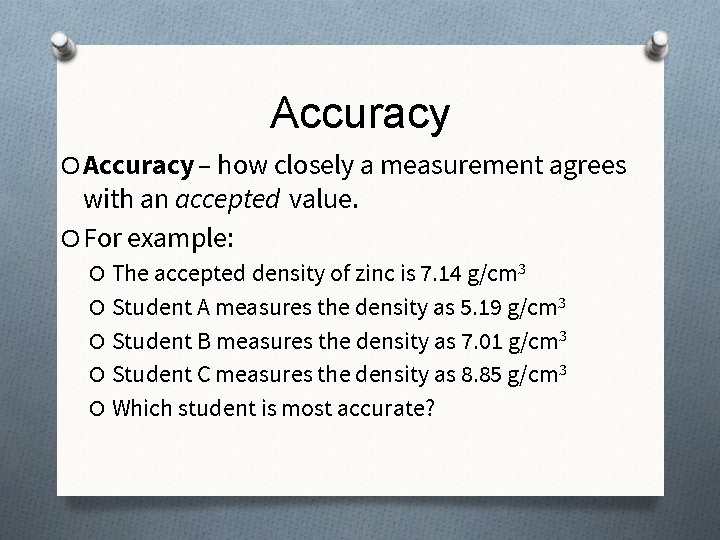
Accuracy O Accuracy – how closely a measurement agrees with an accepted value. O For example: O The accepted density of zinc is 7. 14 g/cm 3 O Student A measures the density as 5. 19 g/cm 3 O Student B measures the density as 7. 01 g/cm 3 O Student C measures the density as 8. 85 g/cm 3 O Which student is most accurate?
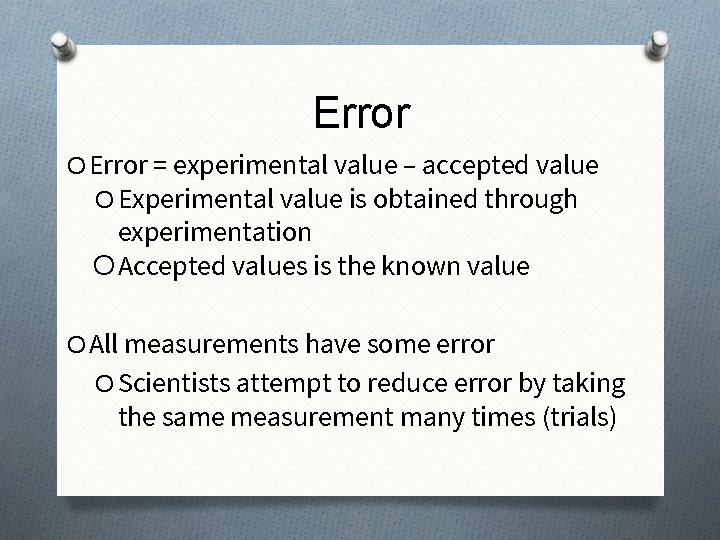
Error O Error = experimental value – accepted value O Experimental value is obtained through experimentation OAccepted values is the known value O All measurements have some error O Scientists attempt to reduce error by taking the same measurement many times (trials)
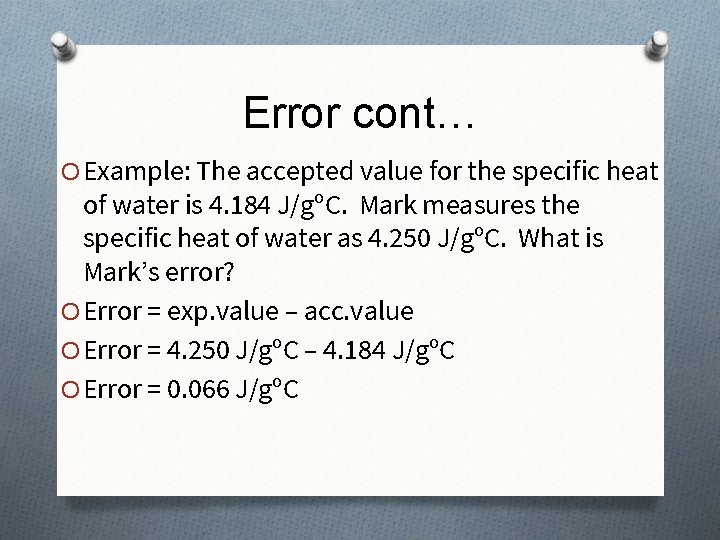
Error cont… O Example: The accepted value for the specific heat of water is 4. 184 J/gºC. Mark measures the specific heat of water as 4. 250 J/gºC. What is Mark’s error? O Error = exp. value – acc. value O Error = 4. 250 J/gºC – 4. 184 J/gºC O Error = 0. 066 J/gºC
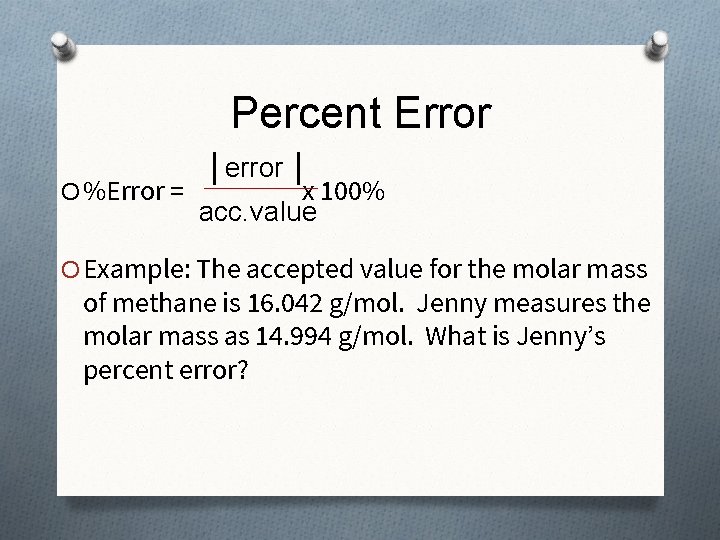
Percent Error │error │ O %Error = x 100% acc. value O Example: The accepted value for the molar mass of methane is 16. 042 g/mol. Jenny measures the molar mass as 14. 994 g/mol. What is Jenny’s percent error?
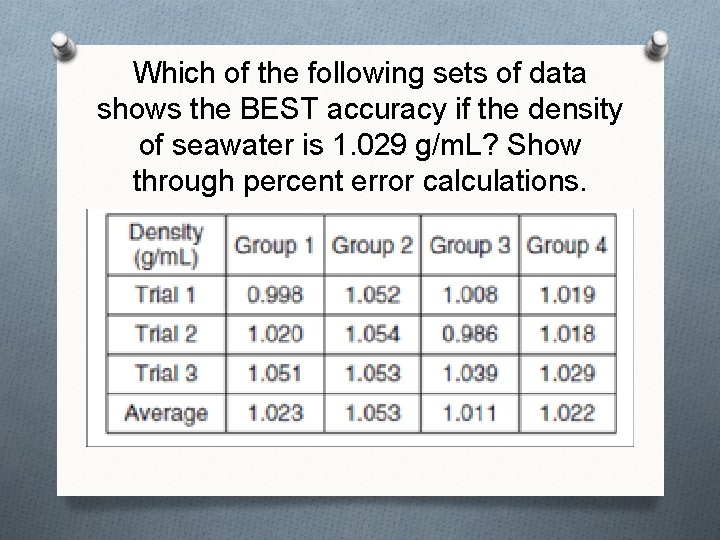
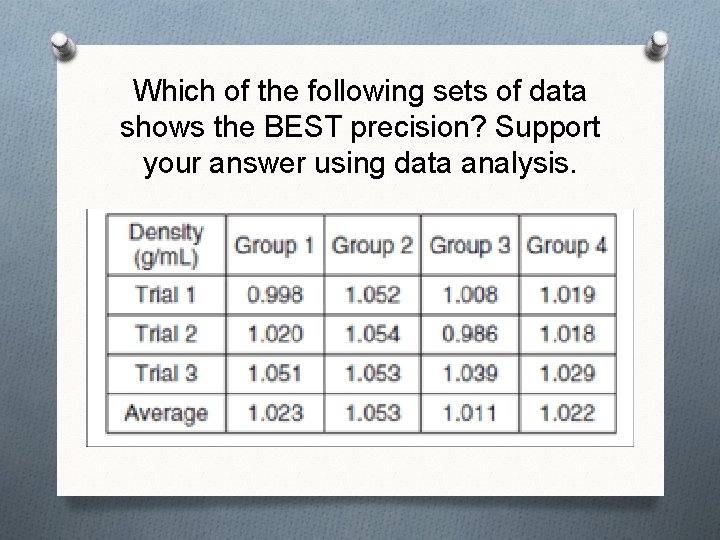
Which of the following sets of data shows the BEST accuracy if the density of seawater is 1. 029 g/m. L? Show through percent error calculations.
Precision OPrecision – describes the closeness of a set of measurements taking under the same conditions. OGood precision does not mean that measurements are accurate.
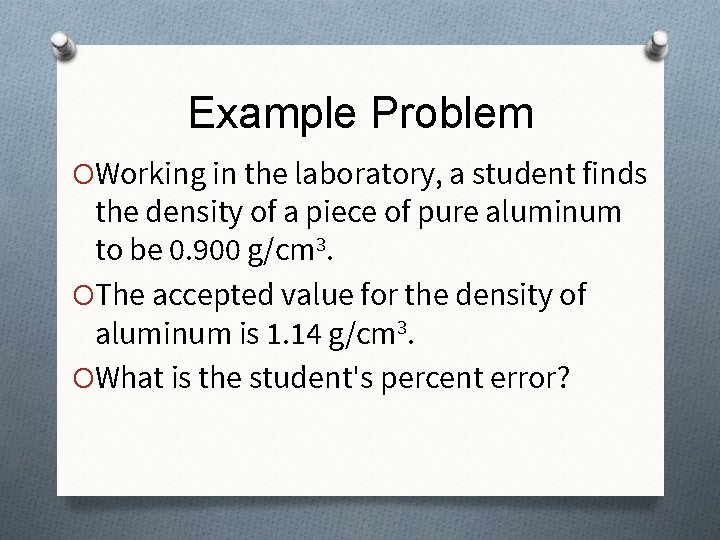
Example Problem OWorking in the laboratory, a student finds the density of a piece of pure aluminum to be 0. 900 g/cm 3. OThe accepted value for the density of aluminum is 1. 14 g/cm 3. OWhat is the student's percent error?
Which of the following sets of data shows the BEST precision? Support your answer using data analysis.