accelerator centers worldwide Manfred Jeitler The Physics of
- Slides: 21
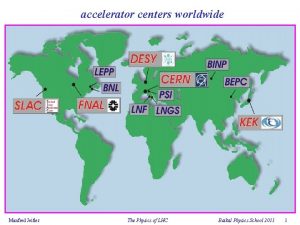
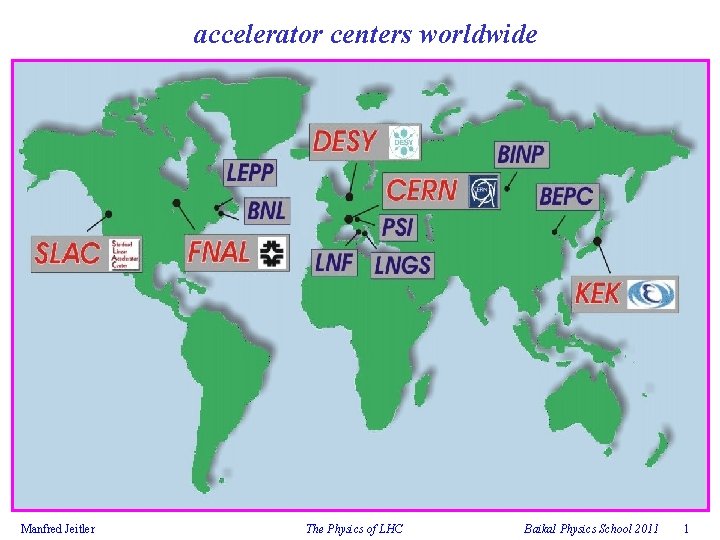
accelerator centers worldwide Manfred Jeitler The Physics of LHC Baikal Physics School 2011 1
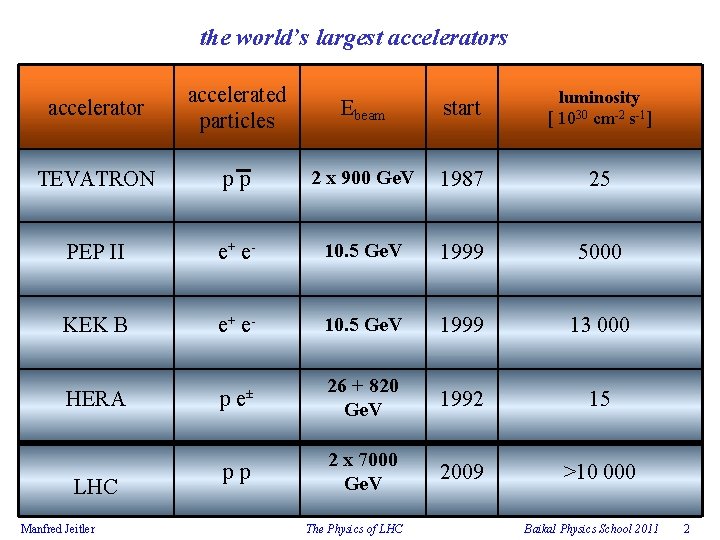
the world’s largest accelerators accelerator accelerated particles Ebeam start luminosity [ 1030 cm-2 s-1] TEVATRON pp 2 x 900 Ge. V 1987 25 PEP II e+ e- 10. 5 Ge. V 1999 5000 KEK B e+ e- 10. 5 Ge. V 1999 13 000 HERA p e± 26 + 820 Ge. V 1992 15 pp 2 x 7000 Ge. V 2009 >10 000 LHC Manfred Jeitler The Physics of LHC Baikal Physics School 2011 2
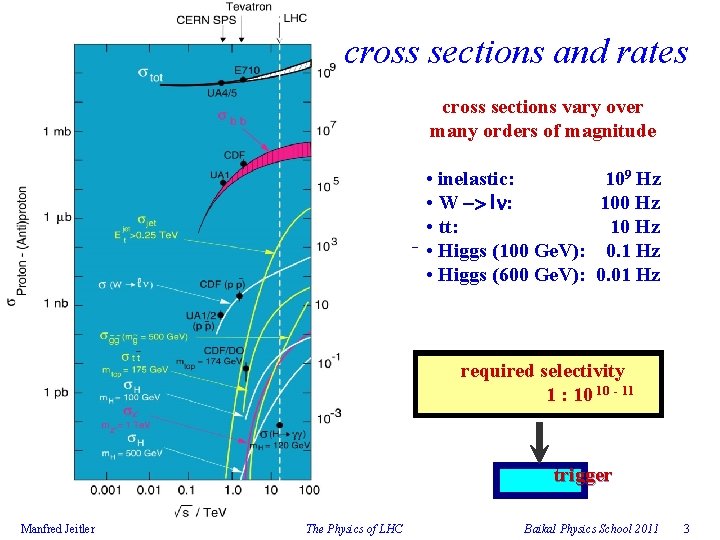
cross sections and rates cross sections vary over many orders of magnitude • inelastic: • W -> ln: • tt: - • Higgs (100 Ge. V): • Higgs (600 Ge. V): 109 Hz 100 Hz 10 Hz 0. 1 Hz 0. 01 Hz required selectivity 1 : 10 10 - 11 trigger Manfred Jeitler The Physics of LHC Baikal Physics School 2011 3
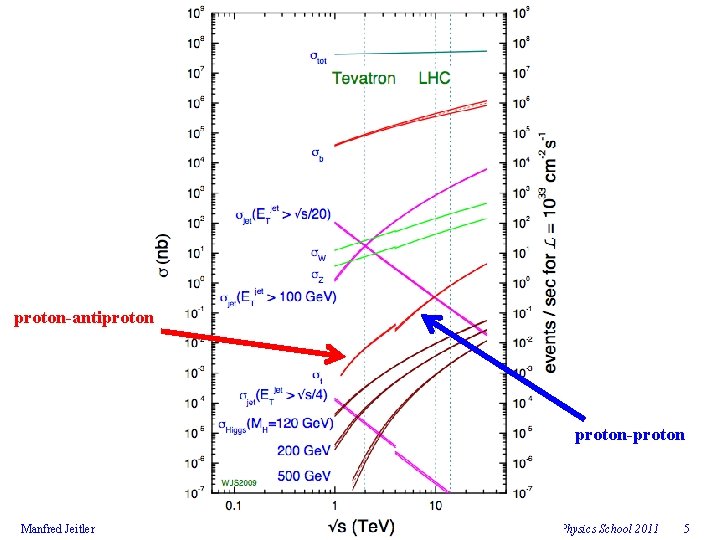
projectiles n SPS and Fermilab used proton-antiproton collisions n LHC uses proton-proton collisions n why? Manfred Jeitler The Physics of LHC Baikal Physics School 2011 4
proton-antiproton-proton Manfred Jeitler The Physics of LHC Baikal Physics School 2011 5
how big is a proton? n roughly 1 fm (10 -15 m) – “femtometer” or “fermi” n 1 barn is the area of a 10 fm × 10 fm square – big unit – derived from uranium nucleus – physicists joked: “that cross section is as big as a barn” n proton-proton cross section at LHC energies: 70 mbarn – = 7 fm 2 – r ~ 1. 5 fm Manfred Jeitler The Physics of LHC Baikal Physics School 2011 6
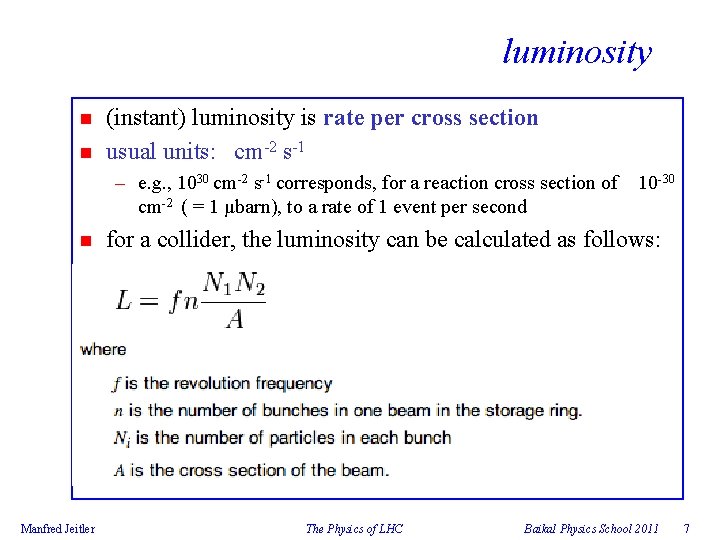
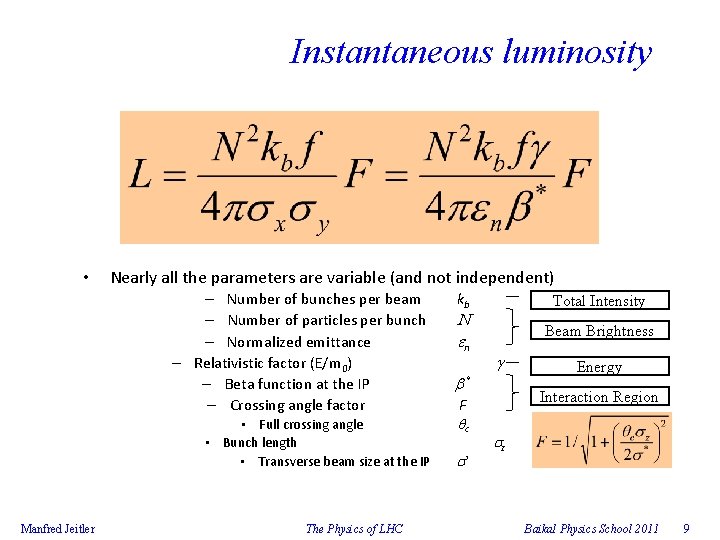
luminosity n n (instant) luminosity is rate per cross section usual units: cm-2 s-1 – e. g. , 1030 cm-2 s-1 corresponds, for a reaction cross section of 10 -30 cm-2 ( = 1 μbarn), to a rate of 1 event per second n Manfred Jeitler for a collider, the luminosity can be calculated as follows: The Physics of LHC Baikal Physics School 2011 7
integrated luminosity n n number of events collected divided by the cross section usual units: nb-1 (“inverse nanobarn”), pb-1 (“inverse picobarn”) etc. § an integrated luminosity of 1 fb-1 means that for a process with a cross section of 1 fb, 1 event (on average) should have been collected § or 1000 events for a cross section of 1 nb, etc. § so, 1 inverse femtobarn = 1000 inverse picobarns : § 1 fb-1 = 1000 pb-1 § physicists are now looking for very rare events, so it is vital to reach not only high energies (so that heavy particles can be produced) but also high luminosities § handling the resulting data rates is a challenge also for the detectors, trigger systems, and readout electronics Manfred Jeitler The Physics of LHC Baikal Physics School 2011 8
Instantaneous luminosity • Nearly all the parameters are variable (and not independent) – Number of bunches per beam – Number of particles per bunch – Normalized emittance – Relativistic factor (E/m 0) – Beta function at the IP – Crossing angle factor • Full crossing angle • Bunch length • Transverse beam size at the IP Manfred Jeitler The Physics of LHC kb n Total Intensity Beam Brightness * Interaction Region F c * Energy z Baikal Physics School 2011 9
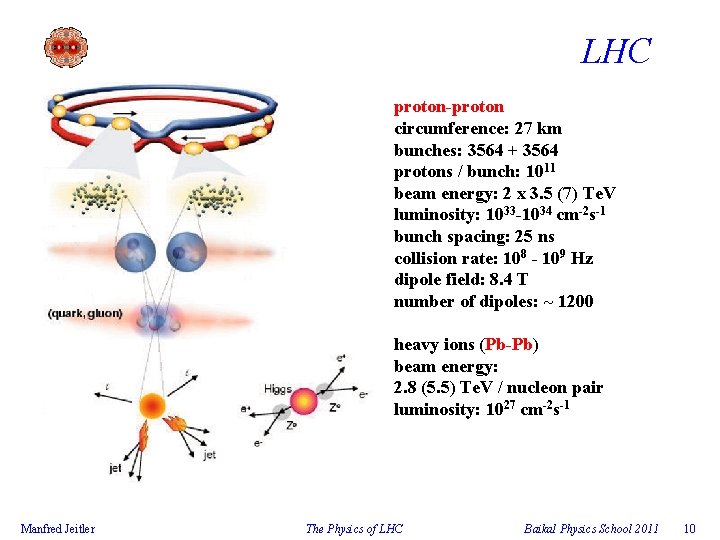
LHC proton-proton circumference: 27 km bunches: 3564 + 3564 protons / bunch: 1011 beam energy: 2 x 3. 5 (7) Te. V luminosity: 1033 -1034 cm-2 s-1 bunch spacing: 25 ns collision rate: 108 - 109 Hz dipole field: 8. 4 T number of dipoles: ~ 1200 heavy ions (Pb-Pb) beam energy: 2. 8 (5. 5) Te. V / nucleon pair luminosity: 1027 cm-2 s-1 Manfred Jeitler The Physics of LHC Baikal Physics School 2011 10
Manfred Jeitler The Physics of LHC Baikal Physics School 2011 11
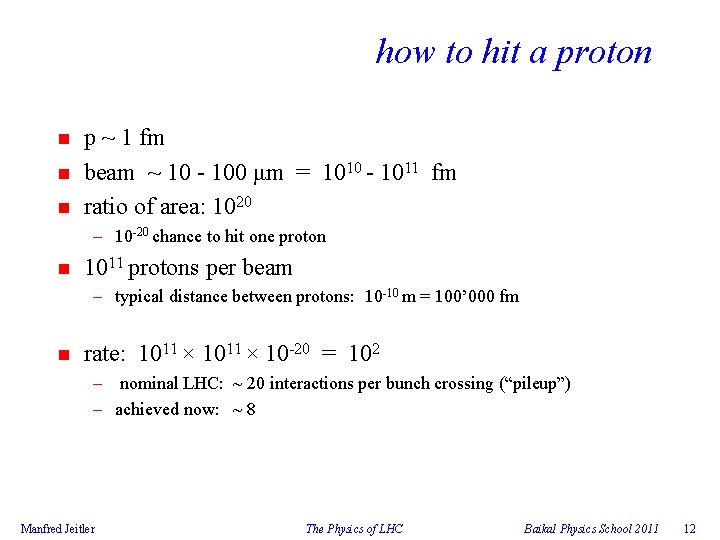
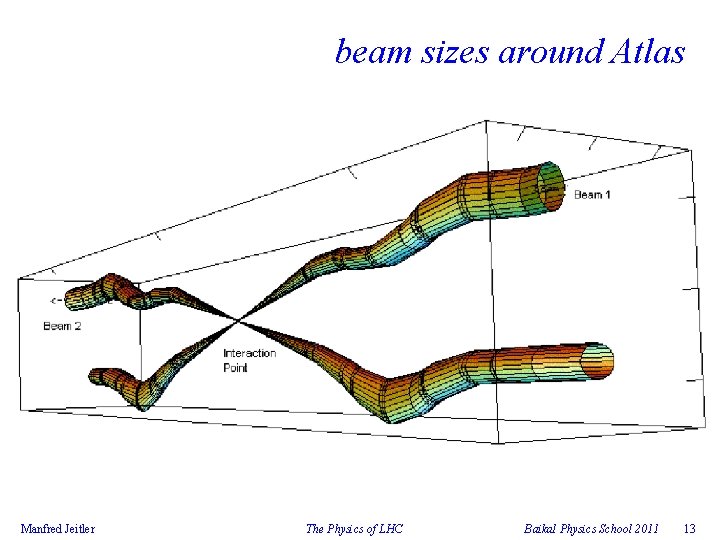
how to hit a proton n p ~ 1 fm beam ~ 10 - 100 μm = 1010 - 1011 fm ratio of area: 1020 – 10 -20 chance to hit one proton n 1011 protons per beam – typical distance between protons: 10 -10 m = 100’ 000 fm n rate: 1011 × 10 -20 = 102 – nominal LHC: ~ 20 interactions per bunch crossing (“pileup”) – achieved now: ~ 8 Manfred Jeitler The Physics of LHC Baikal Physics School 2011 12
beam sizes around Atlas Manfred Jeitler The Physics of LHC Baikal Physics School 2011 13
Manfred Jeitler The Physics of LHC Baikal Physics School 2011 14
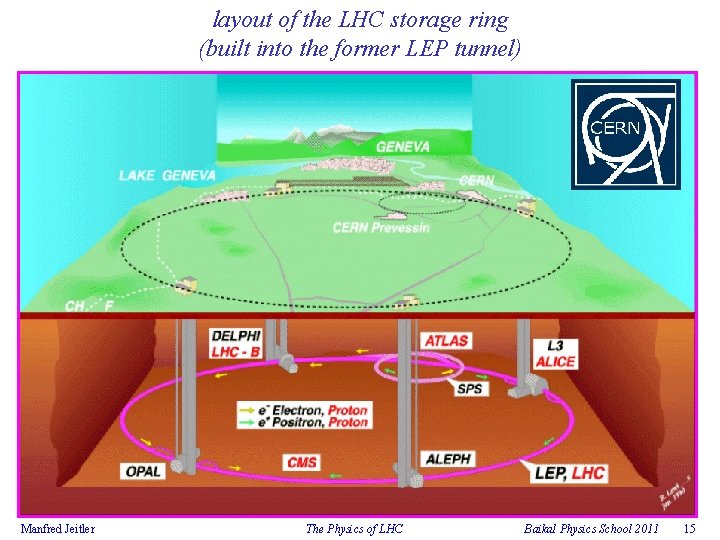
layout of the LHC storage ring (built into the former LEP tunnel) Manfred Jeitler The Physics of LHC Baikal Physics School 2011 15
Manfred Jeitler The Physics of LHC Baikal Physics 16 School 2011 16
Manfred Jeitler The Physics of LHC Baikal Physics School 2011 17
Manfred Jeitler The Physics of LHC Baikal Physics School 2011 18
I don’t want to fall into a black hooooolee. . . !!! n some (few) physicists believe that at LHC energies we could already produce “mini black holes” – they would disappear very quickly n but what if they don’t ? – could they engulf the Earth? – eat up Cern, Geneva, Switzerland, Europa. . . and then Siberia and Lake Baikal with the nice seals ? ? – are those scientists crazy ? ? n n don’t worry, be happy! there are convincing experimental arguments that we are safe Manfred Jeitler The Physics of LHC Baikal Physics School 2011 19
I don’t want to fall into a black hooooolee. . . !!! n n physicist: those black holes will evaporate much too quickly – we know that from calculations concerned citizen: and what if those calculations are wrong (as usual)? ? physicist: the Earth has been bombarded by cosmic rays of much higher energy for the last 5 billion years and we are still here! concerned citizen: but maybe then they are so fast they just whiz through the Earth and have no chance to stop and grow? Manfred Jeitler The Physics of LHC Baikal Physics School 2011 20
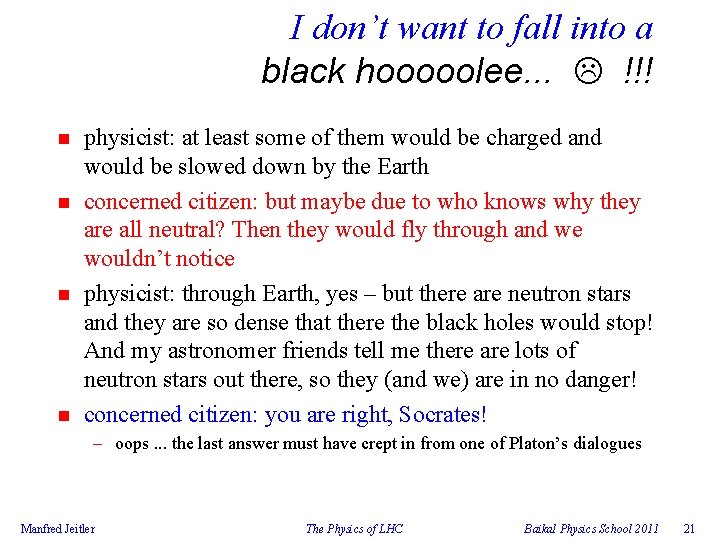
I don’t want to fall into a black hooooolee. . . !!! n n physicist: at least some of them would be charged and would be slowed down by the Earth concerned citizen: but maybe due to who knows why they are all neutral? Then they would fly through and we wouldn’t notice physicist: through Earth, yes – but there are neutron stars and they are so dense that there the black holes would stop! And my astronomer friends tell me there are lots of neutron stars out there, so they (and we) are in no danger! concerned citizen: you are right, Socrates! – oops. . . the last answer must have crept in from one of Platon’s dialogues Manfred Jeitler The Physics of LHC Baikal Physics School 2011 21