AC Analysis Using Thevenins Theorem and Superposition Discussion
- Slides: 14
AC Analysis Using Thevenin's Theorem and Superposition Discussion D 11. 2 Chapter 4 1
AC Thevenin's Theorem 2
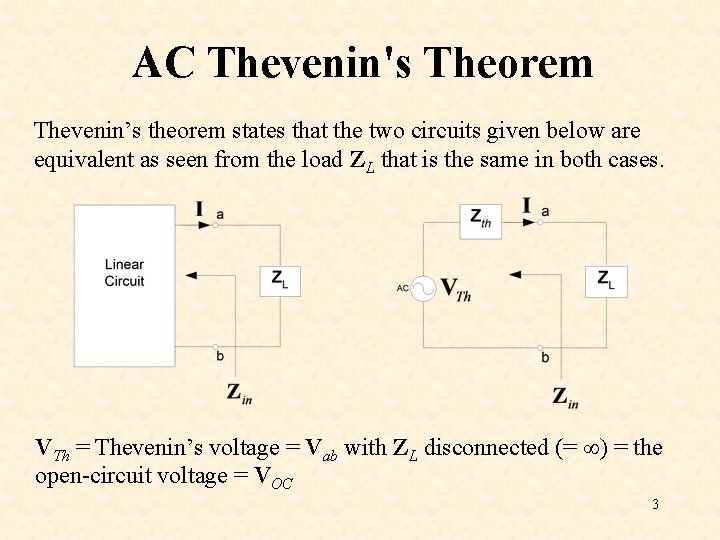
AC Thevenin's Theorem Thevenin’s theorem states that the two circuits given below are equivalent as seen from the load ZL that is the same in both cases. VTh = Thevenin’s voltage = Vab with ZL disconnected (= ) = the open-circuit voltage = VOC 3
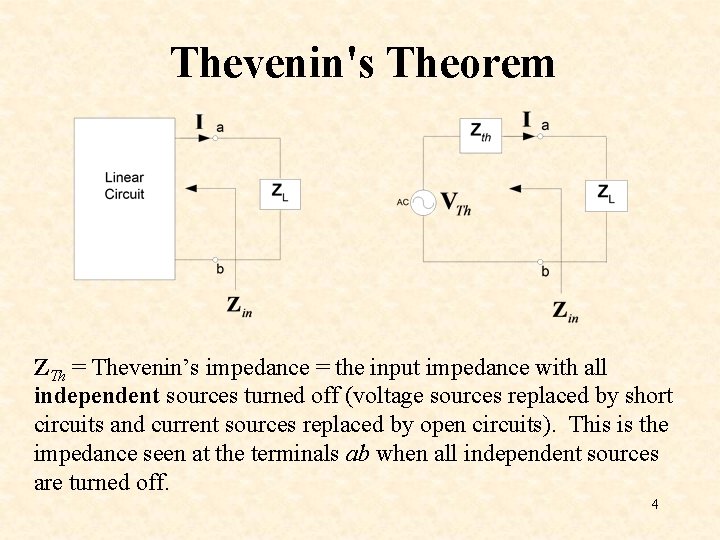
Thevenin's Theorem ZTh = Thevenin’s impedance = the input impedance with all independent sources turned off (voltage sources replaced by short circuits and current sources replaced by open circuits). This is the impedance seen at the terminals ab when all independent sources are turned off. 4
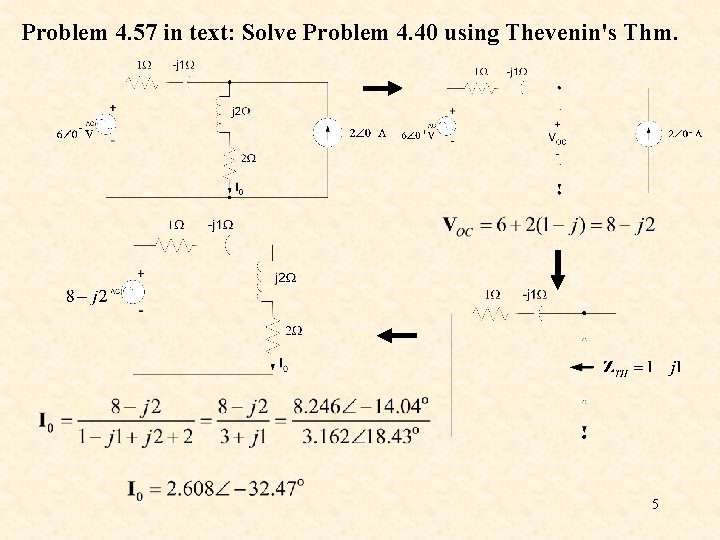
Problem 4. 57 in text: Solve Problem 4. 40 using Thevenin's Thm. 5
AC Superposition 6
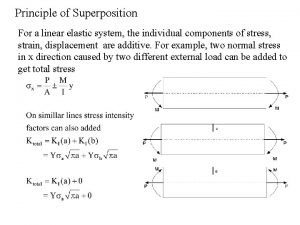
Superposition Principle Because the circuit is linear we can find the response of the circuit to each source acting alone, and then add them up to find the response of the circuit to all sources acting together. This is known as the superposition principle. The superposition principle states that the voltage across (or the current through) an element in a linear circuit is the algebraic sum of the voltages across (or currents through) that element due to each independent source acting alone. 7
Steps in Applying the Superposition Principle 1. Turn off all independent sources except one. Find the output (voltage or current) due to the active source. 2. Repeat step 1 for each of the other independent sources. 3. Find the total output by adding algebraically all of the results found in steps 1 & 2 above. In some cases, but certainly not all, superposition can simplify the analysis. 8
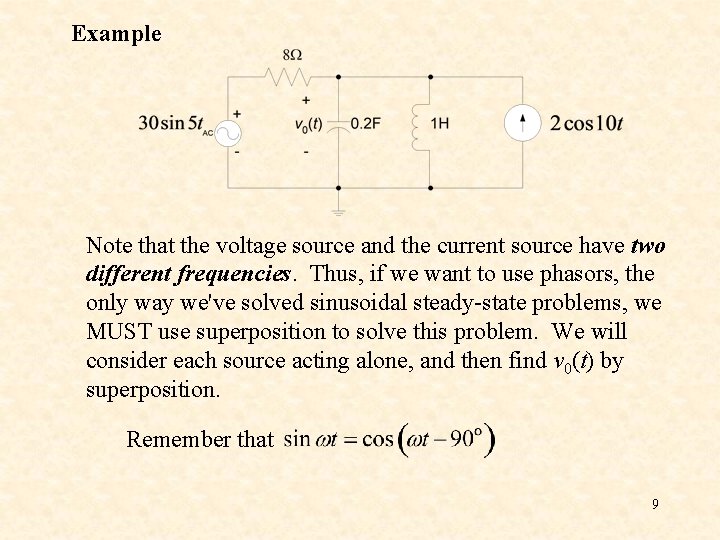
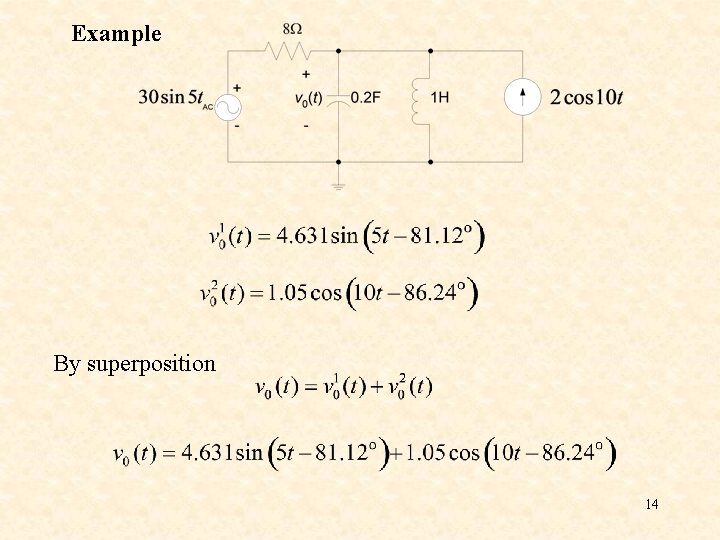
Example Note that the voltage source and the current source have two different frequencies. Thus, if we want to use phasors, the only way we've solved sinusoidal steady-state problems, we MUST use superposition to solve this problem. We will consider each source acting alone, and then find v 0(t) by superposition. Remember that 9
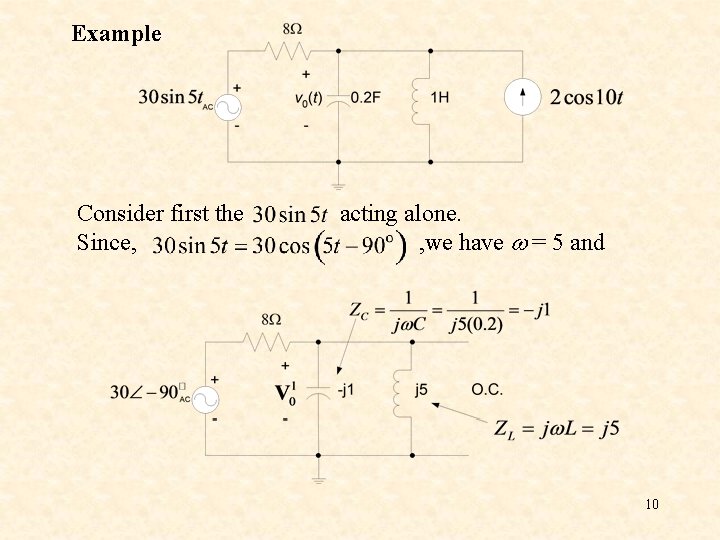
Example Consider first the Since, acting alone. , we have w = 5 and 10
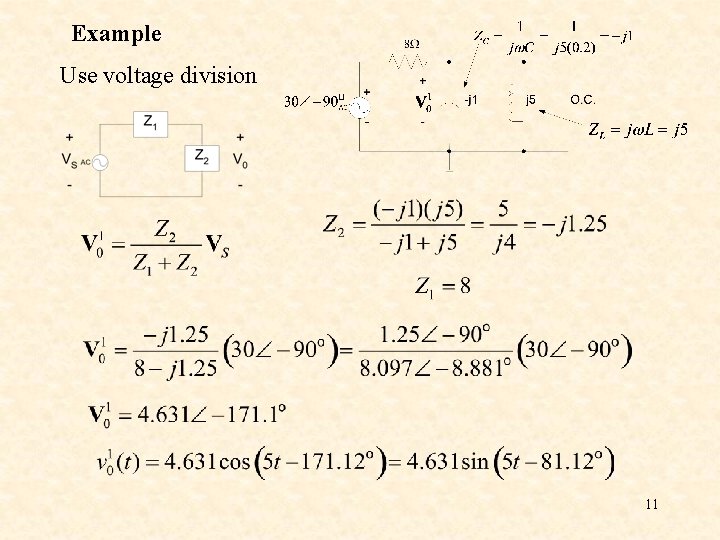
Example Use voltage division 11
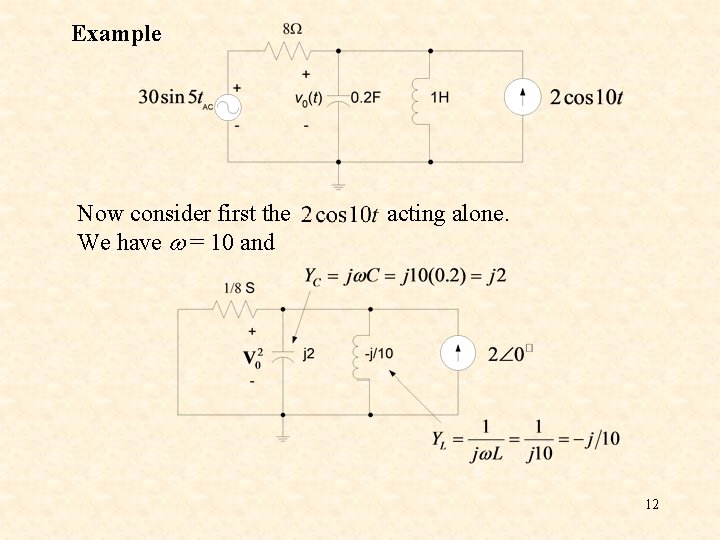
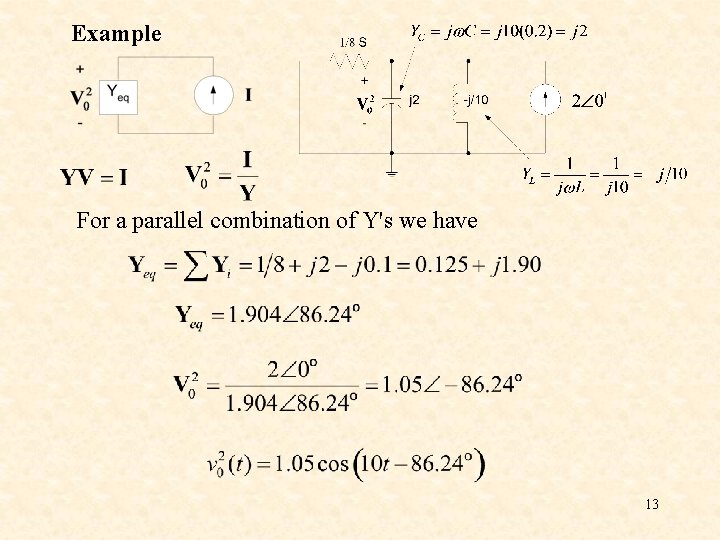
Example Now consider first the We have w = 10 and acting alone. 12
Example For a parallel combination of Y's we have 13
Example By superposition 14