
Superposition Thevenin Norton Equivalents Maximum Power Transfer By
Superposition, Thevenin / Norton Equivalents, Maximum Power Transfer By Dr. M. Padma Lalitha Hod & Professor AITS RAJAMPET
Outline – Ch. 4 § Superposition § Method of analyzing a circuit by turning off all sources but 1 and then finding their contributions individually. End by summing up all the contributions. § Thevenin Equivalent Circuits § A circuit at a given 2 terminals can be replaced by a voltage source with a resistor in series. § Norton Equivalent Circuits § A circuit at a given 2 terminals can also be replaced with a current source and a parallel resistor. § Maximum Power Transfer § When you have a load, when does it receive the maximum power? We’ve already answered this in lab.
Superposition § Resistors are linear elements, meaning that the output is linearly related to the input. § Voltages around a loop can simply be added up – no non linear math is required. § Instead of analyzing circuits like we did in Ch. 2 and Ch. 3, we can analyze them using Superposition. § Definition: The voltage across (or current through) a resistor is the algebraic sum of all the contributions due to each source acting alone. § So, another way to analyze a circuit is to find the contribution of each source individually and them add them up at the end to get the total.
Superposition 2 § We only consider 1 independent source at a time when we use superposition. This means that we: § Replace voltage sources with a wire (0 V). § Replace current sources with an open circuit (no current can flow). § Dependent sources are left intact since they are controlled by circuit variables.
Superposition 3 § To solve a circuit using superposition: § Turn off all independent sources but 1. Use the techniques of Ch. 2 and Ch. 3 to solve for the desired voltage or current. § Repeat for each independent source. § Find the total voltage or contribution by taking the algebraic sum.

Superposition – Exp. 1 Find the voltage over the 2 Ohm resistor using superposition.

Superposition Exp. 2 Find the voltage over the 5 ohm resistor using superposition. +V -
Equivalent Circuits § A model of the real thing. § Used to capture only the necessary details of a potentially complex circuit. § Examples of various models: § Battery § OSI network layer § Function calls § You (as a user), don’t really care how the function operates, just that it does.
Thevenin Equivalent Circuits § Consists of a voltage source and a resistor in series. § Used to provide a “black box” picture from the view of a load. The load, looking back in to the circuit, only wants to know the voltage and current that is provided to it.
Finding a TEC § Steps: § Find the open circuit voltage – disconnect the load from the circuit and calculate the voltage looking in to the circuit. § Find the open circuit equivalent resistance looking back in to the circuit § Remove all independent current sources § Replace all independent voltage sources with wires. § Rth is then that equivalent resistance and Vth is just the voltage that you found.
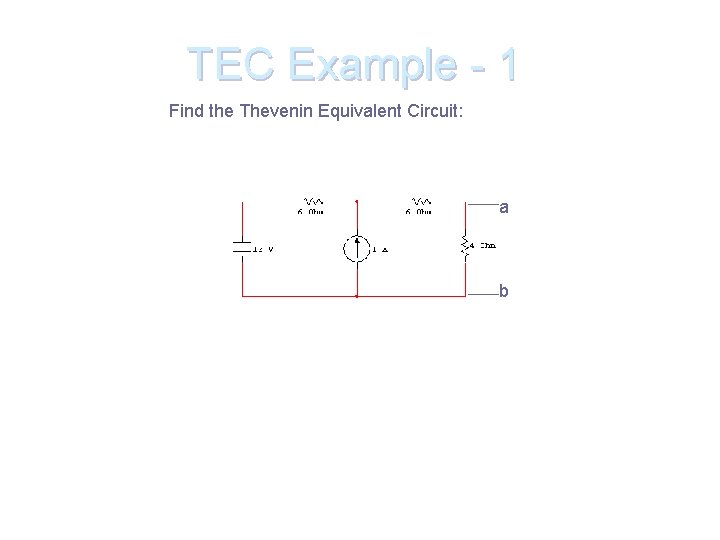
TEC Example - 1 Find the Thevenin Equivalent Circuit: a b
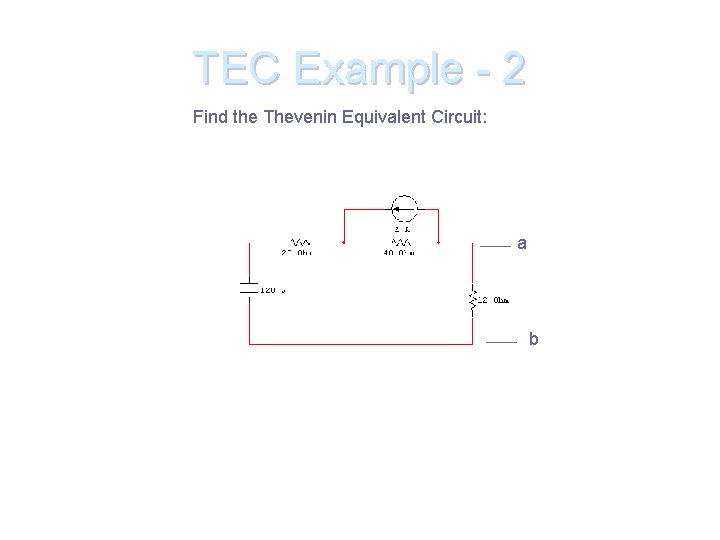
TEC Example - 2 Find the Thevenin Equivalent Circuit: a b
Norton Equivalent Circuits § Consists of a current source with a resistor in parallel. § Electrically equivalent to the Thevenin model § Rth is the same § In is equal to Vth / Rth § When finding Norton equivalents, I often recommend just finding the Thevenin equivalent and then just switch at the end.
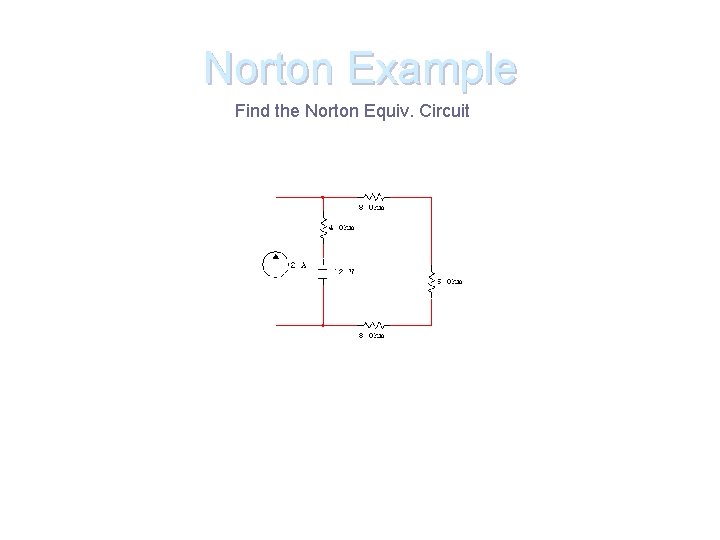
Norton Example Find the Norton Equiv. Circuit
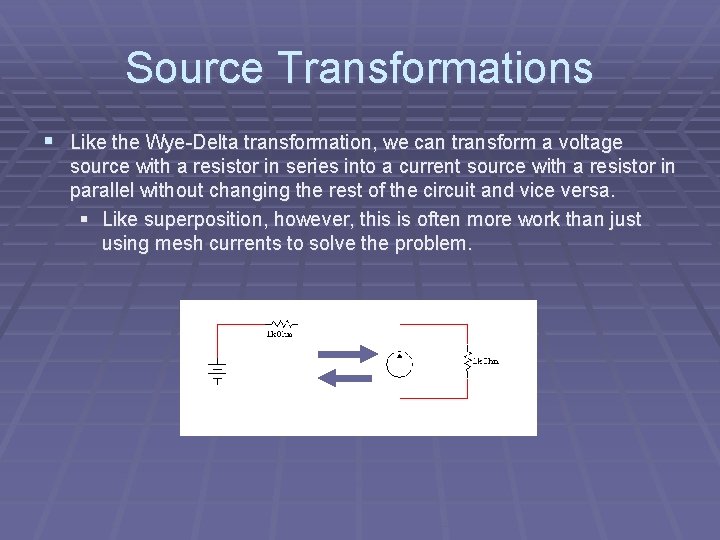
Source Transformations § Like the Wye-Delta transformation, we can transform a voltage source with a resistor in series into a current source with a resistor in parallel without changing the rest of the circuit and vice versa. § Like superposition, however, this is often more work than just using mesh currents to solve the problem.
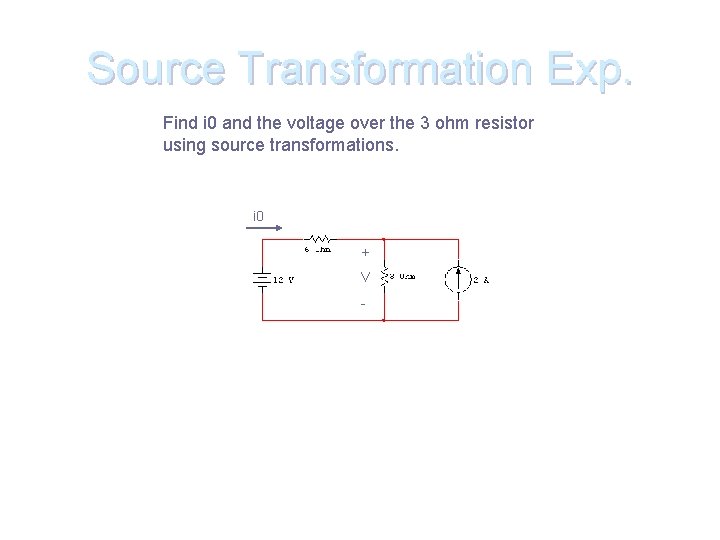
Source Transformation Exp. Find i 0 and the voltage over the 3 ohm resistor using source transformations. i 0 + V -
Maximum Power Transfer § When does the load receive maximum power? – see notes § When RL = Rth

Maximum Power Example Find the RL that achieves maximum power transfer. Find the power it absorbs. Note: You must find Vth to calculate the power.
- Slides: 18