
A Topical Approach to LifeSpan Development 7 th
- Slides: 21
A Topical Approach to Life-Span Development, 7 th edition John W. Santrock Chapter 14 – Families, Lifestyles, and Parenting Copyright Mc. Graw-Hill Education, 2014
Diversity of Adult Lifestyles • Adults today choose many different lifestyles and forms of families • United States has more marriages and remarriages, divorces, short-term cohabitation relationships than most countries • Dramatic rise in percentage of single adults • Rising rates of cohabitation and trend toward postponing marriage • Single adults are often stereotyped Copyright Mc. Graw-Hill Education, 2014
Diversity of Adult Lifestyles • Cohabitation • Living together in a sexual relationship without being married • Number of cohabitating couples in U. S. has increased dramatically since 1970 s • More than 75% of adults cohabitate prior to getting married • Cohabitation as a precursor to marriage or ongoing lifestyle • In U. S. , cohabitating arrangements tend to be short-lived • Fewer than 1 out of 5 last for five years Copyright Mc. Graw-Hill Education, 2014
Diversity of Adult Lifestyles • Young adults’ reasons to cohabitate: • Spend time together • Share expenses • Evaluate compatibility • In cohabitating relationships, men are more concerned with loss of freedom while women are more concerned about delays in getting married Copyright Mc. Graw-Hill Education, 2014
Diversity of Adult Lifestyles • Couples who cohabitate face problems: • Disapproval from parents and other family members • Difficulty owning property jointly • Uncertain legal rights concerning dissolution of relationship Copyright Mc. Graw-Hill Education, 2014
Diversity of Adult Lifestyles • Lower rates of marital satisfaction and higher rates of divorce in couples who live together before getting married • Less traditional lifestyles may attract less conventional individuals who are not great believers in marriage • Cohabitation may change attitudes and habits in ways that increase likelihood of divorce Copyright Mc. Graw-Hill Education, 2014
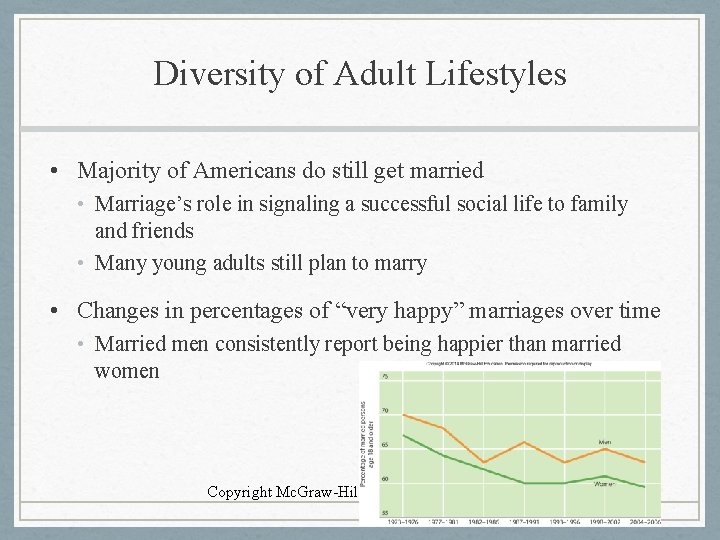
Diversity of Adult Lifestyles • Majority of Americans do still get married • Marriage’s role in signaling a successful social life to family and friends • Many young adults still plan to marry • Changes in percentages of “very happy” marriages over time • Married men consistently report being happier than married women Copyright Mc. Graw-Hill Education, 2014
Marriages • Successful Types • Validating • Volatile • Avoidant • Unsuccessful Types • Hostile Engaged • Hostile Detached • Divorce • Economic Effects • Social Support
Diversity in Adult Lifestyles • Predictors of success in marriage: • • • Establishing love maps Nurturing, fondness, and admiration Turning toward each other instead of away Letting your partner influence you Overcoming gridlock Creating shared meaning Copyright Mc. Graw-Hill Education, 2014
Diversity in Adult Lifestyles • Premarital education occurs in groups and focuses on relationship advice • Programs range from several hours to 20 hours • Recommended 6 months to 1 year before wedding • Premarital education linked to higher level of marital satisfaction, commitment to spouse, lower level of destructive marital conflict, lower likelihood of divorce • Beneficial for first and second marriages Copyright Mc. Graw-Hill Education, 2014
Diversity in Adult Lifestyles • Some marriages that were difficult and rocky during early adulthood improve in middle adulthood • Partners develop a deep and solid foundation to anchor relationship • In middle adulthood, partners experience fewer financial worries, less housework and chores, more time with each other • Engaging in mutual activities linked with viewing marriage more positively Copyright Mc. Graw-Hill Education, 2014
Diversity in Adult Lifestyles • In midlife, most married individuals voice satisfaction with being married • Higher levels of emotional intimacy skills in early twenties predict well-adjusted marriages in middle age • In late adulthood, married individuals are happier, less distressed, and live longer than singles • Older adults more satisfied with marriages than young or middle-aged adults • Married individuals more likely to care for a sick partner with limited health conditions • Stress of caring for spouse places demands on intimacy Copyright Mc. Graw-Hill Education, 2014
Diversity of Adult Lifestyles • United States has one of the highest divorce rates in the world • Factors that increase likelihood of divorce: • Youthful marriages, low education level, low income, no religious affiliation, parents who are divorced, having a baby before marriage • Alcoholism, psychological problems, domestic violence, infidelity, inadequate division of household labor Copyright Mc. Graw-Hill Education, 2014
Parenting • Age of having children has been increasing over time • Birth control is more common practice • Marrying later and having children later or not at all • Advantages of having children early (in twenties): • More physical energy • Fewer medical problems with pregnancy and childbirth • Fewer built-up expectations for children • Problems? Copyright Mc. Graw-Hill Education, 2014
Parenting • Baumrind’s parenting styles: • • Authoritarian parenting Authoritative parenting Neglectful parenting Indulgent parenting Copyright Mc. Graw-Hill Education, 2014
Parenting • Consequences of child maltreatment: • • • Poor emotional regulation Attachment problems Problems in peer relations Difficulty adapting to school Psychological problems, such as depression and delinquency • During adult years, individuals who were maltreated as children are more likely to experience physical, emotional, and sexual problems Copyright Mc. Graw-Hill Education, 2014
Parenting • Parent-child attachment remains important • Mothers maintain closer emotional ties with adolescents than fathers, especially with daughters • Parent-adolescent conflict escalates during early adolescence • Conflict usually involves everyday issues of family life • Rarely involve major dilemmas, such as drugs and delinquency • Conflicts become less frequent during late adolescence Copyright Mc. Graw-Hill Education, 2014
Parenting • Children in divorced families more likely to experience: • • Academic problems Internalized and externalized problems Less socially responsible Less competent intimate relationships Drop out of school Become sexually active earlier Take drugs, associate with antisocial peers, low self-esteem Less secure attachment as young adults Copyright Mc. Graw-Hill Education, 2014
Other Family Relationships • Many adults become grandparents in middle age • Grandmothers have more frequent contact than grandfathers • Meanings attached to being grandparent: • Source of biological reward and continuity • Source of emotional fulfillment • Remote role • Divorce, adolescent pregnancy, drug use by parents among reasons grandparents are thrust back into parenting role Copyright Mc. Graw-Hill Education, 2014
Other Family Relationships • Empty nest syndrome • When all children leave parental home • Marital couple has more time to pursue careers and other interests and more time for each other • Refilling of empty nest linked to uncertain economic climate • Adult children return to live at home • Middle generation provides support for younger generation, even if nest is bare Copyright Mc. Graw-Hill Education, 2014
Other Family Relationships • Middle-aged adults have been described as “sandwich, ” “squeezed, ” or “overload” generation • Responsibilities to adolescent and young adult children and to aging parents • Stress experienced when elderly parents become ill and die • When middle-aged adults have parents with disability, their support increases • Women have important role in maintaining family relationships across generations Copyright Mc. Graw-Hill Education, 2014