A P World History Unit 4 1750 1900
- Slides: 14
A. P. World History Unit 4: 1750 -1900
Key Concepts of Unit 4 Key Concept 5. 1: Industrialization and Global Capitalism. Key Concept 5. 2: Imperialism and Nation-State Formation Key Concept 5. 3: Nationalism, Revolution, & Reform Key Concept 5. 4: Global Migration
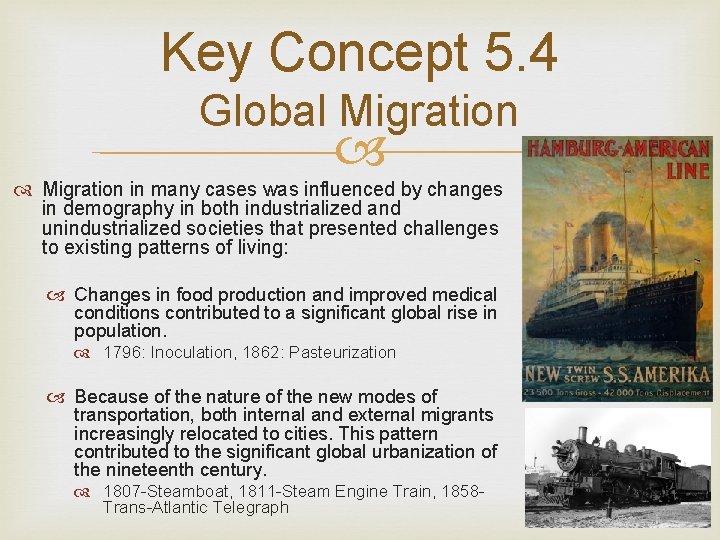
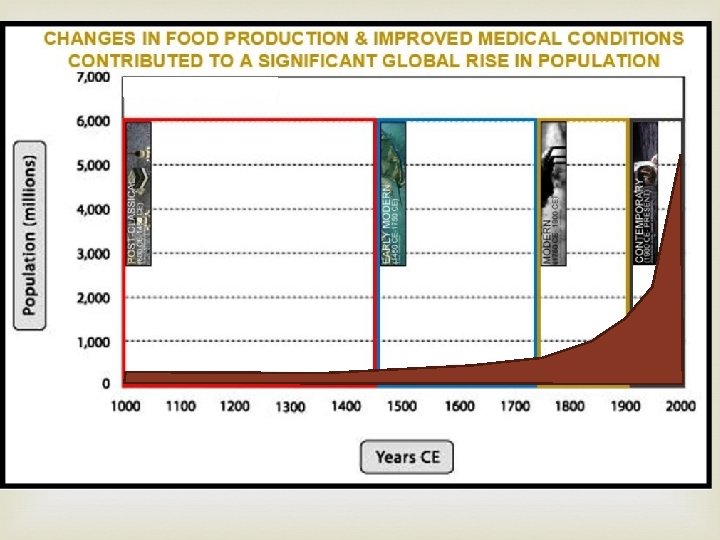
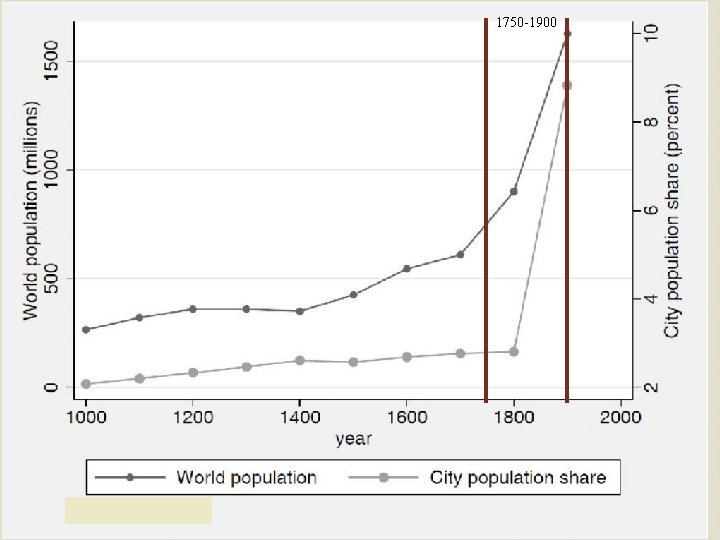
Key Concept 5. 4 Global Migration in many cases was influenced by changes in demography in both industrialized and unindustrialized societies that presented challenges to existing patterns of living: Changes in food production and improved medical conditions contributed to a significant global rise in population. 1796: Inoculation, 1862: Pasteurization Because of the nature of the new modes of transportation, both internal and external migrants increasingly relocated to cities. This pattern contributed to the significant global urbanization of the nineteenth century. 1807 -Steamboat, 1811 -Steam Engine Train, 1858 Trans-Atlantic Telegraph
1750 -1900
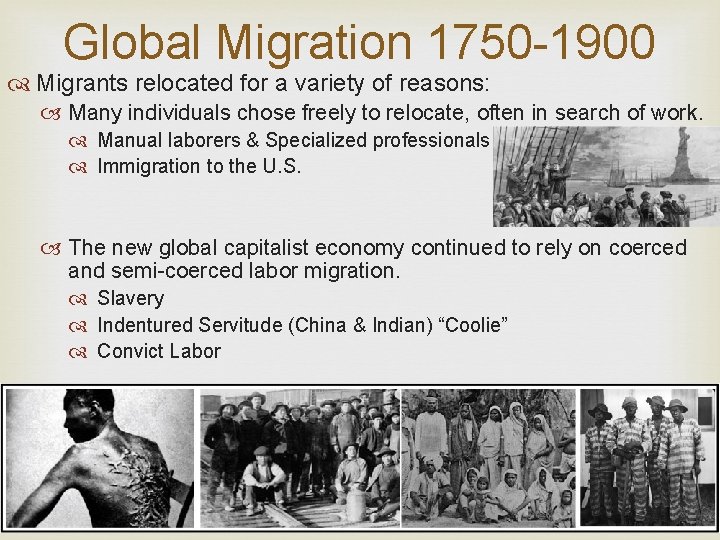
Global Migration 1750 -1900 Migrants relocated for a variety of reasons: Many individuals chose freely to relocate, often in search of work. Manual laborers & Specialized professionals Immigration to the U. S. The new global capitalist economy continued to rely on coerced and semi-coerced labor migration. Slavery Indentured Servitude (China & Indian) “Coolie” Convict Labor
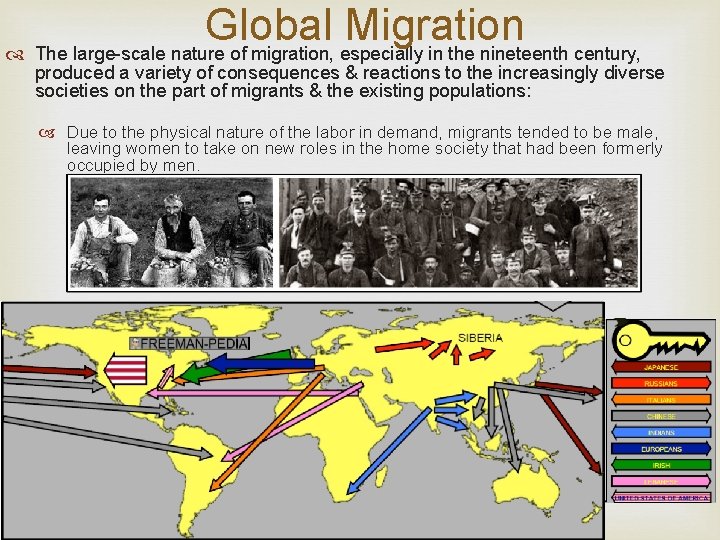
Global Migration The large-scale nature of migration, especially in the nineteenth century, produced a variety of consequences & reactions to the increasingly diverse societies on the part of migrants & the existing populations: Due to the physical nature of the labor in demand, migrants tended to be male, leaving women to take on new roles in the home society that had been formerly occupied by men.
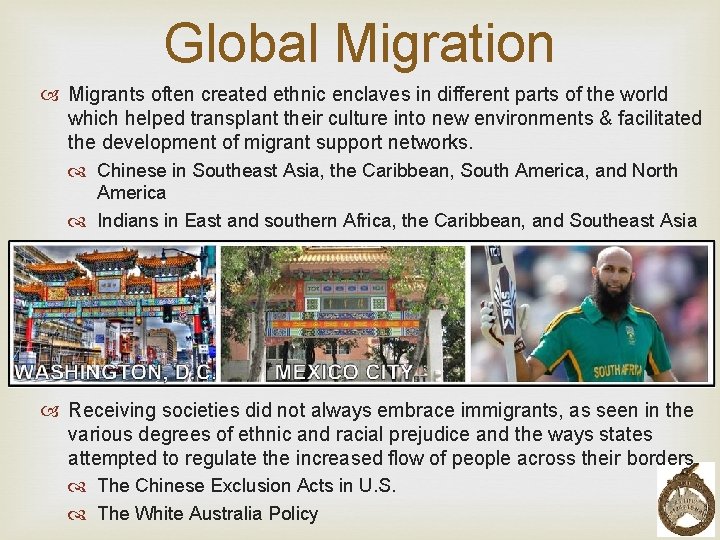
Global Migration Migrants often created ethnic enclaves in different parts of the world which helped transplant their culture into new environments & facilitated the development of migrant support networks. Chinese in Southeast Asia, the Caribbean, South America, and North America Indians in East and southern Africa, the Caribbean, and Southeast Asia Receiving societies did not always embrace immigrants, as seen in the various degrees of ethnic and racial prejudice and the ways states attempted to regulate the increased flow of people across their borders. The Chinese Exclusion Acts in U. S. The White Australia Policy
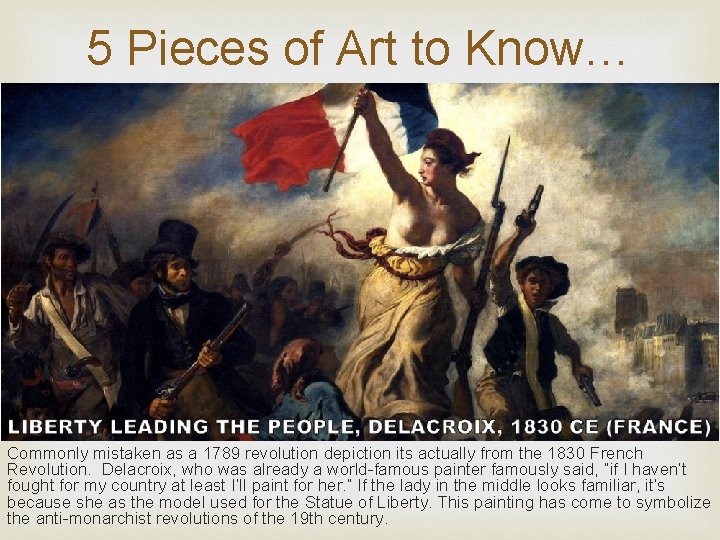
5 Pieces of Art to Know… Commonly mistaken as a 1789 revolution depiction its actually from the 1830 French Revolution. Delacroix, who was already a world-famous painter famously said, “if I haven’t fought for my country at least I’ll paint for her. ” If the lady in the middle looks familiar, it’s because she as the model used for the Statue of Liberty. This painting has come to symbolize the anti-monarchist revolutions of the 19 th century.
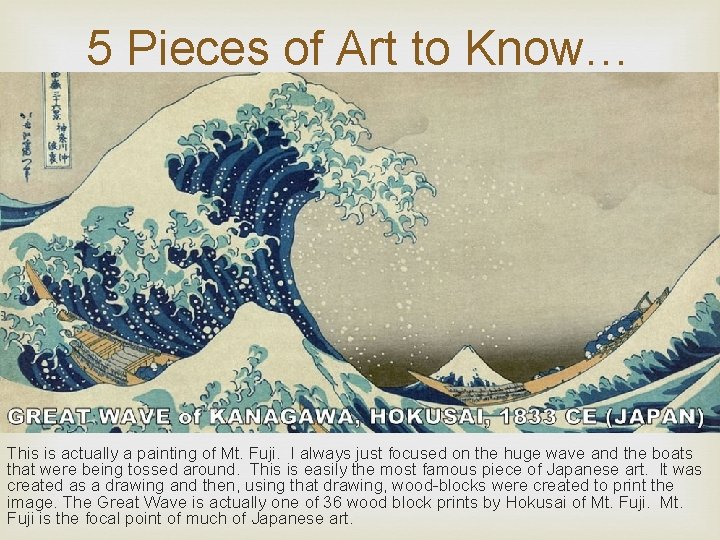
5 Pieces of Art to Know… This is actually a painting of Mt. Fuji. I always just focused on the huge wave and the boats that were being tossed around. This is easily the most famous piece of Japanese art. It was created as a drawing and then, using that drawing, wood-blocks were created to print the image. The Great Wave is actually one of 36 wood block prints by Hokusai of Mt. Fuji is the focal point of much of Japanese art.
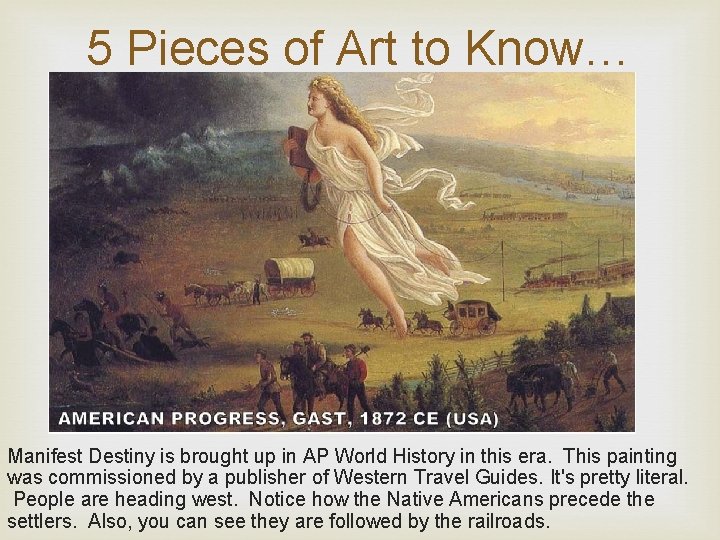
5 Pieces of Art to Know… Manifest Destiny is brought up in AP World History in this era. This painting was commissioned by a publisher of Western Travel Guides. It's pretty literal. People are heading west. Notice how the Native Americans precede the settlers. Also, you can see they are followed by the railroads.
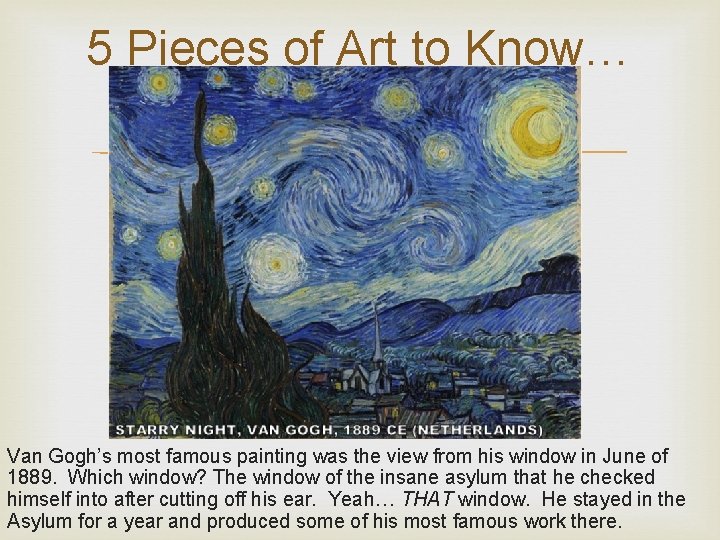
5 Pieces of Art to Know… Van Gogh’s most famous painting was the view from his window in June of 1889. Which window? The window of the insane asylum that he checked himself into after cutting off his ear. Yeah… THAT window. He stayed in the Asylum for a year and produced some of his most famous work there.
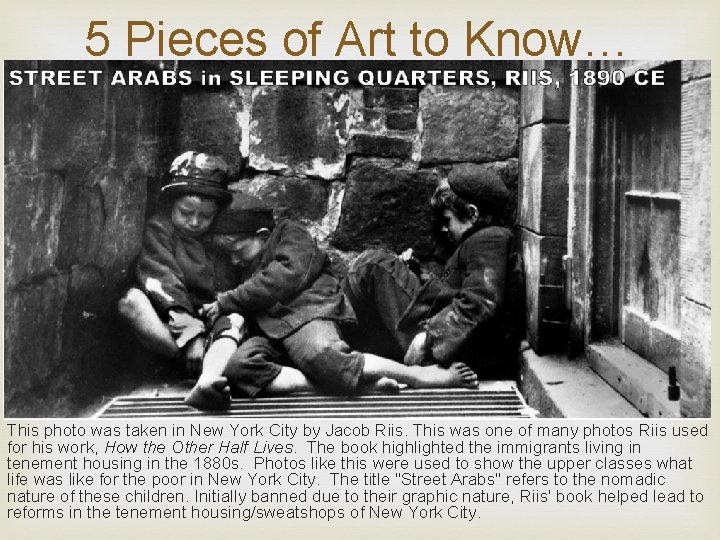
5 Pieces of Art to Know… This photo was taken in New York City by Jacob Riis. This was one of many photos Riis used for his work, How the Other Half Lives. The book highlighted the immigrants living in tenement housing in the 1880 s. Photos like this were used to show the upper classes what life was like for the poor in New York City. The title "Street Arabs" refers to the nomadic nature of these children. Initially banned due to their graphic nature, Riis' book helped lead to reforms in the tenement housing/sweatshops of New York City.
Unit 5 In a Nutshell THE INDUSTRIAL REVOLUTION CHANGED THE WAY THAT EVERYTHING IS MADE AND WOULD LEAD EUROPE TO DOMINATE THE WORLD. USING THEIR NEW INDUSTRIAL POWERS, EUROPE WENT OUT AND CONQUERED EVERYWHERE THEY HAD NOT GOTTEN TO IN THE LAST ERA (CENTRAL AFRICA, ASIA, AUSTRALIA). EUROPEAN ENLIGHTENMENT IDEAS SPREAD AND LED TO REVOLUTIONS IN THE NEW WORLD (AND IN EUROPE). TRADITIONAL WORLD POWERS FROM THE LAST ERA WEAKENED (SPAIN, OTTOMANS, MUGHALS, QING CHINA) WHILE NEW WORLD POWERS ROSE ( USA, GERMANY, JAPAN). HUGE EMPIRES + BOOMING INDUSTRIAL ECONOMIES= GLOBAL MIGRATIONS (People moving for work)