A Lunar Fission Surface Power FSP System Presented
- Slides: 14
A Lunar Fission Surface Power (FSP) System Presented to: Nuclear and Emerging Technologies for Space NETS 2009 James Werner/INL, Project Lead June 15, 2009 Pre-Decisional, For Discussion Purposes Only 1
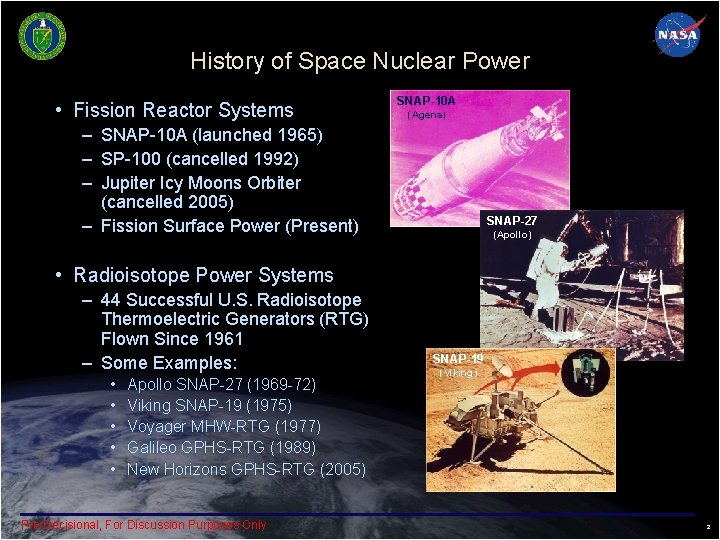
History of Space Nuclear Power • Fission Reactor Systems SNAP-10 A (Agena) – SNAP-10 A (launched 1965) – SP-100 (cancelled 1992) – Jupiter Icy Moons Orbiter (cancelled 2005) – Fission Surface Power (Present) SNAP-27 (Apollo) • Radioisotope Power Systems – 44 Successful U. S. Radioisotope Thermoelectric Generators (RTG) Flown Since 1961 – Some Examples: • • • Apollo SNAP-27 (1969 -72) Viking SNAP-19 (1975) Voyager MHW-RTG (1977) Galileo GPHS-RTG (1989) New Horizons GPHS-RTG (2005) Pre-Decisional, For Discussion Purposes Only SNAP-19 (Viking) 2
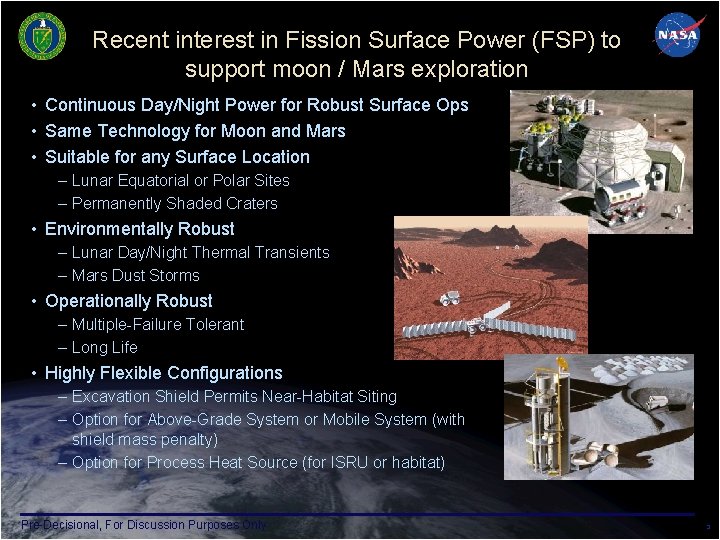
Recent interest in Fission Surface Power (FSP) to support moon / Mars exploration • Continuous Day/Night Power for Robust Surface Ops • Same Technology for Moon and Mars • Suitable for any Surface Location – Lunar Equatorial or Polar Sites – Permanently Shaded Craters • Environmentally Robust – Lunar Day/Night Thermal Transients – Mars Dust Storms • Operationally Robust – Multiple-Failure Tolerant – Long Life • Highly Flexible Configurations – Excavation Shield Permits Near-Habitat Siting – Option for Above-Grade System or Mobile System (with shield mass penalty) – Option for Process Heat Source (for ISRU or habitat) Pre-Decisional, For Discussion Purposes Only 3
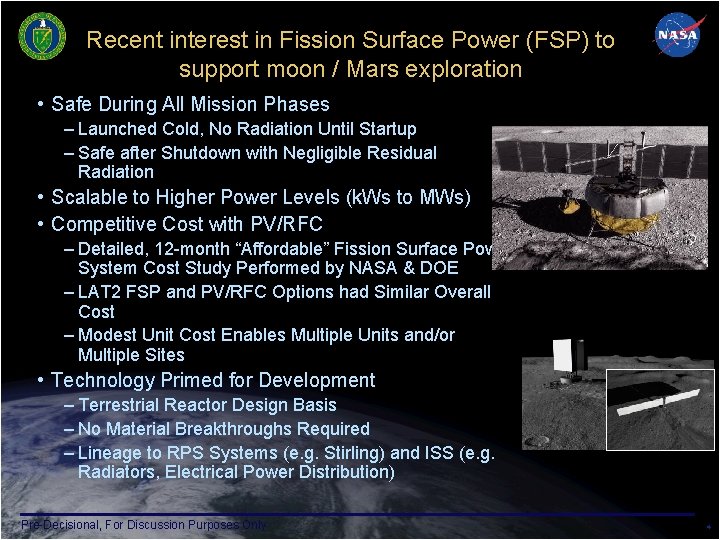
Recent interest in Fission Surface Power (FSP) to support moon / Mars exploration • Safe During All Mission Phases – Launched Cold, No Radiation Until Startup – Safe after Shutdown with Negligible Residual Radiation • Scalable to Higher Power Levels (k. Ws to MWs) • Competitive Cost with PV/RFC – Detailed, 12 -month “Affordable” Fission Surface Power System Cost Study Performed by NASA & DOE – LAT 2 FSP and PV/RFC Options had Similar Overall Cost – Modest Unit Cost Enables Multiple Units and/or Multiple Sites • Technology Primed for Development – Terrestrial Reactor Design Basis – No Material Breakthroughs Required – Lineage to RPS Systems (e. g. Stirling) and ISS (e. g. Radiators, Electrical Power Distribution) Pre-Decisional, For Discussion Purposes Only 4
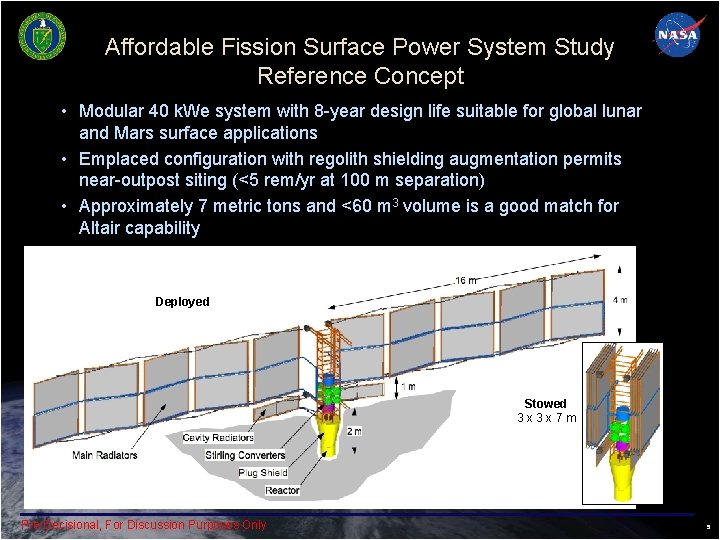
Affordable Fission Surface Power System Study Reference Concept • Modular 40 k. We system with 8 -year design life suitable for global lunar and Mars surface applications • Emplaced configuration with regolith shielding augmentation permits near-outpost siting (<5 rem/yr at 100 m separation) • Approximately 7 metric tons and <60 m 3 volume is a good match for Altair capability Deployed Stowed 3 x 3 x 7 m Pre-Decisional, For Discussion Purposes Only 5
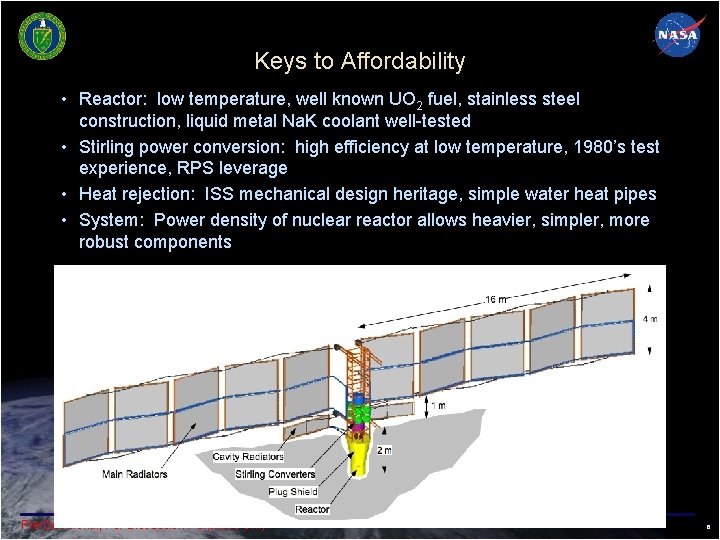
Keys to Affordability • Reactor: low temperature, well known UO 2 fuel, stainless steel construction, liquid metal Na. K coolant well-tested • Stirling power conversion: high efficiency at low temperature, 1980’s test experience, RPS leverage • Heat rejection: ISS mechanical design heritage, simple water heat pipes • System: Power density of nuclear reactor allows heavier, simpler, more robust components Pre-Decisional, For Discussion Purposes Only 6
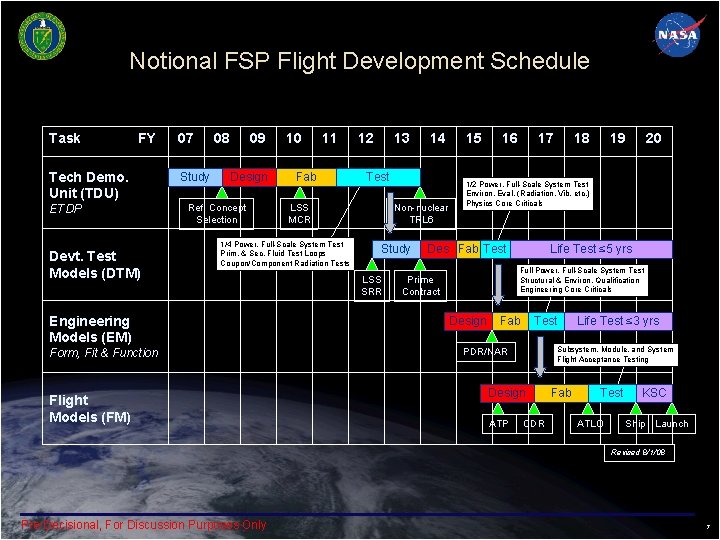
Notional FSP Flight Development Schedule Task FY Tech Demo. Unit (TDU) ETDP Devt. Test Models (DTM) 07 Study 08 09 Design Ref. Concept Selection 10 11 Fab Form, Fit & Function Flight Models (FM) 13 14 Test LSS MCR 1/4 Power, Full-Scale System Test Prim. & Sec. Fluid Test Loops Coupon/Component Radiation Tests Engineering Models (EM) 12 Non-nuclear TRL 6 Study LSS SRR 15 16 17 18 19 20 1/2 Power, Full-Scale System Test Environ. Eval. (Radiation, Vib, etc. ) Physics Core Criticals Des Fab Test Life Test ≤ 5 yrs Full Power, Full-Scale System Test Structural & Environ. Qualification Engineering Core Criticals Prime Contract Design Fab Test Subsystem, Module, and System Flight Acceptance Testing PDR/NAR Design ATP Life Test ≤ 3 yrs CDR Fab Test ATLO KSC Ship Launch Revised 8/1/08 Pre-Decisional, For Discussion Purposes Only 7
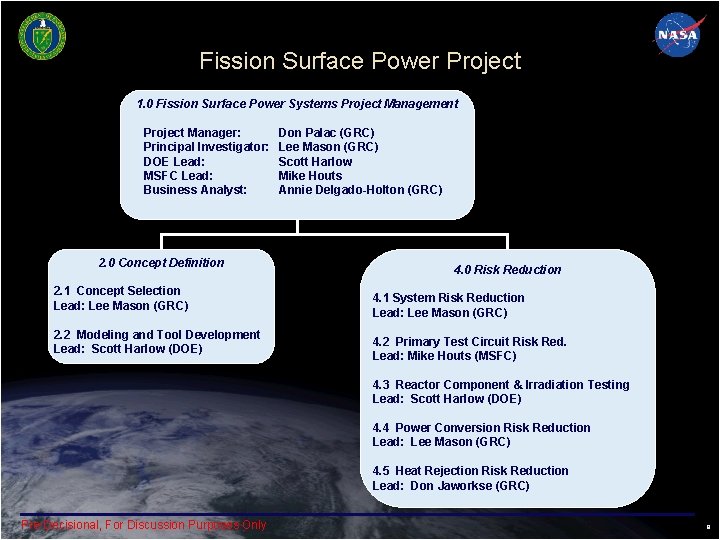
Fission Surface Power Project 1. 0 Fission Surface Power Systems Project Management Project Manager: Principal Investigator: DOE Lead: MSFC Lead: Business Analyst: 2. 0 Concept Definition 2. 1 Concept Selection Lead: Lee Mason (GRC) 2. 2 Modeling and Tool Development Lead: Scott Harlow (DOE) Don Palac (GRC) Lee Mason (GRC) Scott Harlow Mike Houts Annie Delgado-Holton (GRC) 4. 0 Risk Reduction 4. 1 System Risk Reduction Lead: Lee Mason (GRC) 4. 2 Primary Test Circuit Risk Red. Lead: Mike Houts (MSFC) 4. 3 Reactor Component & Irradiation Testing Lead: Scott Harlow (DOE) 4. 4 Power Conversion Risk Reduction Lead: Lee Mason (GRC) 4. 5 Heat Rejection Risk Reduction Lead: Don Jaworkse (GRC) Pre-Decisional, For Discussion Purposes Only 8
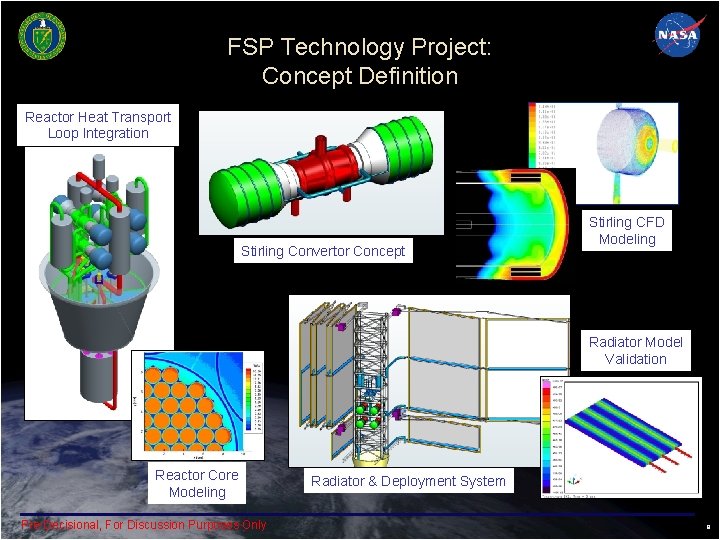
FSP Technology Project: Concept Definition Reactor Heat Transport Loop Integration Stirling Convertor Concept Stirling CFD Modeling Radiator Model Validation Reactor Core Modeling Pre-Decisional, For Discussion Purposes Only Radiator & Deployment System 9
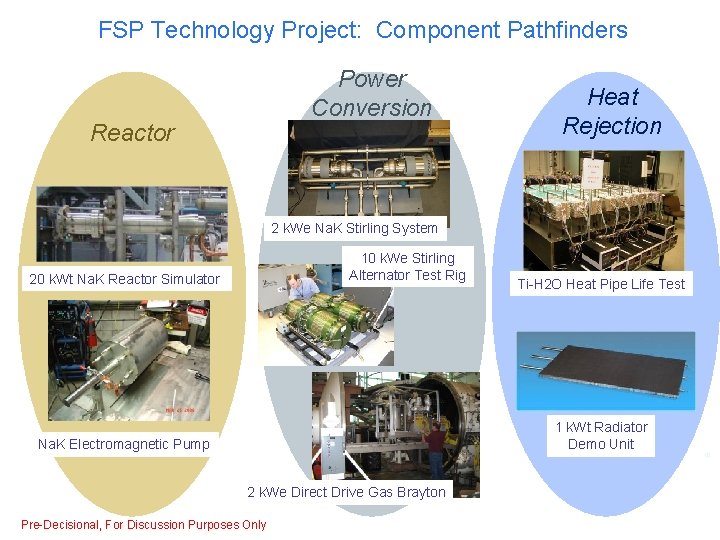
FSP Technology Project: Component Pathfinders Power Conversion Reactor Heat Rejection 2 k. We Na. K Stirling System 10 k. We Stirling Alternator Test Rig 20 k. Wt Na. K Reactor Simulator Ti-H 2 O Heat Pipe Life Test 1 k. Wt Radiator Demo Unit Na. K Electromagnetic Pump 2 k. We Direct Drive Gas Brayton Pre-Decisional, For Discussion Purposes Only 10
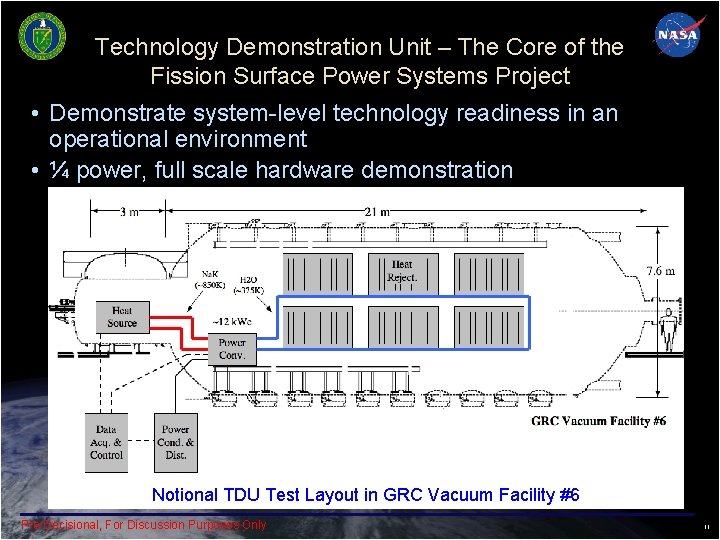
Technology Demonstration Unit – The Core of the Fission Surface Power Systems Project • Demonstrate system-level technology readiness in an operational environment • ¼ power, full scale hardware demonstration Notional TDU Test Layout in GRC Vacuum Facility #6 Pre-Decisional, For Discussion Purposes Only 11
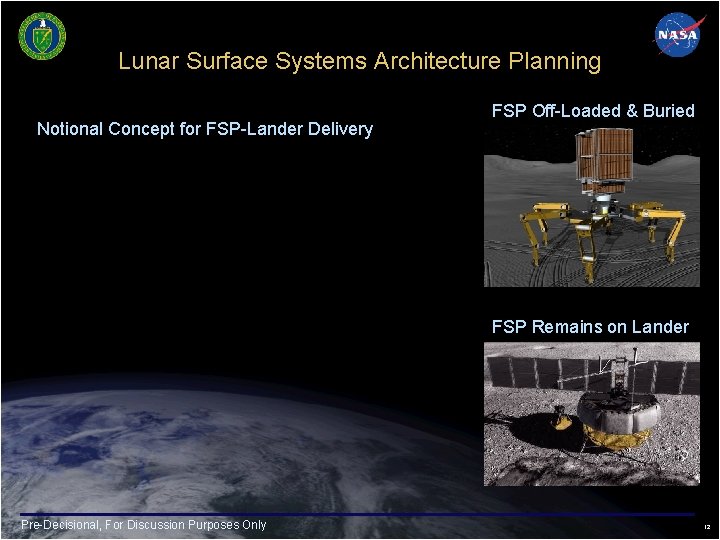
Lunar Surface Systems Architecture Planning Notional Concept for FSP-Lander Delivery FSP Off-Loaded & Buried FSP Remains on Lander Pre-Decisional, For Discussion Purposes Only 12
Summary • FSP has many advantages – – – Day/night power Location independence Environment tolerance Moon/Mars commonality High power, low mass • Mission integration options are plentiful – Buried or Landed, Early or Later, With or without PV – Minimal impact on crew – Major impact on surface capabilities • Affordability = Conservative, Simple, Robust – Known materials, generous margins – Modest requirements – Self-regulating controls – Fault tolerant, designed to recover from anomalies – Hardware-rich test program – Low risk, accept mass penalties if necessary FSP Technology Development Project is addressing the fundamental issues Pre-Decisional, For Discussion Purposes Only 13
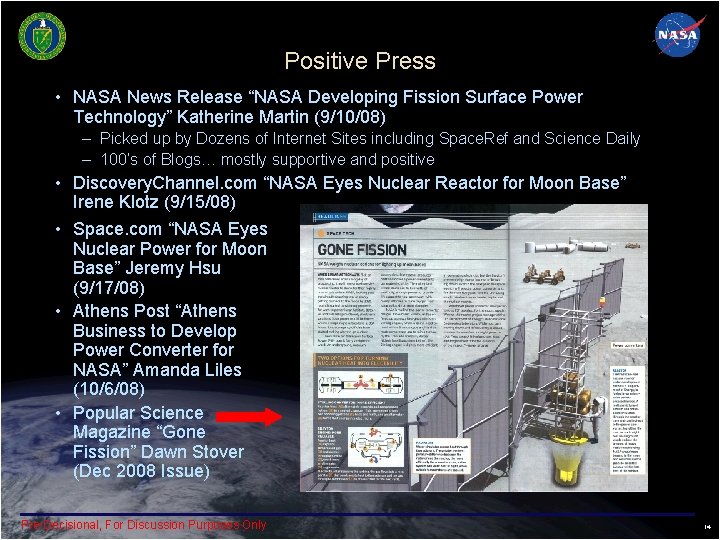
Positive Press • NASA News Release “NASA Developing Fission Surface Power Technology” Katherine Martin (9/10/08) – Picked up by Dozens of Internet Sites including Space. Ref and Science Daily – 100’s of Blogs… mostly supportive and positive • Discovery. Channel. com “NASA Eyes Nuclear Reactor for Moon Base” Irene Klotz (9/15/08) • Space. com “NASA Eyes Nuclear Power for Moon Base” Jeremy Hsu (9/17/08) • Athens Post “Athens Business to Develop Power Converter for NASA” Amanda Liles (10/6/08) • Popular Science Magazine “Gone Fission” Dawn Stover (Dec 2008 Issue) Pre-Decisional, For Discussion Purposes Only 14