9 12 3 Notes Direct and Inverse Variation

- Slides: 18
9 -1/2 -3 Notes Direct and Inverse Variation
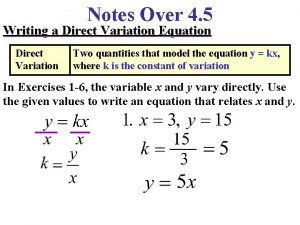
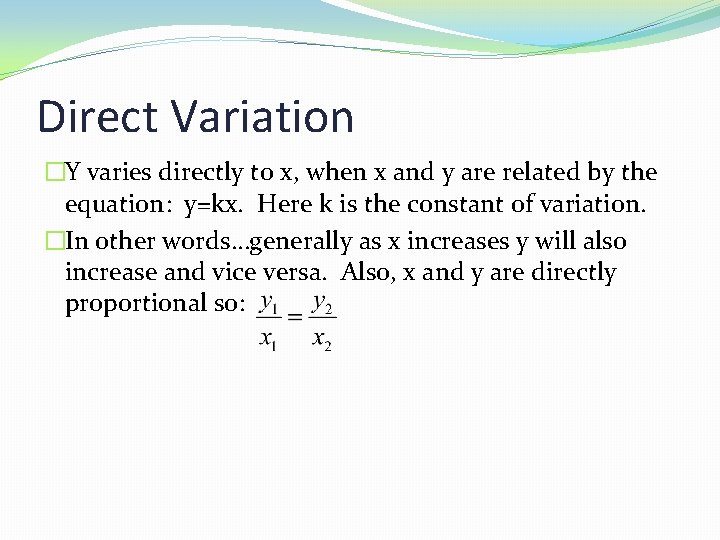
Direct Variation �Y varies directly to x, when x and y are related by the equation: y=kx. Here k is the constant of variation. �In other words…generally as x increases y will also increase and vice versa. Also, x and y are directly proportional so:
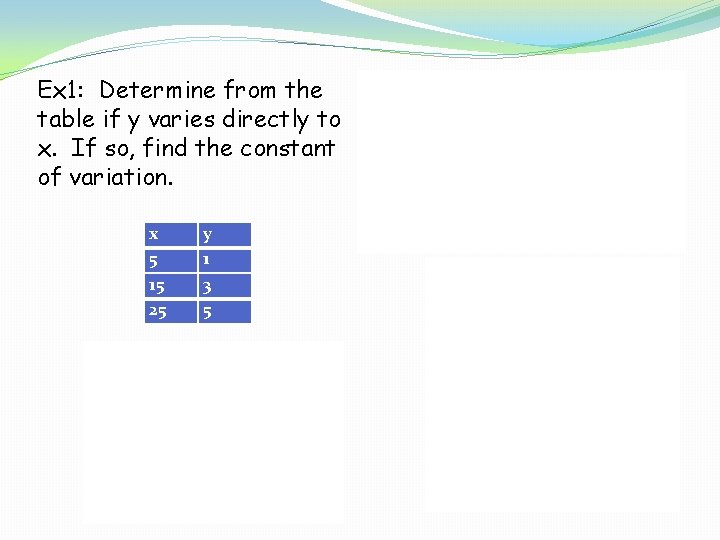
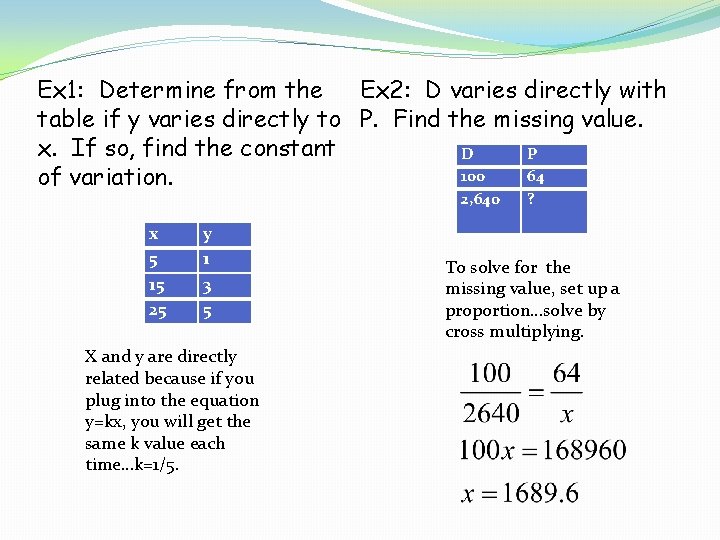
Ex 1: Determine from the Ex 2: D varies directly with table if y varies directly to P. Find the missing value. x. If so, find the constant D P 100 64 of variation. 2, 640 x 5 15 25 y 1 3 5 X and y are directly related because if you plug into the equation y=kx, you will get the same k value each time…k=1/5. ? To solve for the missing value, set up a proportion…solve by cross multiplying.
Ex 1: Determine from the Ex 2: D varies directly with table if y varies directly to P. Find the missing value. x. If so, find the constant D P 100 64 of variation. 2, 640 x 5 15 25 y 1 3 5 X and y are directly related because if you plug into the equation y=kx, you will get the same k value each time…k=1/5. ? To solve for the missing value, set up a proportion…solve by cross multiplying.
Do numbers 1 to 4…Compare answers as a class.
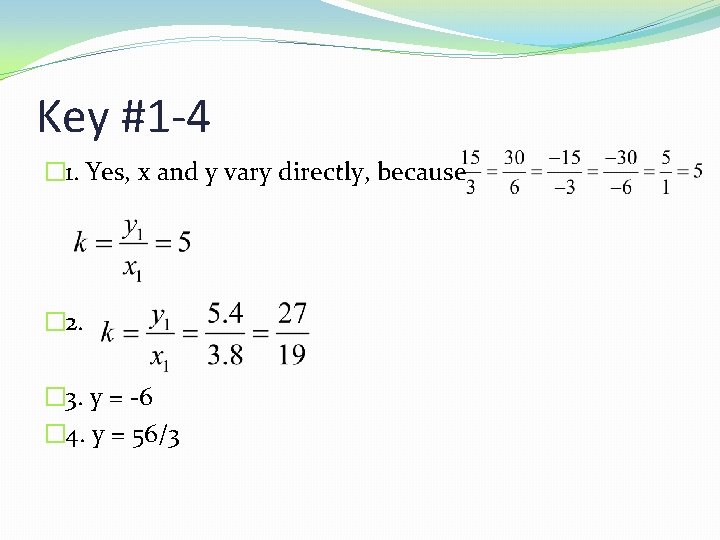
Key #1 -4 � 1. Yes, x and y vary directly, because � 2. � 3. y = -6 � 4. y = 56/3
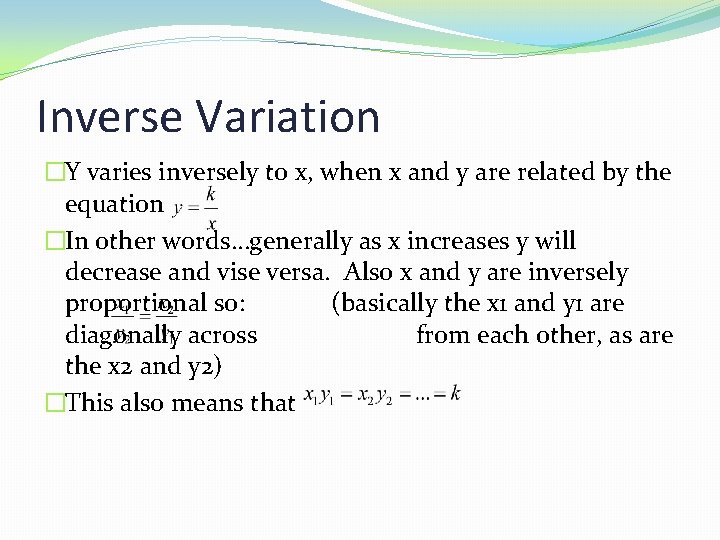
Inverse Variation �Y varies inversely to x, when x and y are related by the equation �In other words…generally as x increases y will decrease and vise versa. Also x and y are inversely proportional so: (basically the x 1 and y 1 are diagonally across from each other, as are the x 2 and y 2) �This also means that
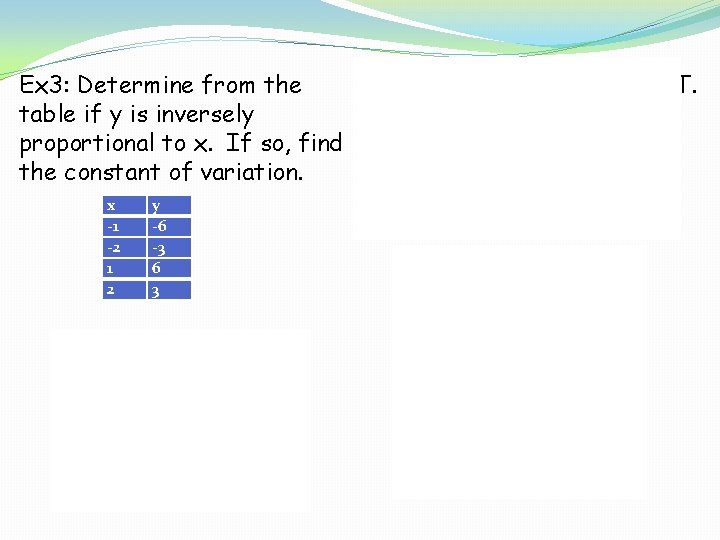
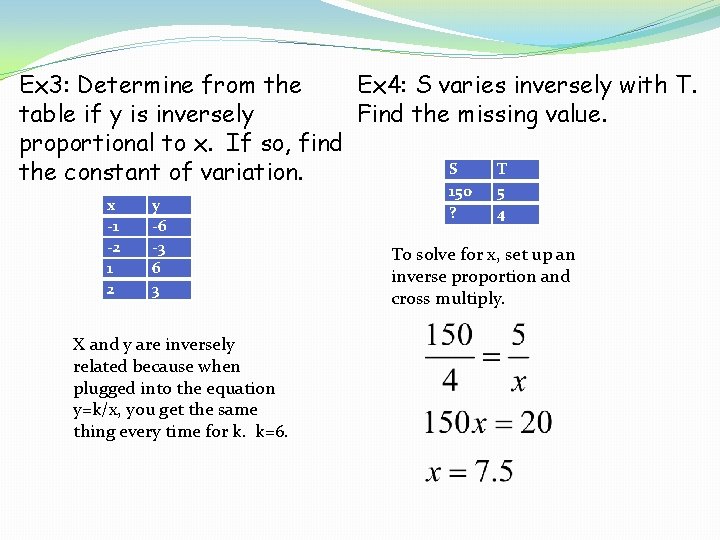
Ex 3: Determine from the Ex 4: S varies inversely with T. table if y is inversely Find the missing value. proportional to x. If so, find S T the constant of variation. x -1 -2 1 2 y -6 -3 6 3 X and y are inversely related because when plugged into the equation y=k/x, you get the same thing every time for k. k=6. 150 ? 5 4 To solve for x, set up an inverse proportion and cross multiply.
Ex 3: Determine from the Ex 4: S varies inversely with T. table if y is inversely Find the missing value. proportional to x. If so, find S T the constant of variation. x -1 -2 1 2 y -6 -3 6 3 X and y are inversely related because when plugged into the equation y=k/x, you get the same thing every time for k. k=6. 150 ? 5 4 To solve for x, set up an inverse proportion and cross multiply.
Do numbers 5 to 8…Compare answers as a class.
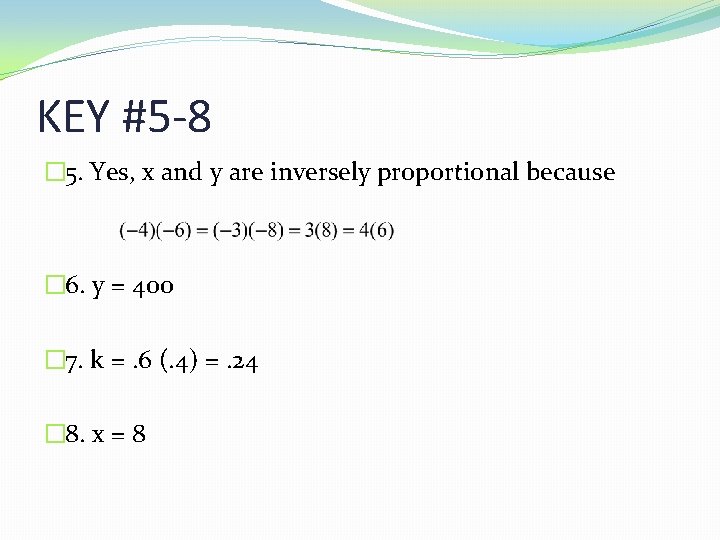
KEY #5 -8 � 5. Yes, x and y are inversely proportional because � 6. y = 400 � 7. k =. 6 (. 4) =. 24 � 8. x = 8
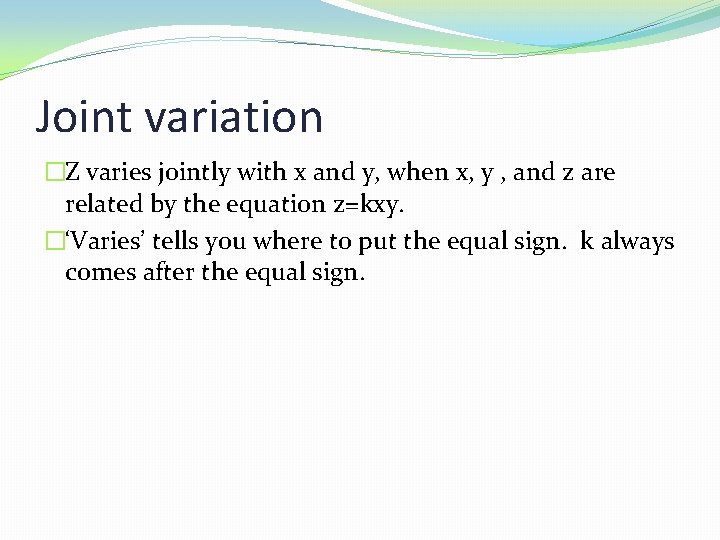
Joint variation �Z varies jointly with x and y, when x, y , and z are related by the equation z=kxy. �‘Varies’ tells you where to put the equal sign. k always comes after the equal sign.
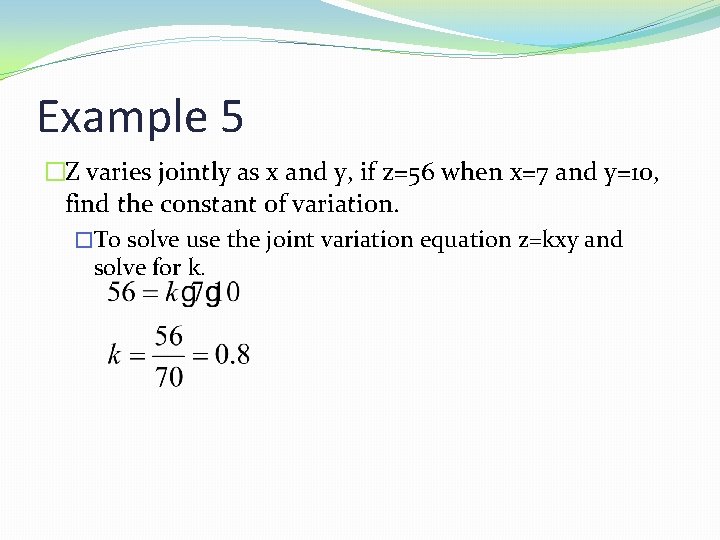
Example 5 �Z varies jointly as x and y, if z=56 when x=7 and y=10, find the constant of variation. �To solve use the joint variation equation z=kxy and solve for k.
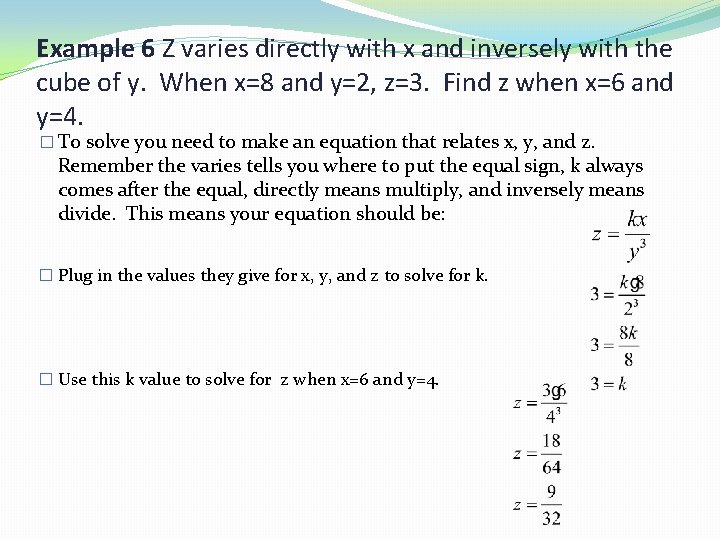
Example 6 Z varies directly with x and inversely with the cube of y. When x=8 and y=2, z=3. Find z when x=6 and y=4. � To solve you need to make an equation that relates x, y, and z. Remember the varies tells you where to put the equal sign, k always comes after the equal, directly means multiply, and inversely means divide. This means your equation should be: � Plug in the values they give for x, y, and z to solve for k. � Use this k value to solve for z when x=6 and y=4.
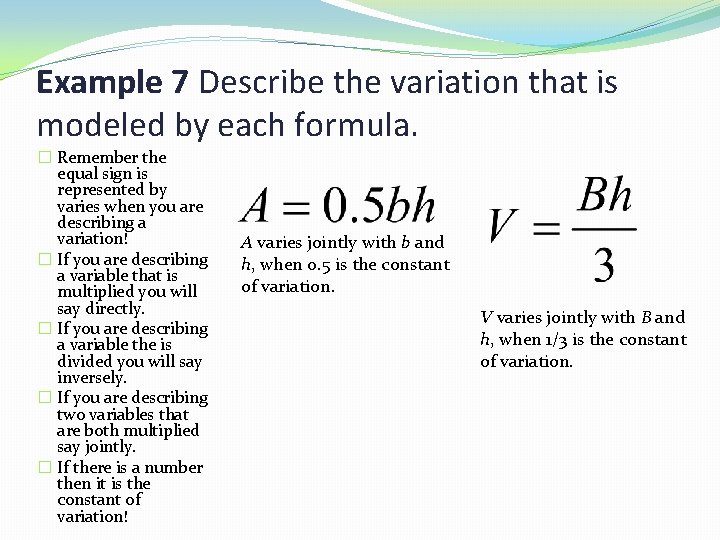
Example 7 Describe the variation that is modeled by each formula. � Remember the equal sign is represented by varies when you are describing a variation! � If you are describing a variable that is multiplied you will say directly. � If you are describing a variable the is divided you will say inversely. � If you are describing two variables that are both multiplied say jointly. � If there is a number then it is the constant of variation! A varies jointly with b and h, when 0. 5 is the constant of variation. V varies jointly with B and h, when 1/3 is the constant of variation.
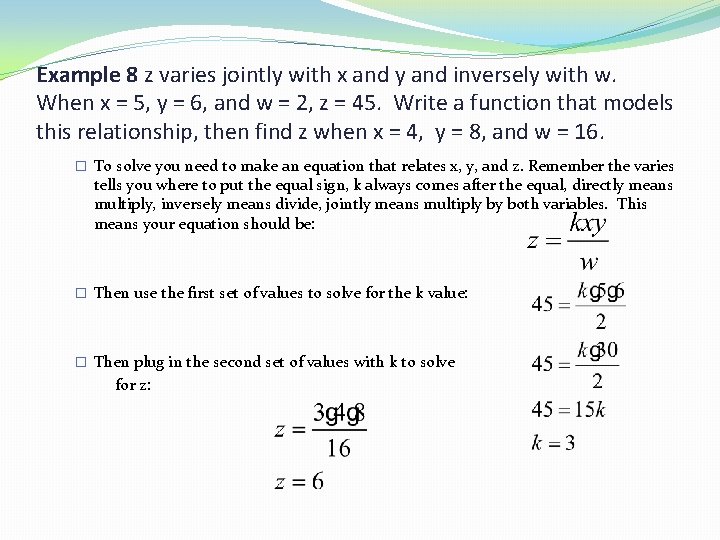
Example 8 z varies jointly with x and y and inversely with w. When x = 5, y = 6, and w = 2, z = 45. Write a function that models this relationship, then find z when x = 4, y = 8, and w = 16. � To solve you need to make an equation that relates x, y, and z. Remember the varies tells you where to put the equal sign, k always comes after the equal, directly means multiply, inversely means divide, jointly means multiply by both variables. This means your equation should be: � Then use the first set of values to solve for the k value: � Then plug in the second set of values with k to solve for z:
Do numbers 9 to 20…Compare as a class.
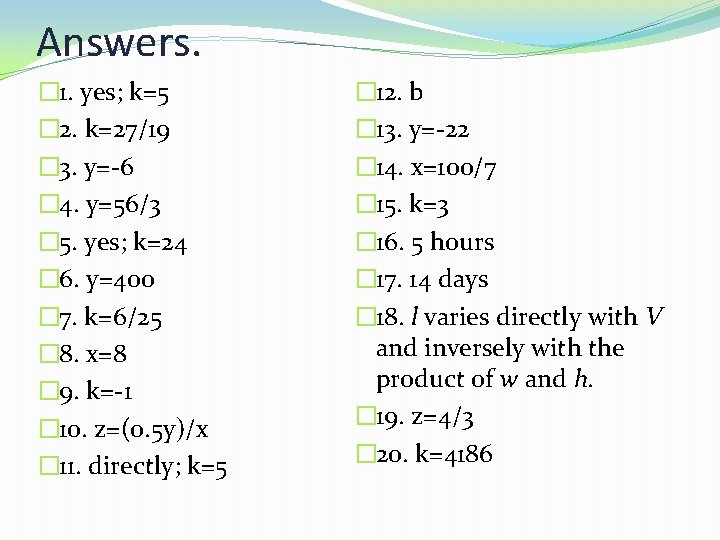
Answers. � 1. yes; k=5 � 2. k=27/19 � 3. y=-6 � 4. y=56/3 � 5. yes; k=24 � 6. y=400 � 7. k=6/25 � 8. x=8 � 9. k=-1 � 10. z=(0. 5 y)/x � 11. directly; k=5 � 12. b � 13. y=-22 � 14. x=100/7 � 15. k=3 � 16. 5 hours � 17. 14 days � 18. l varies directly with V and inversely with the product of w and h. � 19. z=4/3 � 20. k=4186