8 th Annual CMAS Conference 19 21 th
- Slides: 20
8 th Annual CMAS Conference 19 -21 th October, 2009 EFFICIENT CHARACTERIZATION OF UNCERTAINTY IN CONTROL STRATEGY IMPACT PREDICTIONS Antara Digar and Daniel S. Cohan Rice University CMAS
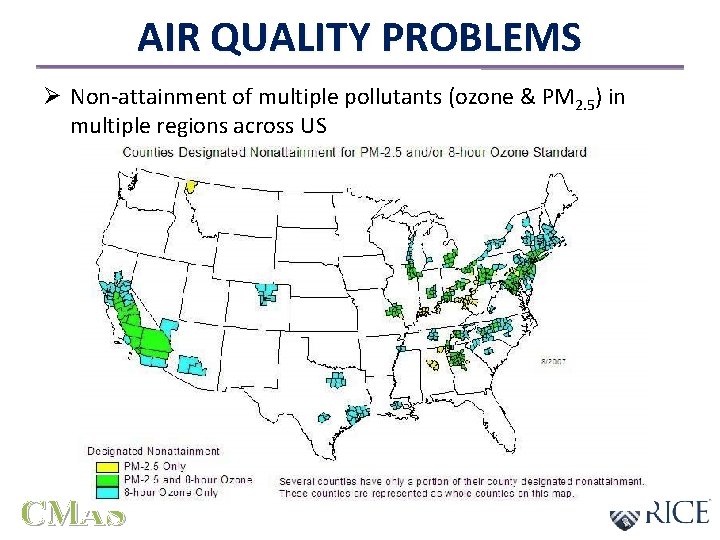
AIR QUALITY PROBLEMS Ø Non-attainment of multiple pollutants (ozone & PM 2. 5) in multiple regions across US CMAS
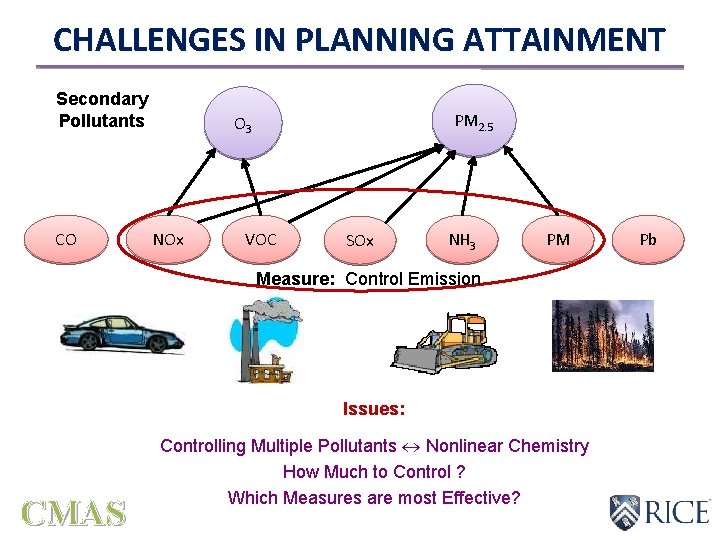
CHALLENGES IN PLANNING ATTAINMENT Secondary Pollutants CO PM 2. 5 O 3 NOx VOC SOx NH 3 PM Measure: Control Emission Issues: CMAS Controlling Multiple Pollutants Nonlinear Chemistry How Much to Control ? Which Measures are most Effective? Pb
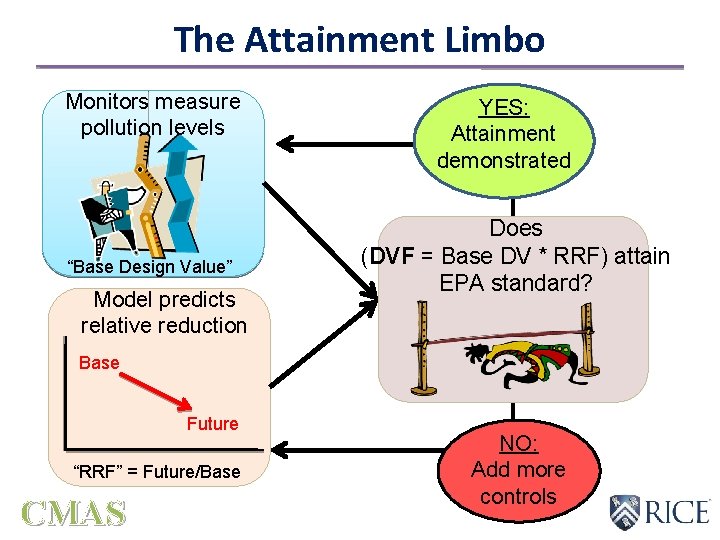
The Attainment Limbo Monitors measure pollution levels “Base Design Value” Model predicts relative reduction YES: Attainment demonstrated Does (DVF = Base DV * RRF) attain EPA standard? Base Future “RRF” = Future/Base CMAS NO: Add more controls
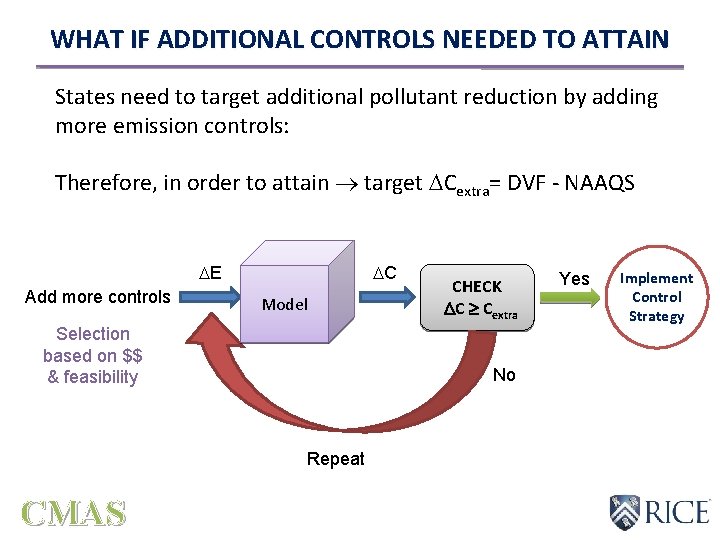
WHAT IF ADDITIONAL CONTROLS NEEDED TO ATTAIN States need to target additional pollutant reduction by adding more emission controls: Therefore, in order to attain target Cextra= DVF - NAAQS E Add more controls C Model Selection based on $$ & feasibility No Repeat CMAS CHECK C Cextra Yes Implement Control Strategy
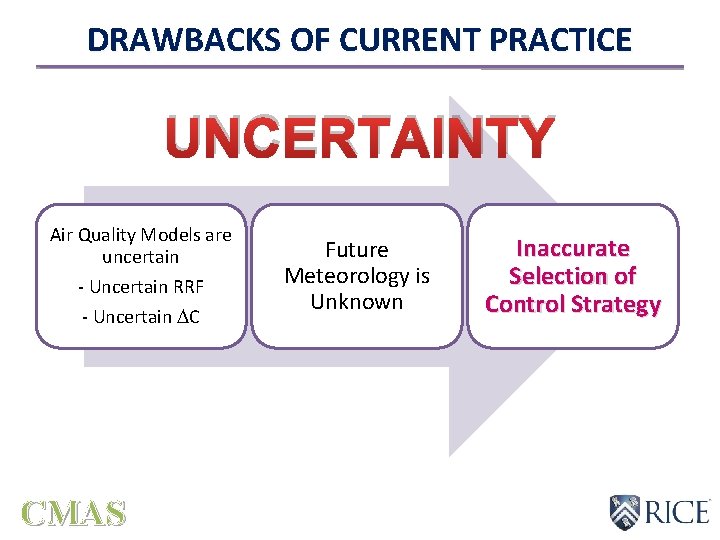
DRAWBACKS OF CURRENT PRACTICE UNCERTAINTY Air Quality Models are uncertain - Uncertain RRF - Uncertain C CMAS Future Meteorology is Unknown Inaccurate Selection of Control Strategy
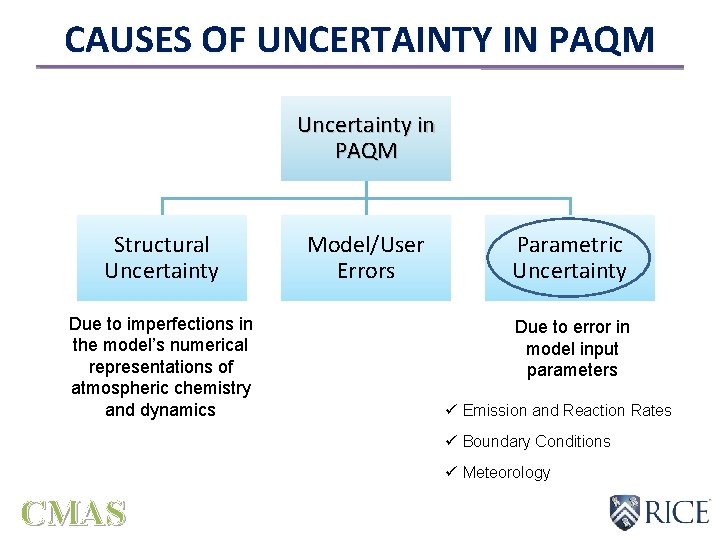
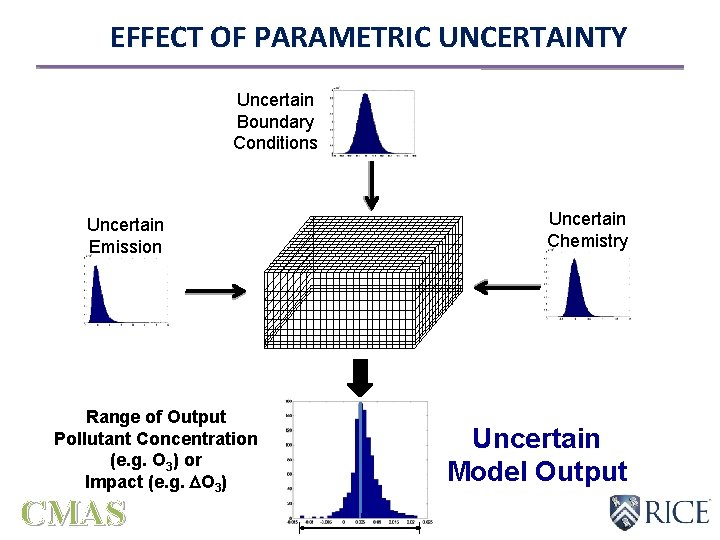
CAUSES OF UNCERTAINTY IN PAQM Uncertainty in PAQM Structural Uncertainty Due to imperfections in the model’s numerical representations of atmospheric chemistry and dynamics Model/User Errors Parametric Uncertainty Due to error in model input parameters ü Emission and Reaction Rates ü Boundary Conditions ü Meteorology CMAS
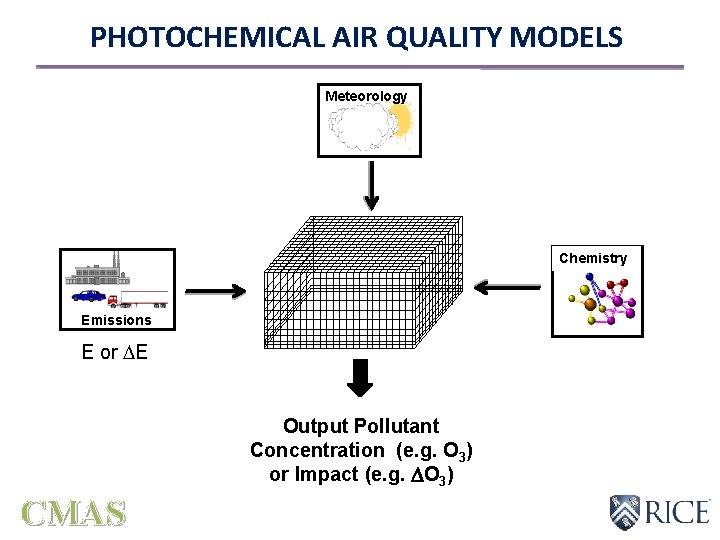
PHOTOCHEMICAL AIR QUALITY MODELS Meteorology Chemistry Emissions E or E Output Pollutant Concentration (e. g. O 3) or Impact (e. g. O 3) CMAS
EFFECT OF PARAMETRIC UNCERTAINTY Uncertain Boundary Conditions Uncertain Emission Range of Output Pollutant Concentration (e. g. O 3) or Impact (e. g. O 3) CMAS Uncertain Chemistry Uncertain Model Output
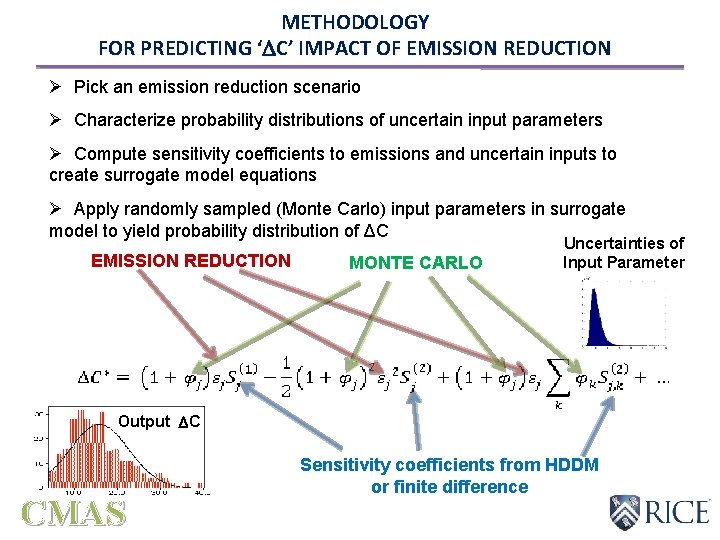
METHODOLOGY FOR PREDICTING ‘ C’ IMPACT OF EMISSION REDUCTION Ø Pick an emission reduction scenario Ø Characterize probability distributions of uncertain input parameters Ø Compute sensitivity coefficients to emissions and uncertain inputs to create surrogate model equations Ø Apply randomly sampled (Monte Carlo) input parameters in surrogate model to yield probability distribution of ΔC EMISSION REDUCTION MONTE CARLO Uncertainties of Input Parameter Output C CMAS Sensitivity coefficients from HDDM or finite difference
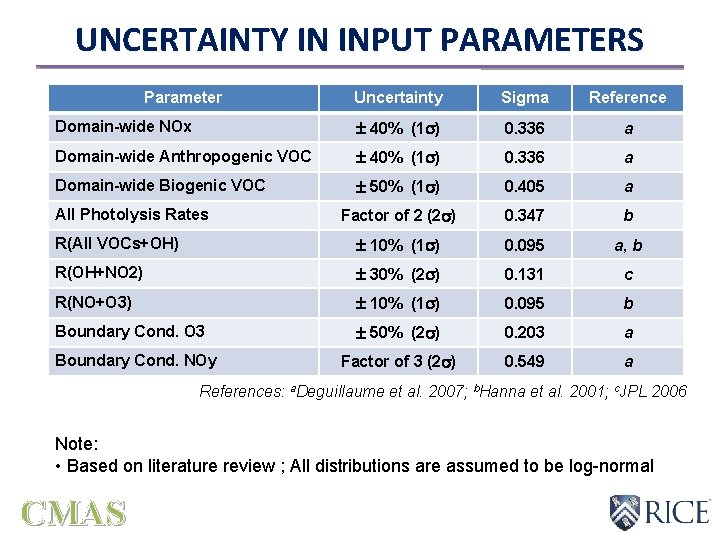
UNCERTAINTY IN INPUT PARAMETERS Parameter Uncertainty Sigma Reference Domain-wide NOx 40% (1 ) 0. 336 a Domain-wide Anthropogenic VOC 40% (1 ) 0. 336 a Domain-wide Biogenic VOC 50% (1 ) 0. 405 a Factor of 2 (2 ) 0. 347 b R(All VOCs+OH) 10% (1 ) 0. 095 a, b R(OH+NO 2) 30% (2 ) 0. 131 c R(NO+O 3) 10% (1 ) 0. 095 b Boundary Cond. O 3 50% (2 ) 0. 203 a Factor of 3 (2 ) 0. 549 a All Photolysis Rates Boundary Cond. NOy References: a. Deguillaume et al. 2007; b. Hanna et al. 2001; c. JPL 2006 Note: • Based on literature review ; All distributions are assumed to be log-normal CMAS
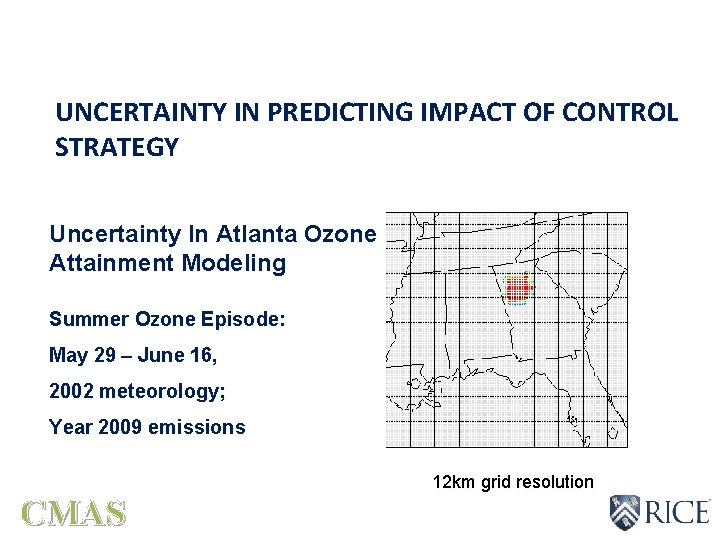
UNCERTAINTY IN PREDICTING IMPACT OF CONTROL STRATEGY Uncertainty In Atlanta Ozone Attainment Modeling Summer Ozone Episode: May 29 – June 16, 2002 meteorology; Year 2009 emissions CMAS 12 km grid resolution
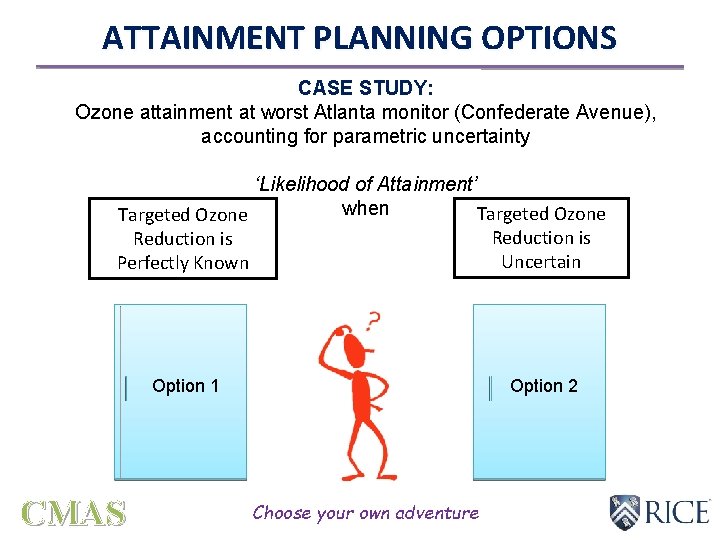
ATTAINMENT PLANNING OPTIONS CASE STUDY: Ozone attainment at worst Atlanta monitor (Confederate Avenue), accounting for parametric uncertainty ‘Likelihood of Attainment’ when Targeted Ozone Reduction is Uncertain Perfectly Known Option 1 CMAS Option 2 Choose your own adventure
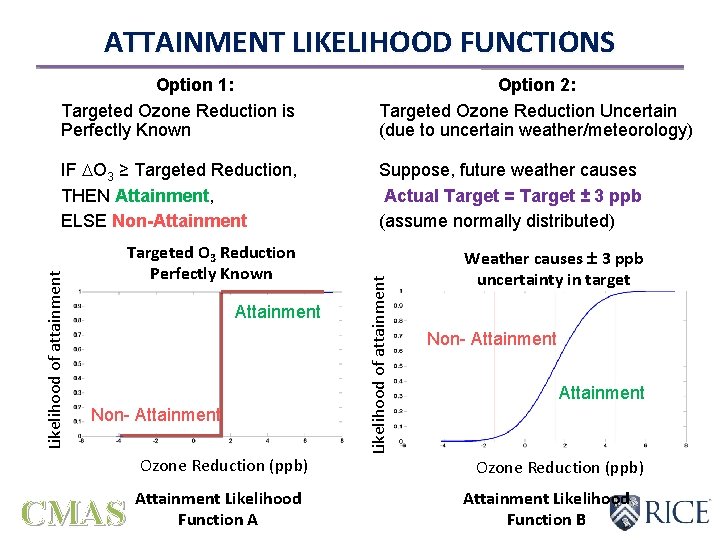
ATTAINMENT LIKELIHOOD FUNCTIONS IF O 3 ≥ Targeted Reduction, THEN Attainment, ELSE Non-Attainment Suppose, future weather causes Actual Target = Target ± 3 ppb (assume normally distributed) Targeted O 3 Reduction Perfectly Known Weather causes 3 ppb uncertainty in target Attainment Non- Attainment Ozone Reduction (ppb) CMAS Attainment Likelihood Function A Likelihood of attainment Option 2: Targeted Ozone Reduction Uncertain (due to uncertain weather/meteorology) Likelihood of attainment Option 1: Targeted Ozone Reduction is Perfectly Known Non- Attainment Ozone Reduction (ppb) Attainment Likelihood Function B
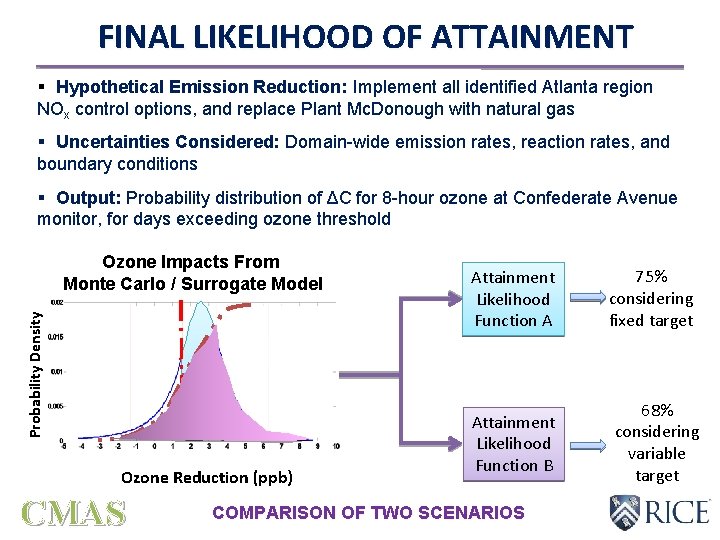
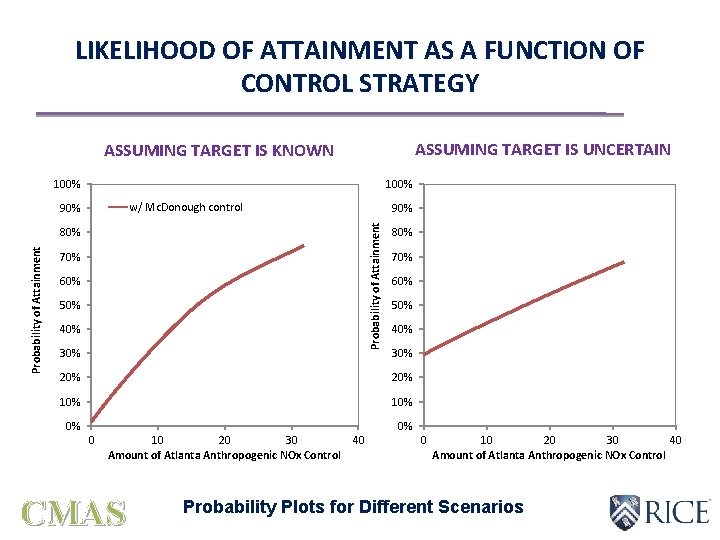
FINAL LIKELIHOOD OF ATTAINMENT § Hypothetical Emission Reduction: Implement all identified Atlanta region NOx control options, and replace Plant Mc. Donough with natural gas § Uncertainties Considered: Domain-wide emission rates, reaction rates, and boundary conditions § Output: Probability distribution of ΔC for 8 -hour ozone at Confederate Avenue monitor, for days exceeding ozone threshold Probability Density Ozone Impacts From Monte Carlo / Surrogate Model Ozone Reduction (ppb) CMAS Attainment Likelihood Function A Attainment Likelihood Function B COMPARISON OF TWO SCENARIOS 75% considering fixed target 68% considering variable target
LIKELIHOOD OF ATTAINMENT AS A FUNCTION OF CONTROL STRATEGY ASSUMING TARGET IS UNCERTAIN ASSUMING TARGET IS KNOWN 100% w/ Mc. Donough control 80% Probability of Attainment 90% 70% 60% 50% 40% 30% 80% 70% 60% 50% 40% 30% 20% 10% 0% 0% 0 10 20 30 40 Amount of Atlanta Anthropogenic NOx Control CMAS 0 10 20 30 40 Amount of Atlanta Anthropogenic NOx Control Probability Plots for Different Scenarios
SUMMARY Ø Uncertainty is typically neglected in modeling impact of SIP control measures Ø Efficient new method to characterize probabilistic impact of controls under parametric uncertainty Ø Demonstration for Atlanta ozone case study Ø Can flexibly apply with alternate control amounts and input uncertainties Ø Can compute likelihood of attaining a known or uncertain pollution reduction target Ø Likelihood of attainment is far more responsive to amount of emission control if the target is known (fixed) CMAS
FUTURE PLAN OF ACTION Explore the likelihood of ozone attainment under different available control scenarios Extend to winter episode for PM 2. 5 Assess which controls are most effective at improving attainment likelihood & health Jointly consider uncertainty in cost, AQ sensitivity, and health estimates CMAS
ACKNOWLEDGEMENT U. S. EPA For funding our project (STAR Grant # R 833665) GA EPD For providing emission data and baseline modeling CMAS
For further information & updates of our project Contact: antara@rice. edu Log on to http: //uncertainty. rice. edu/ CMAS