600 325425 Declarative Methods Prof Jason Eisner MWF

- Slides: 11
600. 325/425 Declarative Methods Prof. Jason Eisner MWF 3 -4 pm (sometimes 3 -4: 15) 600. 325/425 Declarative Methods - J. Eisner 1
What is this course about? n What do you learn in a programming course? q q How to use a language (e. g. , Java) to solve problems How the computer actually executes that language n n (Why do you need to know this? ) Ok, this is a programming course q q We’ll survey several languages But they aren’t normal languages! 600. 325/425 Declarative Methods - J. Eisner 2
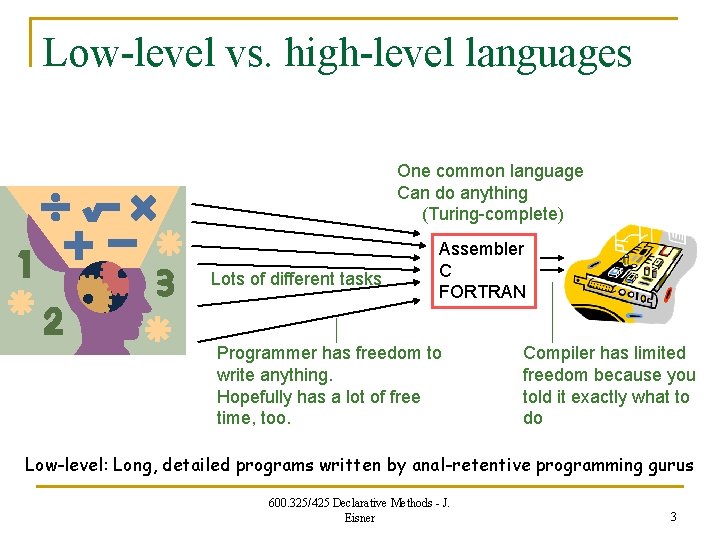
Low-level vs. high-level languages One common language Can do anything (Turing-complete) Lots of different tasks Assembler C FORTRAN Programmer has freedom to write anything. Hopefully has a lot of free time, too. Compiler has limited freedom because you told it exactly what to do Low-level: Long, detailed programs written by anal-retentive programming gurus 600. 325/425 Declarative Methods - J. Eisner 3
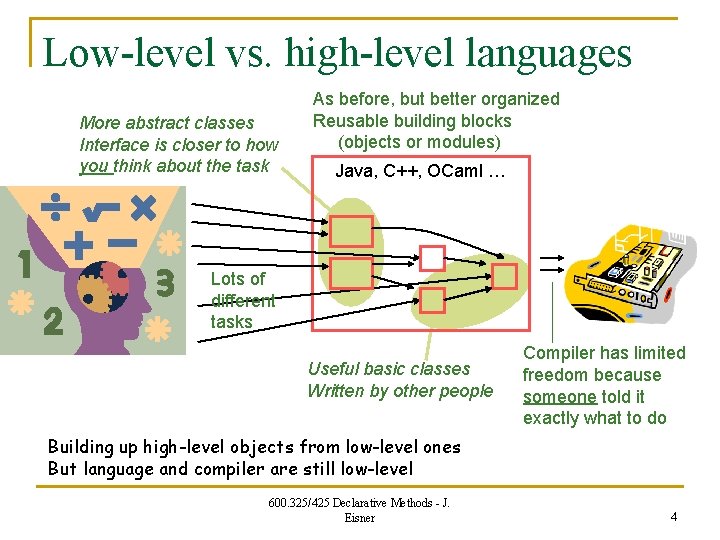
Low-level vs. high-level languages More abstract classes Interface is closer to how you think about the task As before, but better organized Reusable building blocks (objects or modules) Java, C++, OCaml … Lots of different tasks Useful basic classes Written by other people Compiler has limited freedom because someone told it exactly what to do Building up high-level objects from low-level ones But language and compiler are still low-level 600. 325/425 Declarative Methods - J. Eisner 4
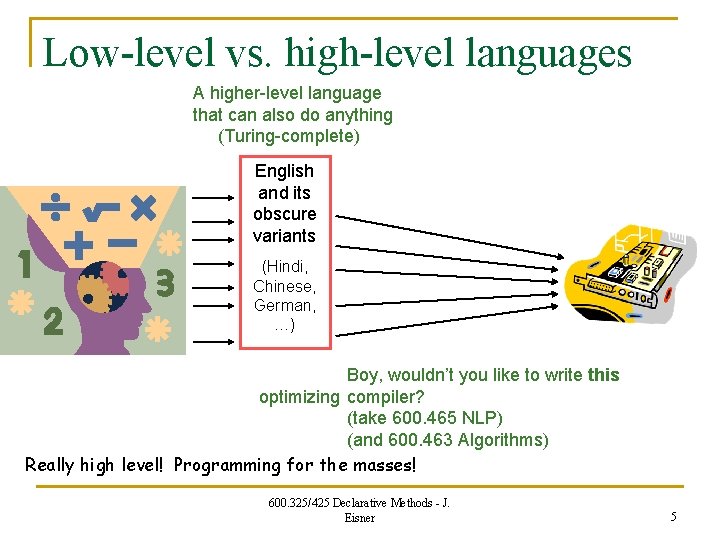
Low-level vs. high-level languages A higher-level language that can also do anything (Turing-complete) English and its obscure variants (Hindi, Chinese, German, …) Boy, wouldn’t you like to write this optimizing compiler? (take 600. 465 NLP) (and 600. 463 Algorithms) Really high level! Programming for the masses! 600. 325/425 Declarative Methods - J. Eisner 5
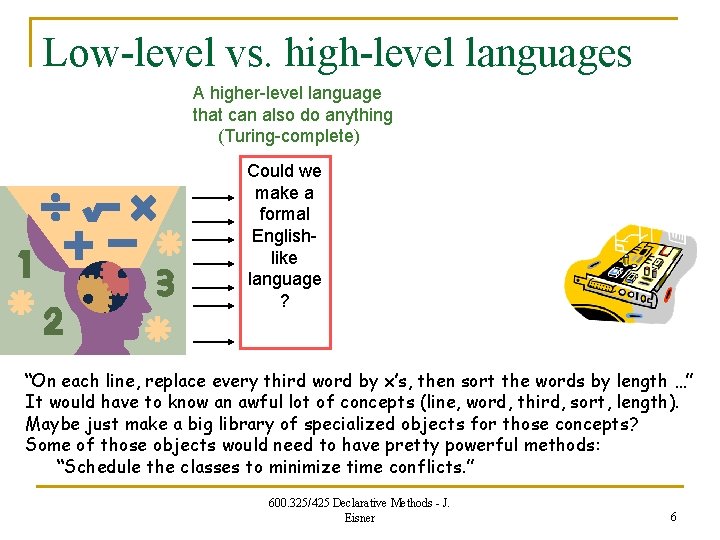
Low-level vs. high-level languages A higher-level language that can also do anything (Turing-complete) Could we make a formal Englishlike language ? “On each line, replace every third word by x’s, then sort the words by length …” It would have to know an awful lot of concepts (line, word, third, sort, length). Maybe just make a big library of specialized objects for those concepts? Some of those objects would need to have pretty powerful methods: “Schedule the classes to minimize time conflicts. ” 600. 325/425 Declarative Methods - J. Eisner 6
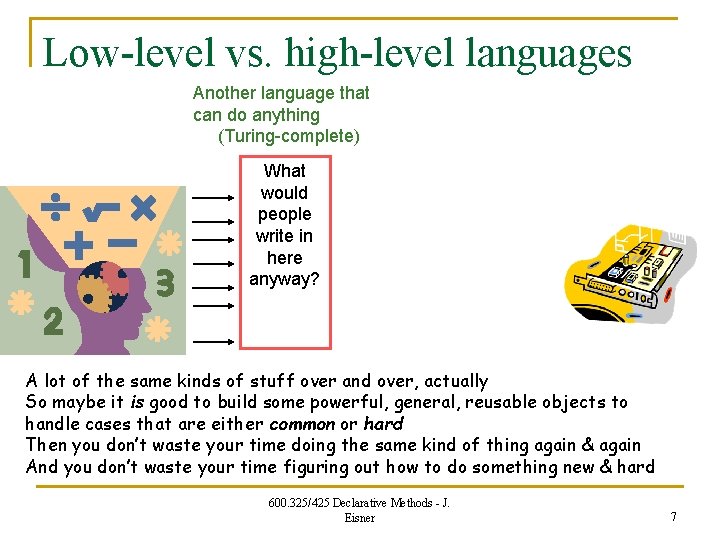
Low-level vs. high-level languages Another language that can do anything (Turing-complete) What would people write in here anyway? A lot of the same kinds of stuff over and over, actually So maybe it is good to build some powerful, general, reusable objects to handle cases that are either common or hard Then you don’t waste your time doing the same kind of thing again & again And you don’t waste your time figuring out how to do something new & hard 600. 325/425 Declarative Methods - J. Eisner 7
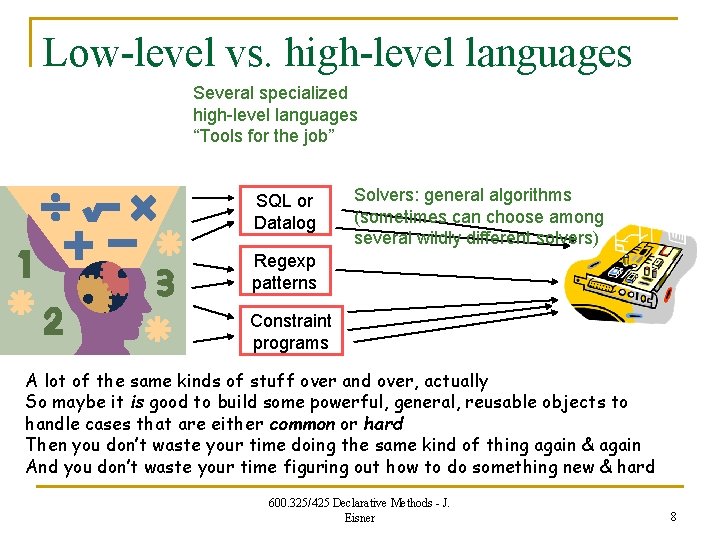
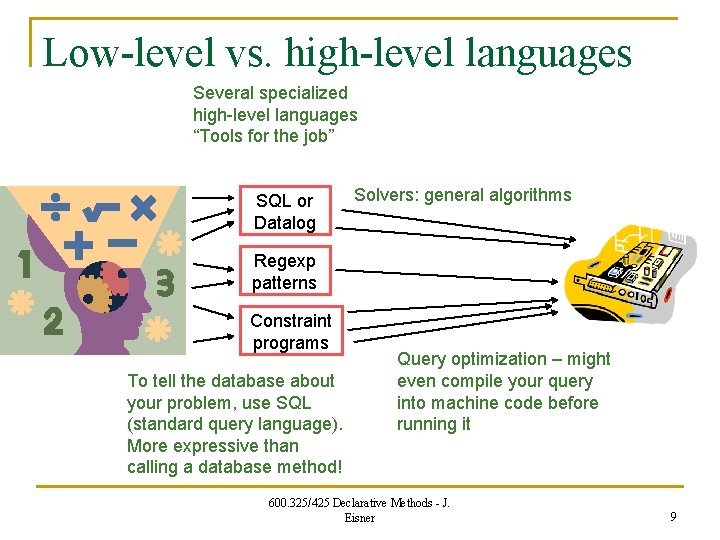
Low-level vs. high-level languages Several specialized high-level languages “Tools for the job” SQL or Datalog Solvers: general algorithms (sometimes can choose among several wildly different solvers) Regexp patterns Constraint programs A lot of the same kinds of stuff over and over, actually So maybe it is good to build some powerful, general, reusable objects to handle cases that are either common or hard Then you don’t waste your time doing the same kind of thing again & again And you don’t waste your time figuring out how to do something new & hard 600. 325/425 Declarative Methods - J. Eisner 8
Low-level vs. high-level languages Several specialized high-level languages “Tools for the job” SQL or Datalog Solvers: general algorithms Regexp patterns Constraint programs To tell the database about your problem, use SQL (standard query language). More expressive than calling a database method! Query optimization – might even compile your query into machine code before running it 600. 325/425 Declarative Methods - J. Eisner 9
600. 325/425 Declarative Methods - J. Eisner 10
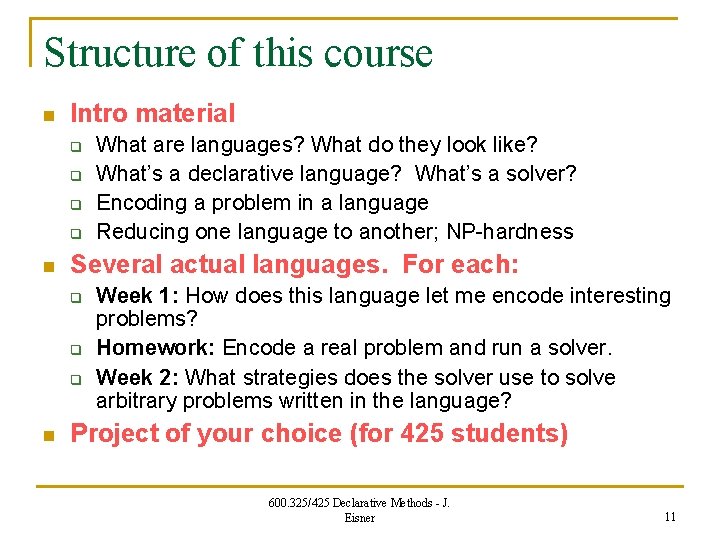
Structure of this course n Intro material q q n Several actual languages. For each: q q q n What are languages? What do they look like? What’s a declarative language? What’s a solver? Encoding a problem in a language Reducing one language to another; NP-hardness Week 1: How does this language let me encode interesting problems? Homework: Encode a real problem and run a solver. Week 2: What strategies does the solver use to solve arbitrary problems written in the language? Project of your choice (for 425 students) 600. 325/425 Declarative Methods - J. Eisner 11