
Satisfiability Solvers Part 2 Stochastic Solvers 600 325425
Satisfiability Solvers Part 2: Stochastic Solvers 600. 325/425 Declarative Methods - J. Eisner 1
Structured vs. Random Problems n n So far, we’ve been dealing with SAT problems that encode other problems Most not as hard as # of variables & clauses suggests q q q n Small crossword grid + medium-sized dictionary may turn into a big formula … but still a small puzzle at some level Unit propagation does a lot of work for you Clause learning picks up on the structure of the encoding But some random SAT problems really are hard! q z. Chaff’s tricks don’t work so well here 600. 325/425 Declarative Methods - J. Eisner 2
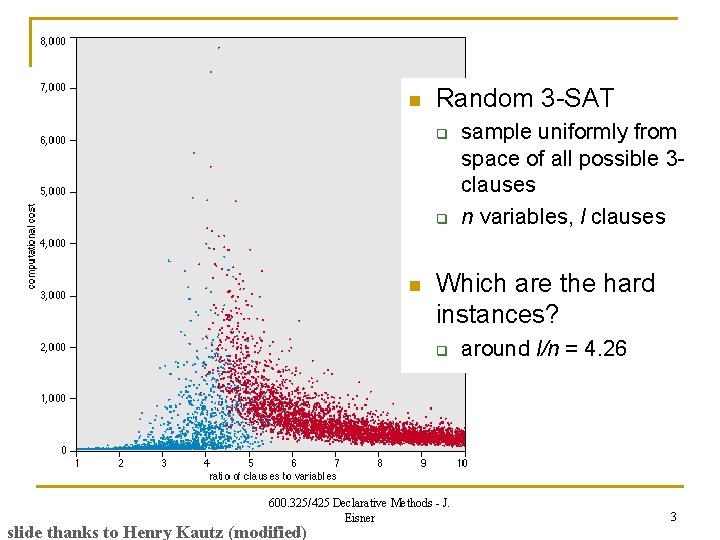
n Random 3 -SAT q q n Which are the hard instances? q 600. 325/425 Declarative Methods - J. Eisner slide thanks to Henry Kautz (modified) sample uniformly from space of all possible 3 clauses n variables, l clauses around l/n = 4. 26 3
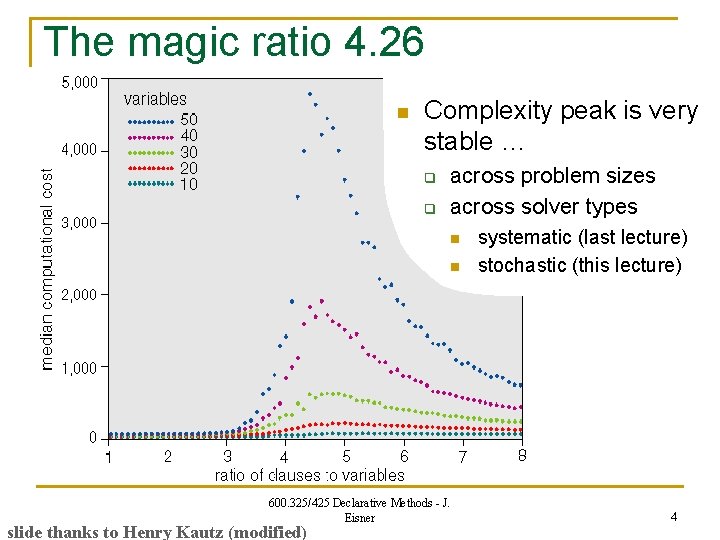
The magic ratio 4. 26 n Complexity peak is very stable … q q across problem sizes across solver types n n 600. 325/425 Declarative Methods - J. Eisner slide thanks to Henry Kautz (modified) systematic (last lecture) stochastic (this lecture) 4
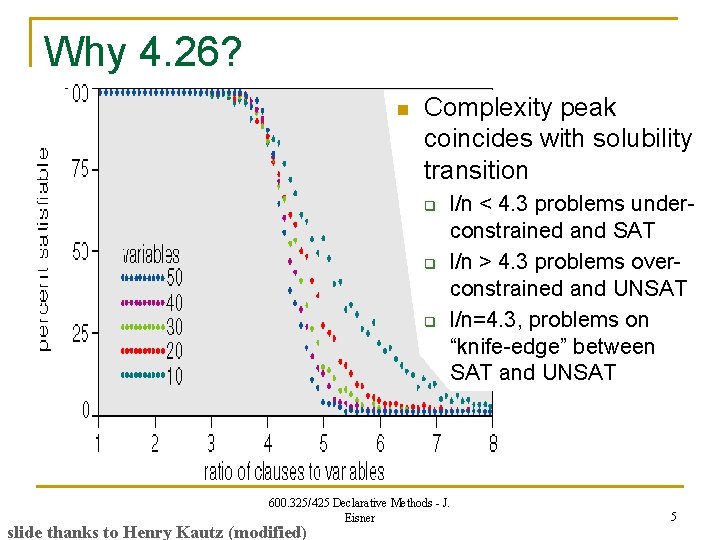
Why 4. 26? n Complexity peak coincides with solubility transition q q q l/n < 4. 3 problems underconstrained and SAT l/n > 4. 3 problems overconstrained and UNSAT l/n=4. 3, problems on “knife-edge” between SAT and UNSAT 600. 325/425 Declarative Methods - J. Eisner slide thanks to Henry Kautz (modified) 5
That’s called a “phase transition” n n Problems < 32˚F are like ice; > 32˚F are like water Similar “phase transitions” for other NP-hard problems q q q n job shop scheduling traveling salesperson (instances from TSPlib) exam timetables (instances from Edinburgh) Boolean circuit synthesis Latin squares (alias sports scheduling) Hot research topic: q predict hardness of a given instance, & use hardness to control search strategy (Horvitz, Kautz, Ruan 2001 -3) 600. 325/425 Declarative Methods - J. Eisner slide thanks to Henry Kautz (modified) 6
Methods in today’s lecture … n Can handle “big” random SAT problems q q n Also handle big structured SAT problems q n Can go up about 10 x bigger than systematic solvers! Rather smaller than structured problems (espec. if ratio 4. 26) But lose here to best systematic solvers Try hard to find a good solution q q q Very useful for approximating MAX-SAT Not intended to find all solutions Not intended to show that there are no solutions (UNSAT) 600. 325/425 Declarative Methods - J. Eisner 7
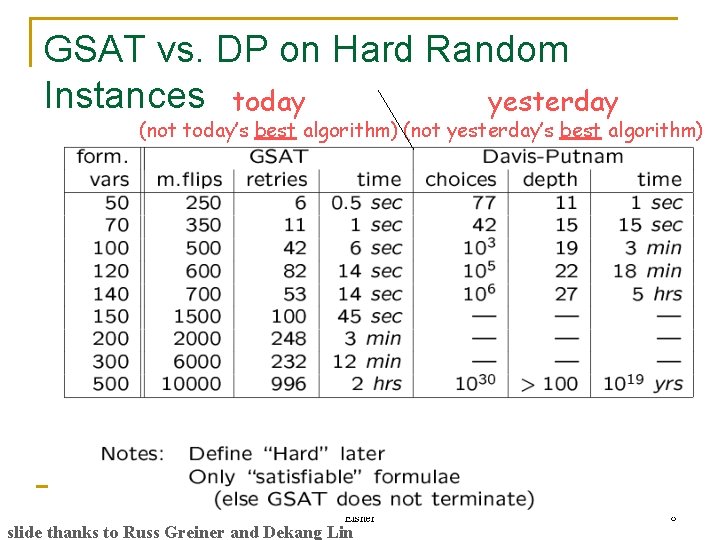
GSAT vs. DP on Hard Random Instances today yesterday (not today’s best algorithm) (not yesterday’s best algorithm) 600. 325/425 Declarative Methods - J. Eisner slide thanks to Russ Greiner and Dekang Lin 8
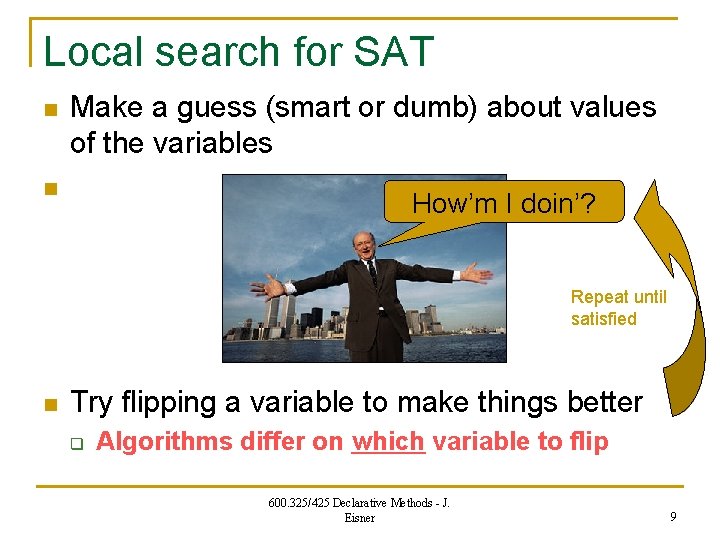
Local search for SAT n Make a guess (smart or dumb) about values of the variables n How’m I doin’? Repeat until satisfied n Try flipping a variable to make things better q Algorithms differ on which variable to flip 600. 325/425 Declarative Methods - J. Eisner 9
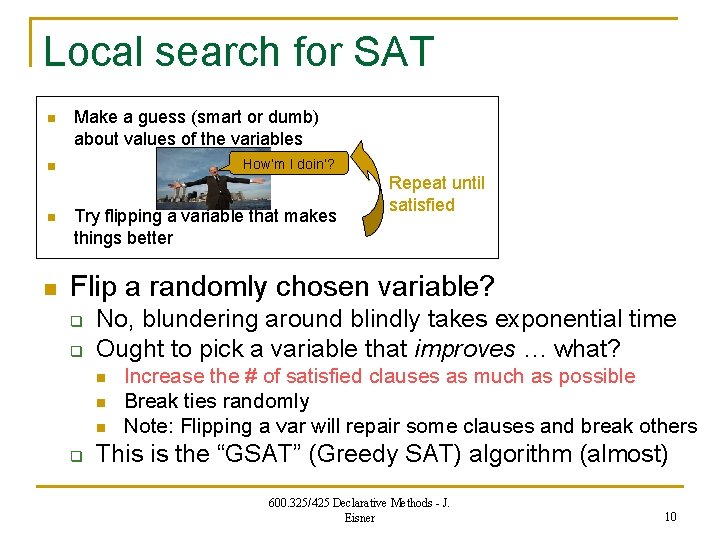
Local search for SAT n Make a guess (smart or dumb) about values of the variables n How’m I doin’? n Try flipping a variable that makes things better n Repeat until satisfied Flip a randomly chosen variable? q q No, blundering around blindly takes exponential time Ought to pick a variable that improves … what? n n n q Increase the # of satisfied clauses as much as possible Break ties randomly Note: Flipping a var will repair some clauses and break others This is the “GSAT” (Greedy SAT) algorithm (almost) 600. 325/425 Declarative Methods - J. Eisner 10
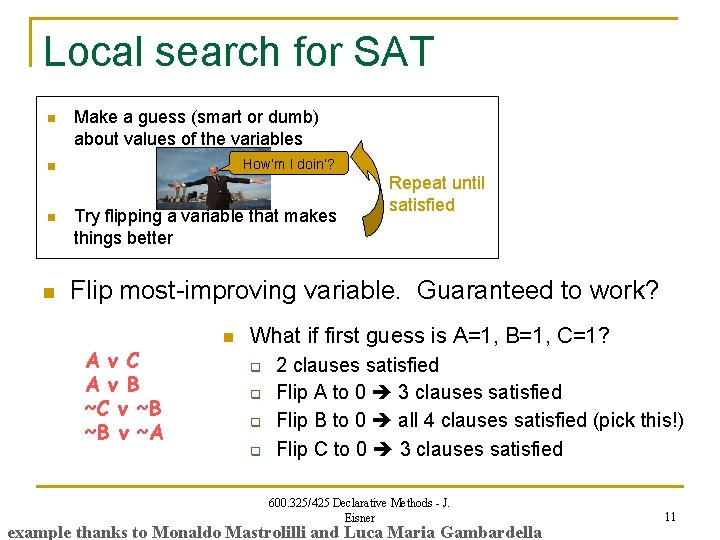
Local search for SAT n Make a guess (smart or dumb) about values of the variables n How’m I doin’? n Try flipping a variable that makes things better n Repeat until satisfied Flip most-improving variable. Guaranteed to work? A v C A v B ~C v ~B ~B v ~A n What if first guess is A=1, B=1, C=1? q q 2 clauses satisfied Flip A to 0 3 clauses satisfied Flip B to 0 all 4 clauses satisfied (pick this!) Flip C to 0 3 clauses satisfied 600. 325/425 Declarative Methods - J. Eisner example thanks to Monaldo Mastrolilli and Luca Maria Gambardella 11
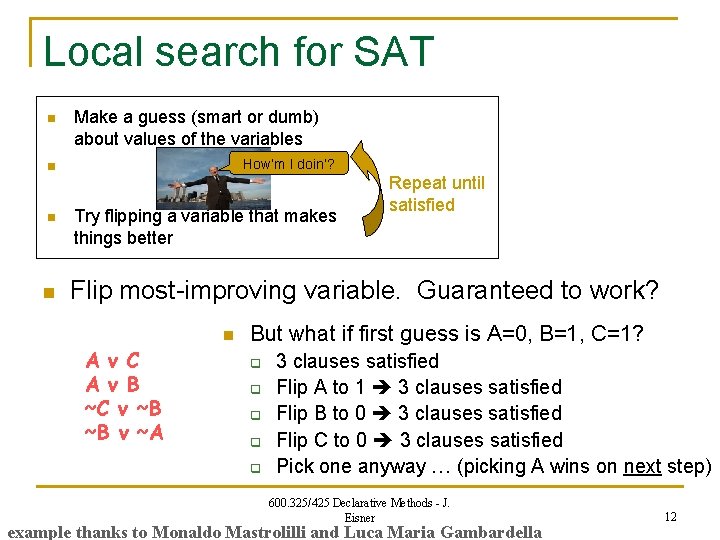
Local search for SAT n Make a guess (smart or dumb) about values of the variables n How’m I doin’? n Try flipping a variable that makes things better n Repeat until satisfied Flip most-improving variable. Guaranteed to work? n A v C A v B ~C v ~B ~B v ~A But what if first guess is A=0, B=1, C=1? q q q 3 clauses satisfied Flip A to 1 3 clauses satisfied Flip B to 0 3 clauses satisfied Flip C to 0 3 clauses satisfied Pick one anyway … (picking A wins on next step) 600. 325/425 Declarative Methods - J. Eisner example thanks to Monaldo Mastrolilli and Luca Maria Gambardella 12
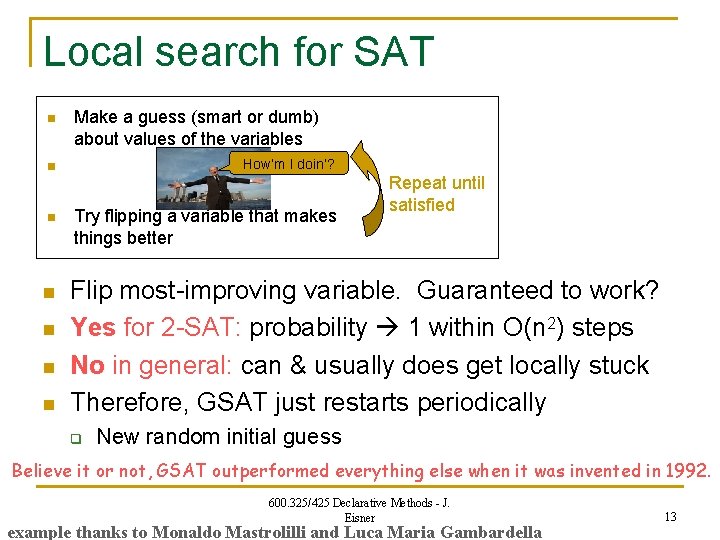
Local search for SAT n Make a guess (smart or dumb) about values of the variables n How’m I doin’? n Try flipping a variable that makes things better n n Repeat until satisfied Flip most-improving variable. Guaranteed to work? Yes for 2 -SAT: probability 1 within O(n 2) steps No in general: can & usually does get locally stuck Therefore, GSAT just restarts periodically q New random initial guess Believe it or not, GSAT outperformed everything else when it was invented in 1992. 600. 325/425 Declarative Methods - J. Eisner example thanks to Monaldo Mastrolilli and Luca Maria Gambardella 13
Discrete vs. Continous Optimization In MAX-SAT, we’re maximizing a real-valued function of n n boolean variables q q n SAT is the special case where the function is –infinity or 0 everywhere This is discrete optimization since the variables can’t change gradually You may already know a little about continuous optimization q q q From your calculus class: maximize a function by requiring all its partial derivatives = 0 But what if you can’t solve those simultaneous equations? Well, the partial derivatives tell you which direction to change each variable if you want to increase the function 600. 325/425 Declarative Methods - J. Eisner 14
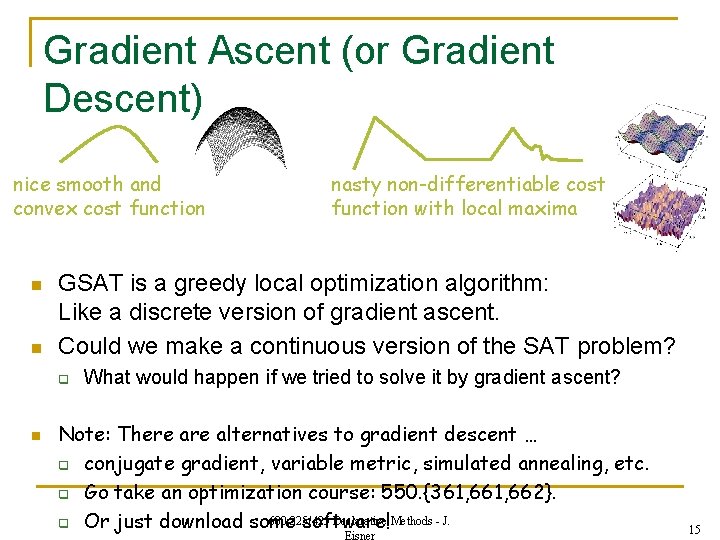
Gradient Ascent (or Gradient Descent) nice smooth and convex cost function n n GSAT is a greedy local optimization algorithm: Like a discrete version of gradient ascent. Could we make a continuous version of the SAT problem? q n nasty non-differentiable cost function with local maxima What would happen if we tried to solve it by gradient ascent? Note: There alternatives to gradient descent … q conjugate gradient, variable metric, simulated annealing, etc. q Go take an optimization course: 550. {361, 662}. 600. 325/425 Declarative Methods - J. q Or just download some software! Eisner 15
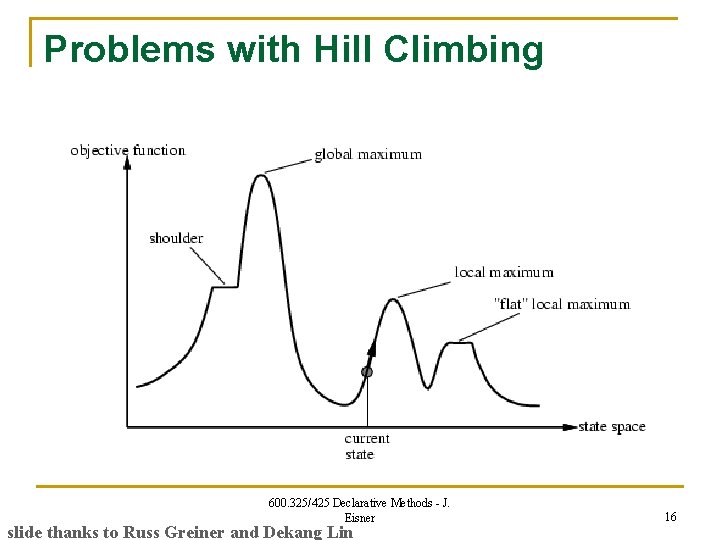
Problems with Hill Climbing 600. 325/425 Declarative Methods - J. Eisner slide thanks to Russ Greiner and Dekang Lin 16
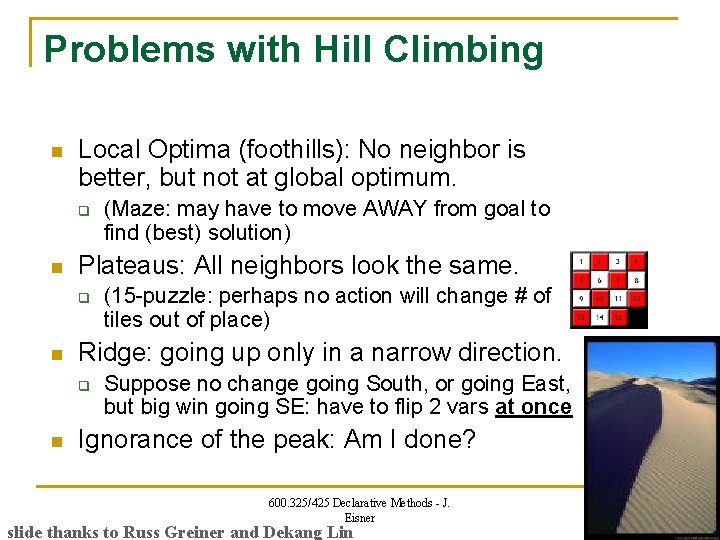
Problems with Hill Climbing n Local Optima (foothills): No neighbor is better, but not at global optimum. q n Plateaus: All neighbors look the same. q n (15 -puzzle: perhaps no action will change # of tiles out of place) Ridge: going up only in a narrow direction. q n (Maze: may have to move AWAY from goal to find (best) solution) Suppose no change going South, or going East, but big win going SE: have to flip 2 vars at once Ignorance of the peak: Am I done? 600. 325/425 Declarative Methods - J. Eisner slide thanks to Russ Greiner and Dekang Lin 17
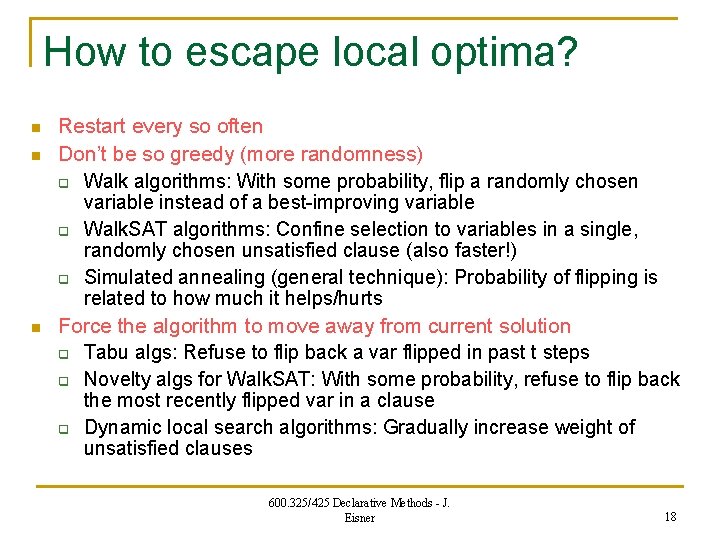
How to escape local optima? n n n Restart every so often Don’t be so greedy (more randomness) q Walk algorithms: With some probability, flip a randomly chosen variable instead of a best-improving variable q Walk. SAT algorithms: Confine selection to variables in a single, randomly chosen unsatisfied clause (also faster!) q Simulated annealing (general technique): Probability of flipping is related to how much it helps/hurts Force the algorithm to move away from current solution q Tabu algs: Refuse to flip back a var flipped in past t steps q Novelty algs for Walk. SAT: With some probability, refuse to flip back the most recently flipped var in a clause q Dynamic local search algorithms: Gradually increase weight of unsatisfied clauses 600. 325/425 Declarative Methods - J. Eisner 18
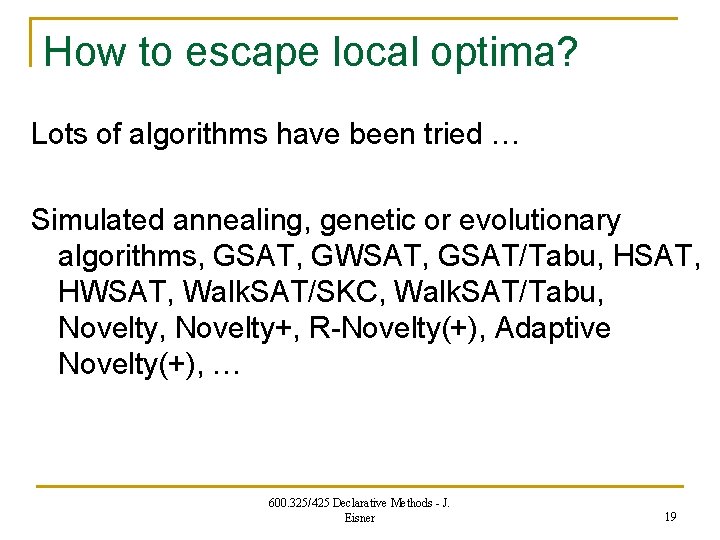
How to escape local optima? Lots of algorithms have been tried … Simulated annealing, genetic or evolutionary algorithms, GSAT, GWSAT, GSAT/Tabu, HSAT, HWSAT, Walk. SAT/SKC, Walk. SAT/Tabu, Novelty+, R-Novelty(+), Adaptive Novelty(+), … 600. 325/425 Declarative Methods - J. Eisner 19
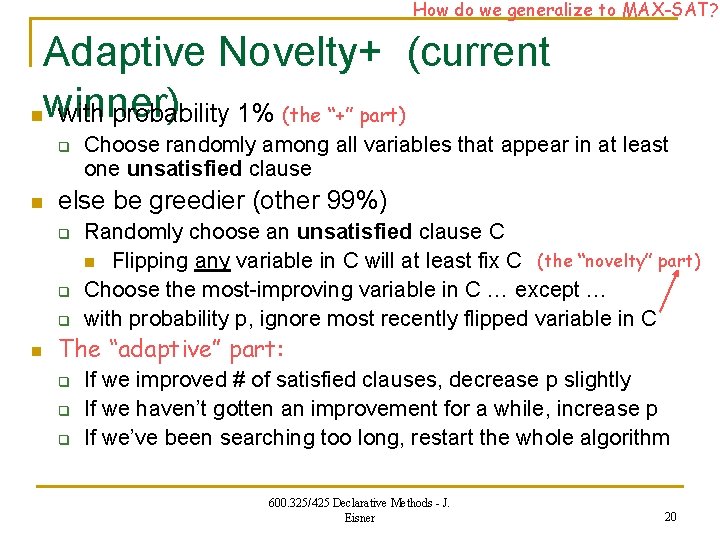
How do we generalize to MAX-SAT? Adaptive Novelty+ (current nwinner) with probability 1% (the “+” part) q n else be greedier (other 99%) q q q n Choose randomly among all variables that appear in at least one unsatisfied clause Randomly choose an unsatisfied clause C n Flipping any variable in C will at least fix C (the “novelty” part) Choose the most-improving variable in C … except … with probability p, ignore most recently flipped variable in C The “adaptive” part: q q q If we improved # of satisfied clauses, decrease p slightly If we haven’t gotten an improvement for a while, increase p If we’ve been searching too long, restart the whole algorithm 600. 325/425 Declarative Methods - J. Eisner 20
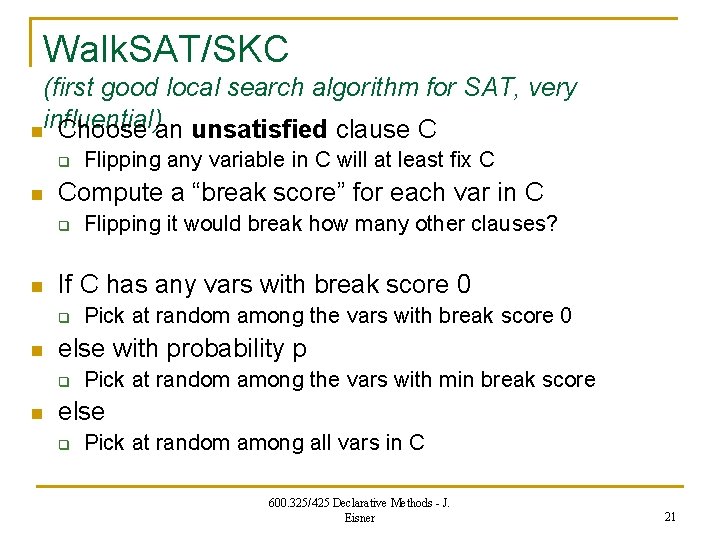
Walk. SAT/SKC (first good local search algorithm for SAT, very influential) n Choose an unsatisfied clause C q n Compute a “break score” for each var in C q n Pick at random among the vars with break score 0 else with probability p q n Flipping it would break how many other clauses? If C has any vars with break score 0 q n Flipping any variable in C will at least fix C Pick at random among the vars with min break score else q Pick at random among all vars in C 600. 325/425 Declarative Methods - J. Eisner 21
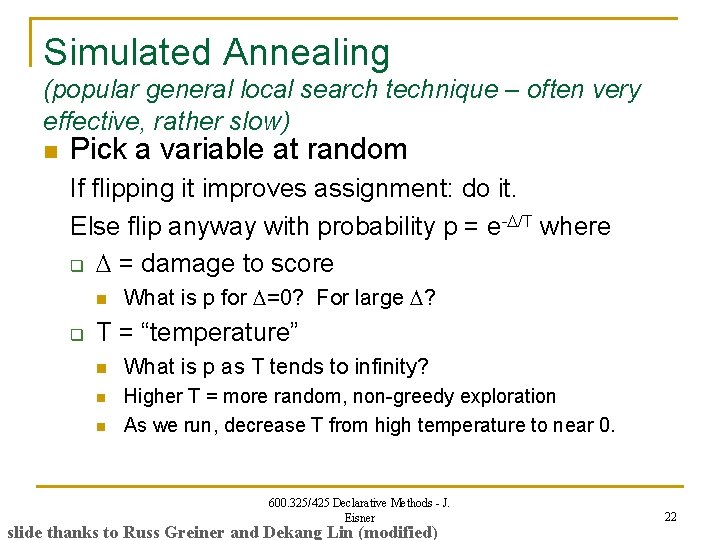
Simulated Annealing (popular general local search technique – often very effective, rather slow) n Pick a variable at random If flipping it improves assignment: do it. Else flip anyway with probability p = e- /T where q = damage to score n q What is p for =0? For large ? T = “temperature” n What is p as T tends to infinity? n Higher T = more random, non-greedy exploration As we run, decrease T from high temperature to near 0. n 600. 325/425 Declarative Methods - J. Eisner slide thanks to Russ Greiner and Dekang Lin (modified) 22
Simulated Annealing and Markov Chains n [discuss connection between optimization and sampling] 600. 325/425 Declarative Methods - J. Eisner 23
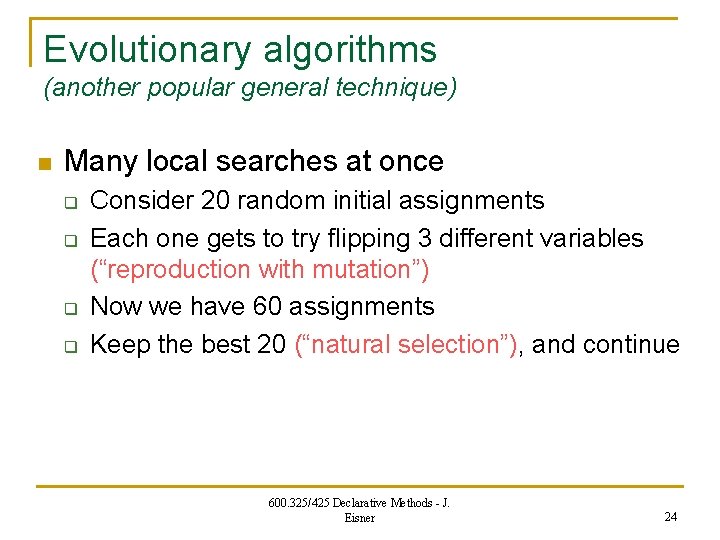
Evolutionary algorithms (another popular general technique) n Many local searches at once q q Consider 20 random initial assignments Each one gets to try flipping 3 different variables (“reproduction with mutation”) Now we have 60 assignments Keep the best 20 (“natural selection”), and continue 600. 325/425 Declarative Methods - J. Eisner 24
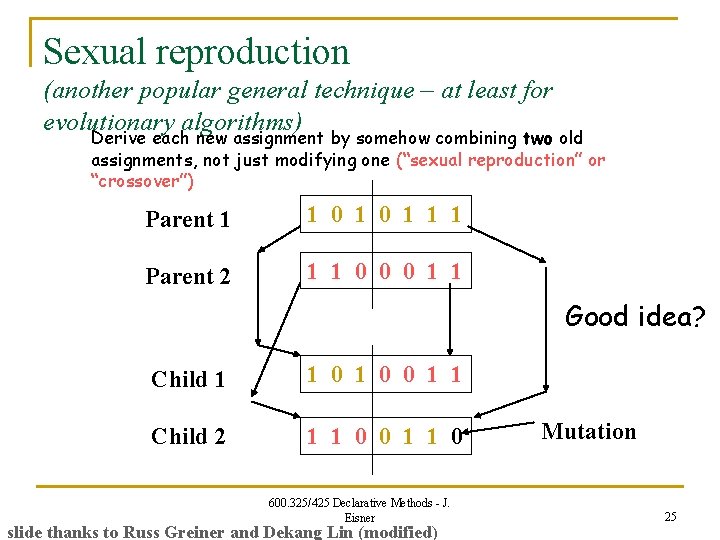
Sexual reproduction (another popular general technique – at least for evolutionary algorithms) Derive each new assignment by somehow combining two old assignments, not just modifying one (“sexual reproduction” or “crossover”) Parent 1 1 0 1 1 1 Parent 2 1 1 0 0 0 1 1 Good idea? Child 1 1 0 0 1 1 Child 2 1 1 0 0 1 1 0 600. 325/425 Declarative Methods - J. Eisner slide thanks to Russ Greiner and Dekang Lin (modified) Mutation 25
- Slides: 25