59 291 Section 1 Lecture 5 Drug Excretion
- Slides: 11
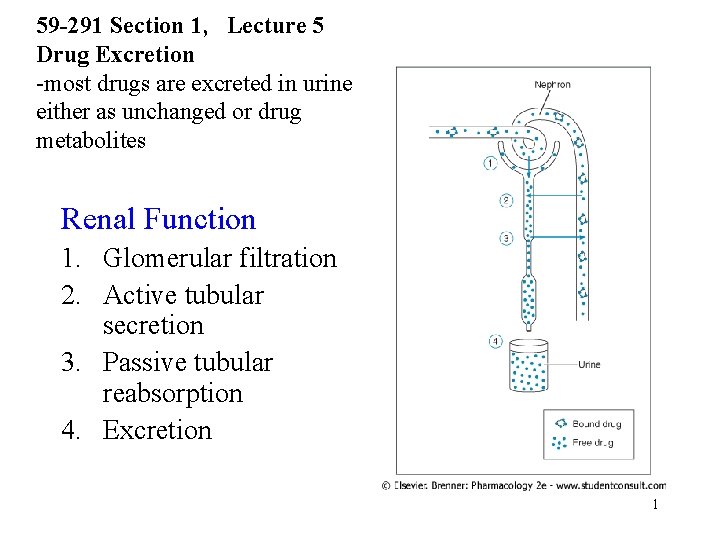
59 -291 Section 1, Lecture 5 Drug Excretion -most drugs are excreted in urine either as unchanged or drug metabolites Renal Function 1. Glomerular filtration 2. Active tubular secretion 3. Passive tubular reabsorption 4. Excretion 1
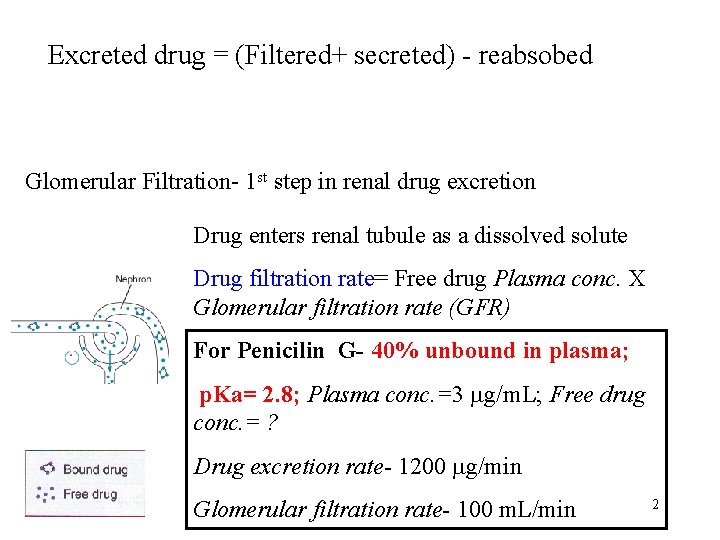
Excreted drug = (Filtered+ secreted) - reabsobed Glomerular Filtration- 1 st step in renal drug excretion Drug enters renal tubule as a dissolved solute Drug filtration rate= Free drug Plasma conc. X Glomerular filtration rate (GFR) For Penicilin G- 40% unbound in plasma; p. Ka= 2. 8; Plasma conc. =3 mg/m. L; Free drug conc. = ? Drug excretion rate- 1200 mg/min Glomerular filtration rate- 100 m. L/min 2
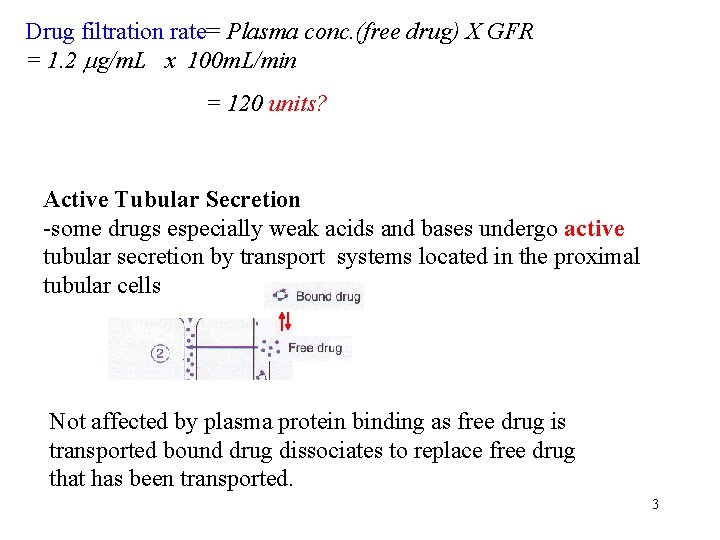
Drug filtration rate= Plasma conc. (free drug) X GFR = 1. 2 mg/m. L x 100 m. L/min = 120 units? Active Tubular Secretion -some drugs especially weak acids and bases undergo active tubular secretion by transport systems located in the proximal tubular cells Not affected by plasma protein binding as free drug is transported bound drug dissociates to replace free drug that has been transported. 3
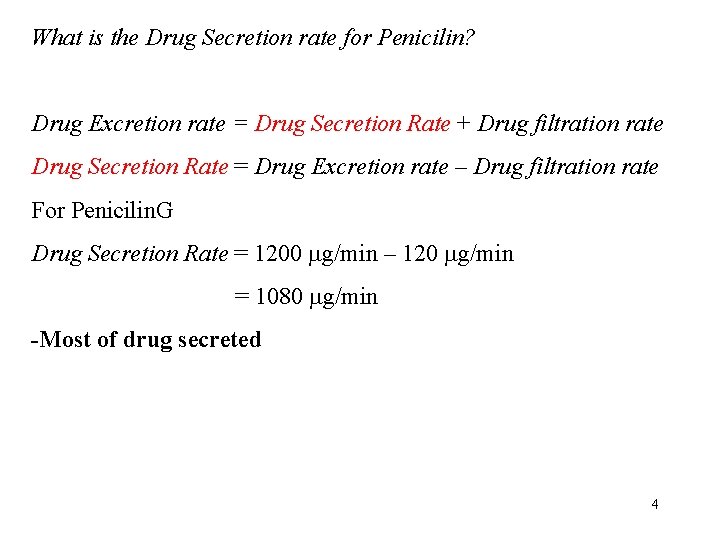
What is the Drug Secretion rate for Penicilin? Drug Excretion rate = Drug Secretion Rate + Drug filtration rate Drug Secretion Rate = Drug Excretion rate – Drug filtration rate For Penicilin. G Drug Secretion Rate = 1200 mg/min – 120 mg/min = 1080 mg/min -Most of drug secreted 4
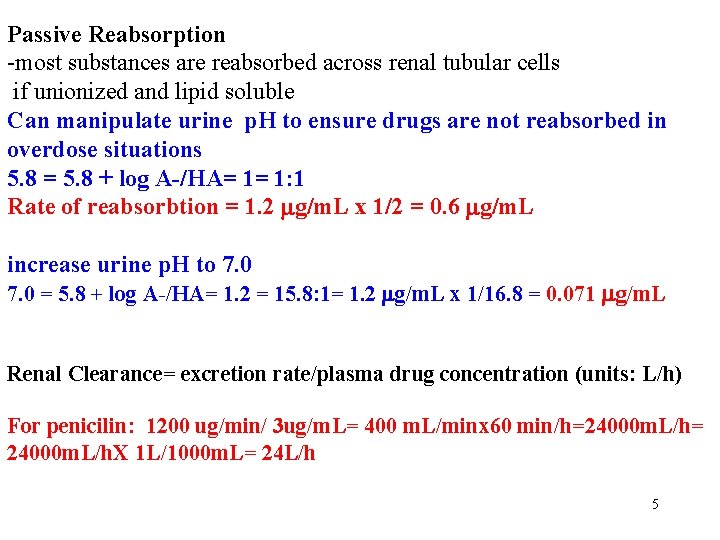
Passive Reabsorption -most substances are reabsorbed across renal tubular cells if unionized and lipid soluble Can manipulate urine p. H to ensure drugs are not reabsorbed in overdose situations 5. 8 = 5. 8 + log A-/HA= 1= 1: 1 Rate of reabsorbtion = 1. 2 g/m. L x 1/2 = 0. 6 g/m. L increase urine p. H to 7. 0 = 5. 8 + log A-/HA= 1. 2 = 15. 8: 1= 1. 2 g/m. L x 1/16. 8 = 0. 071 g/m. L Renal Clearance= excretion rate/plasma drug concentration (units: L/h) For penicilin: 1200 ug/min/ 3 ug/m. L= 400 m. L/minx 60 min/h=24000 m. L/h= 24000 m. L/h. X 1 L/1000 m. L= 24 L/h 5
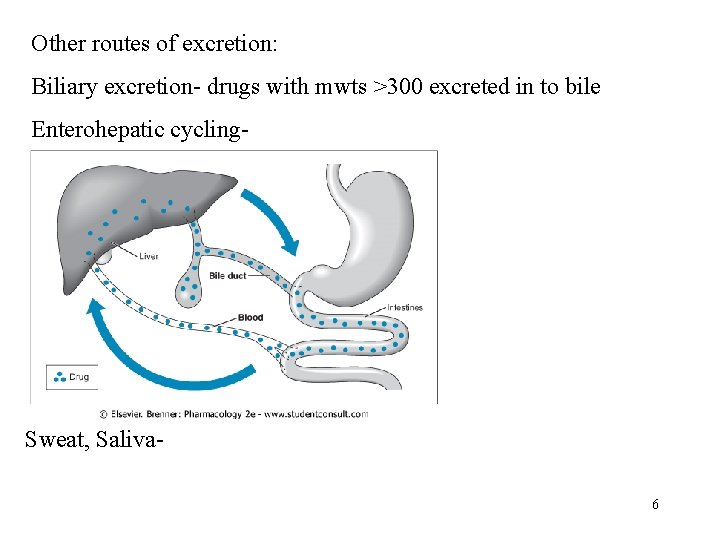
Other routes of excretion: Biliary excretion- drugs with mwts >300 excreted in to bile Enterohepatic cycling- Sweat, Saliva 6
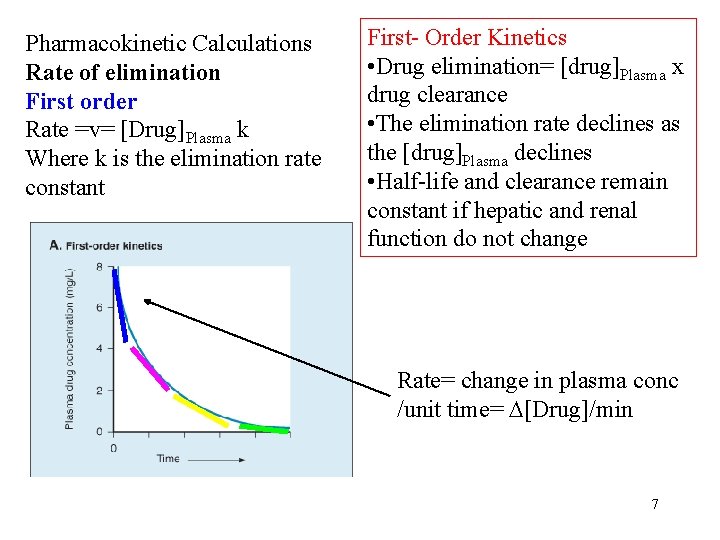
Pharmacokinetic Calculations Rate of elimination First order Rate =v= [Drug]Plasma k Where k is the elimination rate constant First- Order Kinetics • Drug elimination= [drug]Plasma x drug clearance • The elimination rate declines as the [drug]Plasma declines • Half-life and clearance remain constant if hepatic and renal function do not change Rate= change in plasma conc /unit time= D[Drug]/min 7
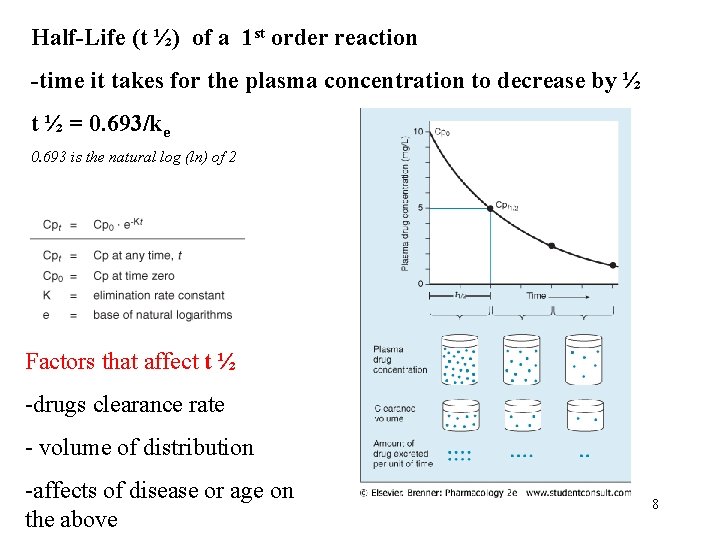
Half-Life (t ½) of a 1 st order reaction -time it takes for the plasma concentration to decrease by ½ t ½ = 0. 693/ke 0. 693 is the natural log (ln) of 2 Factors that affect t ½ -drugs clearance rate - volume of distribution -affects of disease or age on the above 8
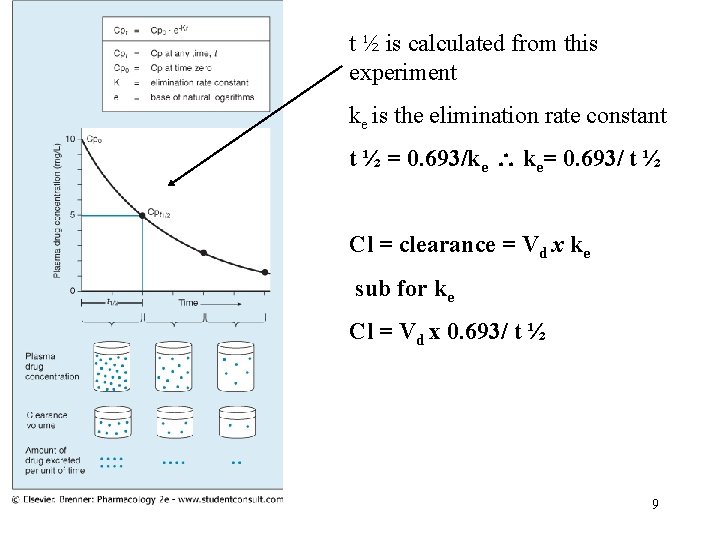
t ½ is calculated from this experiment ke is the elimination rate constant t ½ = 0. 693/ke ke= 0. 693/ t ½ Cl = clearance = Vd x ke sub for ke Cl = Vd x 0. 693/ t ½ 9
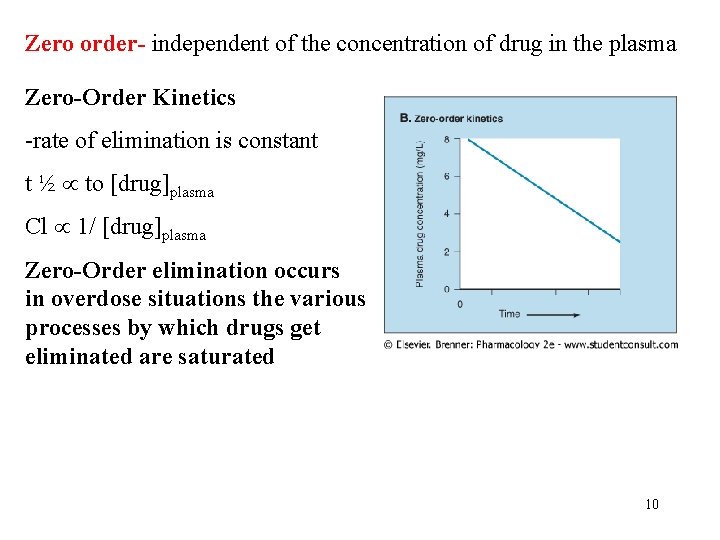
Zero order- independent of the concentration of drug in the plasma Zero-Order Kinetics -rate of elimination is constant t ½ to [drug]plasma Cl 1/ [drug]plasma Zero-Order elimination occurs in overdose situations the various processes by which drugs get eliminated are saturated 10
Practice Questions • Is a drug with p. Ka= 3. 6 reabsorbed in renal tubules with a p. H= 5. 6? Why? – This drug is a weak acid and is ionized at p. H= 5. 6. Since the ionized form of drug is not lipid soluble, therefore, is not reabsorbed • A patient is overdosed with salicylic acid, which is a weak acid. How do you treat this patient in order to remove the drug faster from his blood. – Alkalinizing the urine. • Increasing the drug excretion • Counteracting the metabolic acidosis 11