30 60 90 Right Triangles Consider the following
- Slides: 17
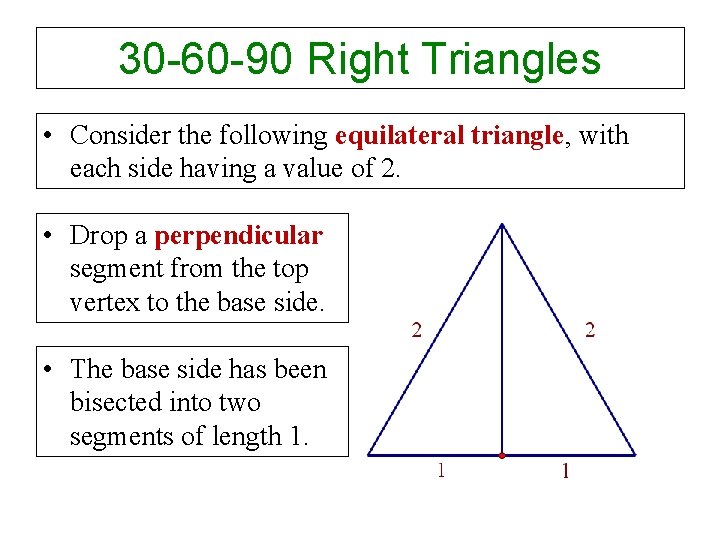
30 -60 -90 Right Triangles • Consider the following equilateral triangle, with each side having a value of 2. • Drop a perpendicular segment from the top vertex to the base side. • The base side has been bisected into two segments of length 1.
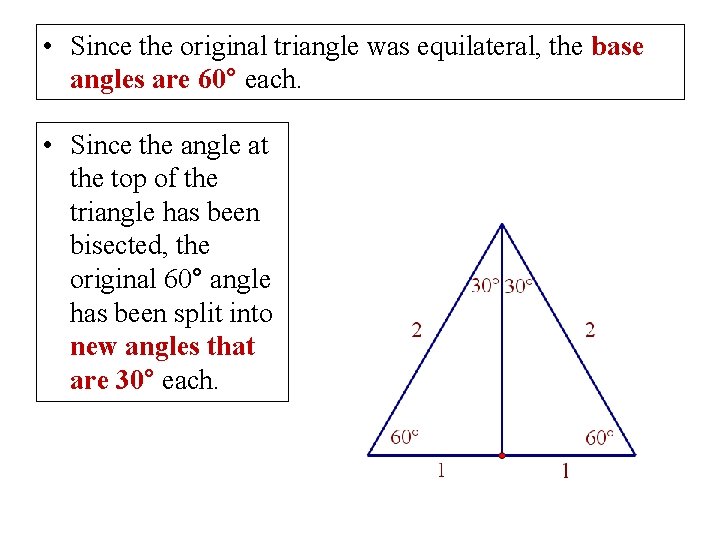
• Since the original triangle was equilateral, the base angles are 60° each. • Since the angle at the top of the triangle has been bisected, the original 60° angle has been split into new angles that are 30° each.
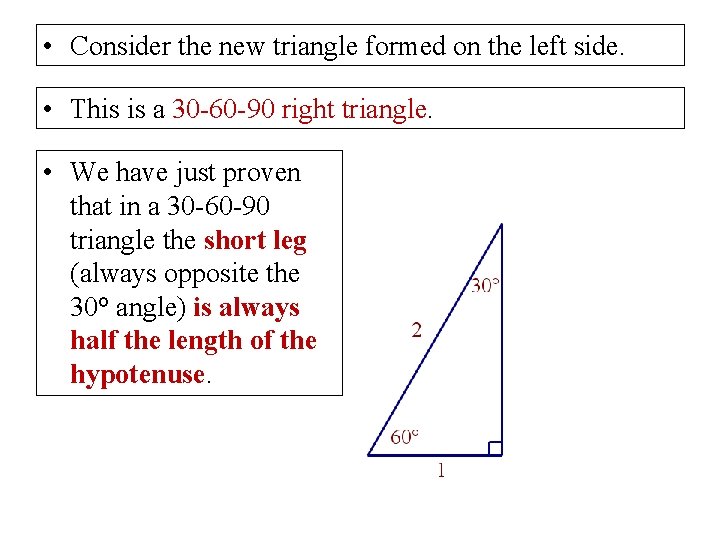
• Consider the new triangle formed on the left side. • This is a 30 -60 -90 right triangle. • We have just proven that in a 30 -60 -90 triangle the short leg (always opposite the 30° angle) is always half the length of the hypotenuse.
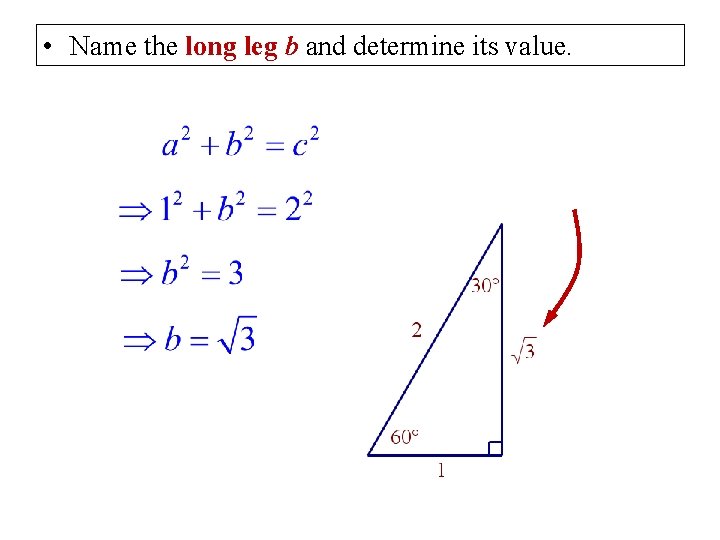
• Name the long leg b and determine its value.
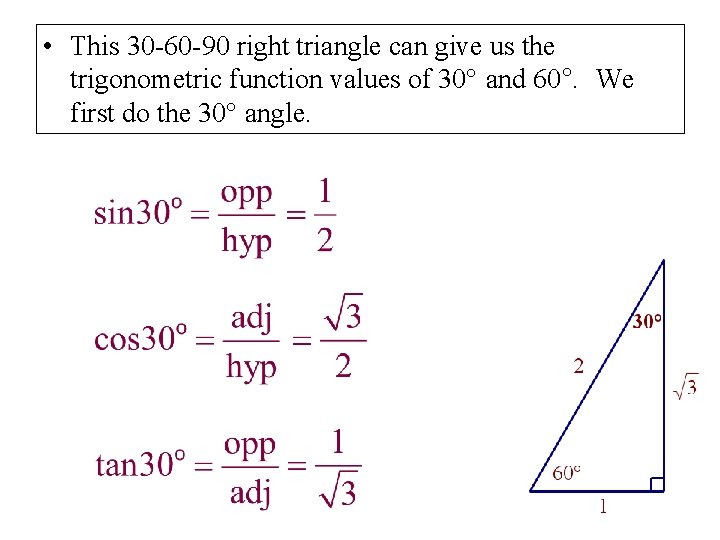
• This 30 -60 -90 right triangle can give us the trigonometric function values of 30° and 60°. We first do the 30° angle.
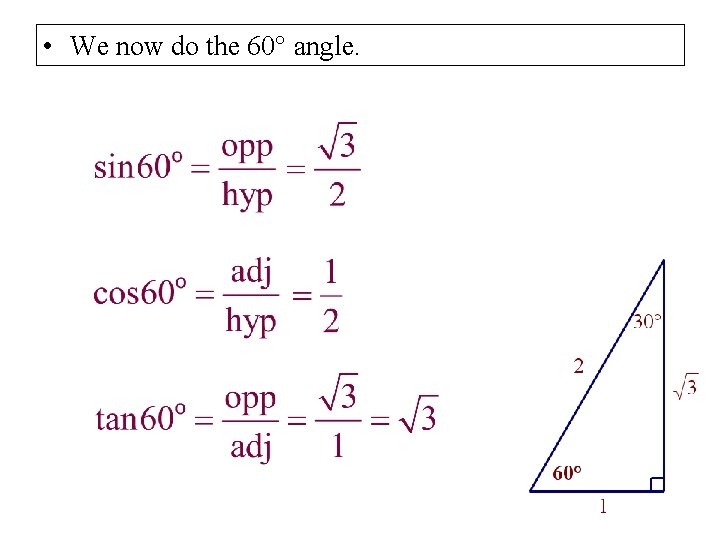
• We now do the 60° angle.
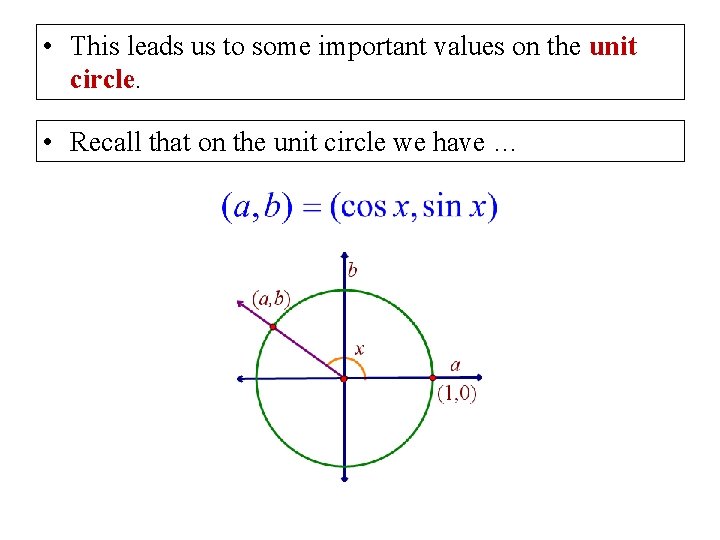
• This leads us to some important values on the unit circle. • Recall that on the unit circle we have …
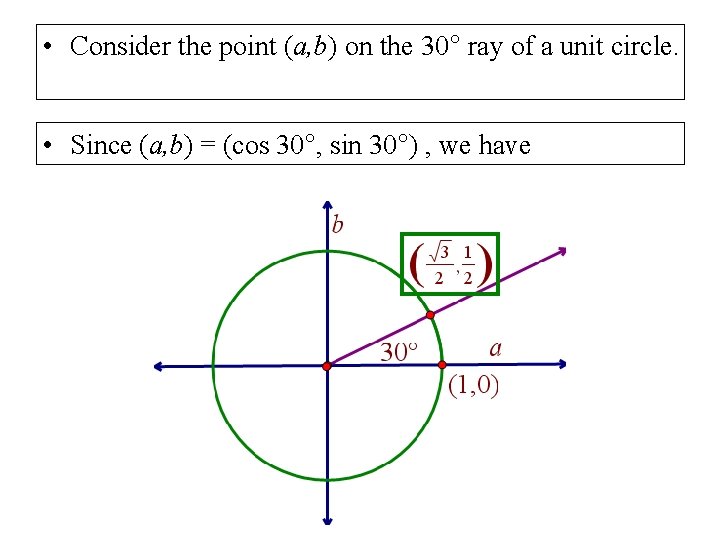
• Consider the point (a, b) on the 30° ray of a unit circle. • Since (a, b) = (cos 30°, sin 30°) , we have
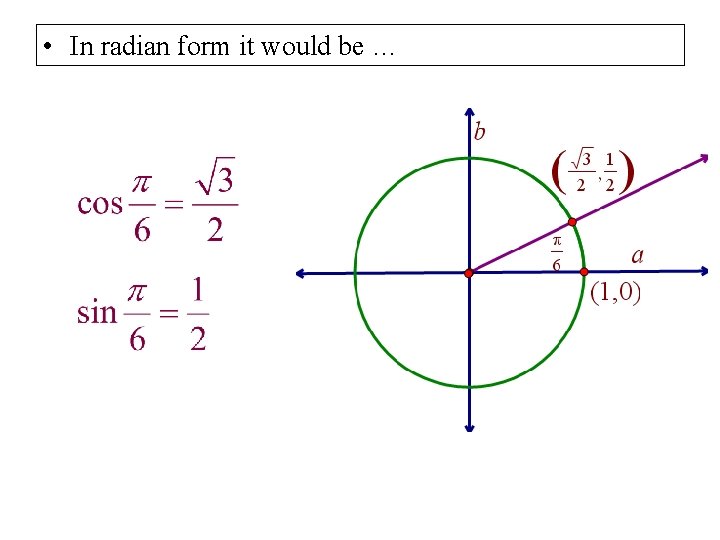
• In radian form it would be …
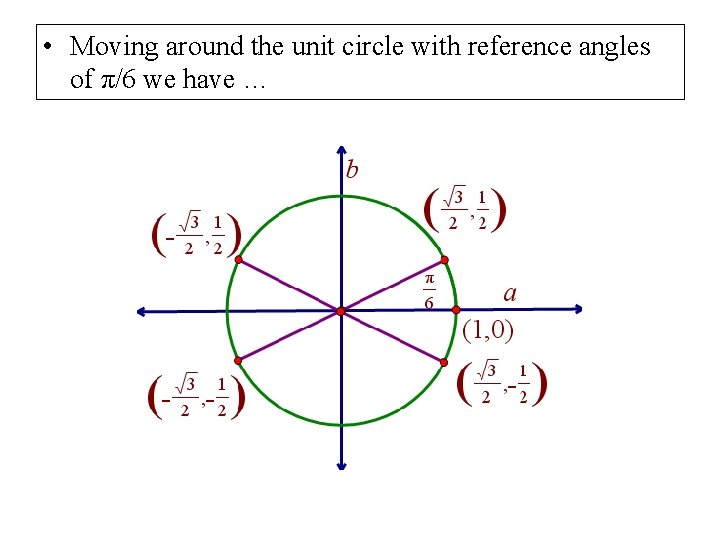
• Moving around the unit circle with reference angles of π/6 we have …
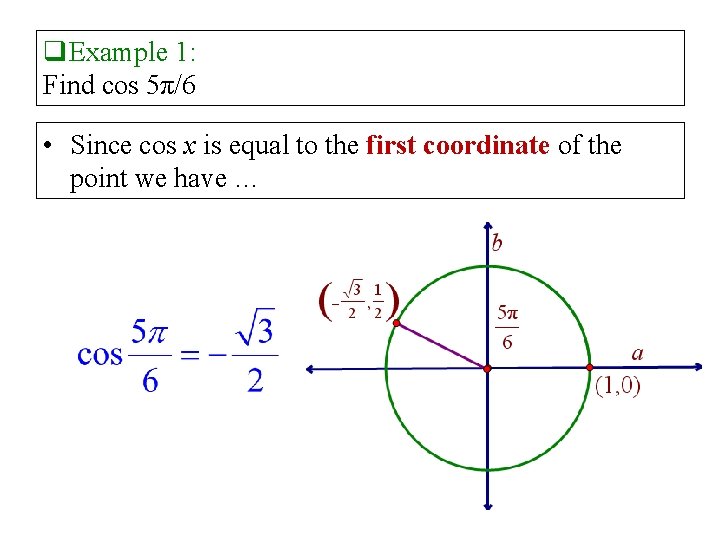
q. Example 1: Find cos 5π/6 • Since cos x is equal to the first coordinate of the point we have …
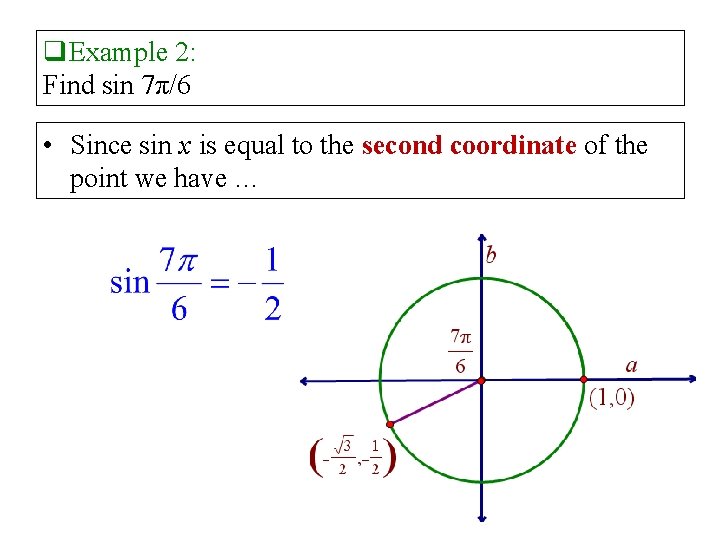
q. Example 2: Find sin 7π/6 • Since sin x is equal to the second coordinate of the point we have …
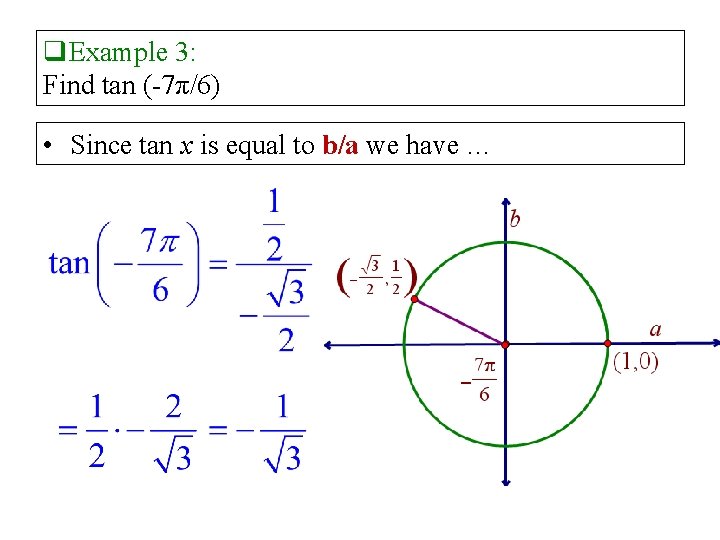
q. Example 3: Find tan (-7π/6) • Since tan x is equal to b/a we have …
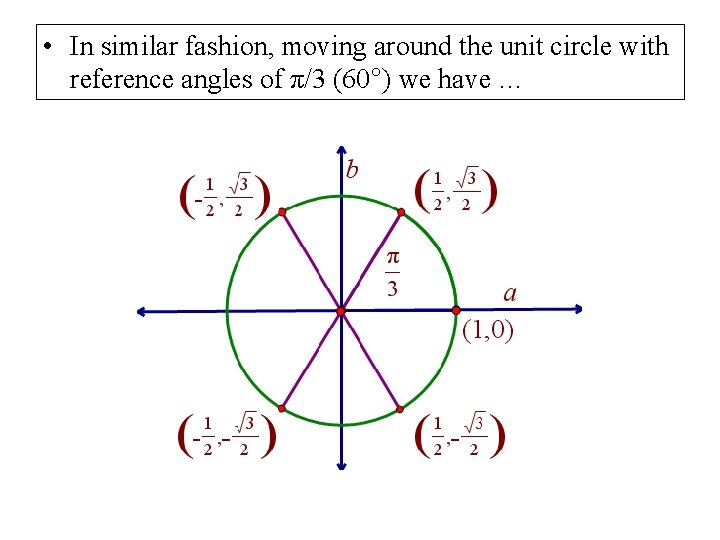
• In similar fashion, moving around the unit circle with reference angles of π/3 (60°) we have …
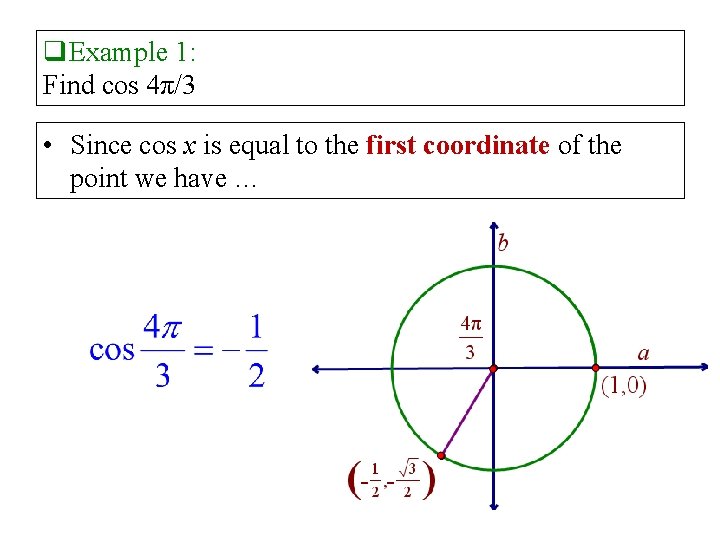
q. Example 1: Find cos 4π/3 • Since cos x is equal to the first coordinate of the point we have …
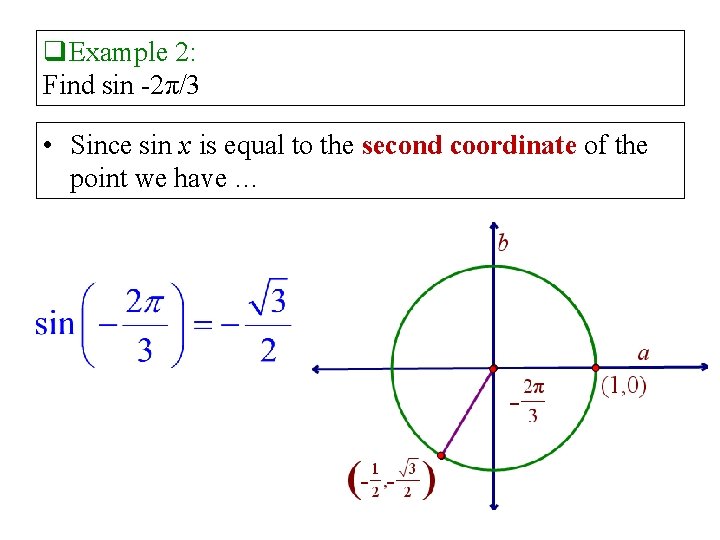
q. Example 2: Find sin -2π/3 • Since sin x is equal to the second coordinate of the point we have …
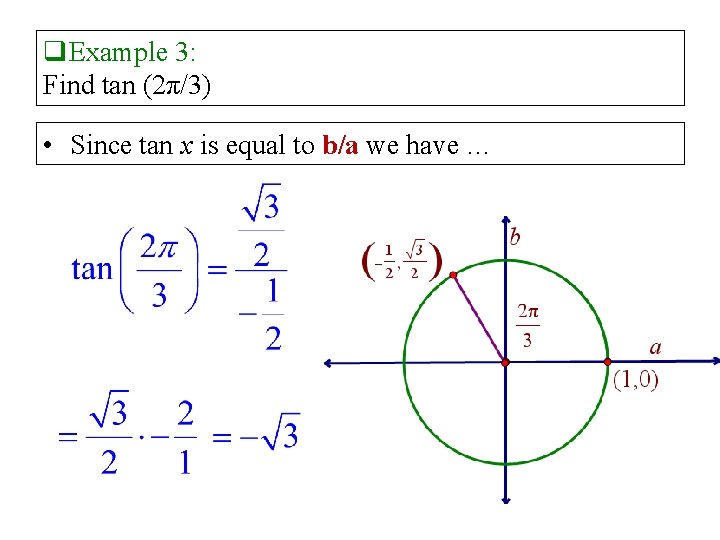
q. Example 3: Find tan (2π/3) • Since tan x is equal to b/a we have …