
1 Which of the following statements regarding photosynthesis

























- Slides: 50
1. Which of the following statements regarding photosynthesis and cellular respiration is TRUe? a. Photosynthesis occurs in chloroplasts and cellular respiration occurs in mitochondria b. Photosynthesis occurs in mitochondria and cellular respiration occurs in chloroplasts c. Photosynthesis occurs in mitochondria and chloroplasts d. Cellular respiration occurs in mitochondria and in chloroplasts
Correct answer: A
2. Which of the following are products of cellular respiration? a. Oxygen and carbon dioxide b. Energy to make ATP and carbon dioxide c. Oxygen and glucose d. Oxygen and energy to make ATP
Correct answer: B
3. A kilocalorie is defined as a. The quantity of glucose needed to increase the body temperature by 10 C b. The quantity of heat needed to raise the temperature of 1 kg of water by 10 C c. The quantity of food used to maintain normal bodily functions d. The quantity of food consumed during a given type of exercise
Correct answer: B
4. During cellular respiration, NADH a. Is chemically converted into ATP b. Is reduced to form NAD+ c. Delivers its electron load to the first electron carrier molecule d. Is the final electron acceptor
Correct answer: C
5. Which of the following options lists the stages in cellular respiration in the correct order? a. Glycolysis, citric acid cycle, and oxidative phosphorylation b. Glycolysis, oxidative phosphorylation and citric acid cycle c. The citric acid cycle, oxidative phosphorylation, and glycolysis d. Oxidative phosphorylation, glycolysis, and the citric acid cycle
Correct answer: A
6. Which of the following metabolic pathways is common in aerobic and anaerobic metabolism? a. The citric acid cycle b. Oxidative phosphorylation c. Glycolysis d. Electron transport chain
Correct answer: C
7. As a result of glycolysis, there is a net gain of _____ ATP. a. Zero b. One c. Two d. Thirty six
Correct answer: C
8. How many molecules of NADH are produced during glycolysis? a. b. c. d. Two Four Six Eight
Correct answer: A
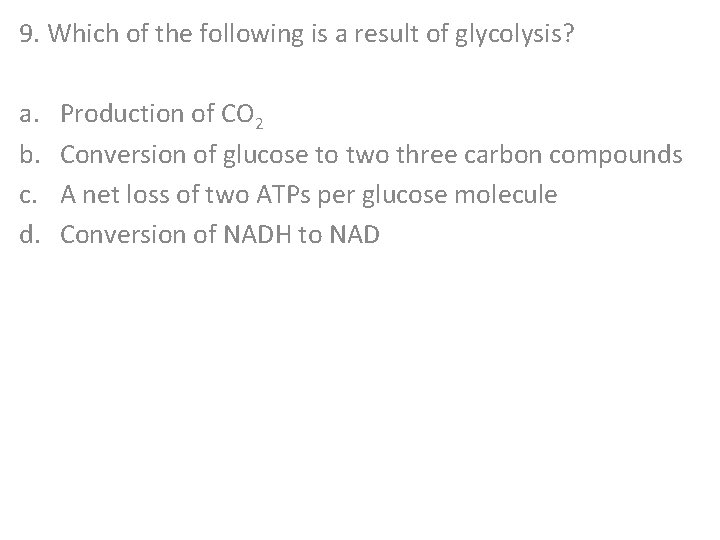
9. Which of the following is a result of glycolysis? a. b. c. d. Production of CO 2 Conversion of glucose to two three carbon compounds A net loss of two ATPs per glucose molecule Conversion of NADH to NAD
Correct answer: B
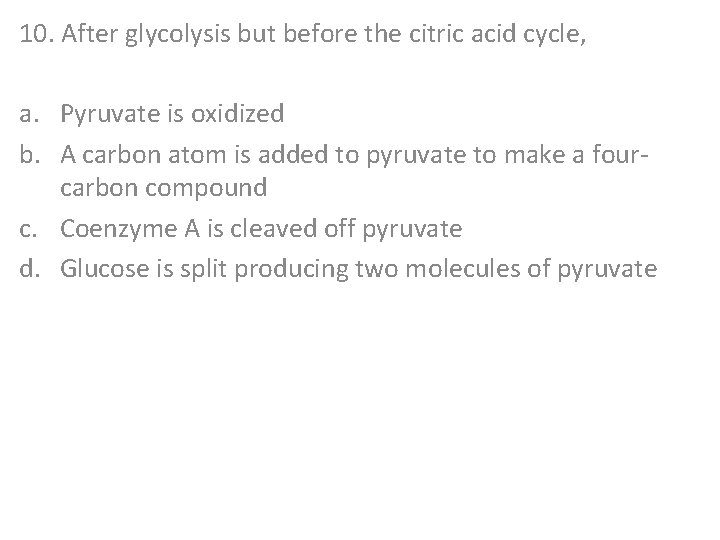
10. After glycolysis but before the citric acid cycle, a. Pyruvate is oxidized b. A carbon atom is added to pyruvate to make a fourcarbon compound c. Coenzyme A is cleaved off pyruvate d. Glucose is split producing two molecules of pyruvate
Correct answer: A
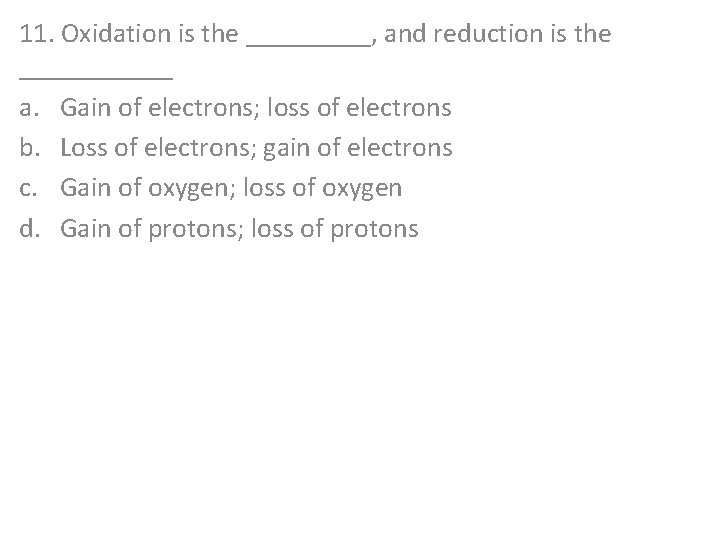
11. Oxidation is the _____, and reduction is the ______ a. Gain of electrons; loss of electrons b. Loss of electrons; gain of electrons c. Gain of oxygen; loss of oxygen d. Gain of protons; loss of protons
Correct answer: B
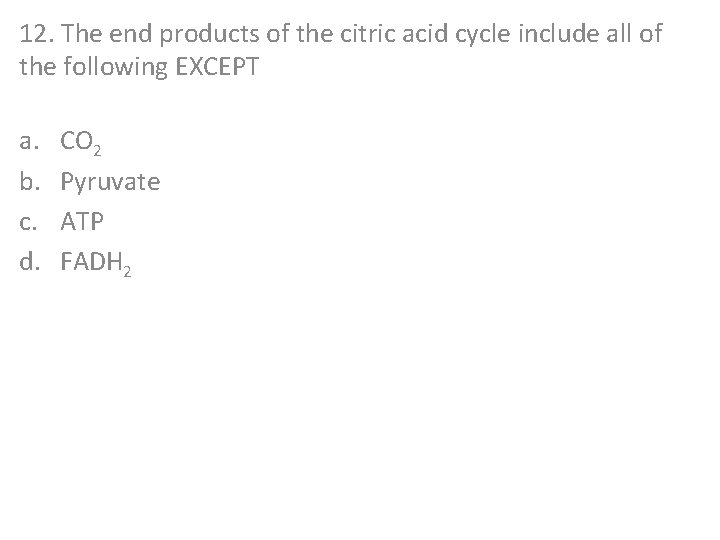
12. The end products of the citric acid cycle include all of the following EXCEPT a. b. c. d. CO 2 Pyruvate ATP FADH 2
Correct Answer: B
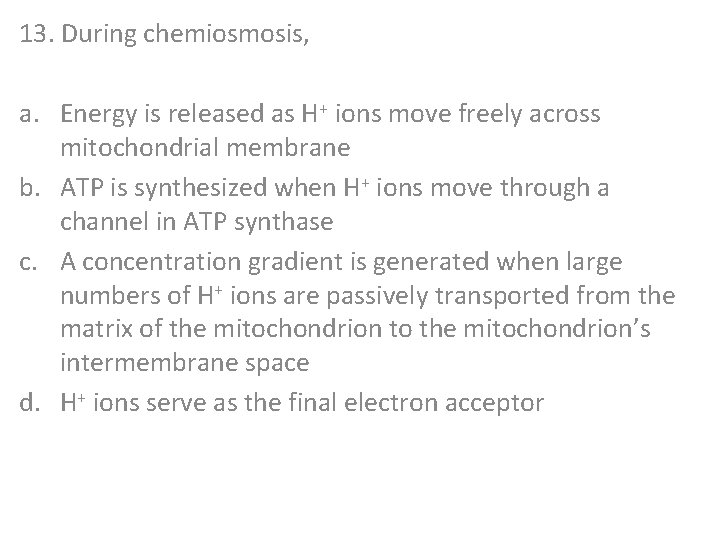
13. During chemiosmosis, a. Energy is released as H+ ions move freely across mitochondrial membrane b. ATP is synthesized when H+ ions move through a channel in ATP synthase c. A concentration gradient is generated when large numbers of H+ ions are passively transported from the matrix of the mitochondrion to the mitochondrion’s intermembrane space d. H+ ions serve as the final electron acceptor
Correct Answer: B
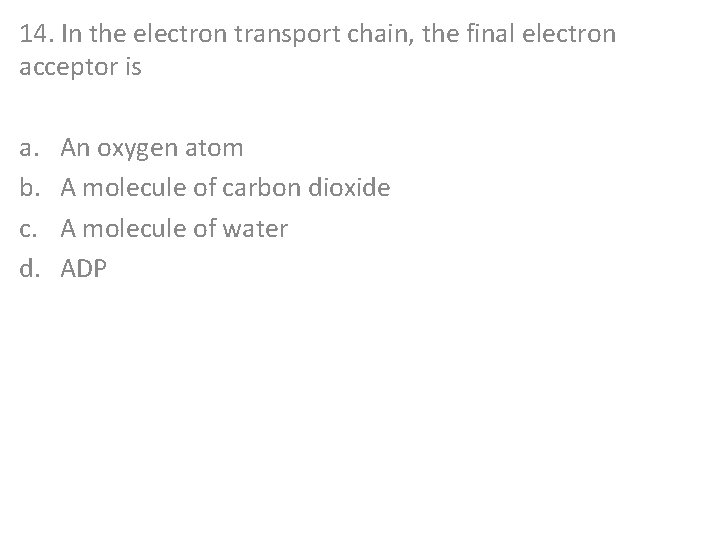
14. In the electron transport chain, the final electron acceptor is a. b. c. d. An oxygen atom A molecule of carbon dioxide A molecule of water ADP
Correct answer: A
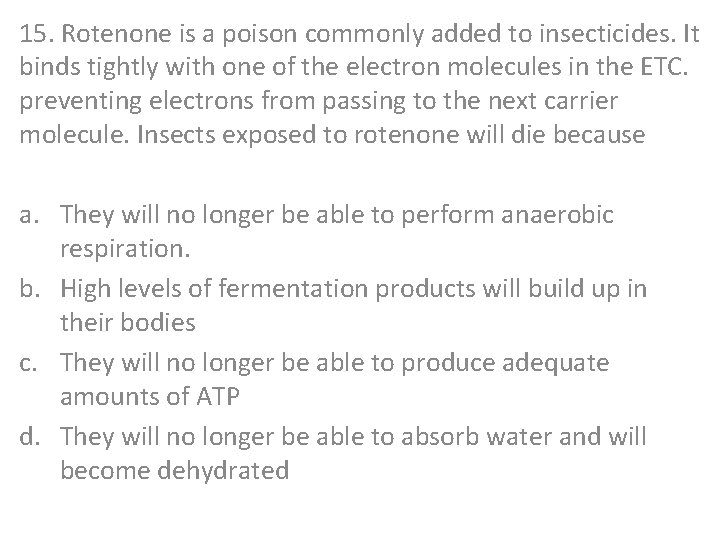
15. Rotenone is a poison commonly added to insecticides. It binds tightly with one of the electron molecules in the ETC. preventing electrons from passing to the next carrier molecule. Insects exposed to rotenone will die because a. They will no longer be able to perform anaerobic respiration. b. High levels of fermentation products will build up in their bodies c. They will no longer be able to produce adequate amounts of ATP d. They will no longer be able to absorb water and will become dehydrated
Correct answer: C
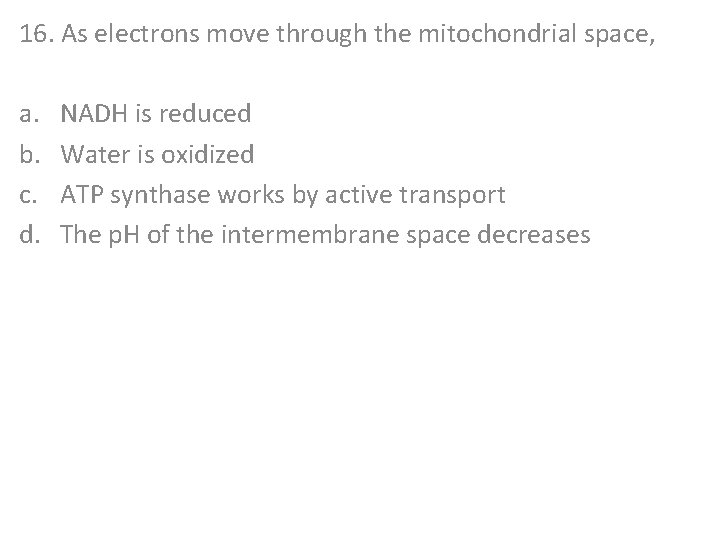
16. As electrons move through the mitochondrial space, a. b. c. d. NADH is reduced Water is oxidized ATP synthase works by active transport The p. H of the intermembrane space decreases
Correct answer: D
17. Which of the following processes produces the most ATP per molecule of glucose oxidized? a. b. c. d. Aerobic respiration Alcoholic fermentation Lactic acid fermentation All produce approximately the same amount of ATP per molecule of glucose
Correct answer: A
18. In fermentation, ________ is _______ a. b. c. d. NADH; reduced NAD+ ; oxidized NADH ; oxidized Ethanol; oxidized
Correct answer: C
19. In yeast cells, a. b. c. d. Lactic acid is produced during anaerobic respiration Lactic acid is produced during glycolysis Alcohol is produced during the citric acid cycle Alcohol is produced after glycolysis
Correct answer: D
20. Bacteria that are unable to survive in the presence of oxygen are called a. b. c. d. Obligate anaerobes Obligate aerobes Facultative anaerobes Aerotolerant anaerobes
Correct answer: A
21. Which of the following statements regarding glycolysis is FALSE? a. Glycolysis is considered to be an ancient metabolic process because it does not require oxygen b. Glycolysis is considered to be an ancient metabolic system because it is not located in a membrane bound organelle c. Glycolysis is considered to be an ancient metabolic system because it occurs universally d. Glycolysis is considered to be an ancient metabolic system because it is the most efficient metabolic pathway for ATP synthesis
Correct answer: D
22. When a cell uses fatty acids for aerobic respiration, it first hydrolyzes fats to a. b. c. d. Glycerol and amino acids Glycerol and fatty acids Fatty acids and sugars Sugars and glycerol
Correct answer: B
23. A friend tells you that he is going on a low-carb diet to lose weight because he thinks that carbs contain more energy than fats or protein. What would you tell your friend about his plan? a. This is a good idea because sugars have more electrons than fats and protein b. This is a good idea because sugars enter the fuel breakdown pathway earlier than other food molecules c. This is an incorrect idea because fats contain more hydrogen atoms than carbohydrates and protein d. This is an incorrect idea because all food molecules store the same amount of energy
Correct answer: C
24. Studies have shown that the muscles of marathon runners contain an abundance of slow-twitch fibers. Which of the following statements about these fibers is TRUE? a. Slow-twitch fibers have lots of mitochondria to make ATP aerobically. b. Slow-twitch fibers have lots of mitochondria to make ATP through fermentation c. Slow-twitch fibers have few mitochondria and make ATP aerobically. d. Slow-twitch fibers have few mitochondria and make ATP through fermentation.
Correct answer: A
25. Arsenic is a poison that binds to a molecule needed to build acetyl Co A. Based on this information, which part of cellular respiration would be stopped if arsenic were ingested? a. b. c. d. Glycolysis Citric acid cycle Electron transport chain ATP synthase
Correct answer: B