3 IGEOS 2019 4 th IGEOS 2020 rd
- Slides: 8
3 IGEOS 2019 4 th IGEOS 2020 rd International Geography Seminar “Geography’s Contribution To The Sustainable Development Goals: International Geography Seminar “Increasing Disaster Literacy Towards Resilient Global Challenges And Opportunities” Communities” B a n d u n g , S e p t e m b e r 3 0 th , 2020 Surakarta, August 31 st, 2019 Media coverage and people’s perspective: nonmuslims perception of human rights Ridwan Effendi 1, V Sukmayadi 1, Seniwati 2, Triyanto 3 and M Z Achsin 4 1 Universitas Pendidikan Indonesia, Bandung, Indonesia - 2 Universitas Hasanuddin, Makassar, Indonesia 3 Universitas Sebelas Maret, Surakarta, Indonesia - 4 Universitas Brawijaya, Malang, Indonesia 4 th IGEOS – International Geography Seminar 2020
INTRODUCTION & LITERATURE REVIEW • Over the past decades, the situation of Rohingyas has surfaced to the world’s attention due to the communal violence that have been occurred in Rakhine State of Myanmar. • Mc. Quail: “the most essential impact of mass communication is the capability to influence individual’s perception and way of thinking toward the social reality “ [1]. • Numerous studies have also showed that news coverage can alter public opinions as it promotes certain interpretations of current issues and media consumers are interested in stories that offer an extra journalistic values such as politics, human rights, and economics [2, 3]. 4 th IGEOS – International Geography Seminar 2020
I N T R O D U C T I O N L I T E R A T U R E V I E W & • Public data on the frequency of media use, individual attention to news and the duration of use or longevity is what the media tries to obtain so that they can strengthen the exposure [4]. • The frequent exposure of media and its impact was also pinpointed by Gerbner and Gross (1976) when they introduced the cultivation theory. • As a development of the assumption, several studies have shown that audiences value news based on significant indicators including important, relevant, timely and socially related [5, 6, 7]. • Based on the aforementioned assumptions, this paper attempts to analyze the influence of media coverage to the audience who are assumed to have prior information exposure due to the social and emotional proximity with the news event. 4 th IGEOS – International Geography Seminar 2020
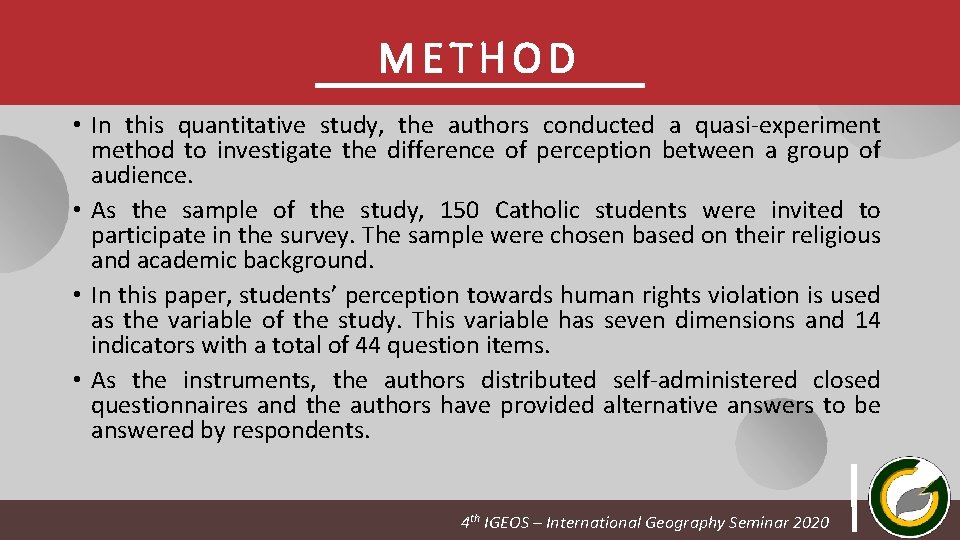
METHOD • In this quantitative study, the authors conducted a quasi-experiment method to investigate the difference of perception between a group of audience. • As the sample of the study, 150 Catholic students were invited to participate in the survey. The sample were chosen based on their religious and academic background. • In this paper, students’ perception towards human rights violation is used as the variable of the study. This variable has seven dimensions and 14 indicators with a total of 44 question items. • As the instruments, the authors distributed self-administered closed questionnaires and the authors have provided alternative answers to be answered by respondents. 4 th IGEOS – International Geography Seminar 2020
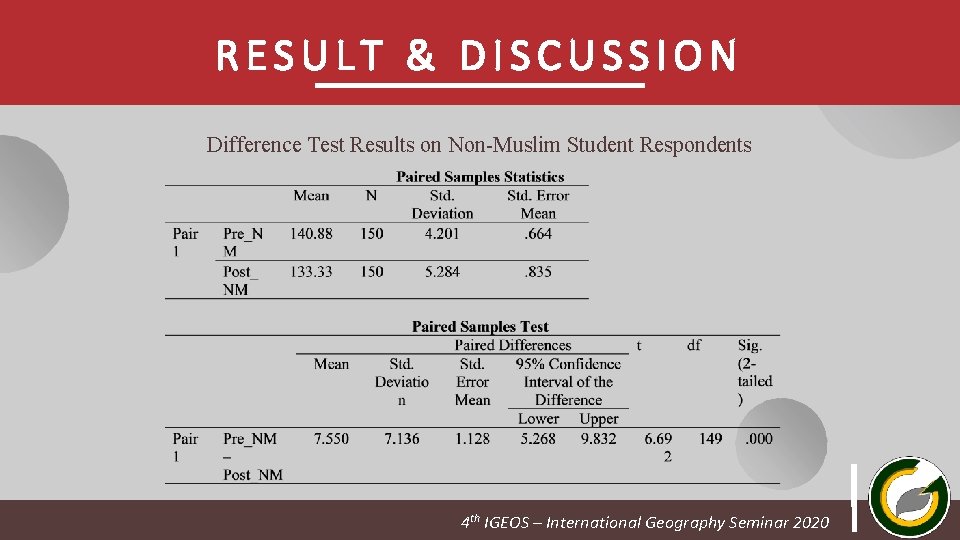
RESULT & DISCUSSION Difference Test Results on Non-Muslim Student Respondents 4 th IGEOS – International Geography Seminar 2020
RESULT & DISCUSSION • The results would therefore side with the findings of Lee assumed that media consumer trends lead to the public interest on information that meets the news values and thus it will direct the media consumers to pay equal attention to an issue [6, 8]. • In addition, it determines one's primary position related to attitudes, concerns, motives, experiences, and expectations in the perception of human rights violations. 4 th IGEOS – International Geography Seminar 2020
CONCLUSION The pre-test and post-test results proved that the group with non-muslim respondents has influenced by media exposure. Before being treated, the group of students had high perception. However, after being given the treatment, group of students had the lower perception of the issue of human rights violations. This fact indicates that media exposure as the primary source of information can influence people to change their perception towards an issue. 4 th 6 IGEOS – International Geography Seminar 2020
REFERENCES [1] Mc. Quail D. Mc. Quail’s Mass Communication Theory. 5 th ed. London: SAGE Publications; 2005. [2] Naeem N. Elements of pathos and media framing as scientific discourse: A newspaper perspective on Rohingya crisis. Int J Adv Appl Sci. 2016; 3(10): 89– 99. [3] Shah D V. , Domke D, Watts MD, Fan DP. News Framing And Cueing Of Issue Regimes Explaining Clinton’s Public Approval In Spite Of Scandal. Public Opin Q. 2002; [4] Sukmayadi V. The Dynamics of Media Landscape and Media Policy in Indonesia. Asia Pacific Media Educator. 2019. [5] Hopkins DJ, Kim E, Kim S. Does newspaper coverage influence or reflect public perceptions of the economy? Res Polit. 2017; 4(4). [6] Lee H. Attention of Direct and Mediated Causal Relationships. Journal Mass Commun Q. 2009; 86(1): 175– 90. [7] Eicholz M. What’s news? News definitions across cultures. Mass Communications; 2003. [8] Lee SH. News Engagement Versus News Consumption. Electron News [Internet]. 2015; 9(2): 75– 90. 4 th 6 IGEOS – International Geography Seminar 2020