2 2 Contrary and similar flexure turnouts Definition

- Slides: 20
2. 2 Contrary and similar flexure turnouts: Definition, Calculations for lead & radius. PERIODS 6
Turn outs taking off from curved track • • P&C are weak system in track Due to discontinuity in rail at crossing. Transfer of wheel from running track to tongue rail. 1 in 20 cant is not provided therefore behavior of vehicles on points is different from normal track. • When P&C is laid in curve the problem of maintenance is increased and extra care is to be given for safety and maintenance of track parameters.
Turn outs taking off from curved track • When the point is laid on curve and when the vehicle passes on turnout it experiences two curvatures, the first is due to curve alignment and second due to turnout. The vehicle travels with dual curvature with effective curvature. • Points can be laid with similar and contrary flexure
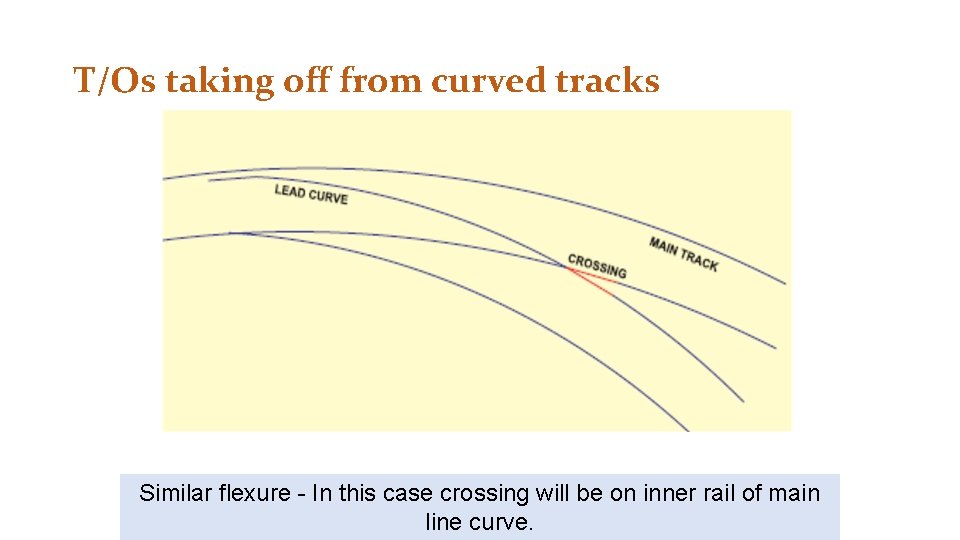
T/Os taking off from curved tracks Similar flexure - In this case crossing will be on inner rail of main line curve.
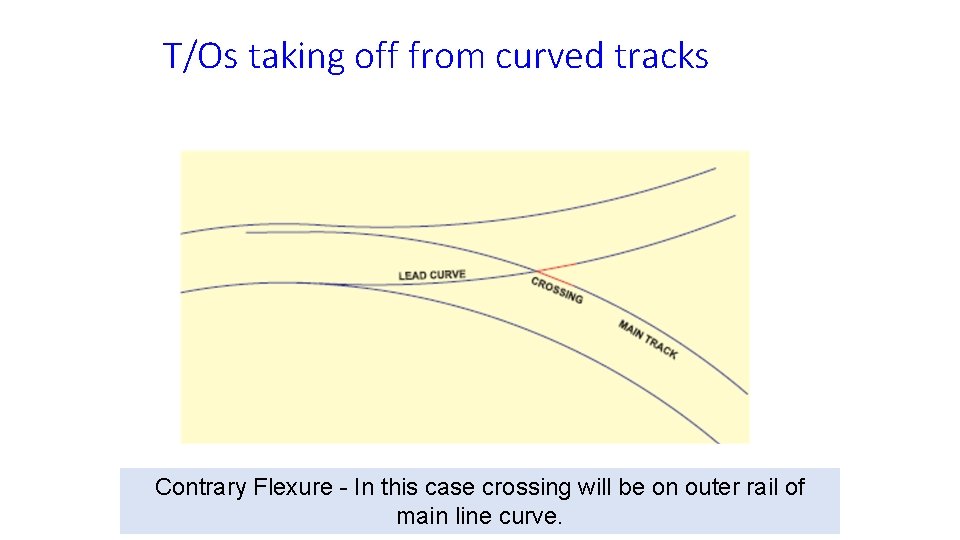
T/Os taking off from curved tracks Contrary Flexure - In this case crossing will be on outer rail of main line curve.
Resultant Lead Radius in Similar Flexure Turnouts Main line with Radius R 1 and Degree D 1 Turnout Laid on Straight Lead curve with Radius R & Degree D Lead curve with resultant Radius R 2 & resultant Degree D 2 For similar flexure, D 2 = D 1 + D 1750/R 2 = 1750/R 1 + 1750/R 1/R 2= 1/R 1 + 1/R
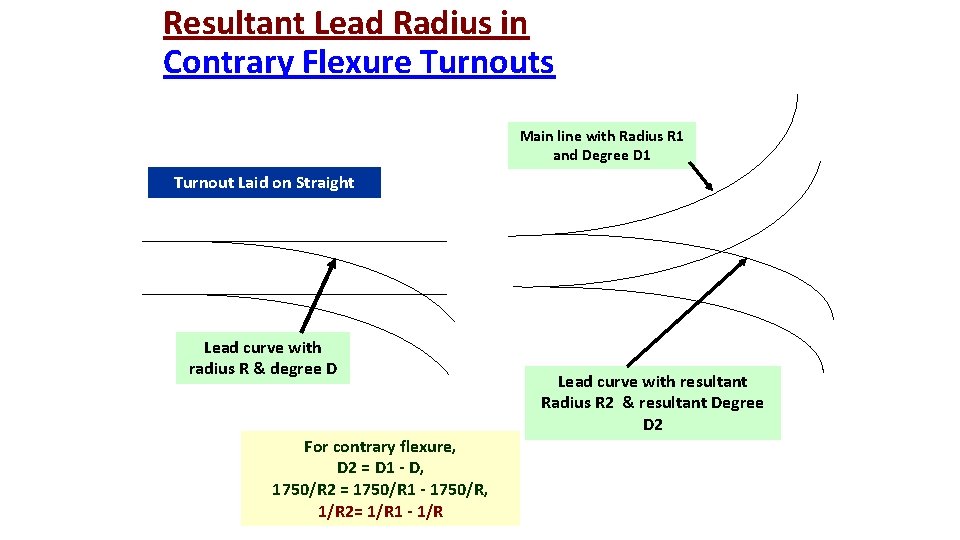
Resultant Lead Radius in Contrary Flexure Turnouts Main line with Radius R 1 and Degree D 1 Turnout Laid on Straight Lead curve with radius R & degree D For contrary flexure, D 2 = D 1 - D, 1750/R 2 = 1750/R 1 - 1750/R, 1/R 2= 1/R 1 - 1/R Lead curve with resultant Radius R 2 & resultant Degree D 2
Working Example • 1. Work out the resultant radius of lead curve if a 1 in 8. 5 PSC fanshaped turnout is taking off from outside of a curve of 2 degree. • 2. Work out the resultant radius of lead curve if a 1 in 12 PSC fanshaped turnout is taking off from inside of a curve of 1 degree. • (trainees to be asked to workout)
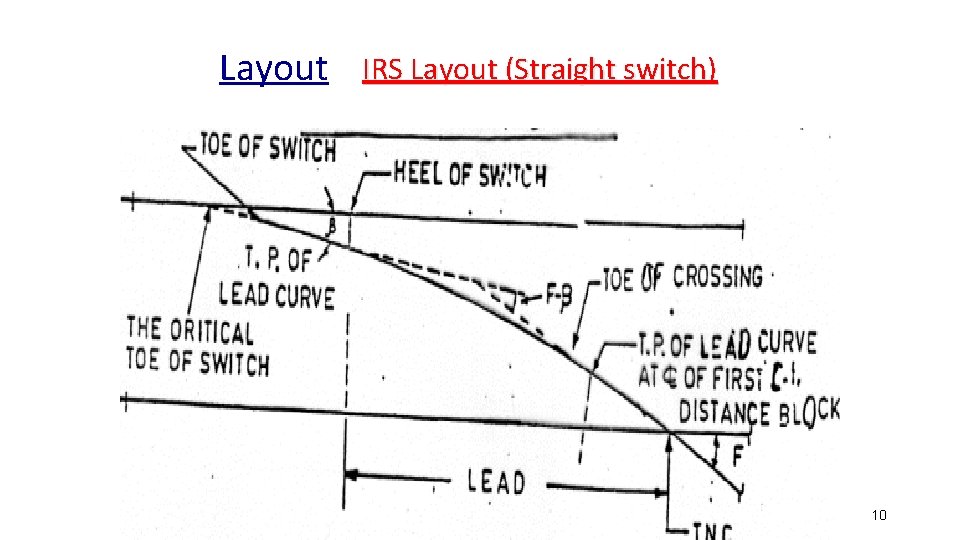
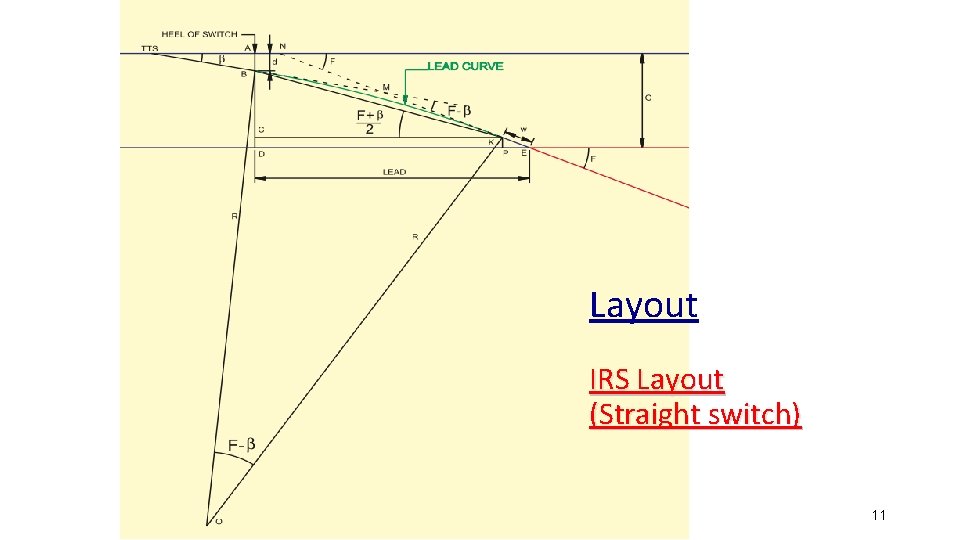
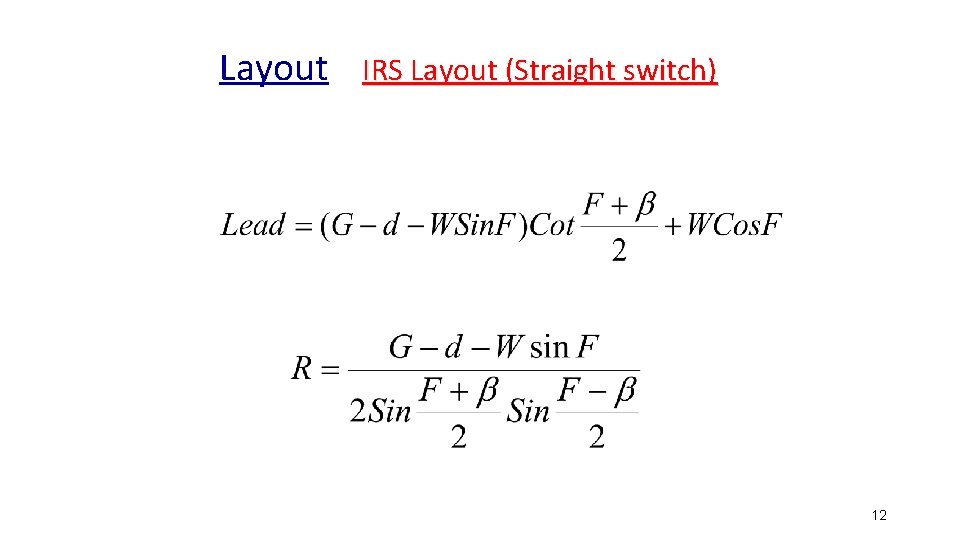
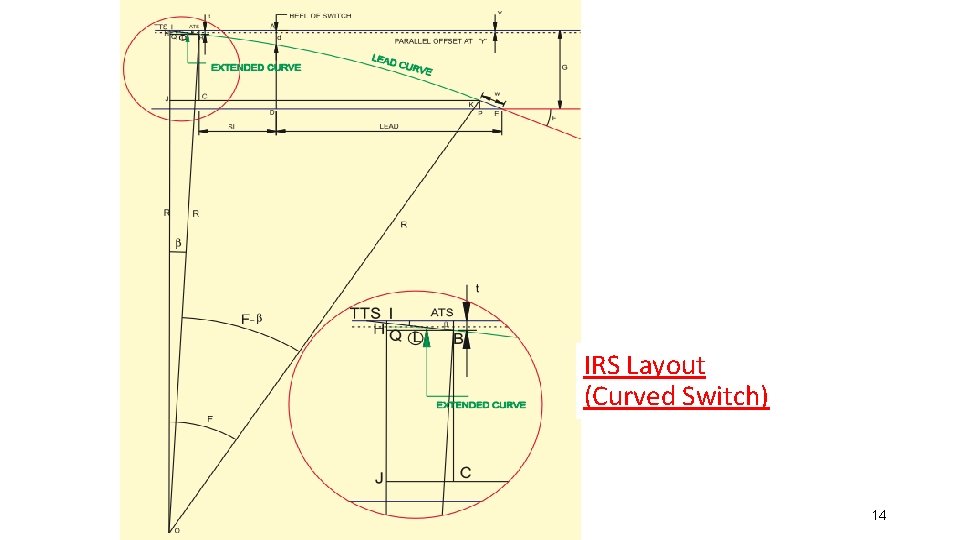
Calculation of Lead
Layout IRS Layout (Straight switch) 10
Layout IRS Layout (Straight switch) 11
Layout IRS Layout (Straight switch) 12
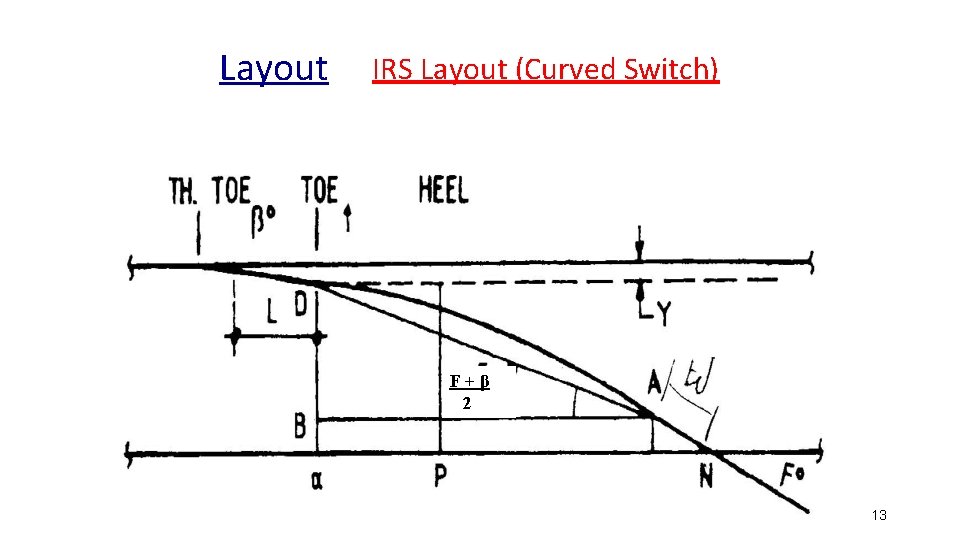
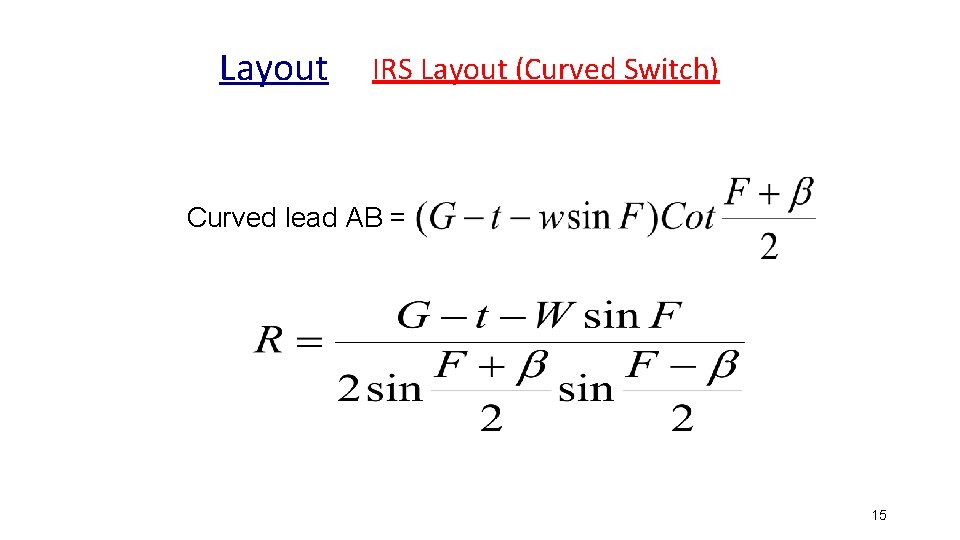
Layout IRS Layout (Curved Switch) F+β 2 13
Layout IRS Layout (Curved Switch) 14
Layout IRS Layout (Curved Switch) Curved lead AB = 15
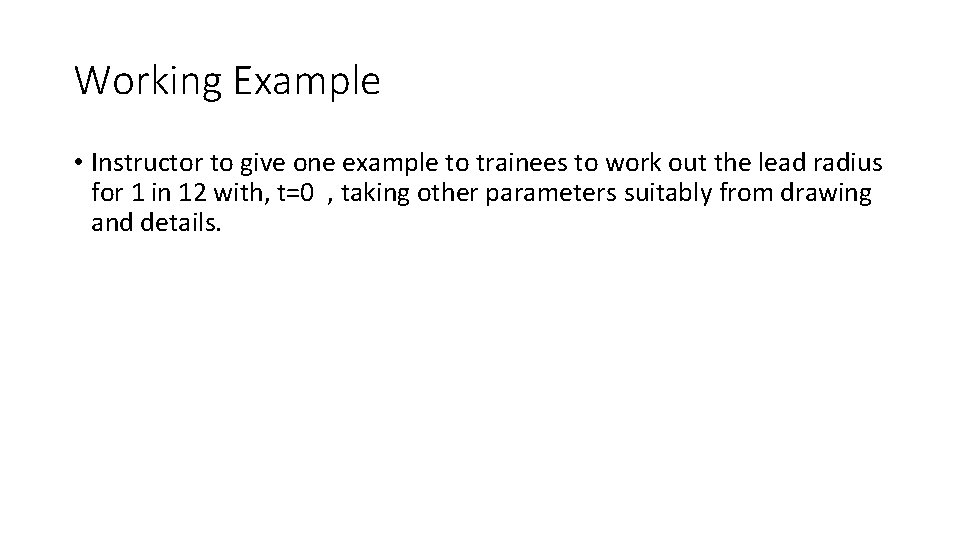
Working Example • Instructor to give one example to trainees to work out the lead radius for 1 in 12 with, t=0 , taking other parameters suitably from drawing and details.
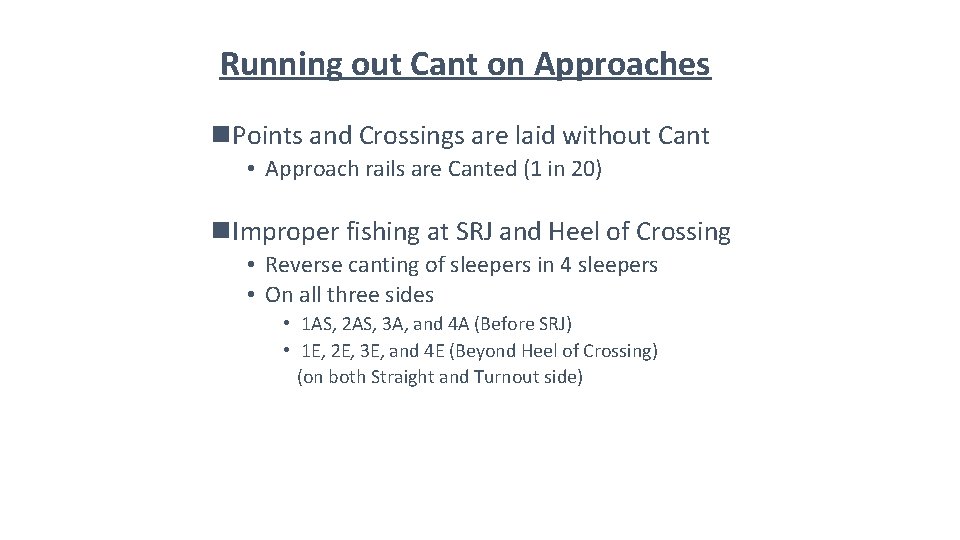
Running out Cant on Approaches n. Points and Crossings are laid without Cant • Approach rails are Canted (1 in 20) n. Improper fishing at SRJ and Heel of Crossing • Reverse canting of sleepers in 4 sleepers • On all three sides • 1 AS, 2 AS, 3 A, and 4 A (Before SRJ) • 1 E, 2 E, 3 E, and 4 E (Beyond Heel of Crossing) (on both Straight and Turnout side)
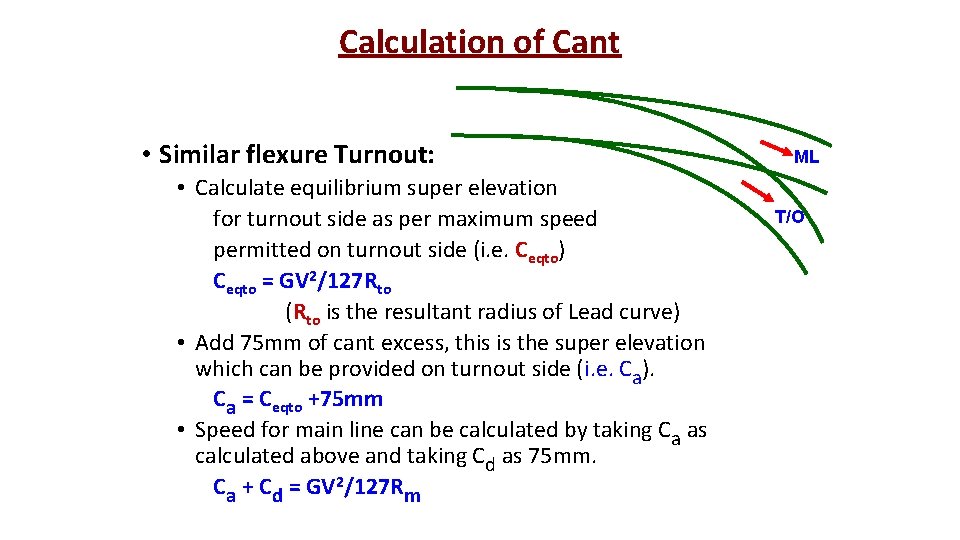
Calculation of Cant • Similar flexure Turnout: • Calculate equilibrium super elevation for turnout side as per maximum speed permitted on turnout side (i. e. Ceqto) Ceqto = GV 2/127 Rto (Rto is the resultant radius of Lead curve) • Add 75 mm of cant excess, this is the super elevation which can be provided on turnout side (i. e. Ca). Ca = Ceqto +75 mm • Speed for main line can be calculated by taking Ca as calculated above and taking Cd as 75 mm. Ca + Cd = GV 2/127 Rm ML T/O
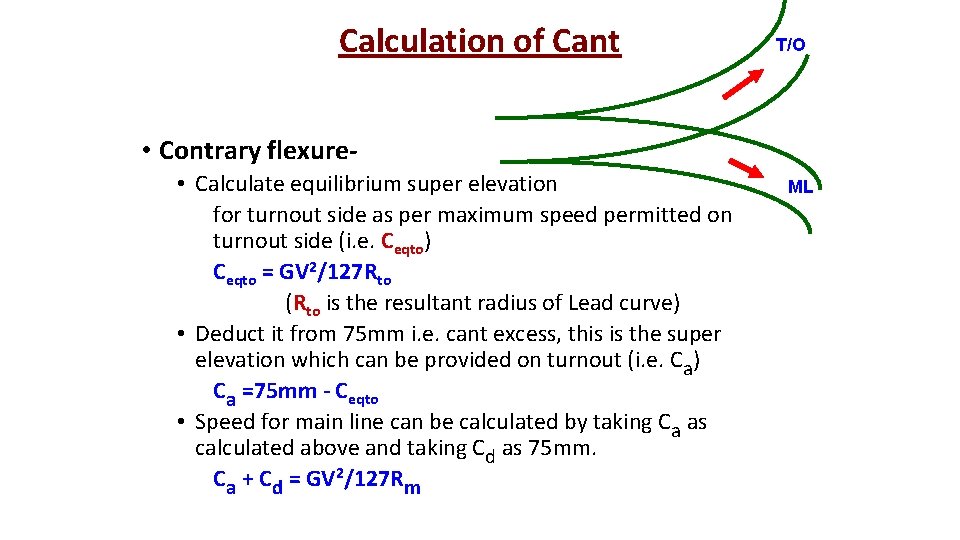
Calculation of Cant T/O • Contrary flexure • Calculate equilibrium super elevation for turnout side as per maximum speed permitted on turnout side (i. e. Ceqto) Ceqto = GV 2/127 Rto (Rto is the resultant radius of Lead curve) • Deduct it from 75 mm i. e. cant excess, this is the super elevation which can be provided on turnout (i. e. Ca) Ca =75 mm - Ceqto • Speed for main line can be calculated by taking Ca as calculated above and taking Cd as 75 mm. Ca + Cd = GV 2/127 Rm ML
Thanks