19 1 Electric Current the flow of charged




- Slides: 31
19. 1 Electric Current
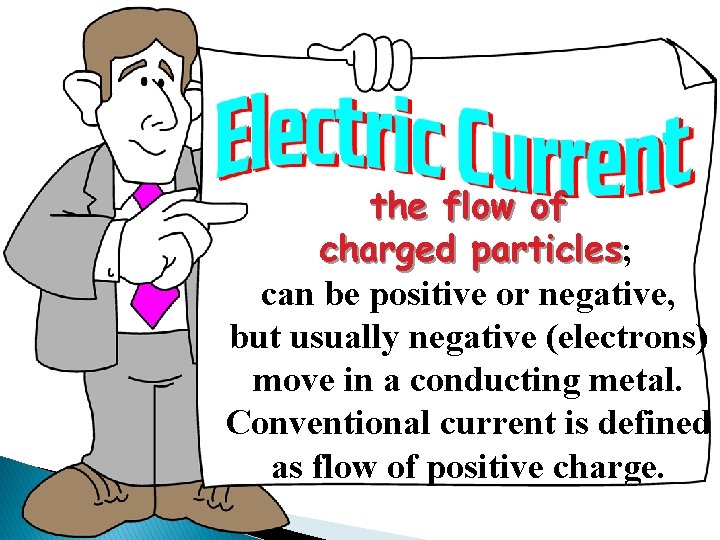
the flow of charged particles; particles can be positive or negative, but usually negative (electrons) move in a conducting metal. Conventional current is defined as flow of positive charge.
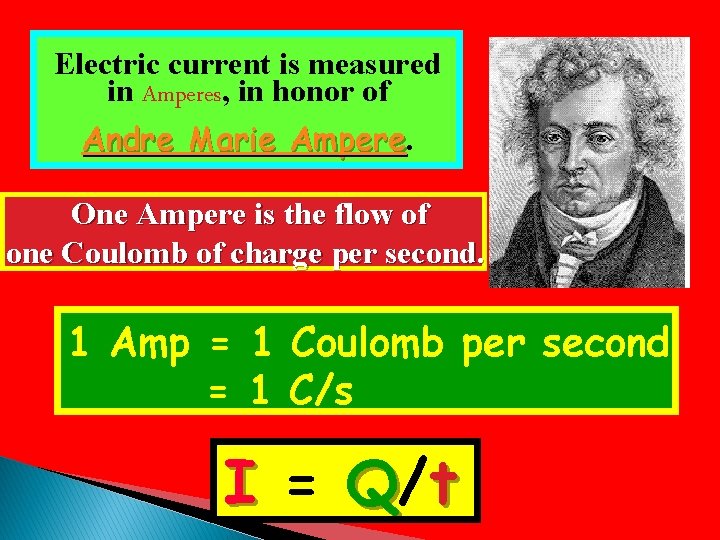
Electric current is measured in Amperes, in honor of Andre Marie Ampere One Ampere is the flow of one Coulomb of charge per second. 1 Amp = 1 Coulomb per second = 1 C/s I = Q/ t
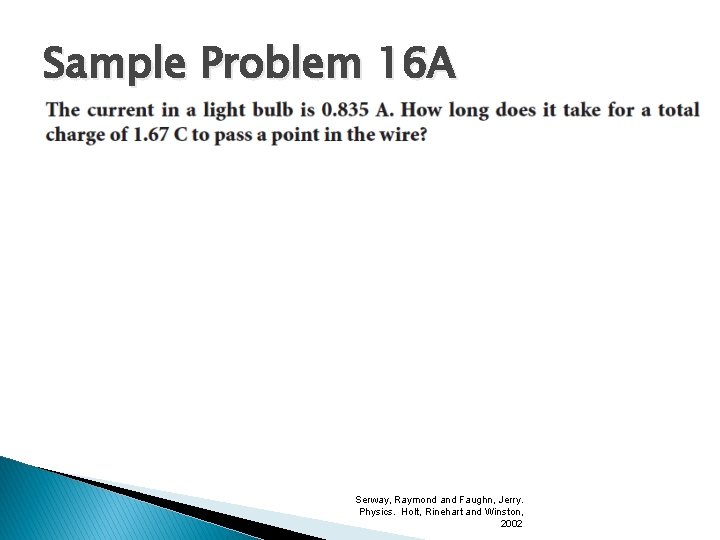
Sample Problem 16 A Serway, Raymond and Faughn, Jerry. Physics. Holt, Rinehart and Winston, 2002
electric cell - a device that converts one form of energy to electrical energy Chemical cells convert chemical energy into electrical energy. Chemical cells can be “wet” or “dry”.
Solar cells convert light energy into electrical energy. A generator converts mechanical energy into electrical energy. battery - two or more cells connected in series or in parallel
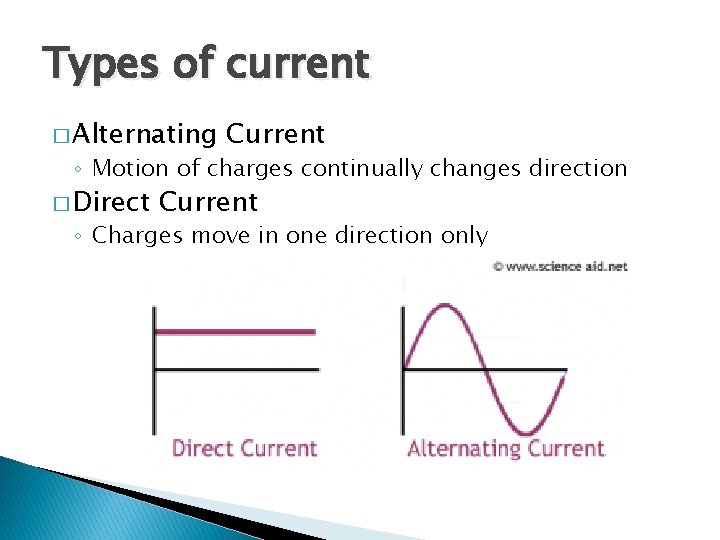
Types of current � Alternating Current ◦ Motion of charges continually changes direction � Direct Current ◦ Charges move in one direction only
19. 2 Resistance
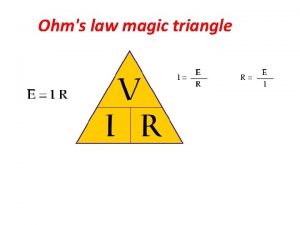
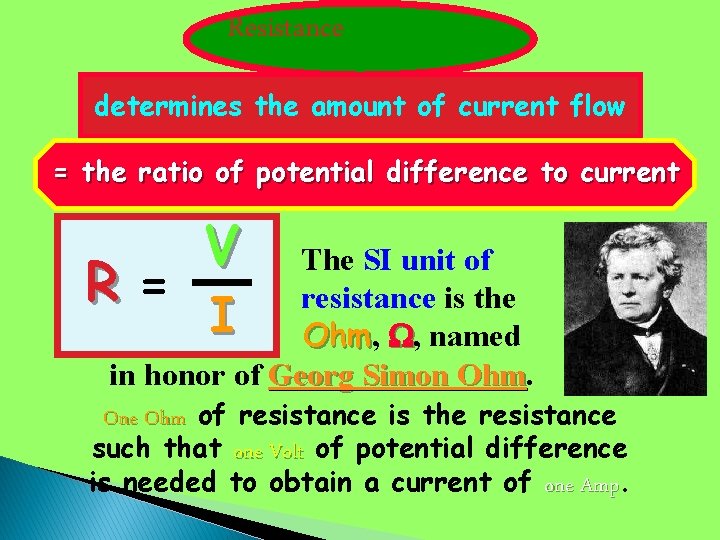
Resistance determines the amount of current flow = the ratio of potential difference to current V The SI unit of resistance is the I Ohm, Ohm W, named in honor of Georg Simon Ohm R= One Ohm of resistance is the resistance such that one Volt of potential difference is needed to obtain a current of one Amp
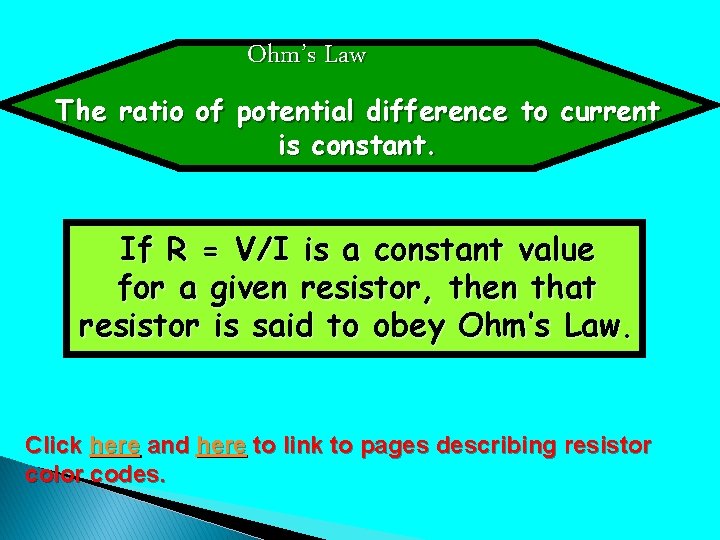
Ohm’s Law The ratio of potential difference to current is constant. If R = V/I is a constant value for a given resistor, then that resistor is said to obey Ohm’s Law. Click here and here to link to pages describing resistor color codes.
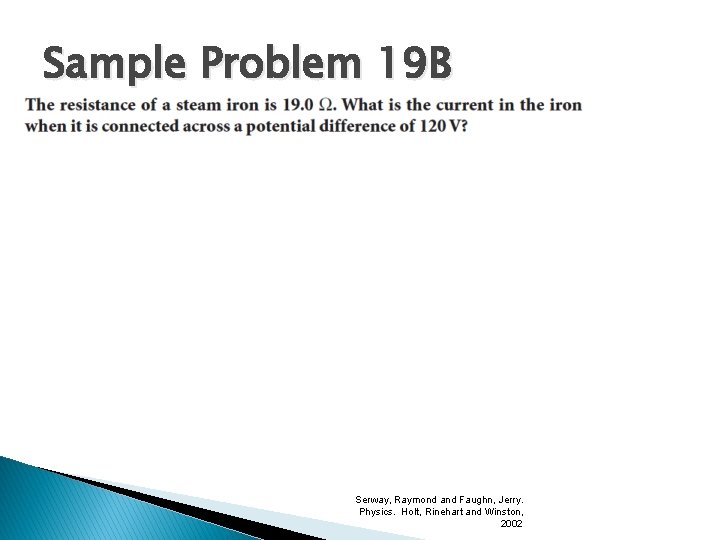
Sample Problem 19 B Serway, Raymond and Faughn, Jerry. Physics. Holt, Rinehart and Winston, 2002
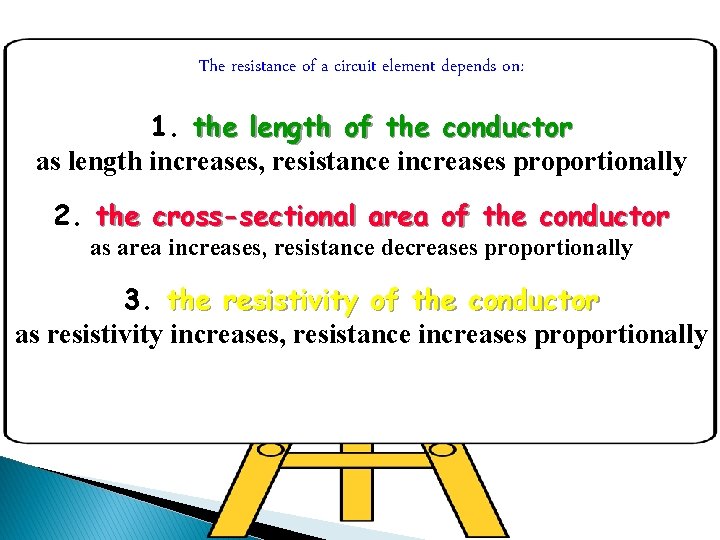
Resistance depends on Serway, Raymond and Faughn, Jerry. Physics. Holt, Rinehart and Winston, 2002
The resistance of a circuit element depends on: 1. the length of the conductor as length increases, resistance increases proportionally 2. the cross-sectional area of the conductor as area increases, resistance decreases proportionally 3. the resistivity of the conductor as resistivity increases, resistance increases proportionally
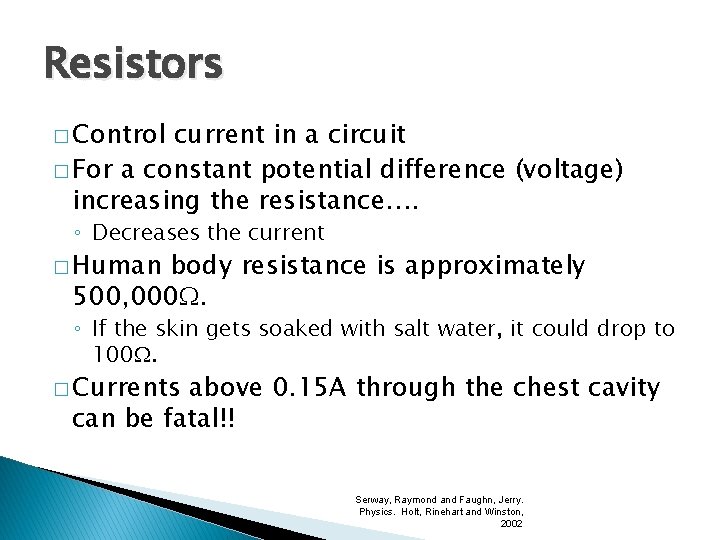
Resistors � Control current in a circuit � For a constant potential difference (voltage) increasing the resistance…. ◦ Decreases the current � Human body resistance is approximately 500, 000. ◦ If the skin gets soaked with salt water, it could drop to 100. � Currents above 0. 15 A through the chest cavity can be fatal!! Serway, Raymond and Faughn, Jerry. Physics. Holt, Rinehart and Winston, 2002
Many circuit elements do not obey Ohm’s Law. Resistors that get hot, like light bulbs and heating elements, do not keep a constant resistance. Resistance generally increases as objects become hotter.
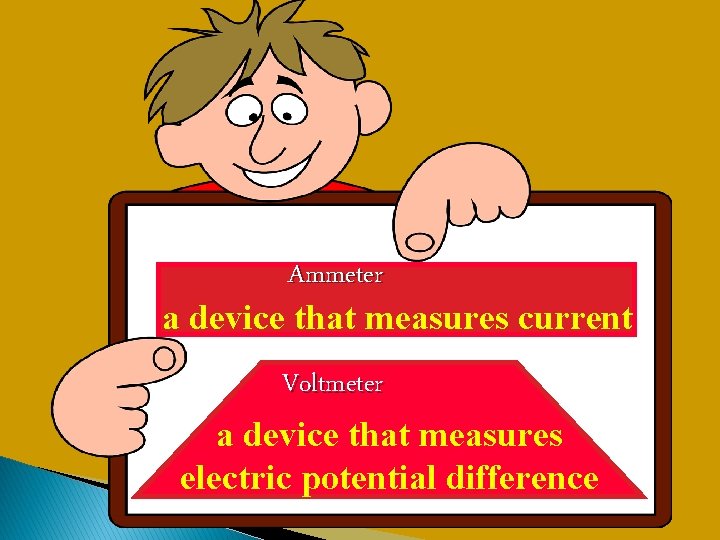
Ammeter a device that measures current Voltmeter a device that measures electric potential difference
19. 3 Electrical Power
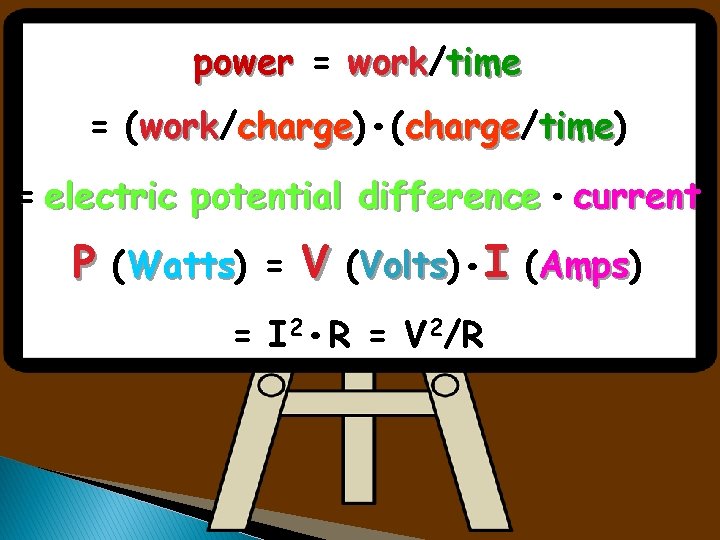
power = work/time . = (work/charge) (charge/time) . = electric potential difference current P (Watts) = V (Volts). I (Amps) . = I 2 R = V 2/R
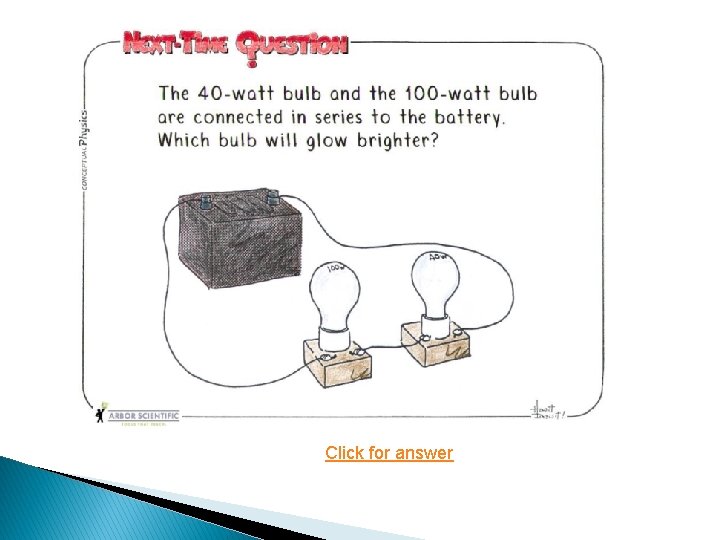
Click for answer
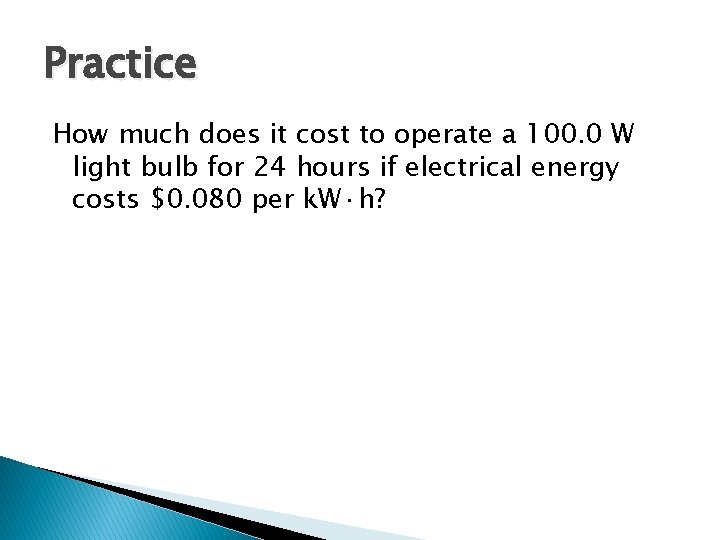
Practice How much does it cost to operate a 100. 0 W light bulb for 24 hours if electrical energy costs $0. 080 per k. W·h?
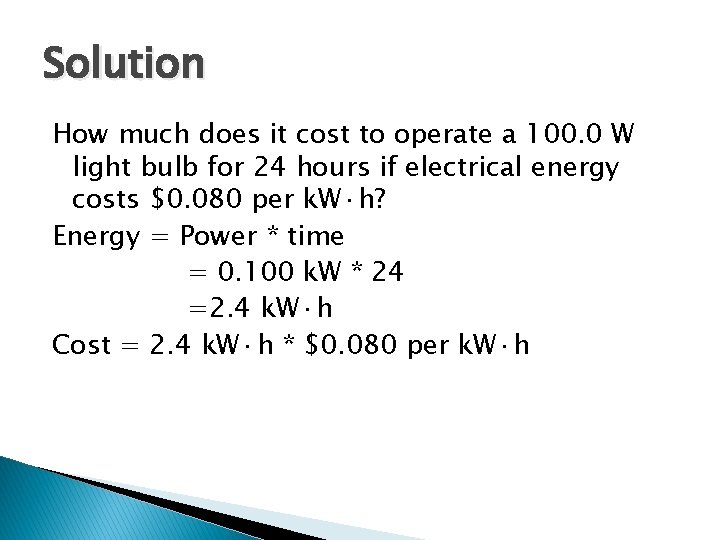
Solution How much does it cost to operate a 100. 0 W light bulb for 24 hours if electrical energy costs $0. 080 per k. W·h? Energy = Power * time = 0. 100 k. W * 24 =2. 4 k. W·h Cost = 2. 4 k. W·h * $0. 080 per k. W·h
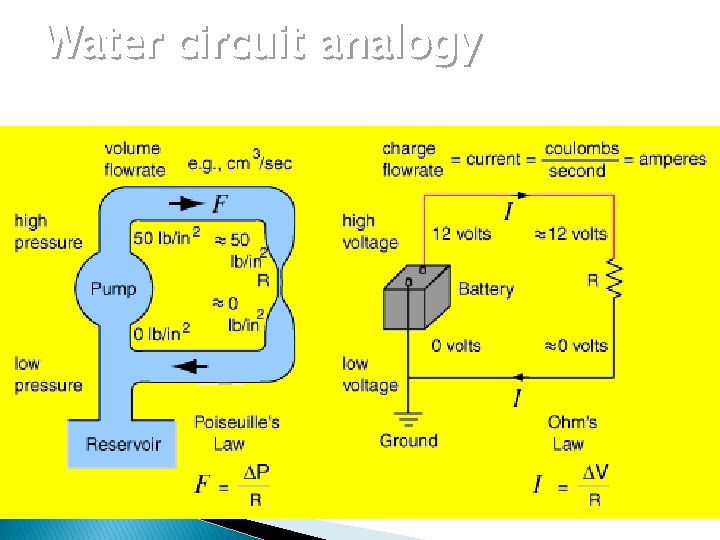
Water circuit analogy
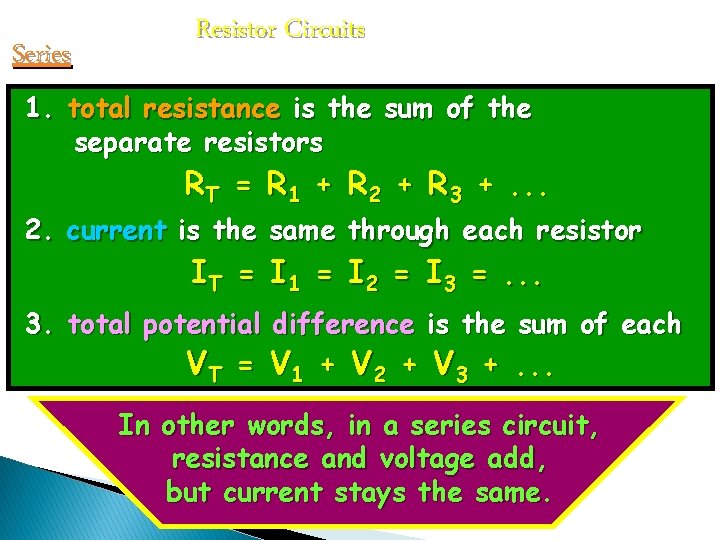
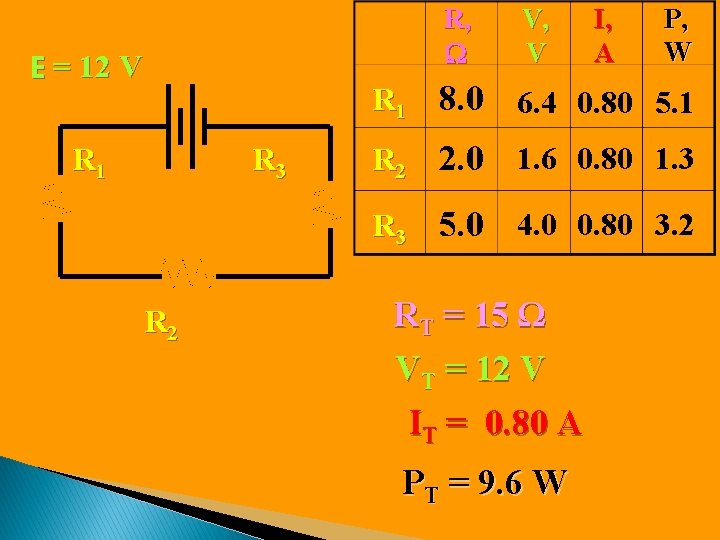
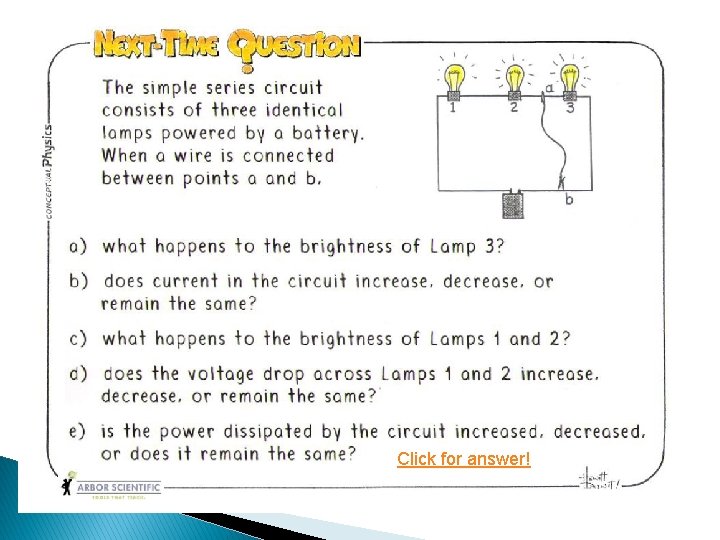
Series Resistor Circuits 1. total resistance is the sum of the separate resistors RT = R 1 + R 2 + R 3 +. . . 2. current is the same through each resistor IT = I 1 = I 2 = I 3 =. . . 3. total potential difference is the sum of each VT = V 1 + V 2 + V 3 +. . . In other words, in a series circuit, resistance and voltage add, but current stays the same.
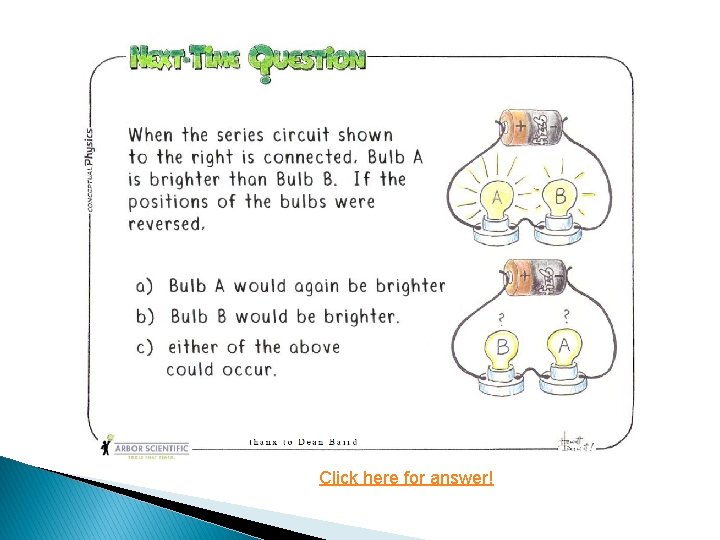
Click here for answer!
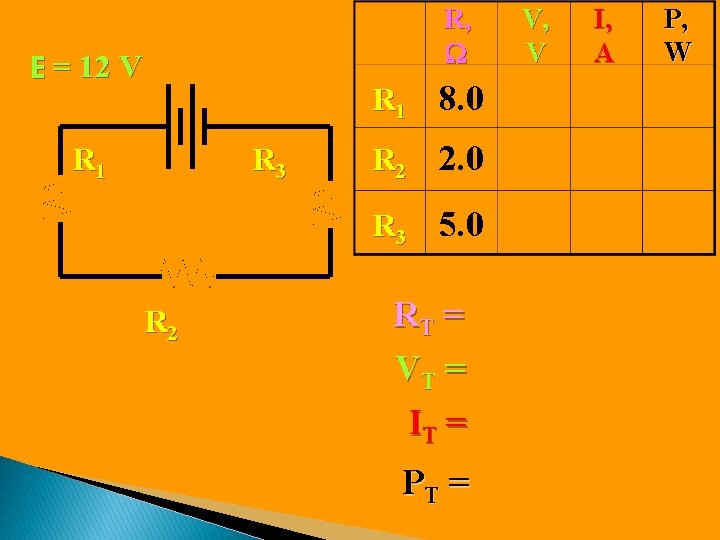
R, W E = 12 V R 1 R 3 R 2 R 1 8. 0 R 2 2. 0 R 3 5. 0 RT = VT = IT = PT = V, V I, A P, W
R, W E = 12 V R 1 R 3 R 2 V, V I, A P, W R 1 8. 0 6. 4 0. 80 5. 1 R 2 2. 0 1. 6 0. 80 1. 3 R 3 5. 0 4. 0 0. 80 3. 2 RT = 15 Ω VT = 12 V IT = 0. 80 A PT = 9. 6 W
Click for answer!
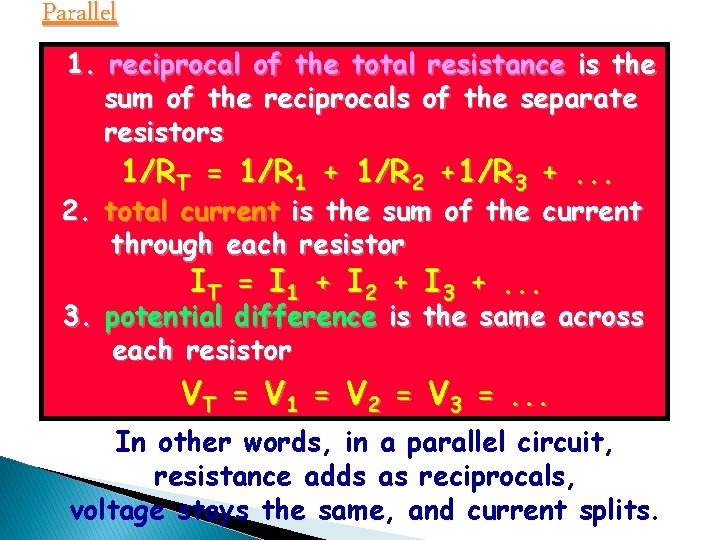
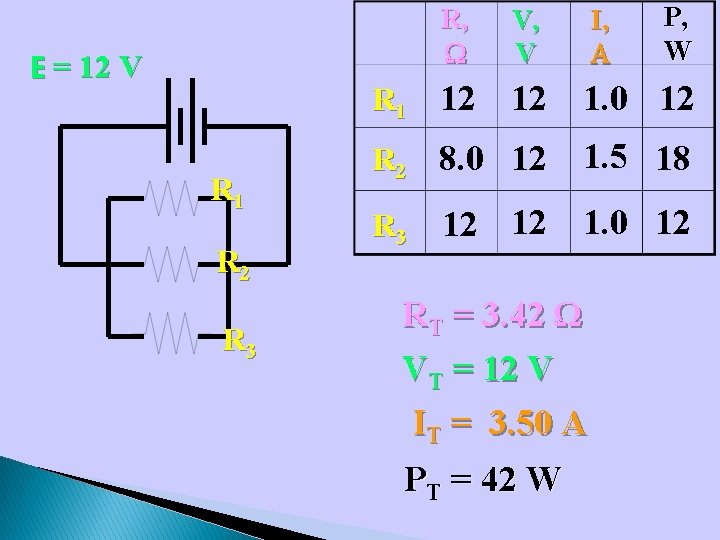
Parallel 1. reciprocal of the total resistance is the sum of the reciprocals of the separate resistors 1/RT = 1/R 1 + 1/R 2 +1/R 3 +. . . 2. total current is the sum of the current through each resistor IT = I 1 + I 2 + I 3 +. . . 3. potential difference is the same across each resistor VT = V 1 = V 2 = V 3 =. . . In other words, in a parallel circuit, resistance adds as reciprocals, voltage stays the same, and current splits.
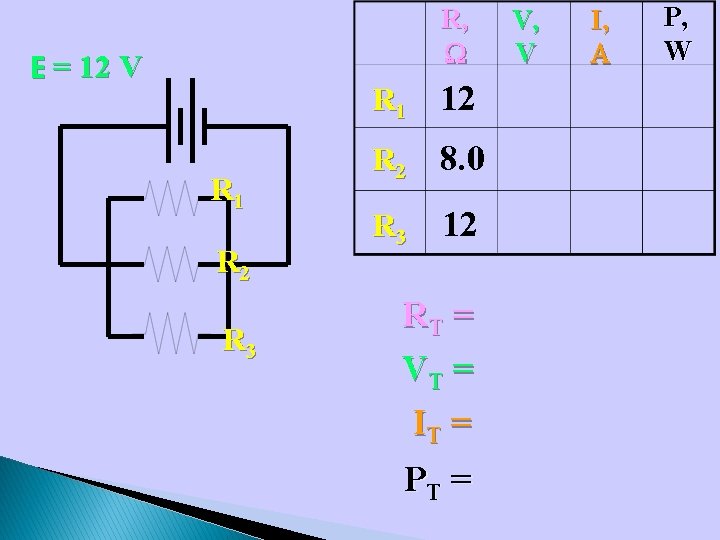
R, W E = 12 V R 1 R 2 R 3 R 1 12 R 2 8. 0 R 3 12 RT = VT = IT = PT = V, V I, A P, W
R, W E = 12 V R 1 R 2 R 3 V, V I, A P, W R 1 12 12 1. 0 12 R 2 8. 0 12 1. 5 18 R 3 12 12 1. 0 12 RT = 3. 42 Ω VT = 12 V IT = 3. 50 A PT = 42 W
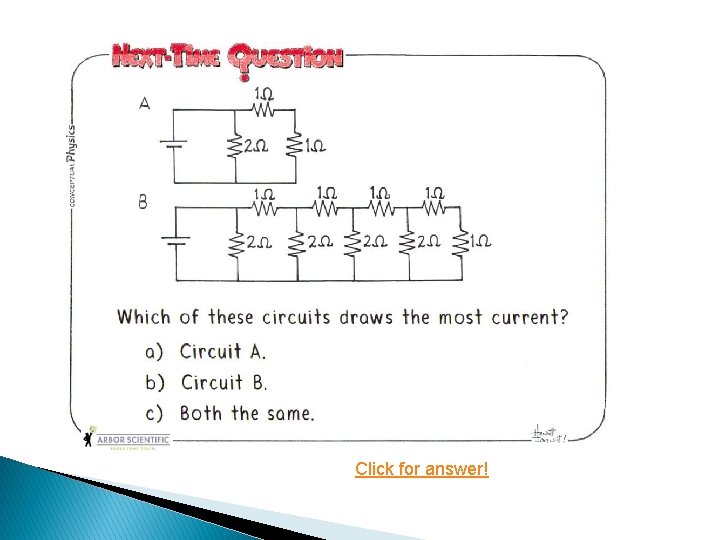
Click for answer!