1 Unit 5 Conservation of Momentum Force and
- Slides: 30
1 Unit 5: Conservation of Momentum üForce and Momentum and Conservation of Momentum (9 -1, 9 -2, 9 -3) üCollisions (9 -4, 9 -5, 9 -6) üCollisions, Center of Mass (9 -7, 9 -8) • Center of Mass, Rocket Propulsion, and Quiz Three Review (9 -9, 9 -10) 2/27/2021 Physics 253
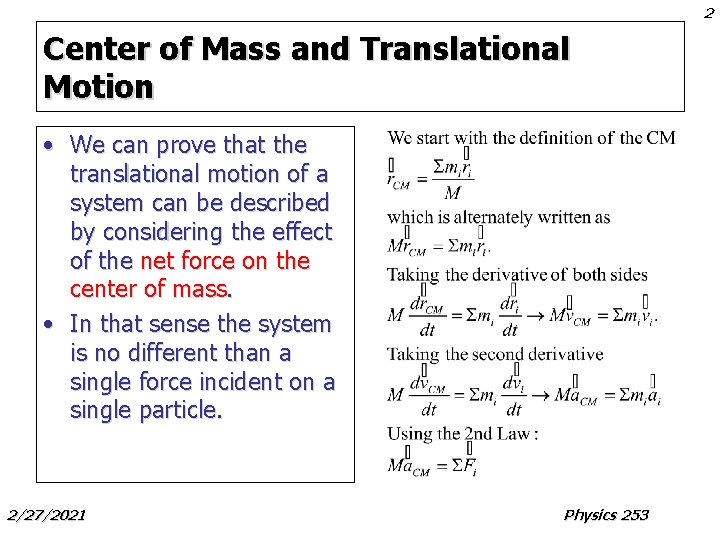
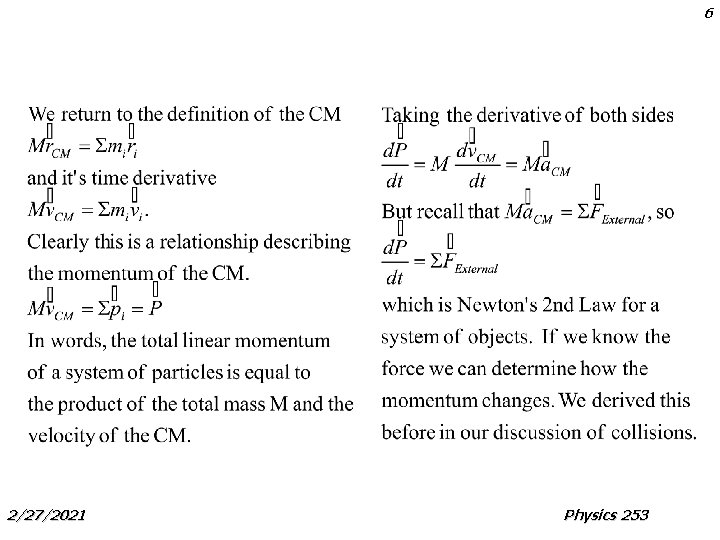
2 Center of Mass and Translational Motion • We can prove that the translational motion of a system can be described by considering the effect of the net force on the center of mass. • In that sense the system is no different than a single force incident on a single particle. 2/27/2021 Physics 253
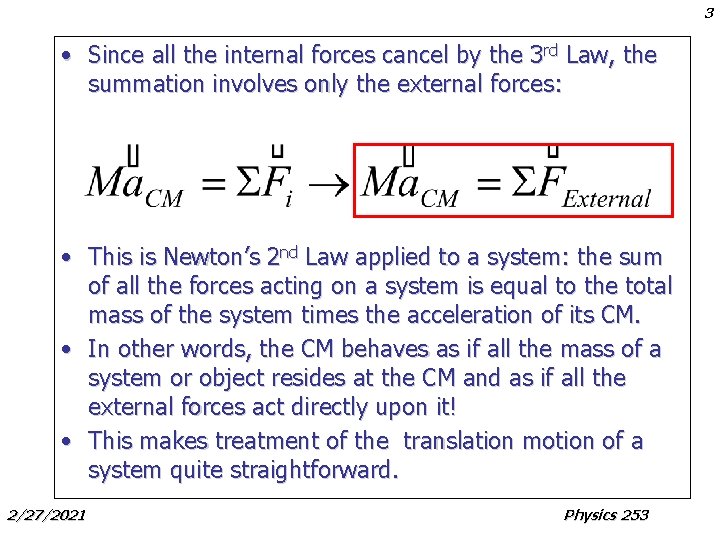
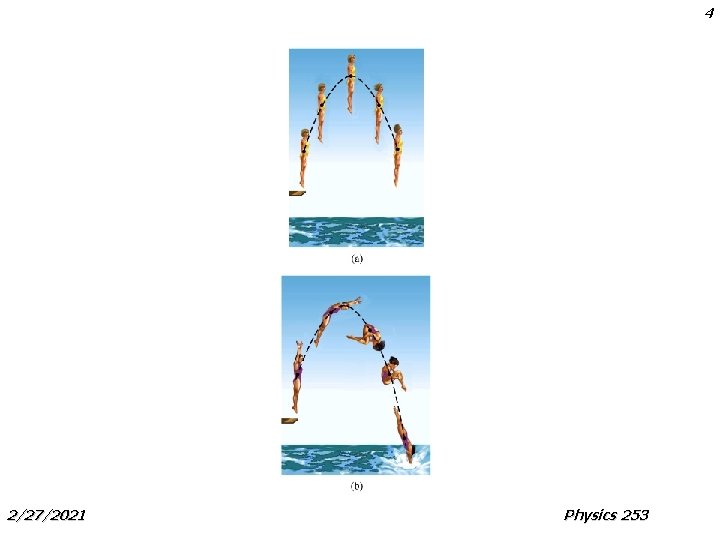
3 • Since all the internal forces cancel by the 3 rd Law, the summation involves only the external forces: • This is Newton’s 2 nd Law applied to a system: the sum of all the forces acting on a system is equal to the total mass of the system times the acceleration of its CM. • In other words, the CM behaves as if all the mass of a system or object resides at the CM and as if all the external forces act directly upon it! • This makes treatment of the translation motion of a system quite straightforward. 2/27/2021 Physics 253
4 2/27/2021 Physics 253
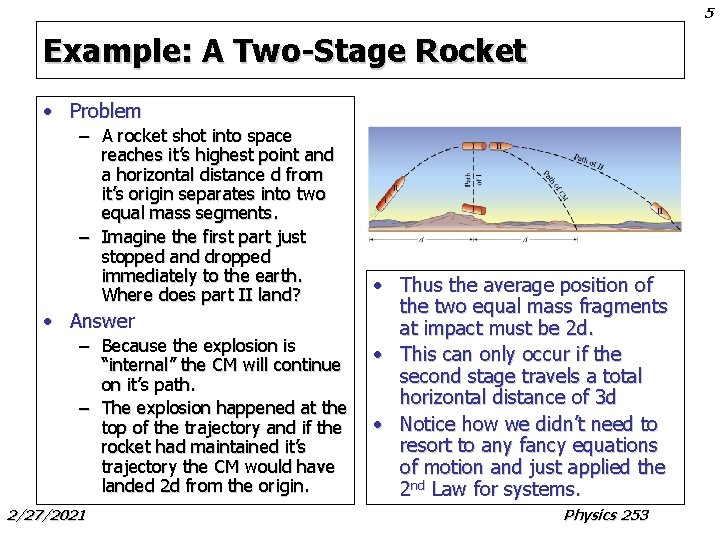
5 Example: A Two-Stage Rocket • Problem – A rocket shot into space reaches it’s highest point and a horizontal distance d from it’s origin separates into two equal mass segments. – Imagine the first part just stopped and dropped immediately to the earth. Where does part II land? • Answer – Because the explosion is “internal” the CM will continue on it’s path. – The explosion happened at the top of the trajectory and if the rocket had maintained it’s trajectory the CM would have landed 2 d from the origin. 2/27/2021 • Thus the average position of the two equal mass fragments at impact must be 2 d. • This can only occur if the second stage travels a total horizontal distance of 3 d • Notice how we didn’t need to resort to any fancy equations of motion and just applied the 2 nd Law for systems. Physics 253
6 2/27/2021 Physics 253
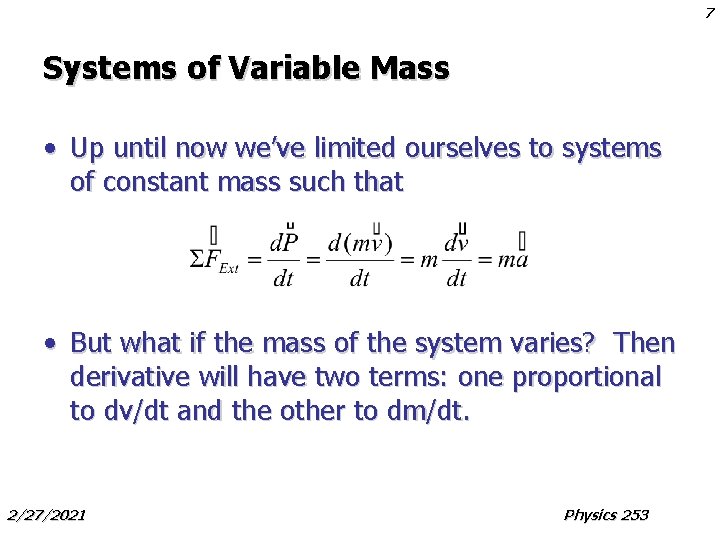
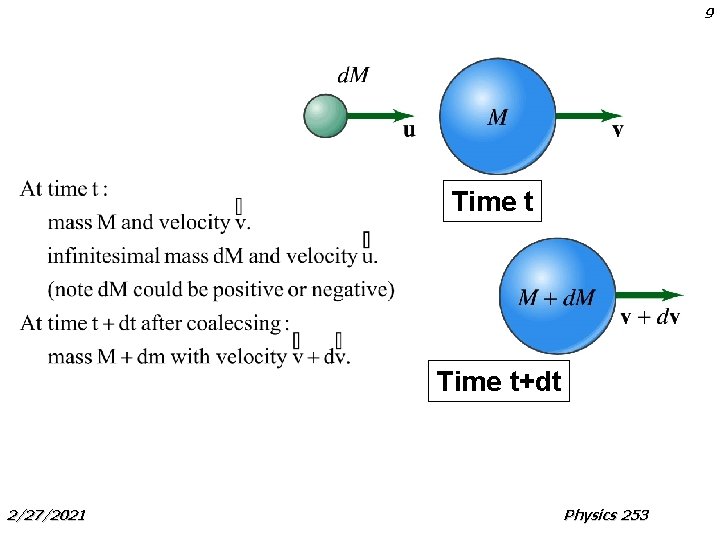
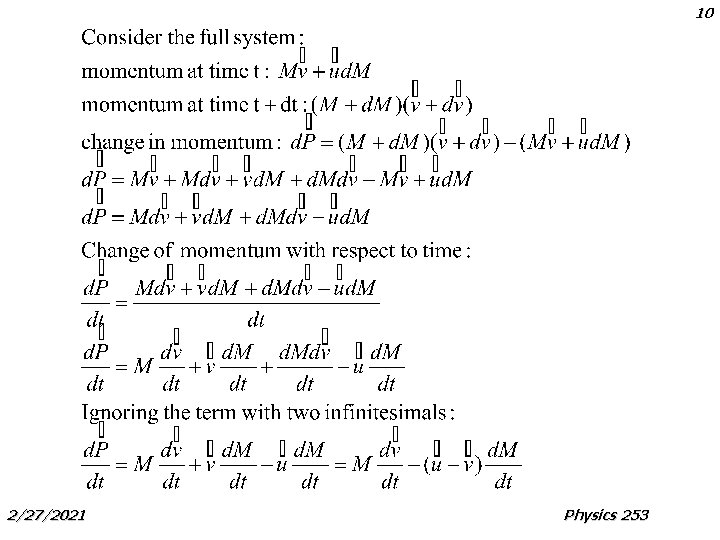
7 Systems of Variable Mass • Up until now we’ve limited ourselves to systems of constant mass such that • But what if the mass of the system varies? Then derivative will have two terms: one proportional to dv/dt and the other to dm/dt. 2/27/2021 Physics 253
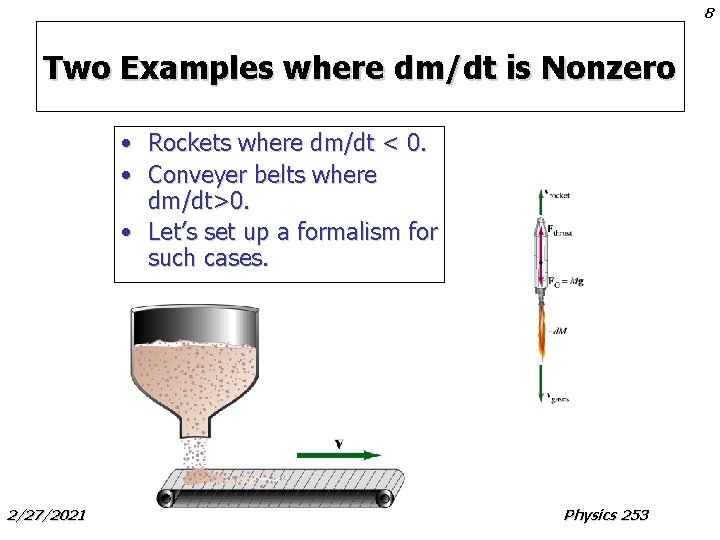
8 Two Examples where dm/dt is Nonzero • Rockets where dm/dt < 0. • Conveyer belts where dm/dt>0. • Let’s set up a formalism for such cases. 2/27/2021 Physics 253
9 Time t+dt 2/27/2021 Physics 253
10 2/27/2021 Physics 253
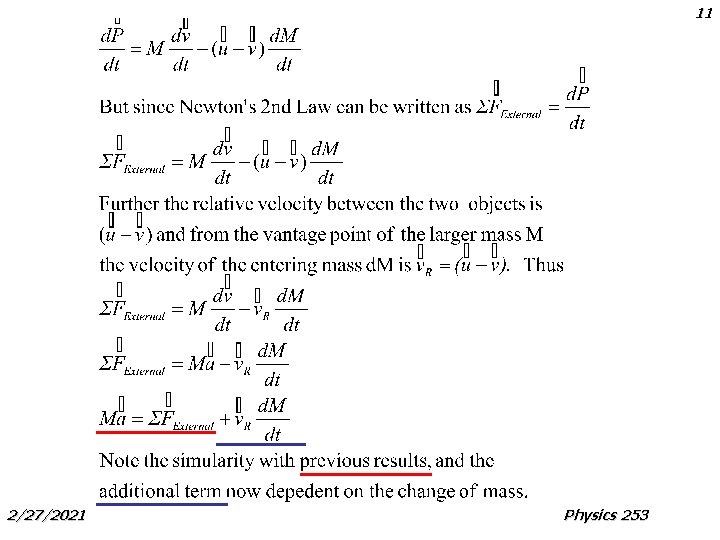
11 2/27/2021 Physics 253
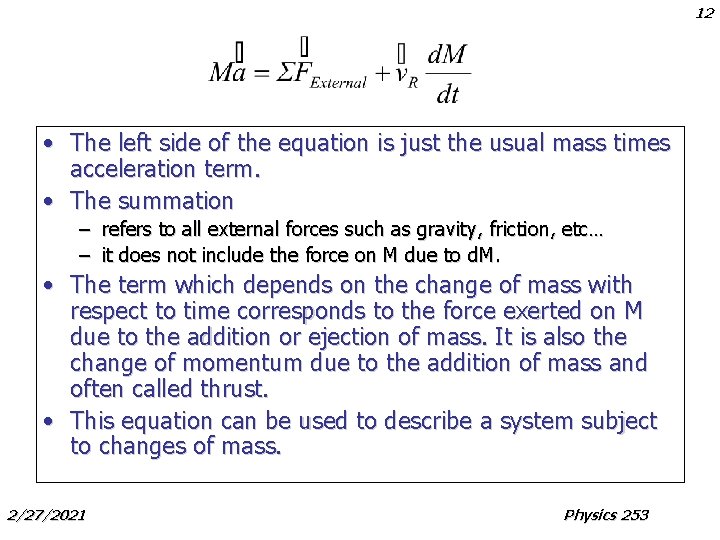
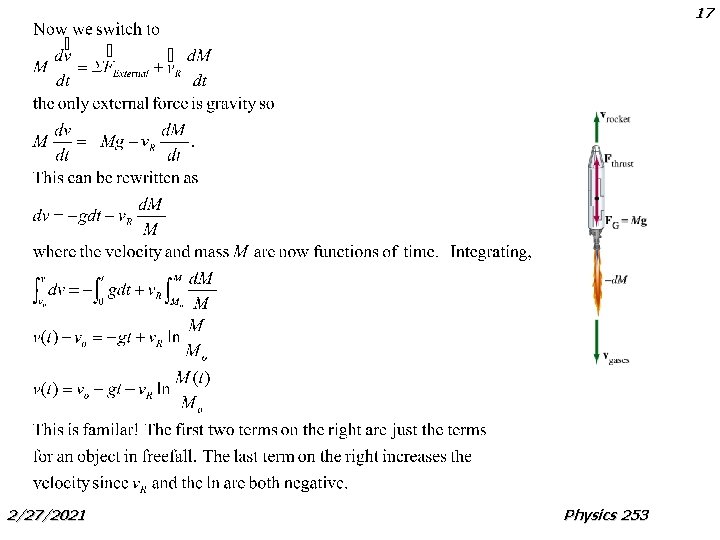
12 • The left side of the equation is just the usual mass times acceleration term. • The summation – refers to all external forces such as gravity, friction, etc… – it does not include the force on M due to d. M. • The term which depends on the change of mass with respect to time corresponds to the force exerted on M due to the addition or ejection of mass. It is also the change of momentum due to the addition of mass and often called thrust. • This equation can be used to describe a system subject to changes of mass. 2/27/2021 Physics 253
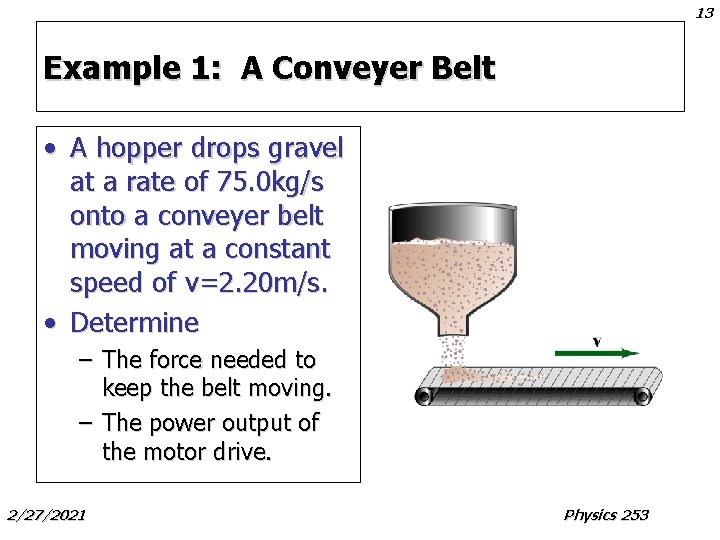
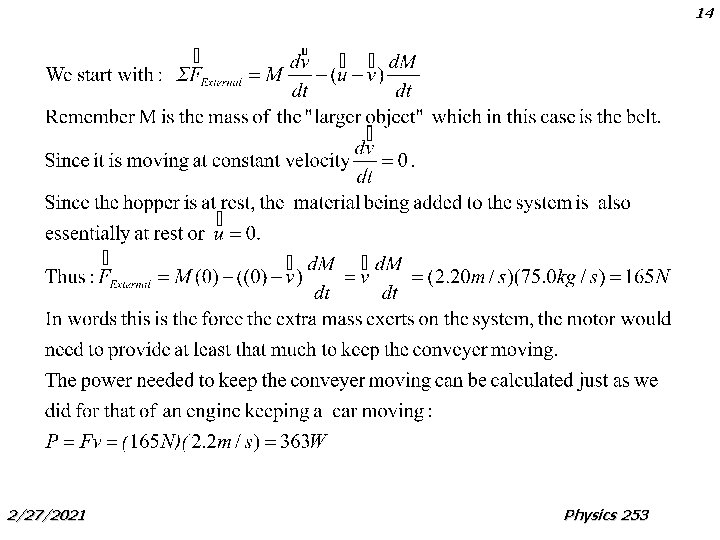
13 Example 1: A Conveyer Belt • A hopper drops gravel at a rate of 75. 0 kg/s onto a conveyer belt moving at a constant speed of v=2. 20 m/s. • Determine – The force needed to keep the belt moving. – The power output of the motor drive. 2/27/2021 Physics 253
14 2/27/2021 Physics 253
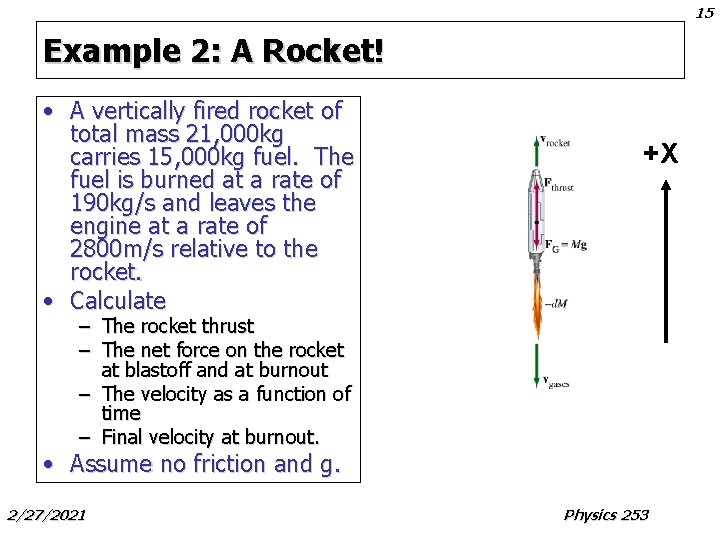
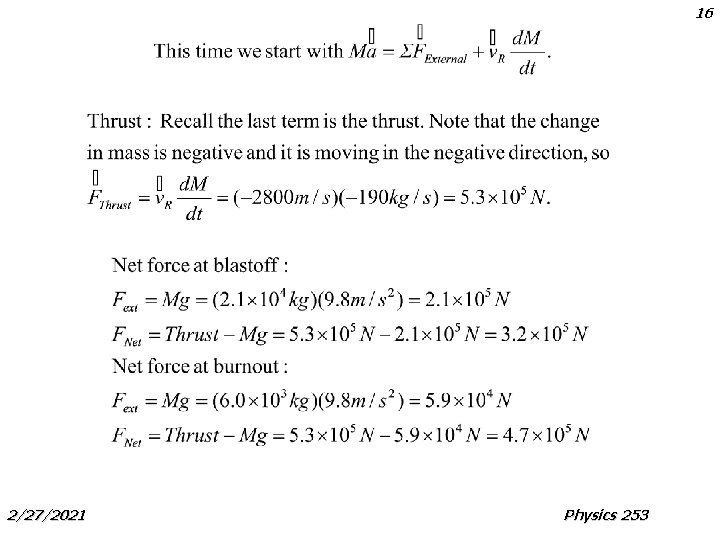
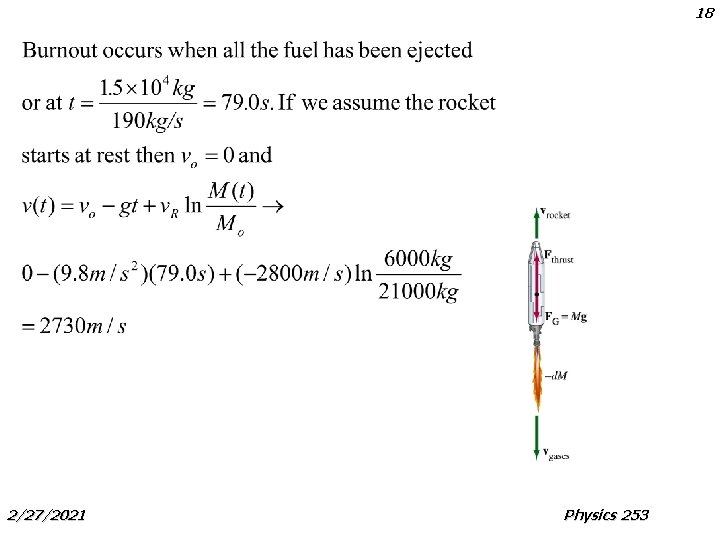
15 Example 2: A Rocket! • A vertically fired rocket of total mass 21, 000 kg carries 15, 000 kg fuel. The fuel is burned at a rate of 190 kg/s and leaves the engine at a rate of 2800 m/s relative to the rocket. • Calculate +X – The rocket thrust – The net force on the rocket at blastoff and at burnout – The velocity as a function of time – Final velocity at burnout. • Assume no friction and g. 2/27/2021 Physics 253
16 2/27/2021 Physics 253
17 2/27/2021 Physics 253
18 2/27/2021 Physics 253
19 Quiz Number Three • Same format as first two quizzes. • Total of 50 points – 4 multiple choice @ 5 pts each – 3 problems @ 5, 10, 15 points. • Bring a calculator • Bring a 3 x 5” note card crib sheet. 2/27/2021 Physics 253
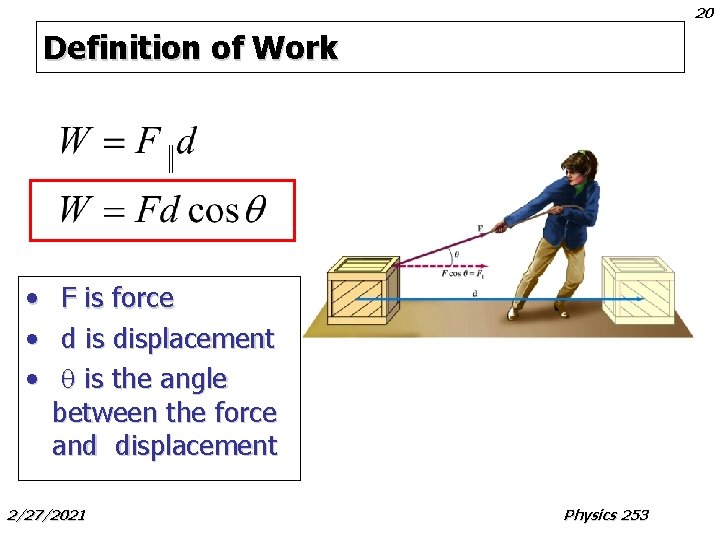
20 Definition of Work • • • F is force d is displacement q is the angle between the force and displacement 2/27/2021 Physics 253
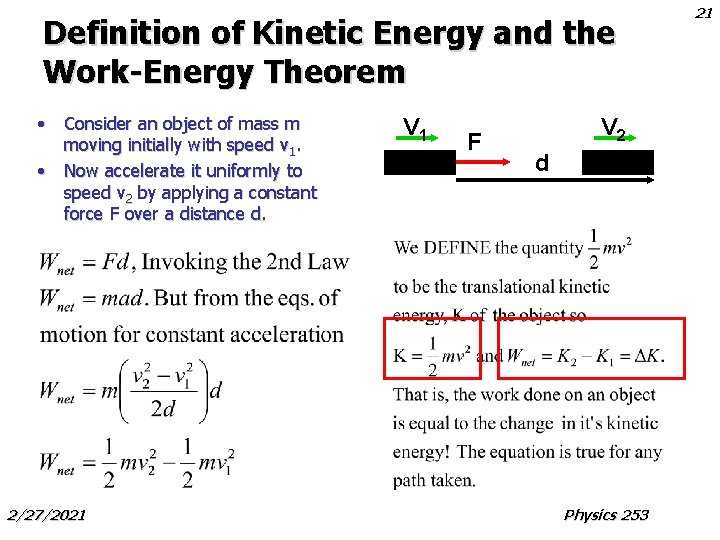
Definition of Kinetic Energy and the Work-Energy Theorem • Consider an object of mass m moving initially with speed v 1. • Now accelerate it uniformly to speed v 2 by applying a constant force F over a distance d. 2/27/2021 V 1 F V 2 d Physics 253 21
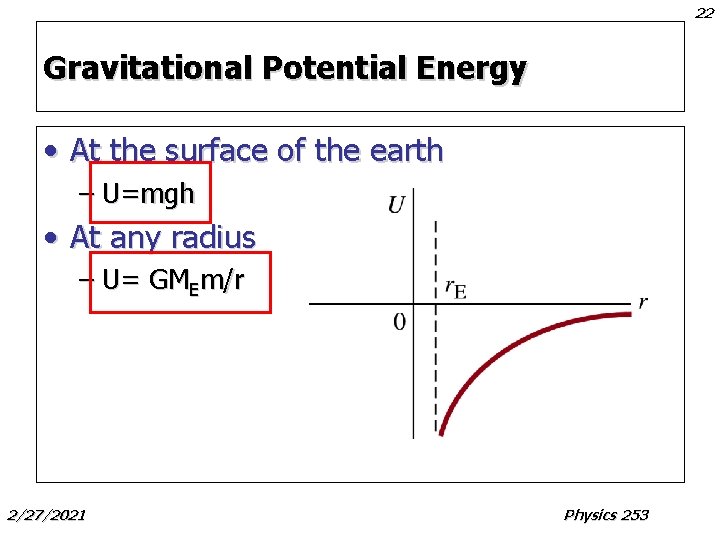
22 Gravitational Potential Energy • At the surface of the earth – U=mgh • At any radius – U= GMEm/r 2/27/2021 Physics 253
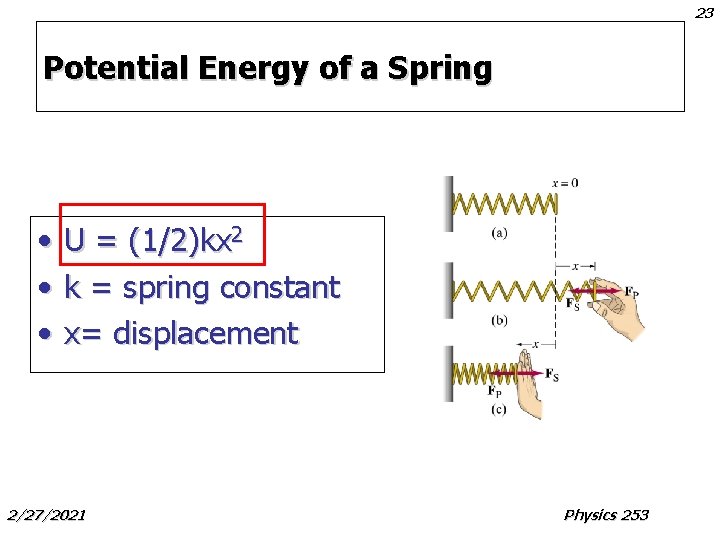
23 Potential Energy of a Spring • • • U = (1/2)kx 2 k = spring constant x= displacement 2/27/2021 Physics 253
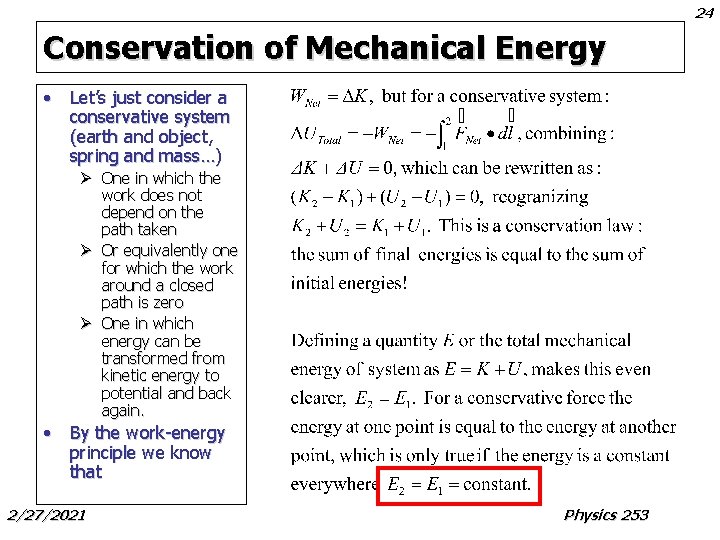
24 Conservation of Mechanical Energy • Let’s just consider a conservative system (earth and object, spring and mass…) Ø One in which the work does not depend on the path taken Ø Or equivalently one for which the work around a closed path is zero Ø One in which energy can be transformed from kinetic energy to potential and back again. • By the work-energy principle we know that 2/27/2021 Physics 253
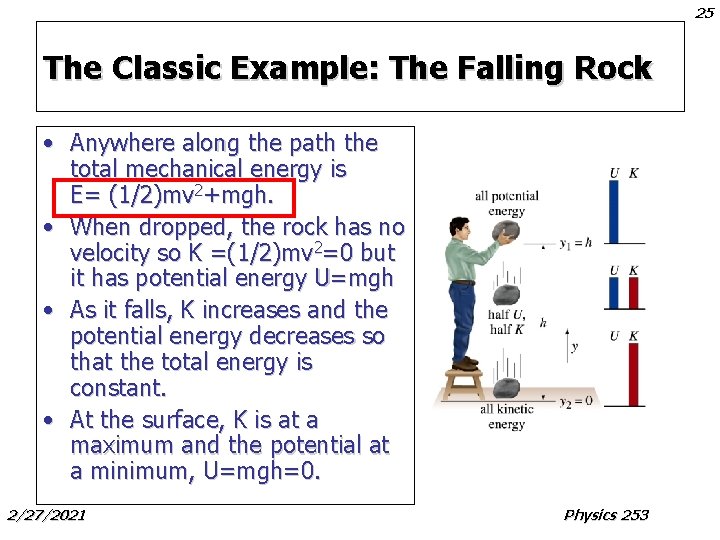
25 The Classic Example: The Falling Rock • Anywhere along the path the total mechanical energy is E= (1/2)mv 2+mgh. • When dropped, the rock has no velocity so K =(1/2)mv 2=0 but it has potential energy U=mgh • As it falls, K increases and the potential energy decreases so that the total energy is constant. • At the surface, K is at a maximum and the potential at a minimum, U=mgh=0. 2/27/2021 Physics 253
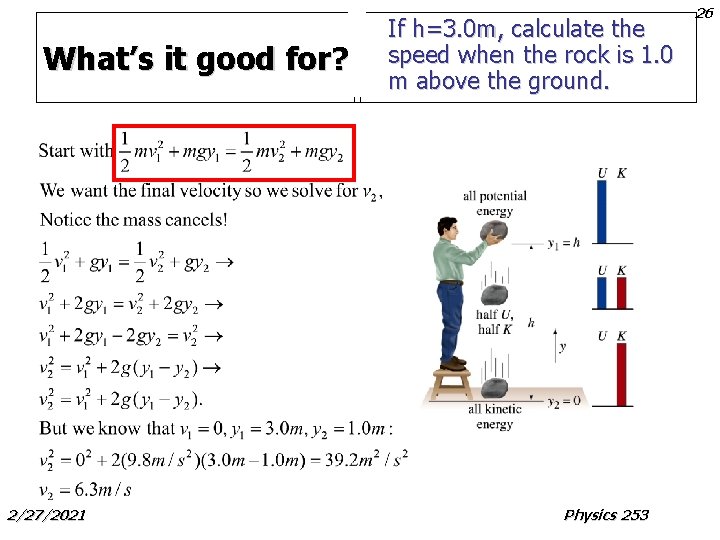
What’s it good for? 2/27/2021 If h=3. 0 m, calculate the speed when the rock is 1. 0 m above the ground. Physics 253 26
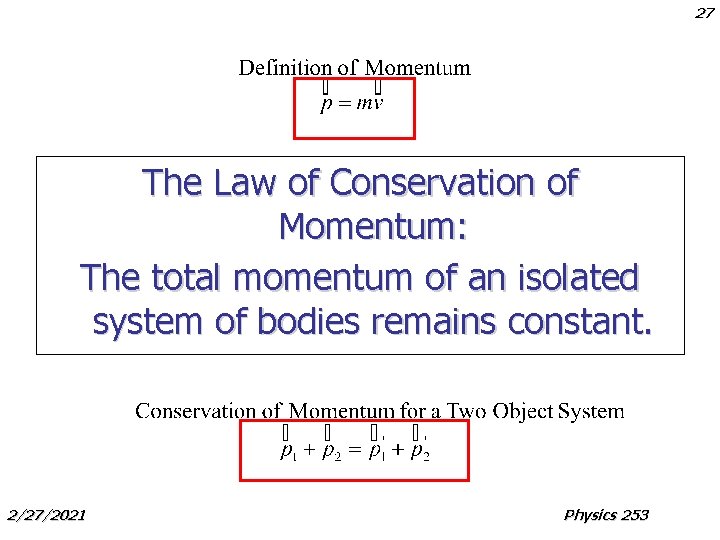
27 The Law of Conservation of Momentum: The total momentum of an isolated system of bodies remains constant. 2/27/2021 Physics 253
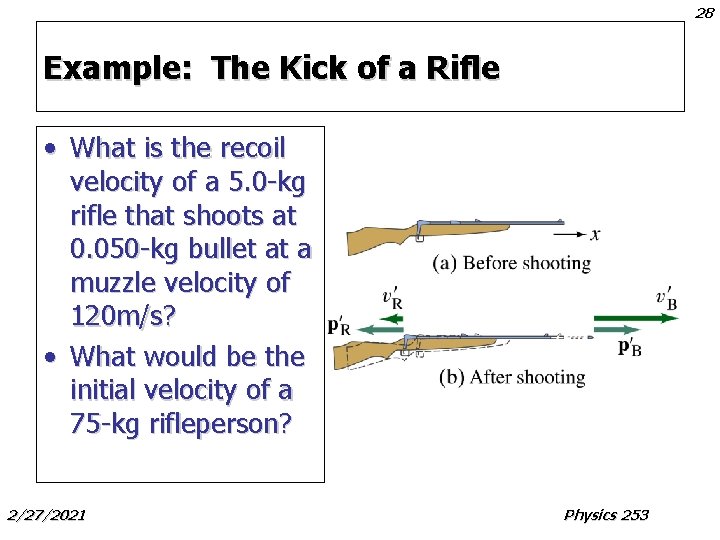
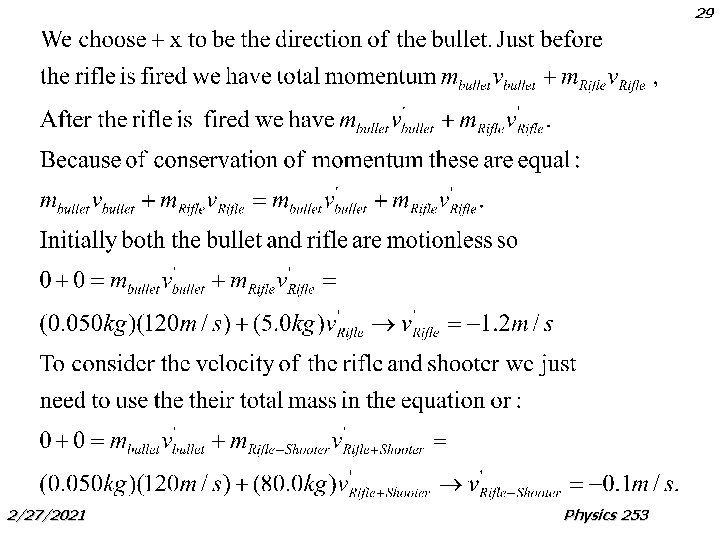
28 Example: The Kick of a Rifle • What is the recoil velocity of a 5. 0 -kg rifle that shoots at 0. 050 -kg bullet at a muzzle velocity of 120 m/s? • What would be the initial velocity of a 75 -kg rifleperson? 2/27/2021 Physics 253
29 2/27/2021 Physics 253
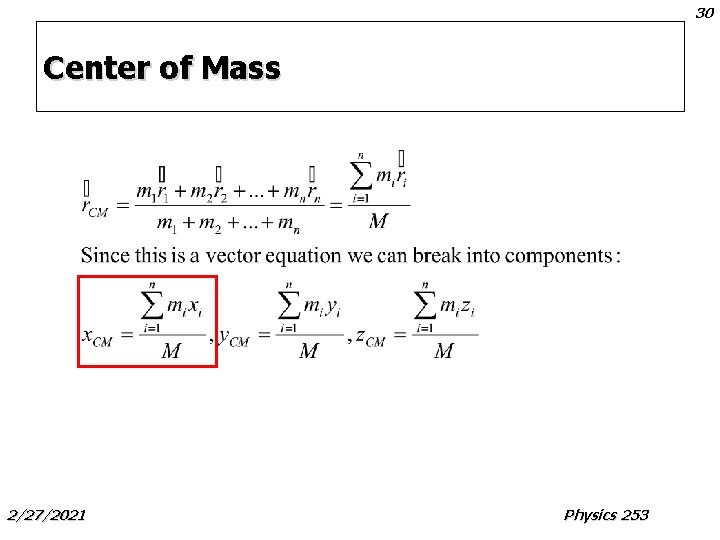
30 Center of Mass 2/27/2021 Physics 253