1 Cross Cultural Negotiations Definition 2 P H


- Slides: 30
1 Cross Cultural Negotiations
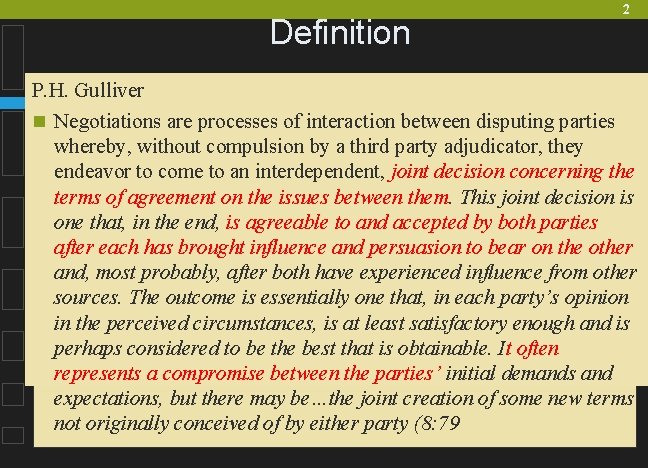
Definition 2 P. H. Gulliver n Negotiations are processes of interaction between disputing parties whereby, without compulsion by a third party adjudicator, they endeavor to come to an interdependent, joint decision concerning the terms of agreement on the issues between them. This joint decision is one that, in the end, is agreeable to and accepted by both parties after each has brought influence and persuasion to bear on the other and, most probably, after both have experienced influence from other sources. The outcome is essentially one that, in each party’s opinion in the perceived circumstances, is at least satisfactory enough and is perhaps considered to be the best that is obtainable. It often represents a compromise between the parties’ initial demands and expectations, but there may be…the joint creation of some new terms not originally conceived of by either party (8: 79
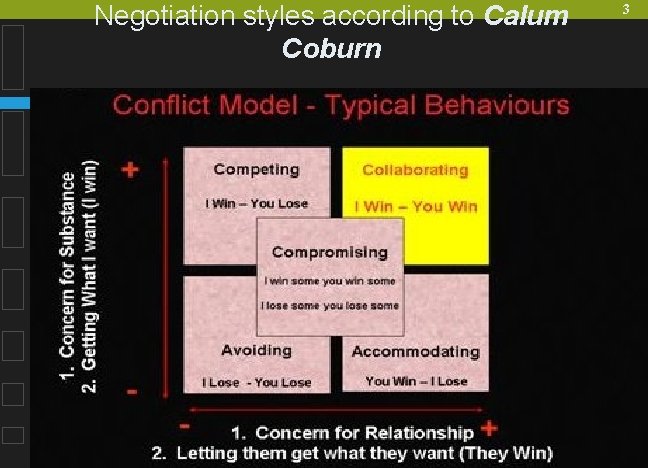
Negotiation styles according to Calum Coburn 3
4 1. Compete (I win - You lose) n Competitive style negotiators pursue their own needs - yes, even when this means others suffer. They usually don't want to cause others to suffer and lose, they are just so narrowly focused on their shorter term gains that they plunder obliviously through negotiations like a pirate. They often use whatever power and tactics they can muster, including their personality, position, economic threats, brand strength or size or market share. At its extreme negotiators call their behaviour aggressive or psychotic.
5 2. Accommodate (I Lose - You Win) n The opposite of competing. For accommodating style negotiators, the relationship is everything. Accommodating profiles think that the route to winning people over is to give them what they want. They don't just give products and services, they are generous with information too. Accommodators are usually very well liked by their colleagues and opposite party negotiators
6 3. Avoid (I Lose - You Lose) n This is most often referred to as "passive aggressive". People who habitually use this style really dislike conflict. Rather than talk directly with you about the issue, avoid styles may instead try to take revenge without you knowing about it. The avoid style can be a typical reaction to high compete negotiators. Sellers will frequently call less often on high compete buyers (i. e. Avoiding Competitive buyers) - and may choose to invest marketing money and share their best ideas and prize promotions with non-avoid profiles.
4. Compromise (I Lose / Win Some You Lose / Win Some) 7 n Compromising is the style that most people think of as negotiation, but in reality compromising is usually just haggling. Compromising often involves splitting the difference, usually resulting in an end position of about half way between both party's opening positions. In the absence of a good rationale or properly exchanged concessions, half way between the two positions seems "fair". What compromising ignores however, is that the people that take the most extreme positions tend to get more of what is on offer.
8 5. Collaborate (I Win - You Win) n. "Win/Win" is about making sure both parties have their needs met, and as much mutual value as can be created is created. "Win/Win" negotiators usually evolve through the other profiles, they grow into a collaborative negotiation style. collaborative negotiators are willing to invest more time and energy in finding innovative solutions, feeling secure in the fact that there will be more value to share out later on.
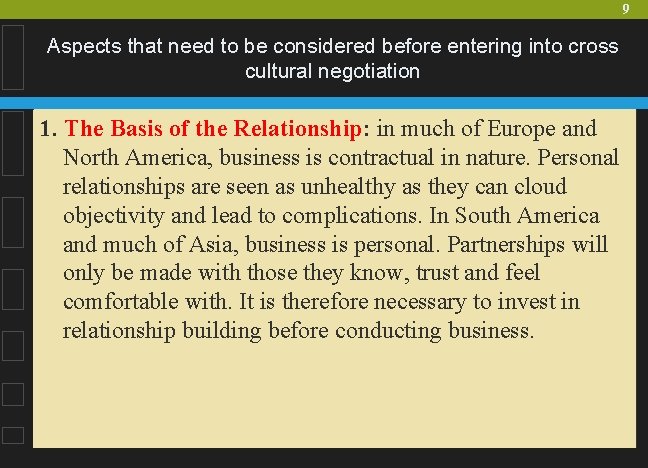
9 Aspects that need to be considered before entering into cross cultural negotiation 1. The Basis of the Relationship: in much of Europe and North America, business is contractual in nature. Personal relationships are seen as unhealthy as they can cloud objectivity and lead to complications. In South America and much of Asia, business is personal. Partnerships will only be made with those they know, trust and feel comfortable with. It is therefore necessary to invest in relationship building before conducting business.
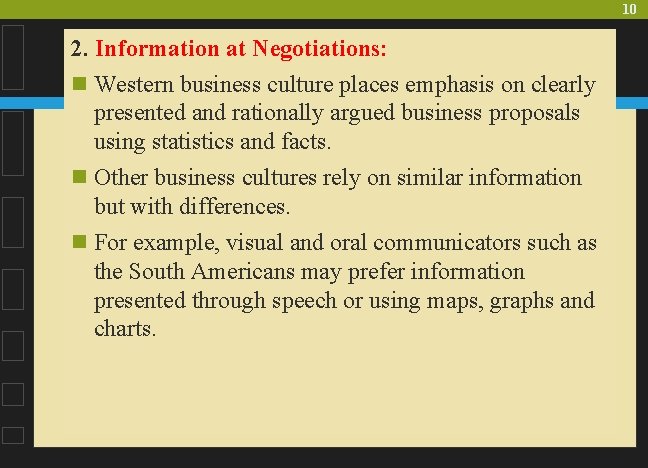
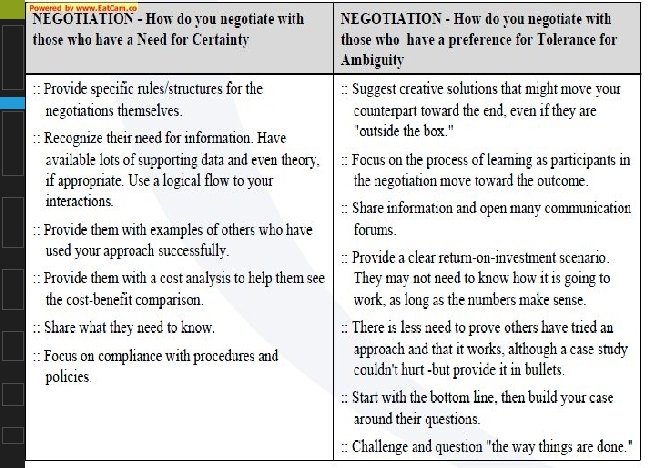
10 2. Information at Negotiations: n Western business culture places emphasis on clearly presented and rationally argued business proposals using statistics and facts. n Other business cultures rely on similar information but with differences. n For example, visual and oral communicators such as the South Americans may prefer information presented through speech or using maps, graphs and charts.
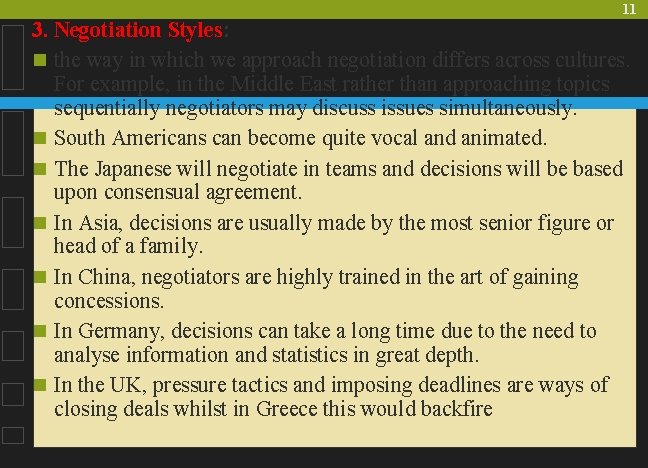
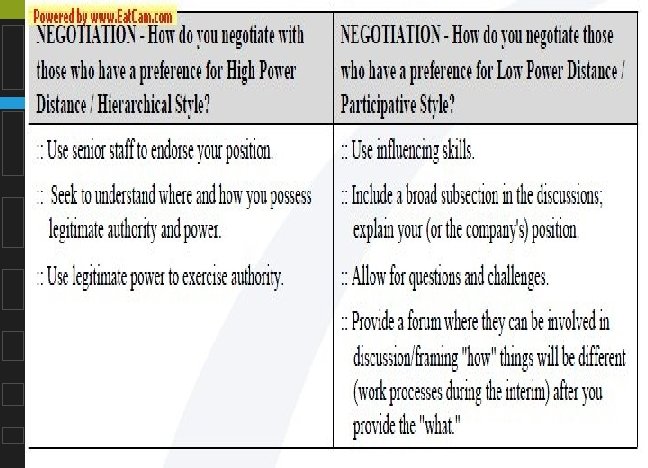
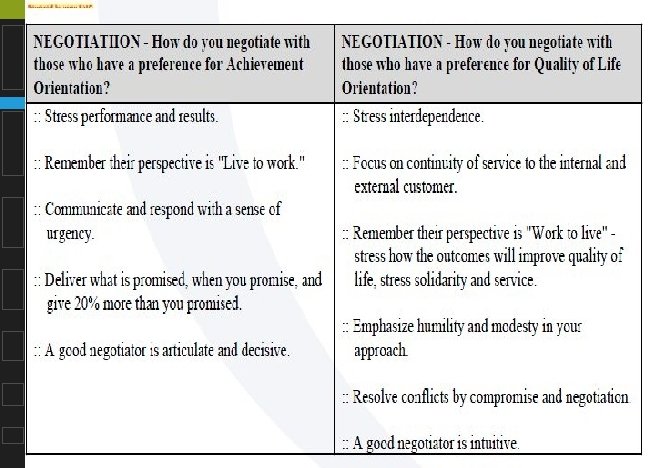
11 3. Negotiation Styles: n the way in which we approach negotiation differs across cultures. For example, in the Middle East rather than approaching topics sequentially negotiators may discuss issues simultaneously. n South Americans can become quite vocal and animated. n The Japanese will negotiate in teams and decisions will be based upon consensual agreement. n In Asia, decisions are usually made by the most senior figure or head of a family. n In China, negotiators are highly trained in the art of gaining concessions. n In Germany, decisions can take a long time due to the need to analyse information and statistics in great depth. n In the UK, pressure tactics and imposing deadlines are ways of closing deals whilst in Greece this would backfire
12
13
14
15
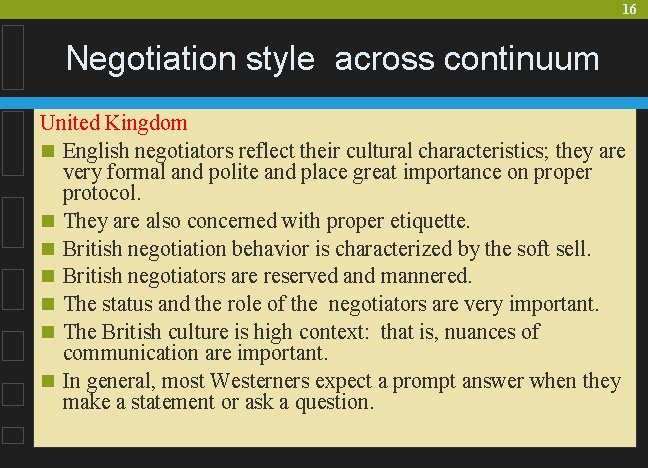
16 Negotiation style across continuum United Kingdom n English negotiators reflect their cultural characteristics; they are very formal and polite and place great importance on proper protocol. n They are also concerned with proper etiquette. n British negotiation behavior is characterized by the soft sell. n British negotiators are reserved and mannered. n The status and the role of the negotiators are very important. n The British culture is high context: that is, nuances of communication are important. n In general, most Westerners expect a prompt answer when they make a statement or ask a question.
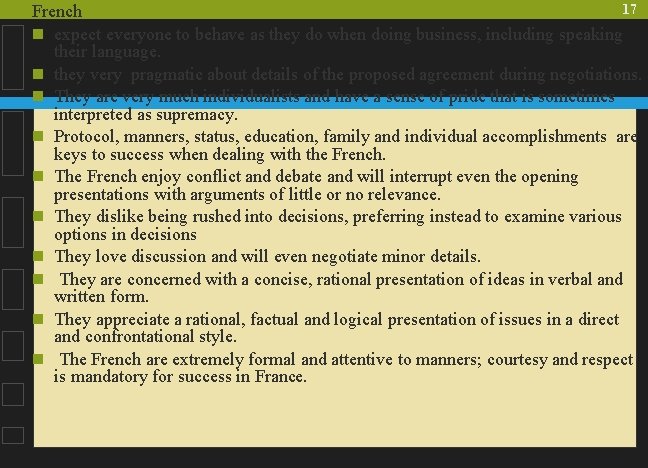
17 French n expect everyone to behave as they do when doing business, including speaking their language. n they very pragmatic about details of the proposed agreement during negotiations. n They are very much individualists and have a sense of pride that is sometimes interpreted as supremacy. n Protocol, manners, status, education, family and individual accomplishments are keys to success when dealing with the French. n The French enjoy conflict and debate and will interrupt even the opening presentations with arguments of little or no relevance. n They dislike being rushed into decisions, preferring instead to examine various options in decisions n They love discussion and will even negotiate minor details. n They are concerned with a concise, rational presentation of ideas in verbal and written form. n They appreciate a rational, factual and logical presentation of issues in a direct and confrontational style. n The French are extremely formal and attentive to manners; courtesy and respect is mandatory for success in France.
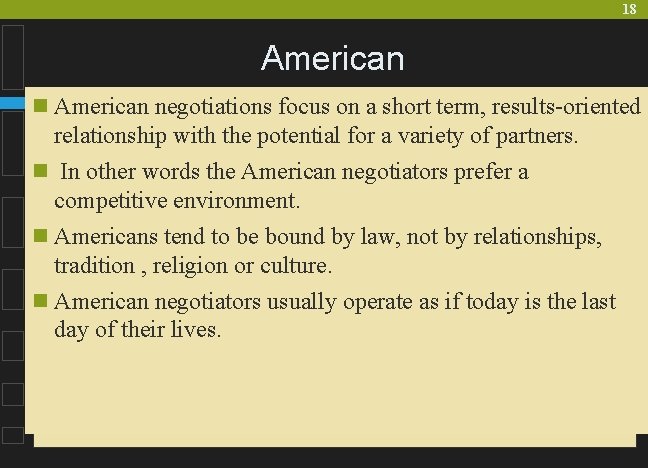
18 American negotiations focus on a short term, results-oriented relationship with the potential for a variety of partners. n In other words the American negotiators prefer a competitive environment. n Americans tend to be bound by law, not by relationships, tradition , religion or culture. n American negotiators usually operate as if today is the last day of their lives.
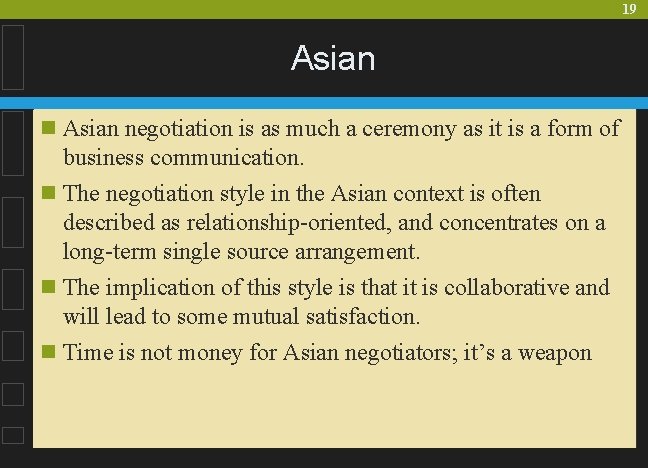
19 Asian negotiation is as much a ceremony as it is a form of business communication. n The negotiation style in the Asian context is often described as relationship-oriented, and concentrates on a long-term single source arrangement. n The implication of this style is that it is collaborative and will lead to some mutual satisfaction. n Time is not money for Asian negotiators; it’s a weapon
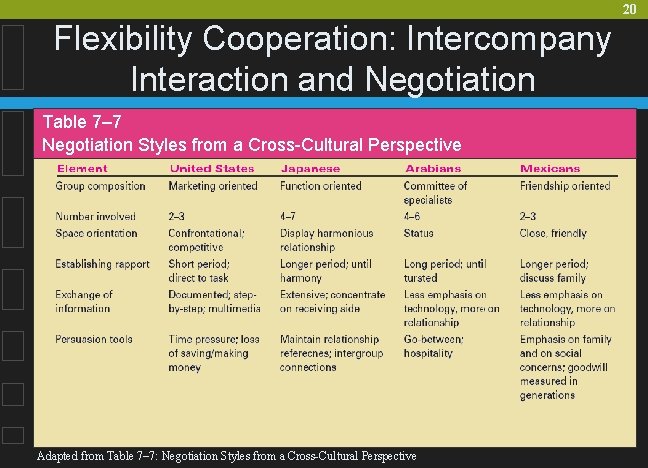
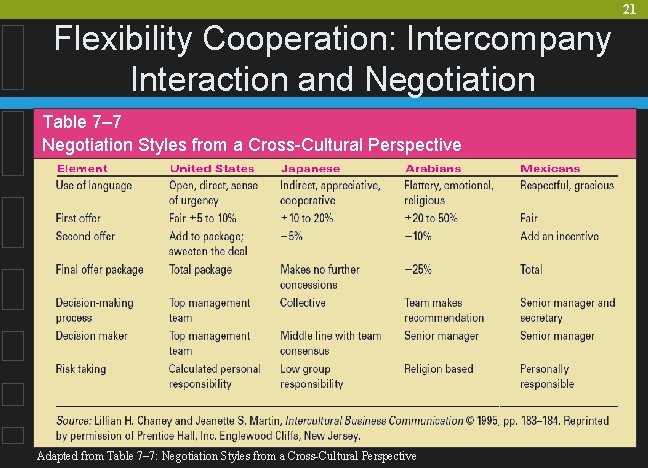
20 Flexibility Cooperation: Intercompany Interaction and Negotiation Table 7– 7 Negotiation Styles from a Cross-Cultural Perspective Adapted from Table 7– 7: Negotiation Styles from a Cross-Cultural Perspective
21 Flexibility Cooperation: Intercompany Interaction and Negotiation Table 7– 7 Negotiation Styles from a Cross-Cultural Perspective Adapted from Table 7– 7: Negotiation Styles from a Cross-Cultural Perspective
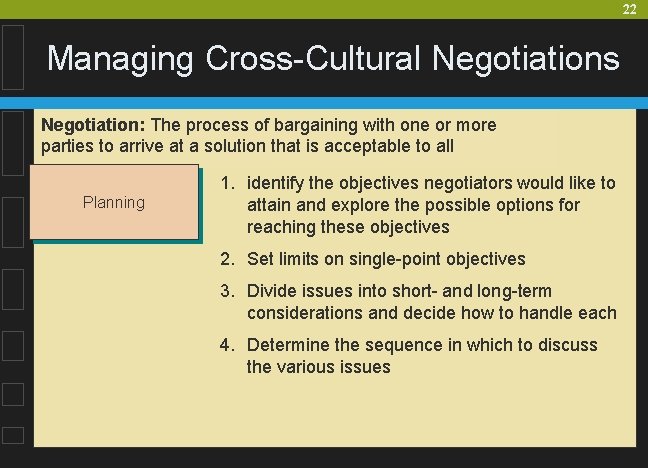
22 Managing Cross-Cultural Negotiations Negotiation: The process of bargaining with one or more parties to arrive at a solution that is acceptable to all Planning 1. identify the objectives negotiators would like to attain and explore the possible options for reaching these objectives 2. Set limits on single-point objectives 3. Divide issues into short- and long-term considerations and decide how to handle each 4. Determine the sequence in which to discuss the various issues
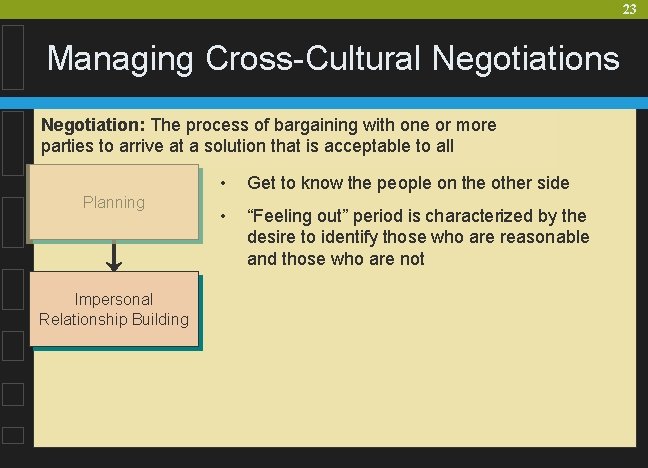
23 Managing Cross-Cultural Negotiations Negotiation: The process of bargaining with one or more parties to arrive at a solution that is acceptable to all Planning Impersonal Relationship Building • Get to know the people on the other side • “Feeling out” period is characterized by the desire to identify those who are reasonable and those who are not
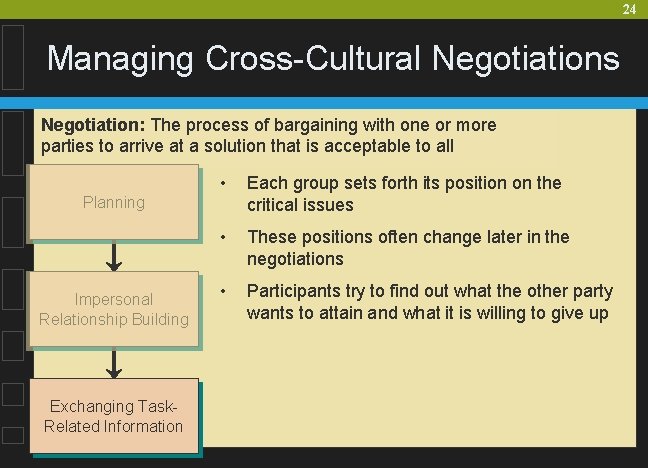
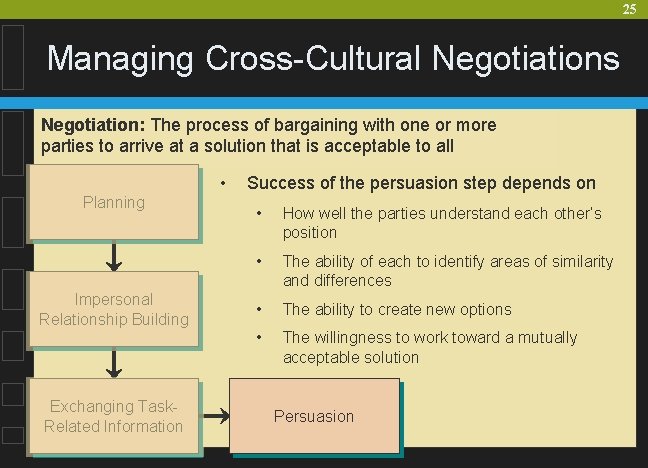
24 Managing Cross-Cultural Negotiations Negotiation: The process of bargaining with one or more parties to arrive at a solution that is acceptable to all • Each group sets forth its position on the critical issues • These positions often change later in the negotiations • Participants try to find out what the other party wants to attain and what it is willing to give up Planning Impersonal Relationship Building Exchanging Task. Related Information
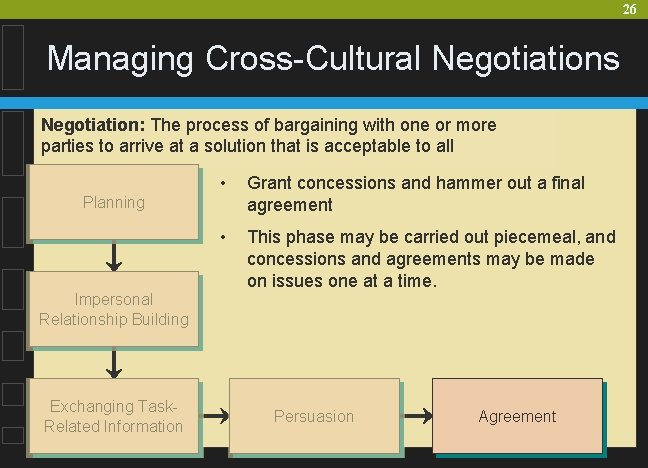
25 Managing Cross-Cultural Negotiations Negotiation: The process of bargaining with one or more parties to arrive at a solution that is acceptable to all • Planning Impersonal Relationship Building Exchanging Task. Related Information Success of the persuasion step depends on • How well the parties understand each other’s position • The ability of each to identify areas of similarity and differences • The ability to create new options • The willingness to work toward a mutually acceptable solution Persuasion
26 Managing Cross-Cultural Negotiations Negotiation: The process of bargaining with one or more parties to arrive at a solution that is acceptable to all • Grant concessions and hammer out a final agreement • This phase may be carried out piecemeal, and concessions and agreements may be made on issues one at a time. Planning Impersonal Relationship Building Exchanging Task. Related Information Persuasion Agreement
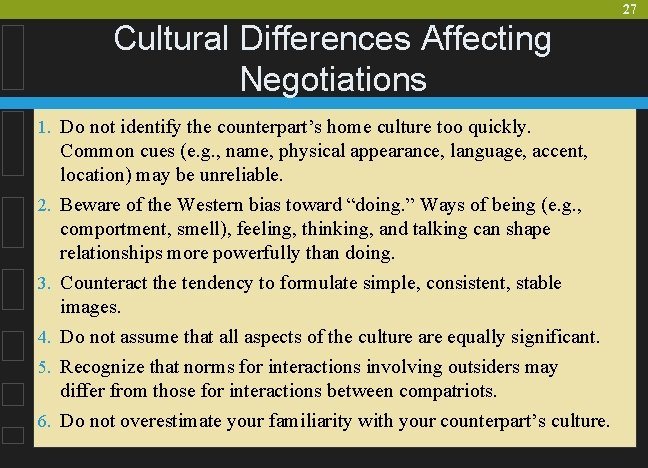
27 Cultural Differences Affecting Negotiations 1. Do not identify the counterpart’s home culture too quickly. 2. 3. 4. 5. 6. Common cues (e. g. , name, physical appearance, language, accent, location) may be unreliable. Beware of the Western bias toward “doing. ” Ways of being (e. g. , comportment, smell), feeling, thinking, and talking can shape relationships more powerfully than doing. Counteract the tendency to formulate simple, consistent, stable images. Do not assume that all aspects of the culture are equally significant. Recognize that norms for interactions involving outsiders may differ from those for interactions between compatriots. Do not overestimate your familiarity with your counterpart’s culture.
28 Negotiation Tactics n Location n Time limits n Buyer-seller relations n Bargaining behaviors n Use of extreme behaviors n Promises, threats and other behaviors n Nonverbal behaviors
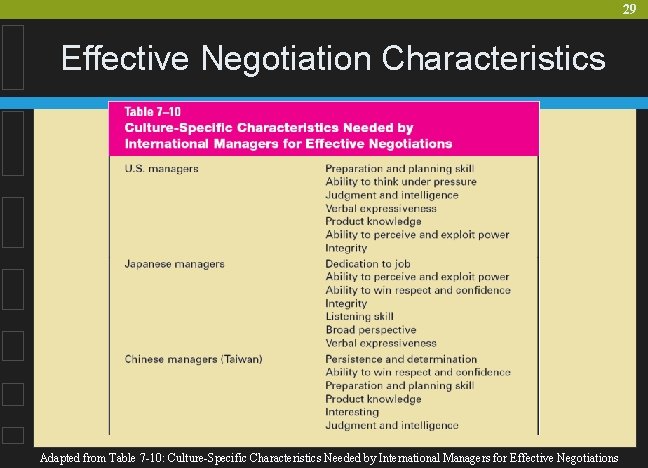
29 Effective Negotiation Characteristics Adapted from Table 7 -10: Culture-Specific Characteristics Needed by International Managers for Effective Negotiations
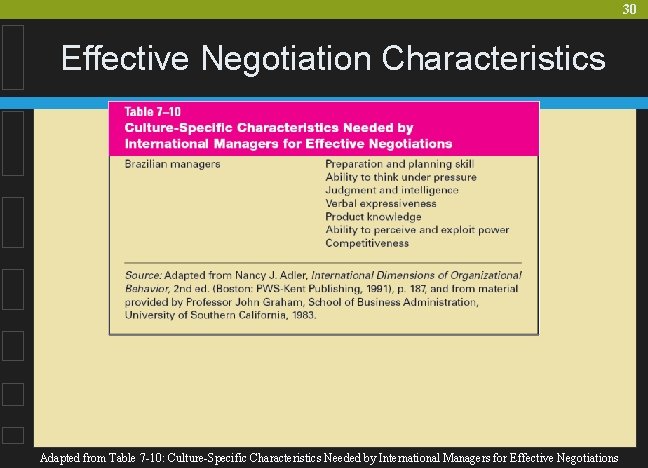
30 Effective Negotiation Characteristics Adapted from Table 7 -10: Culture-Specific Characteristics Needed by International Managers for Effective Negotiations