1 CREATING AWARENESS AND SELF MANAGEMENT Kamal Nayan
- Slides: 31
1 CREATING AWARENESS AND SELF MANAGEMENT Kamal Nayan pradhan 3/12/2021
Agenda 2 Significance of understanding self Dimensions of self awareness Self management techniques Self. Awareness 3/12/2021
3 “He that would govern others must first master himself” - Messinger Self. Awareness 3/12/2021
Understanding Self 4 “How someone perceive themselves” Self-management depends first and foremost on self-awareness Developing self-control and clarifying priorities and goals, help individuals create direction in their own lives Effectively managing time and stress makes it possible for individuals to adapt to and organize their surroundings Self. Awareness 3/12/2021
Paradox of Self-Awareness 5 Individuals cannot improve themselves or develop new capabilities unless and until they know what level of capability they currently possess Self-knowledge may inhibit personal improvement rather than facilitate it Self. Awareness 3/12/2021
Paradox of Self-Awareness 6 (The reason is that individuals frequently evade personal growth and new self-knowledge. They resist acquiring additional information in order to protect their self-esteem or self-respect. ) Self. Awareness 3/12/2021
Reason for Focusing on SA 7 Sensitive Line - When encountering information about themselves that is inconsistent or behavior-altering with their self-concept, individuals become defensive Threat-rigidity response Individuals who face threat, uncertainty or uncomfortable Self. Awareness 3/12/2021
Creating Self Awareness 8 Self Assessment Exercise Self. Awareness 3/12/2021
Self-awareness 9 Individuals who have high selfawareness are: able to conduct accurate selfappraisals, self-confident, perceive situations accurately, and willing to take risks for what they believe to be right. Managing Emotions 3/12/2021
10 Five Dimensions of Self Awareness Emotional Core Self Attitude Learning Intelligenc Evaluatio Values toward Style e n Change Self. Awareness 3/12/2021
Emotional Intelligence 11 Capacity for understanding one’s own feelings and the feelings of others, for motivating self, and for managing emotions effectively in relationships. Self. Awareness 3/12/2021
Emotional Intelligence 12 It is essential in effective leadership and has a direct impact on work performance Research at the Center for Creative Leadership has shown that the primary cause of executive turnover was individual deficiency in the area of emotional competence Managing Emotions 3/12/2021
Contributors for anagerial success 13 Cognitive intelligence (IQ) - 20% Emotional intelligence (EQ) and others - 80% IQ gets you hired, but EQ gets you promoted Both combines to make you successful! Managing Emotions 3/12/2021
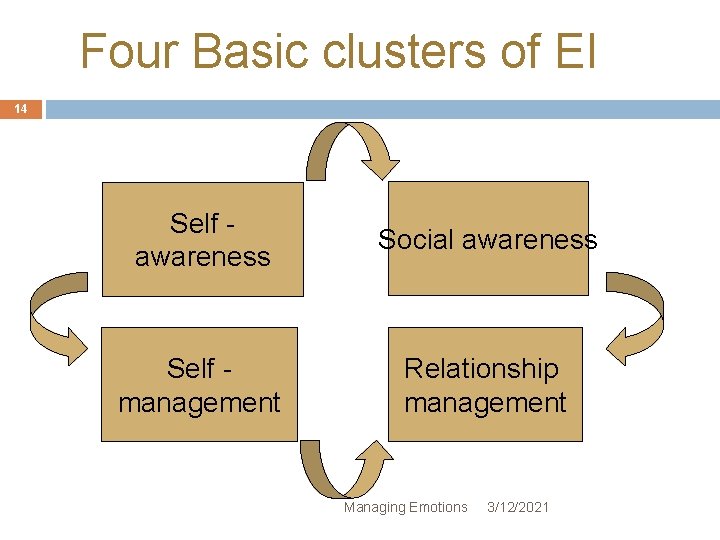
Four Basic clusters of EI 14 Self awareness Social awareness Self management Relationship management Managing Emotions 3/12/2021
15 Emotional Self Awareness (ESA) having a deep understanding of one’s emotion, how their feelings affect them, other people and their job performance Self. Awareness 3/12/2021
Components of ESA 16 Emotional Awareness - recognizes one’s emotions and their effects. Accurate Self-Assessment - knowing one’s strengths and limits. Self-Confidence - a strong sense of one’s self-worth and capabilities. Self. Awareness 3/12/2021
17 Emotional Competence Self Assessment Exercise Self. Awareness 3/12/2021
Major Findings 18 High EQ people exhibit: Balance between emotion and reason Awareness of their own feelings Empathy and compassion for others Signs of high self-esteem People aren’t all created emotionally equal - they have different emotional temperaments. The way an individual act out, express themselves, and use their emotions can be Managing Emotions 3/12/2021 changed!
Core Self Evaluation 19 Self esteem: The extent to which people see themselves as capable, successful and worthy Assess Your Self Esteem Self. Awareness 3/12/2021
Values 20 Choose between alternatives, assumptions about the nature of reality Learned early, continue to develop Drive choices and behavior Differ based on culture and environment Self. Awareness 3/12/2021
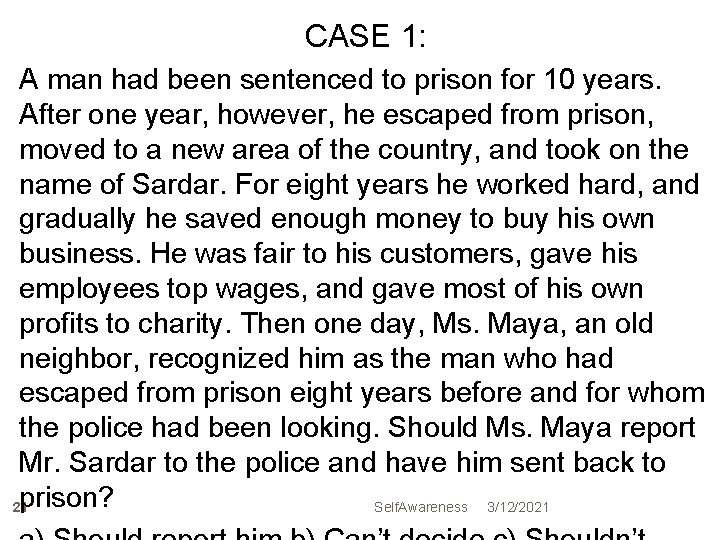
CASE 1: A man had been sentenced to prison for 10 years. After one year, however, he escaped from prison, moved to a new area of the country, and took on the name of Sardar. For eight years he worked hard, and gradually he saved enough money to buy his own business. He was fair to his customers, gave his employees top wages, and gave most of his own profits to charity. Then one day, Ms. Maya, an old neighbor, recognized him as the man who had escaped from prison eight years before and for whom the police had been looking. Should Ms. Maya report Mr. Sardar to the police and have him sent back to prison? Self. Awareness 3/12/2021 21
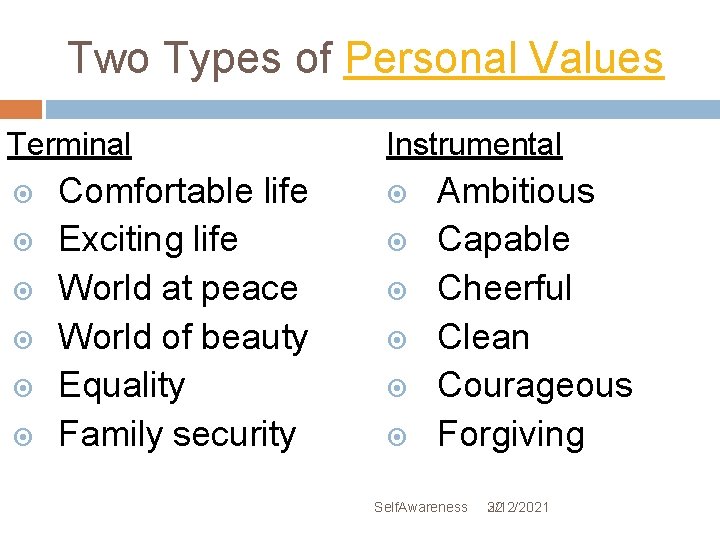
Two Types of Personal Values Terminal Comfortable life Exciting life World at peace World of beauty Equality Family security Instrumental Ambitious Capable Cheerful Clean Courageous Forgiving Self. Awareness 22 3/12/2021
Cognitive Styles (Knowing, Planning, Creating) 23 Identifies individual thought process, perceptions and method of acquiring and storing information. Cognitive style is based on two key dimensions: the manner in which one gather information the way in which one evaluate and act on information Self. Awareness 3/12/2021
Attitude Towards Change 24 The environment becoming more chaotic, more temporary, more complex, and more overloaded with information, The ability to process information is at least partly constrained by the fundamental attitude about change. Two major dimensions Locus of control Tolerance of ambiguity Self. Awareness 3/12/2021
Locus of Control 25 The extent to which a person believes they have power over their successes and/or failures in life. Internal Locus of Control: Believes his or her successes are due to factors within their own control. Behavior is guided by his/her personal decisions and efforts. Self. Awareness 3/12/2021
Locus of Control……. . …. , , , 26 External Locus of Control: Believes his or her successes or failures are due to factors outside of their own control. Behavior is guided by fate, luck, or other external circumstance. Research suggest that successful manager or leaders have higher internal locus of control Self. Awareness 3/12/2021
Tolerance of Ambiguity 27 Tolerance (or intolerance) of ambiguity influences one’s behavior and consequently leadership and decision-making style. Studies have found that managers high on tolerance for ambiguity adjust and perform better, and influence positively at workplaces environments. Self. Awareness 3/12/2021
28 Dimensions of Tolerance of Ambiguity Novelty – coping with new, unfamiliar situations Complexity – using multiple, distinctive, or unrelated information Insolubility – dealing with problems that are difficult to solve Self. Awareness 3/12/2021
Managers with High Tolerance for Ambiguity. . . 29 more entrepreneurial in their actions screen out less information in complex environment choose specialties that are less structured cope more effectively with role stress and conflict Self. Awareness 3/12/2021
30 Self assessment Result Self. Awareness 3/12/2021
31 Thank you Self. Awareness 3/12/2021