1 atm 1 013 x 105 Pa 101



- Slides: 27
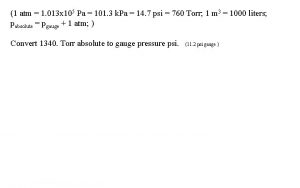
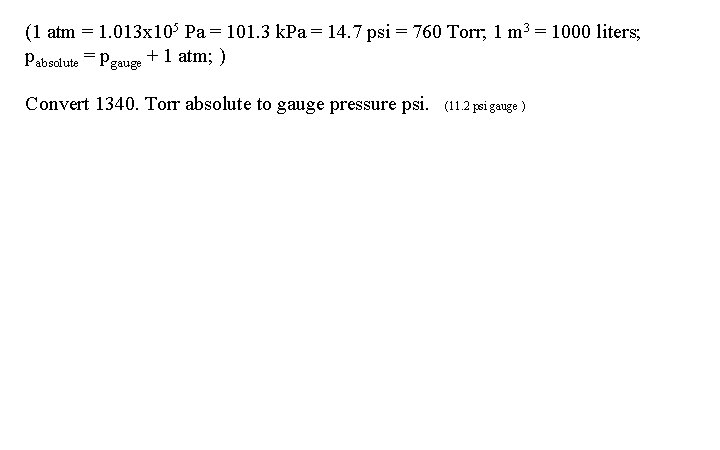
(1 atm = 1. 013 x 105 Pa = 101. 3 k. Pa = 14. 7 psi = 760 Torr; 1 m 3 = 1000 liters; pabsolute = pgauge + 1 atm; ) Convert 1340. Torr absolute to gauge pressure psi. (11. 2 psi gauge )
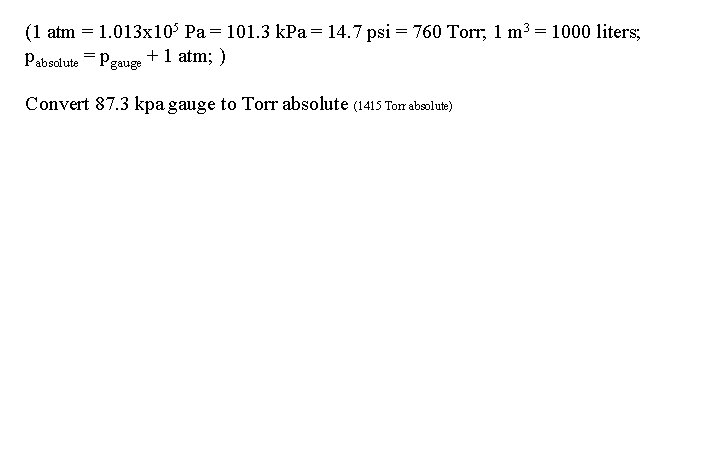
(1 atm = 1. 013 x 105 Pa = 101. 3 k. Pa = 14. 7 psi = 760 Torr; 1 m 3 = 1000 liters; pabsolute = pgauge + 1 atm; ) Convert 87. 3 kpa gauge to Torr absolute (1415 Torr absolute)
(1 atm = 1. 013 x 105 Pa = 101. 3 k. Pa = 14. 7 psi = 760 Torr; 1 m 3 = 1000 liters; pabsolute = pgauge + 1 atm; ) 2. Fred has 1. 65 mols of methane gas at 87. 2 o. C at 56. 3 k. Pa (1 k. Pa = 1000 Pa). What is the volume it occupies? (0. 0878 m ) 3
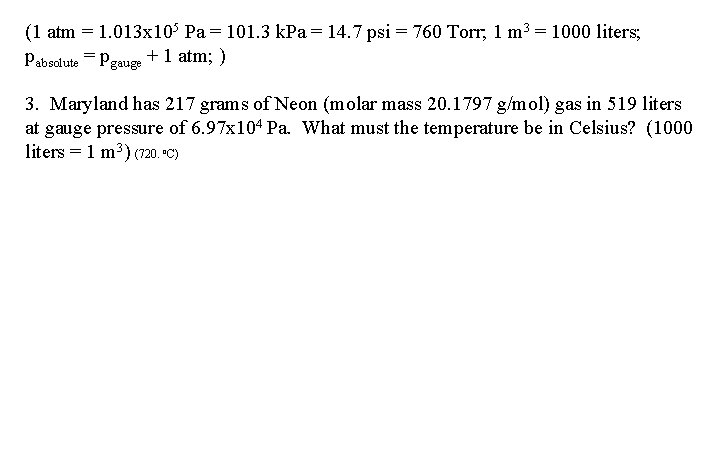
(1 atm = 1. 013 x 105 Pa = 101. 3 k. Pa = 14. 7 psi = 760 Torr; 1 m 3 = 1000 liters; pabsolute = pgauge + 1 atm; ) 3. Maryland has 217 grams of Neon (molar mass 20. 1797 g/mol) gas in 519 liters at gauge pressure of 6. 97 x 104 Pa. What must the temperature be in Celsius? (1000 liters = 1 m 3) (720. C) o
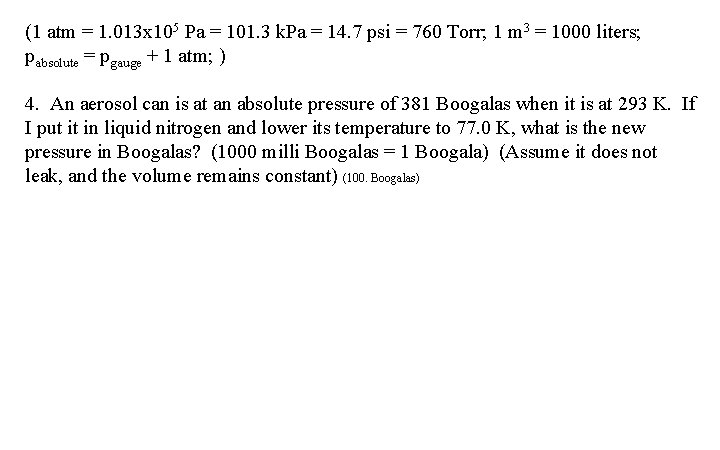
(1 atm = 1. 013 x 105 Pa = 101. 3 k. Pa = 14. 7 psi = 760 Torr; 1 m 3 = 1000 liters; pabsolute = pgauge + 1 atm; ) 4. An aerosol can is at an absolute pressure of 381 Boogalas when it is at 293 K. If I put it in liquid nitrogen and lower its temperature to 77. 0 K, what is the new pressure in Boogalas? (1000 milli Boogalas = 1 Boogala) (Assume it does not leak, and the volume remains constant) (100. Boogalas)
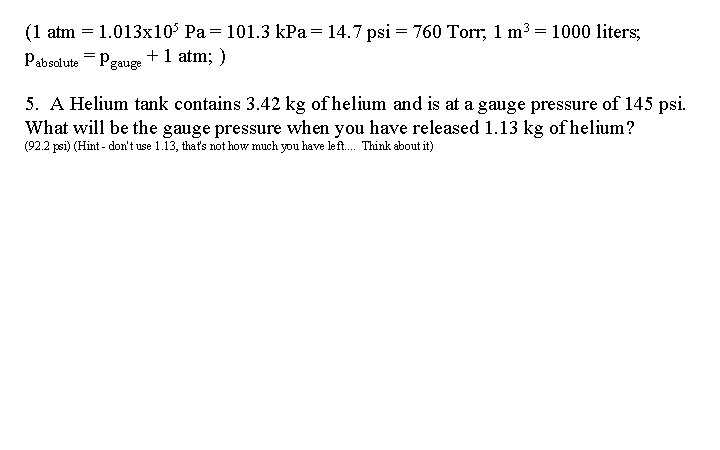
(1 atm = 1. 013 x 105 Pa = 101. 3 k. Pa = 14. 7 psi = 760 Torr; 1 m 3 = 1000 liters; pabsolute = pgauge + 1 atm; ) 5. A Helium tank contains 3. 42 kg of helium and is at a gauge pressure of 145 psi. What will be the gauge pressure when you have released 1. 13 kg of helium? (92. 2 psi) (Hint - don't use 1. 13, that's not how much you have left. . Think about it)
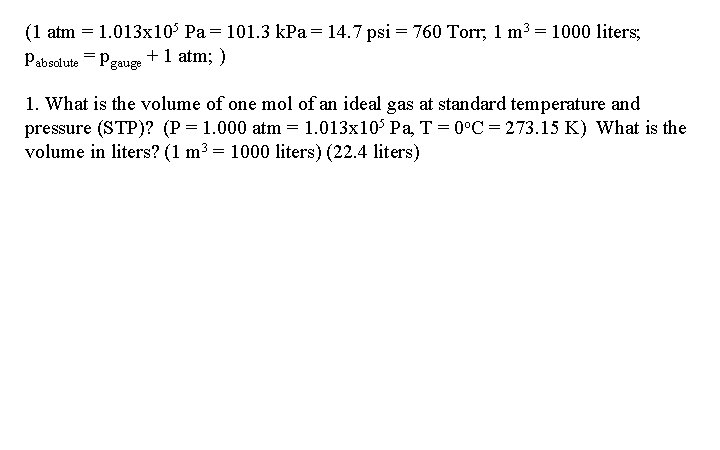
(1 atm = 1. 013 x 105 Pa = 101. 3 k. Pa = 14. 7 psi = 760 Torr; 1 m 3 = 1000 liters; pabsolute = pgauge + 1 atm; ) 1. What is the volume of one mol of an ideal gas at standard temperature and pressure (STP)? (P = 1. 000 atm = 1. 013 x 105 Pa, T = 0 o. C = 273. 15 K) What is the volume in liters? (1 m 3 = 1000 liters) (22. 4 liters)
(1 atm = 1. 013 x 105 Pa = 101. 3 k. Pa = 14. 7 psi = 760 Torr; 1 m 3 = 1000 liters; pabsolute = pgauge + 1 atm; ) 2. George Uss has 0. 34 mols of Xenon tetrafluoride in a container with a volume of 0. 159 m 3 at 78. 0 o. C. What is the pressure? (6. 2 E 3 Pa)
(1 atm = 1. 013 x 105 Pa = 101. 3 k. Pa = 14. 7 psi = 760 Torr; 1 m 3 = 1000 liters; pabsolute = pgauge + 1 atm; ) 3. Hugh Jass has a volume of 143 liters and 2. 56 mols of Xenon gas at a pressure of 67, 120 Pa. What must be the temperature in Kelvins? What is the temperature in o. C (451 K, 178 o. C)
(1 atm = 1. 013 x 105 Pa = 101. 3 k. Pa = 14. 7 psi = 760 Torr; 1 m 3 = 1000 liters; pabsolute = pgauge + 1 atm; ) 4. Anita Breke fills a large helium balloon with 2. 18 grams of Helium gas. How many mols of He is this? What is the pressure in the balloon if the gas occupies a volume of 12. 05 liters (1000 liters = 1 m 3) at a temperature of 18. 0 o. C? (Beware the ides of Celsius!) What is that pressure in atmospheres? What is the gauge pressure in Pa and Atmospheres? (0. 545 mols, 1. 09 x 105 Pa, 1. 08 atm, 8 x 10³ Pa, . 08 atm)
(1 atm = 1. 013 x 105 Pa = 101. 3 k. Pa = 14. 7 psi = 760 Torr; 1 m 3 = 1000 liters; pabsolute = pgauge + 1 atm; ) 5. A reaction vessel operates at 3. 14 atmospheres. What is that pressure in Pa? If the vessel has a volume of 0. 113 m 3, is at a temperature of 145 o. C, and contains pure Nitrogen gas, how many mols of nitrogen gas does it contain? How many grams of Nitrogen does it contain? (None Of Fred’s Clients Bring Iron Hats – Nitrogen is a diatomic gas) (3. 18 x 105 Pa, 10. 3 mols, 290. g)
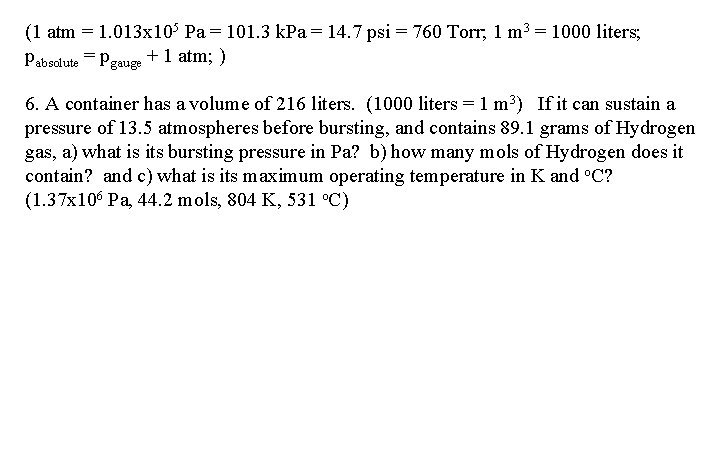
(1 atm = 1. 013 x 105 Pa = 101. 3 k. Pa = 14. 7 psi = 760 Torr; 1 m 3 = 1000 liters; pabsolute = pgauge + 1 atm; ) 6. A container has a volume of 216 liters. (1000 liters = 1 m 3) If it can sustain a pressure of 13. 5 atmospheres before bursting, and contains 89. 1 grams of Hydrogen gas, a) what is its bursting pressure in Pa? b) how many mols of Hydrogen does it contain? and c) what is its maximum operating temperature in K and o. C? (1. 37 x 106 Pa, 44. 2 mols, 804 K, 531 o. C)
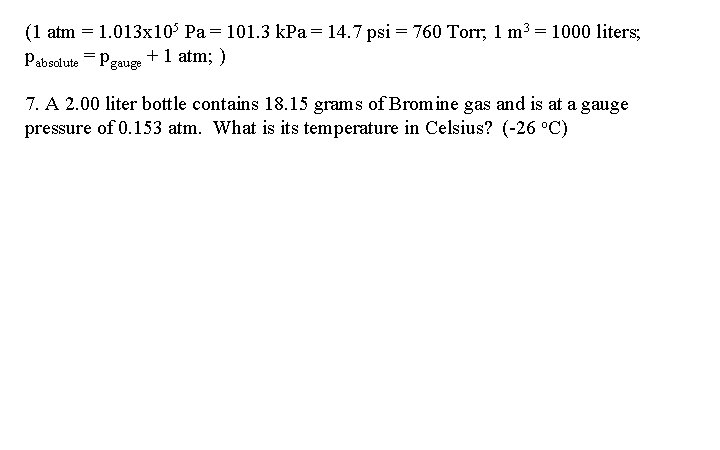
(1 atm = 1. 013 x 105 Pa = 101. 3 k. Pa = 14. 7 psi = 760 Torr; 1 m 3 = 1000 liters; pabsolute = pgauge + 1 atm; ) 7. A 2. 00 liter bottle contains 18. 15 grams of Bromine gas and is at a gauge pressure of 0. 153 atm. What is its temperature in Celsius? (-26 o. C)
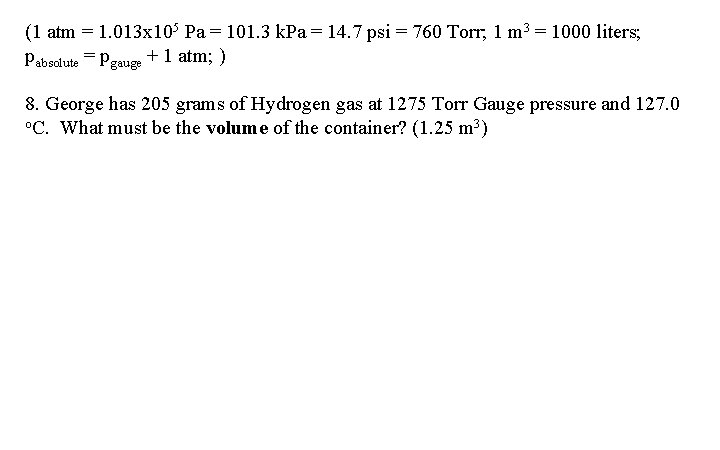
(1 atm = 1. 013 x 105 Pa = 101. 3 k. Pa = 14. 7 psi = 760 Torr; 1 m 3 = 1000 liters; pabsolute = pgauge + 1 atm; ) 8. George has 205 grams of Hydrogen gas at 1275 Torr Gauge pressure and 127. 0 o. C. What must be the volume of the container? (1. 25 m 3)
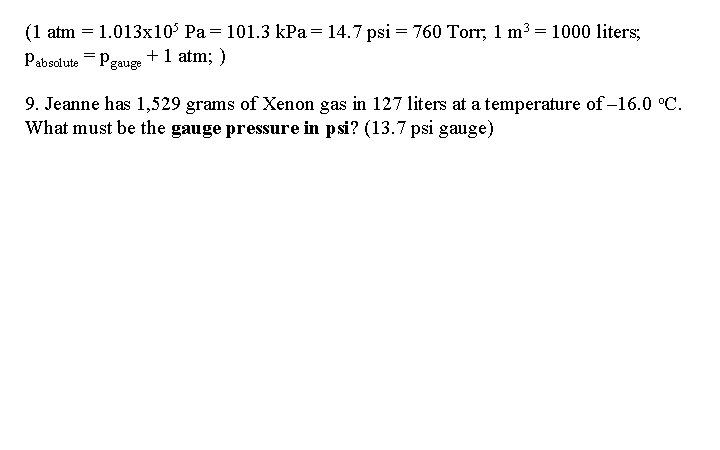
(1 atm = 1. 013 x 105 Pa = 101. 3 k. Pa = 14. 7 psi = 760 Torr; 1 m 3 = 1000 liters; pabsolute = pgauge + 1 atm; ) 9. Jeanne has 1, 529 grams of Xenon gas in 127 liters at a temperature of – 16. 0 o. C. What must be the gauge pressure in psi? (13. 7 psi gauge)
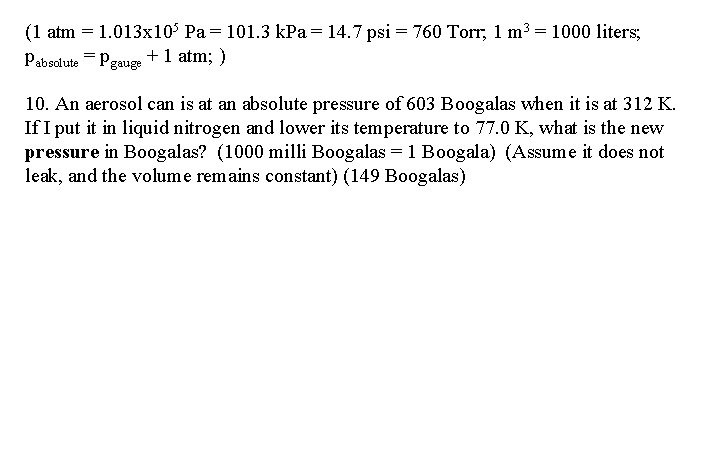
(1 atm = 1. 013 x 105 Pa = 101. 3 k. Pa = 14. 7 psi = 760 Torr; 1 m 3 = 1000 liters; pabsolute = pgauge + 1 atm; ) 10. An aerosol can is at an absolute pressure of 603 Boogalas when it is at 312 K. If I put it in liquid nitrogen and lower its temperature to 77. 0 K, what is the new pressure in Boogalas? (1000 milli Boogalas = 1 Boogala) (Assume it does not leak, and the volume remains constant) (149 Boogalas)
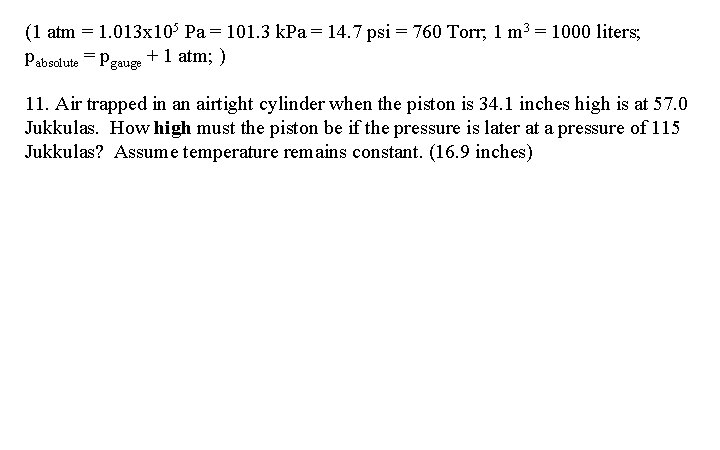
(1 atm = 1. 013 x 105 Pa = 101. 3 k. Pa = 14. 7 psi = 760 Torr; 1 m 3 = 1000 liters; pabsolute = pgauge + 1 atm; ) 11. Air trapped in an airtight cylinder when the piston is 34. 1 inches high is at 57. 0 Jukkulas. How high must the piston be if the pressure is later at a pressure of 115 Jukkulas? Assume temperature remains constant. (16. 9 inches)
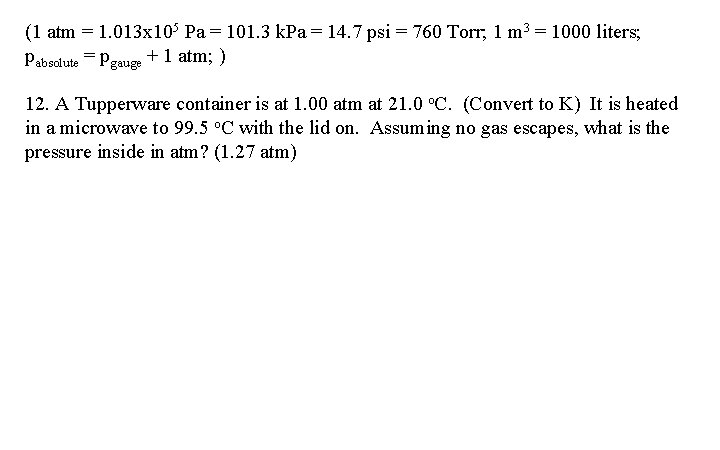
(1 atm = 1. 013 x 105 Pa = 101. 3 k. Pa = 14. 7 psi = 760 Torr; 1 m 3 = 1000 liters; pabsolute = pgauge + 1 atm; ) 12. A Tupperware container is at 1. 00 atm at 21. 0 o. C. (Convert to K) It is heated in a microwave to 99. 5 o. C with the lid on. Assuming no gas escapes, what is the pressure inside in atm? (1. 27 atm)
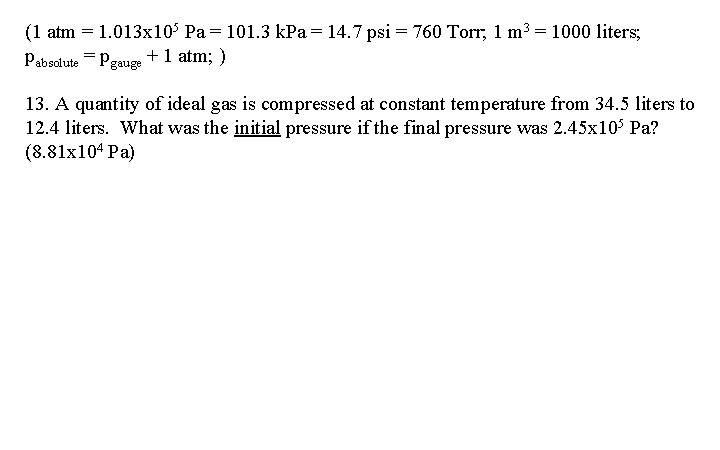
(1 atm = 1. 013 x 105 Pa = 101. 3 k. Pa = 14. 7 psi = 760 Torr; 1 m 3 = 1000 liters; pabsolute = pgauge + 1 atm; ) 13. A quantity of ideal gas is compressed at constant temperature from 34. 5 liters to 12. 4 liters. What was the initial pressure if the final pressure was 2. 45 x 105 Pa? (8. 81 x 104 Pa)
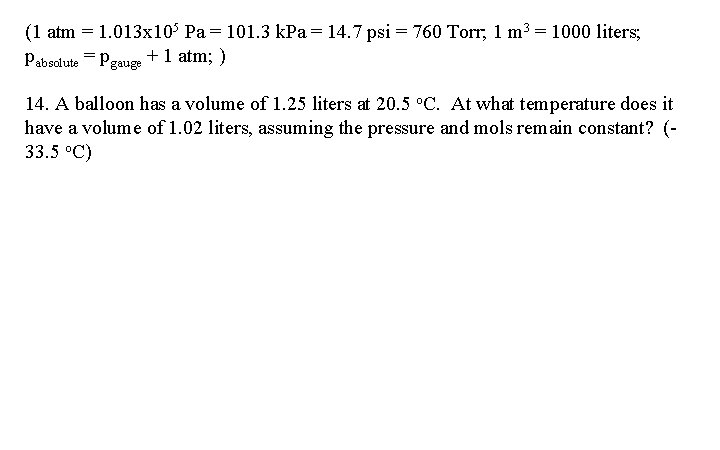
(1 atm = 1. 013 x 105 Pa = 101. 3 k. Pa = 14. 7 psi = 760 Torr; 1 m 3 = 1000 liters; pabsolute = pgauge + 1 atm; ) 14. A balloon has a volume of 1. 25 liters at 20. 5 o. C. At what temperature does it have a volume of 1. 02 liters, assuming the pressure and mols remain constant? (33. 5 o. C)
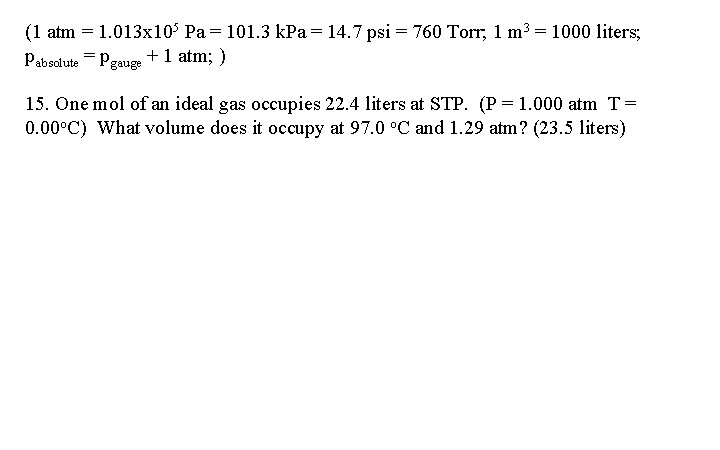
(1 atm = 1. 013 x 105 Pa = 101. 3 k. Pa = 14. 7 psi = 760 Torr; 1 m 3 = 1000 liters; pabsolute = pgauge + 1 atm; ) 15. One mol of an ideal gas occupies 22. 4 liters at STP. (P = 1. 000 atm T = 0. 00 o. C) What volume does it occupy at 97. 0 o. C and 1. 29 atm? (23. 5 liters)
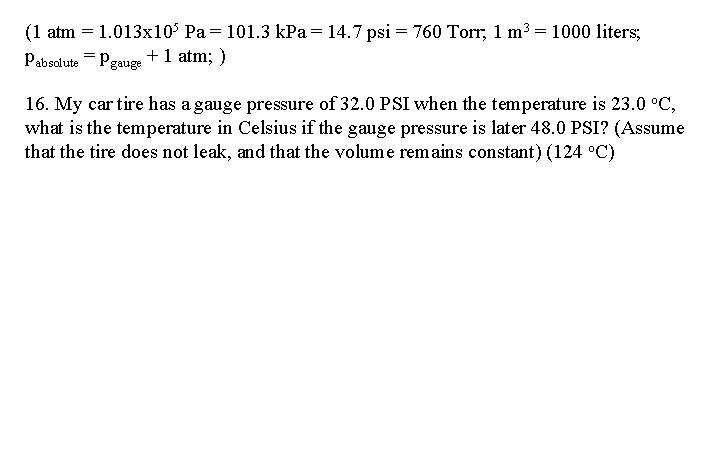
(1 atm = 1. 013 x 105 Pa = 101. 3 k. Pa = 14. 7 psi = 760 Torr; 1 m 3 = 1000 liters; pabsolute = pgauge + 1 atm; ) 16. My car tire has a gauge pressure of 32. 0 PSI when the temperature is 23. 0 o. C, what is the temperature in Celsius if the gauge pressure is later 48. 0 PSI? (Assume that the tire does not leak, and that the volume remains constant) (124 o. C)
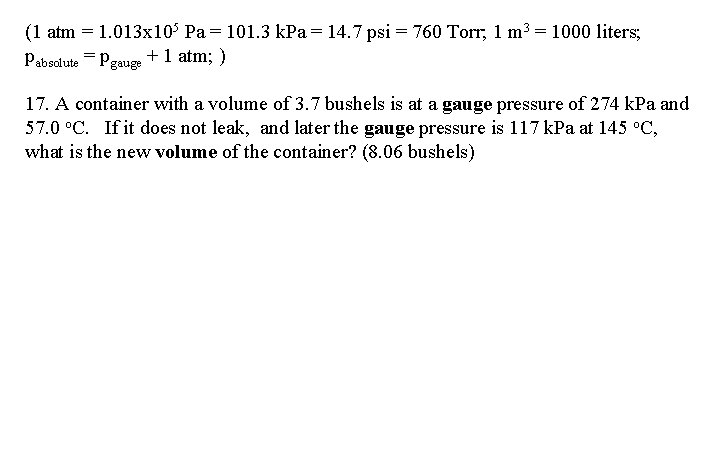
(1 atm = 1. 013 x 105 Pa = 101. 3 k. Pa = 14. 7 psi = 760 Torr; 1 m 3 = 1000 liters; pabsolute = pgauge + 1 atm; ) 17. A container with a volume of 3. 7 bushels is at a gauge pressure of 274 k. Pa and 57. 0 o. C. If it does not leak, and later the gauge pressure is 117 k. Pa at 145 o. C, what is the new volume of the container? (8. 06 bushels)
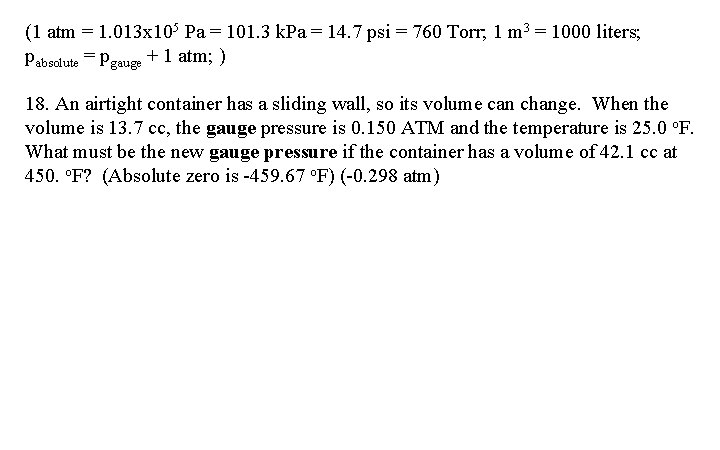
(1 atm = 1. 013 x 105 Pa = 101. 3 k. Pa = 14. 7 psi = 760 Torr; 1 m 3 = 1000 liters; pabsolute = pgauge + 1 atm; ) 18. An airtight container has a sliding wall, so its volume can change. When the volume is 13. 7 cc, the gauge pressure is 0. 150 ATM and the temperature is 25. 0 o. F. What must be the new gauge pressure if the container has a volume of 42. 1 cc at 450. o. F? (Absolute zero is -459. 67 o. F) (-0. 298 atm)
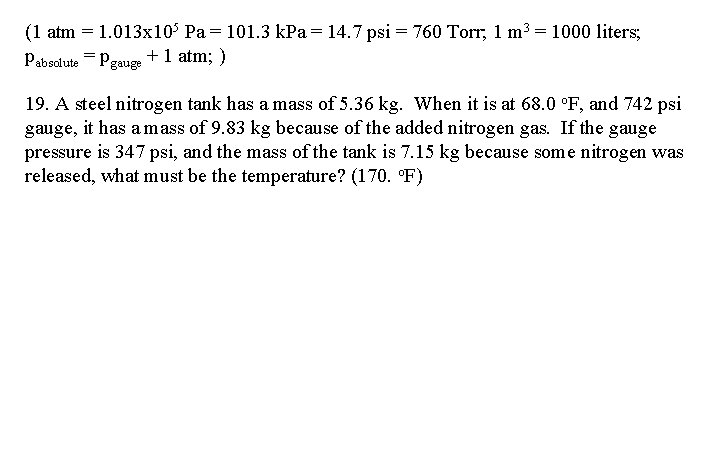
(1 atm = 1. 013 x 105 Pa = 101. 3 k. Pa = 14. 7 psi = 760 Torr; 1 m 3 = 1000 liters; pabsolute = pgauge + 1 atm; ) 19. A steel nitrogen tank has a mass of 5. 36 kg. When it is at 68. 0 o. F, and 742 psi gauge, it has a mass of 9. 83 kg because of the added nitrogen gas. If the gauge pressure is 347 psi, and the mass of the tank is 7. 15 kg because some nitrogen was released, what must be the temperature? (170. o. F)