1 Artist Impression A Schaller Oort Cloud 100
- Slides: 17
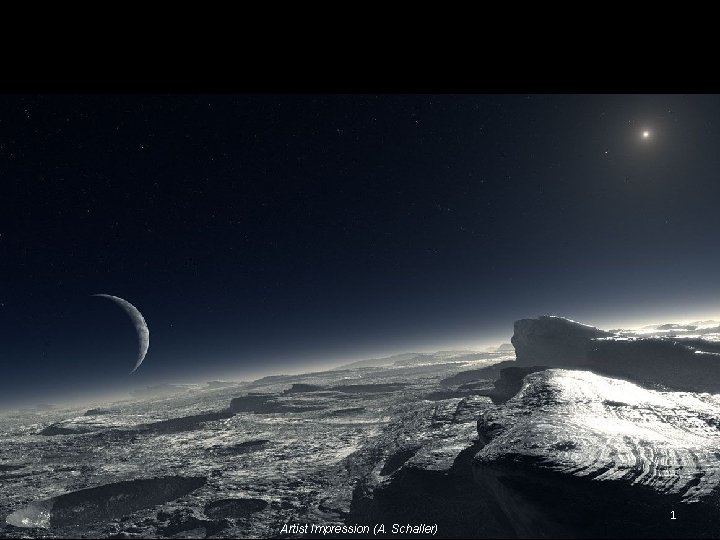
1 Artist Impression (A. Schaller)
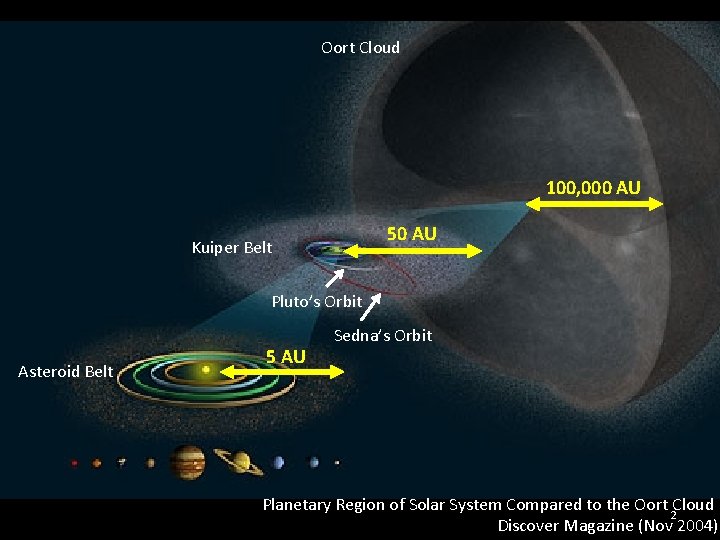
Oort Cloud 100, 000 AU 50 AU Kuiper Belt Pluto’s Orbit Asteroid Belt 5 AU Sedna’s Orbit Planetary Region of Solar System Compared to the Oort Cloud 2 Discover Magazine (Nov 2004)
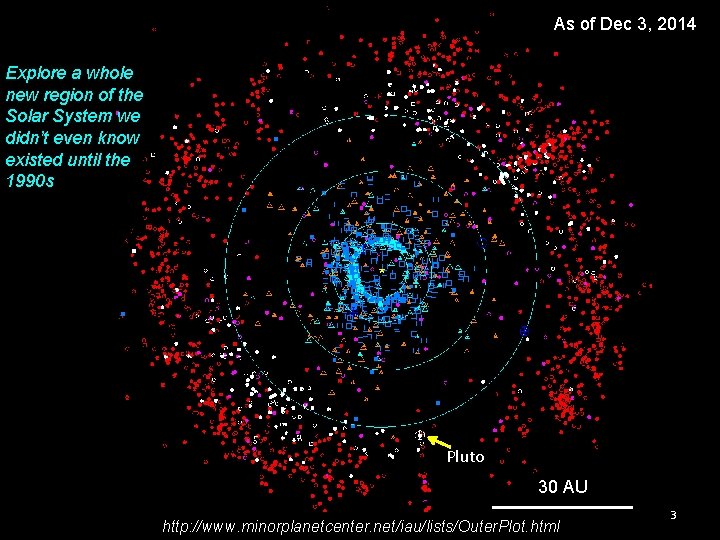
As of Dec 3, 2014 Explore a whole new region of the Solar System we didn’t even know existed until the 1990 s Pluto 30 AU http: //www. minorplanetcenter. net/iau/lists/Outer. Plot. html 3
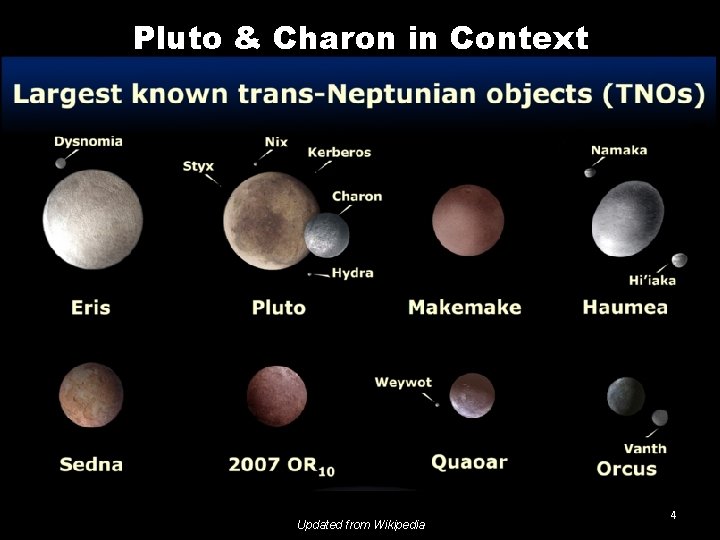
Pluto & Charon in Context Updated from Wikipedia 4
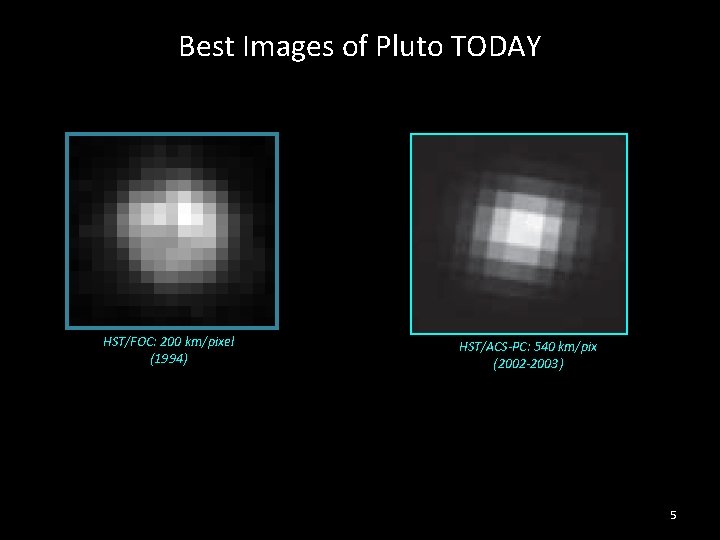
Best Images of Pluto TODAY HST/FOC: 200 km/pixel (1994) HST/ACS-PC: 540 km/pix (2002 -2003) 5
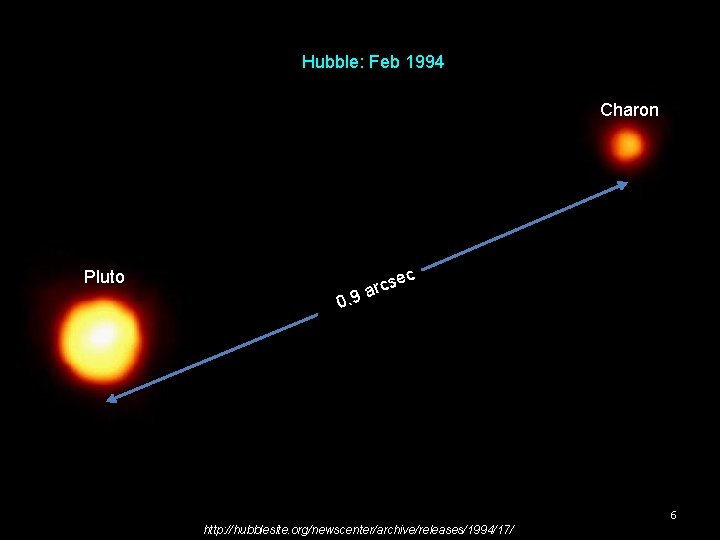
Hubble: Feb 1994 Charon Pluto 0. 9 sec c r a 6 http: //hubblesite. org/newscenter/archive/releases/1994/17/
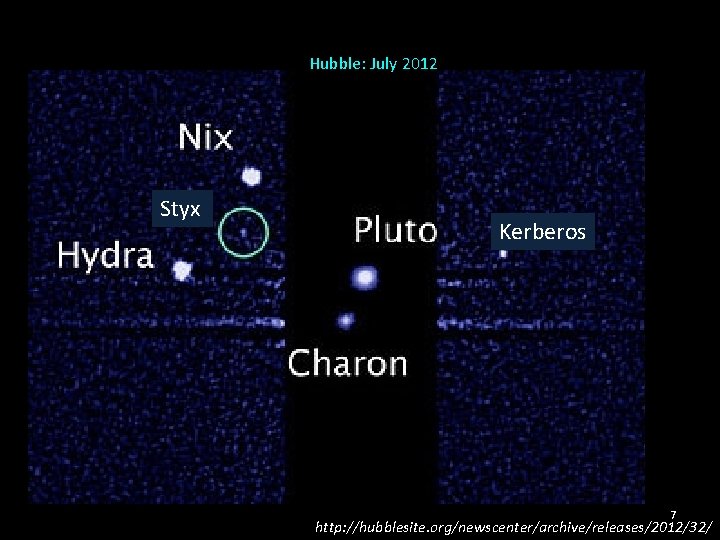
Hubble: July 2012 Styx Kerberos 7 http: //hubblesite. org/newscenter/archive/releases/2012/32/
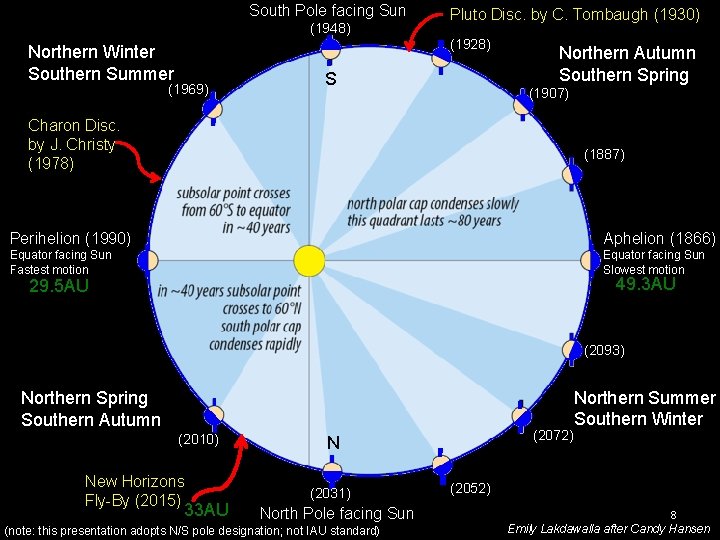
South Pole facing Sun (1948) Pluto Disc. by C. Tombaugh (1930) (1928) Northern Winter Southern Summer (1969) S Northern Autumn Southern Spring (1907) Charon Disc. by J. Christy (1978) (1887) Perihelion (1990) Aphelion (1866) Equator facing Sun Fastest motion Equator facing Sun Slowest motion 49. 3 AU 29. 5 AU (2093) Northern Spring Southern Autumn (2010) New Horizons Fly-By (2015) 33 AU (2072) N (2031) North Pole facing Sun (note: this presentation adopts N/S pole designation; not IAU standard) Northern Summer Southern Winter (2052) 8 Emily Lakdawalla after Candy Hansen
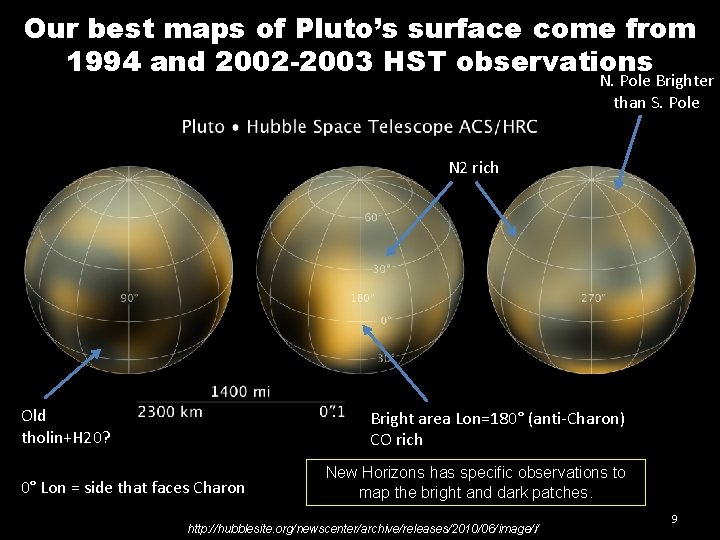
Our best maps of Pluto’s surface come from 1994 and 2002 -2003 HST observations N. Pole Brighter than S. Pole N 2 rich Old tholin+H 20? Bright area Lon=180° (anti-Charon) CO rich 0° Lon = side that faces Charon New Horizons has specific observations to map the bright and dark patches. http: //hubblesite. org/newscenter/archive/releases/2010/06/image/i/ 9
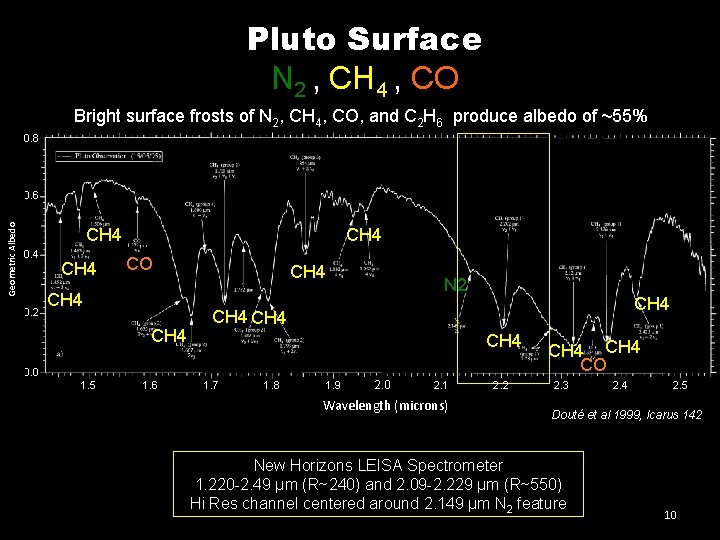
Pluto Surface N 2 , CH 4 , CO Bright surface frosts of N 2, CH 4, CO, and C 2 H 6 produce albedo of ~55% 0. 8 Geometric Albedo 0. 6 CH 4 0. 2 CH 4 CO CH 4 N 2 CH 4 0. 0 1. 5 1. 6 1. 7 1. 8 1. 9 2. 0 2. 1 Wavelength (microns) 2. 2 CH 4 CO 2. 3 2. 4 2. 5 Douté et al 1999, Icarus 142 New Horizons LEISA Spectrometer 1. 220 -2. 49 μm (R~240) and 2. 09 -2. 229 μm (R~550) Hi Res channel centered around 2. 149 μm N 2 feature 10
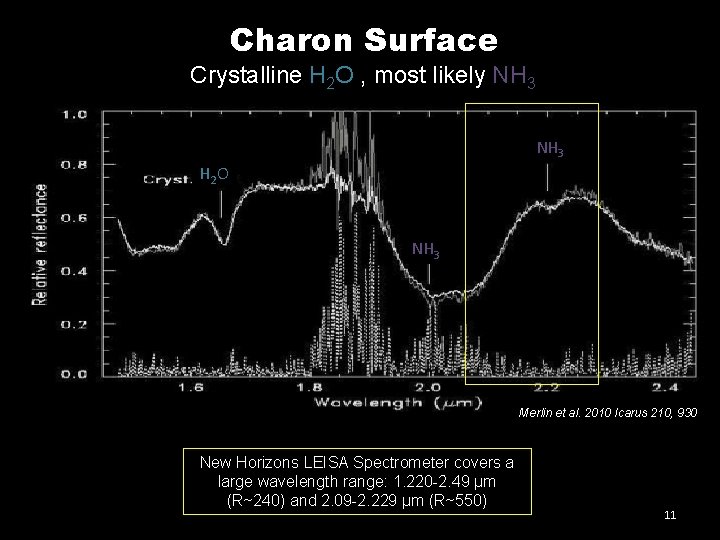
Charon Surface Crystalline H 2 O , most likely NH 3 H 2 O NH 3 Merlin et al. 2010 Icarus 210, 930 New Horizons LEISA Spectrometer covers a large wavelength range: 1. 220 -2. 49 μm (R~240) and 2. 09 -2. 229 μm (R~550) 11
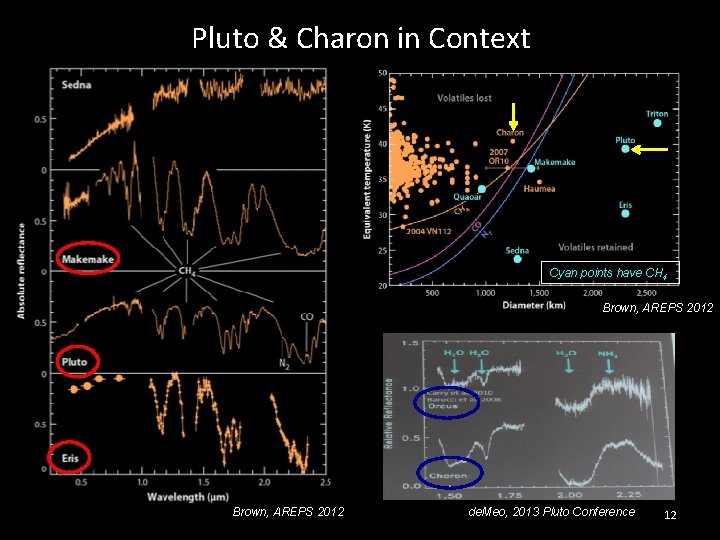
Pluto & Charon in Context Cyan points have CH 4 Brown, AREPS 2012 de. Meo, 2013 Pluto Conference 12
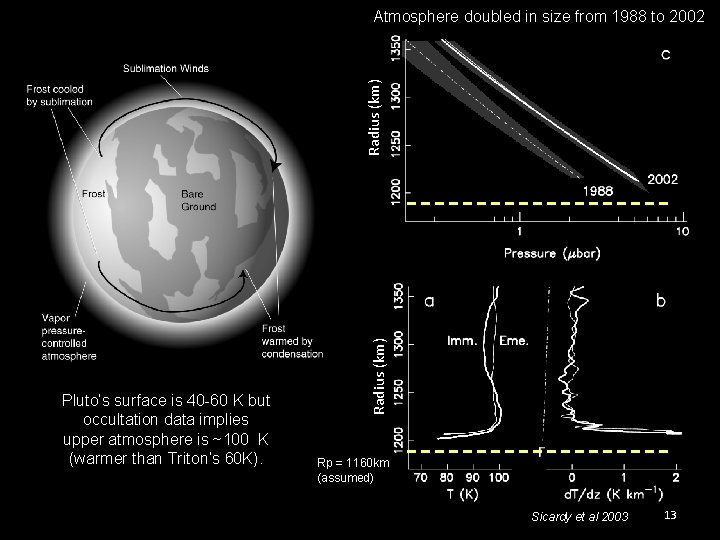
Pluto’s surface is 40 -60 K but occultation data implies upper atmosphere is ~100 K (warmer than Triton’s 60 K). Radius (km) Atmosphere doubled in size from 1988 to 2002 Rp = 1160 km (assumed) Sicardy et al 2003 13
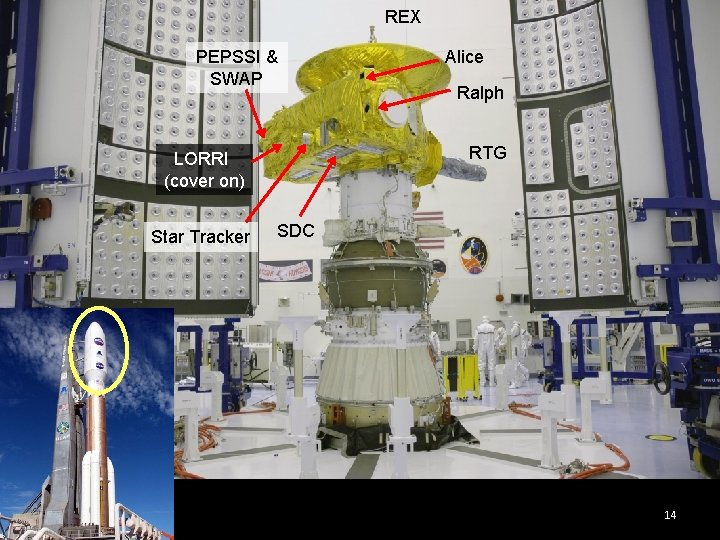
REX New Horizons Instrument Suite Ralph PEPSSI & SWAP RTG LORRI (cover on) Star Tracker Alice SDC 14
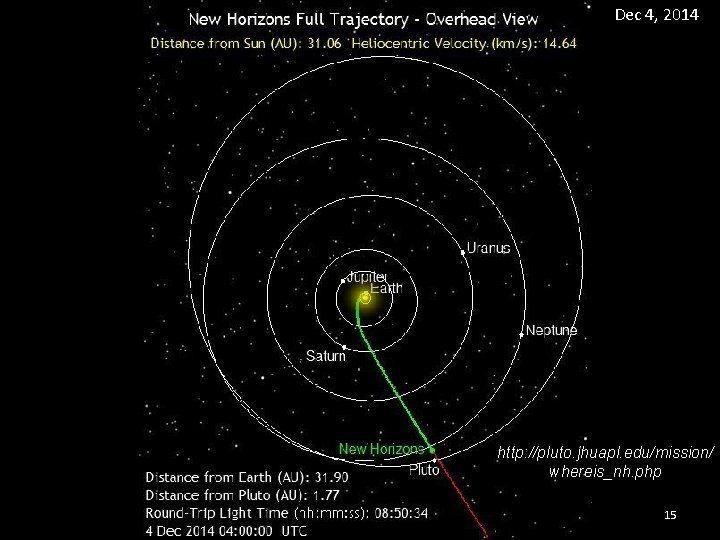
Dec 4, 2014 http: //pluto. jhuapl. edu/mission/ whereis_nh. php 15
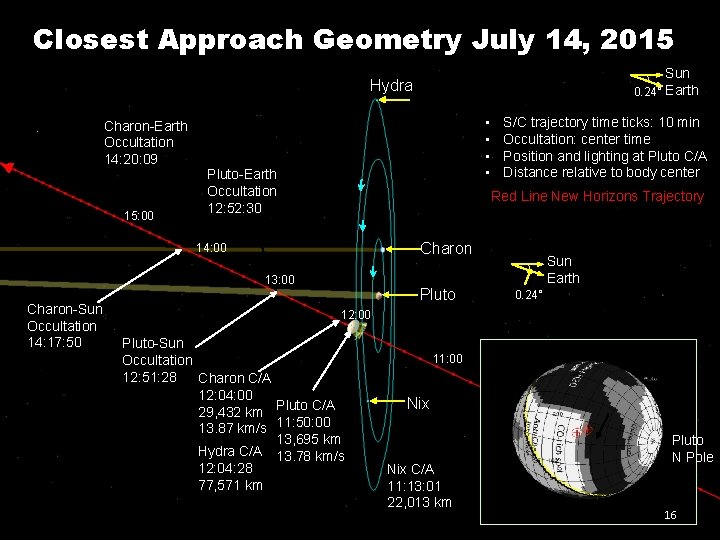
Closest Approach Geometry July 14, 2015 Sun 0. 24° Earth Hydra Charon-Earth Occultation 14: 20: 09 15: 00 • • Pluto-Earth Occultation 12: 52: 30 Red Line New Horizons Trajectory Charon 14: 00 13: 00 Charon-Sun Occultation 14: 17: 50 S/C trajectory time ticks: 10 min Occultation: center time Position and lighting at Pluto C/A Distance relative to body center Pluto Sun Earth 0. 24° 12: 00 Pluto-Sun Occultation 12: 51: 28 Charon C/A 12: 04: 00 29, 432 km Pluto C/A 13. 87 km/s 11: 50: 00 13, 695 km Hydra C/A 13. 78 km/s 12: 04: 28 77, 571 km 11: 00 Nix C/A 11: 13: 01 22, 013 km Pluto N Pole 16
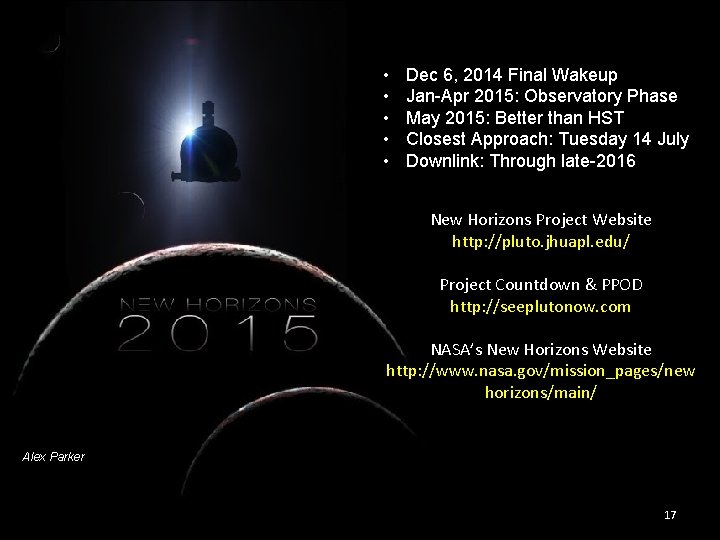
• • • Dec 6, 2014 Final Wakeup Jan-Apr 2015: Observatory Phase May 2015: Better than HST Closest Approach: Tuesday 14 July Downlink: Through late-2016 New Horizons Project Website http: //pluto. jhuapl. edu/ Project Countdown & PPOD http: //seeplutonow. com NASA’s New Horizons Website http: //www. nasa. gov/mission_pages/new horizons/main/ Alex Parker 17