04 13 16 EFT Gottman EFT Approach Emotion

- Slides: 14
+ 04. 13. 16 EFT Gottman
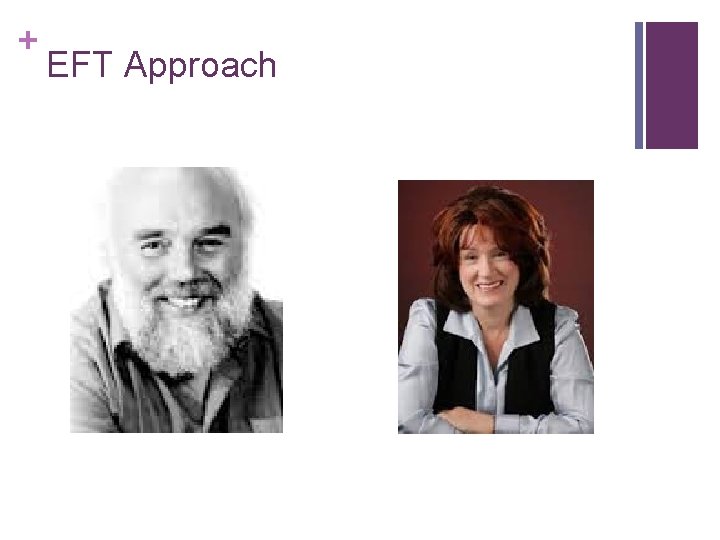
+ EFT Approach
+ Emotion Focused Couples Therapy n “views marital distress as being maintained by the manner in which people organize and process their emotional experience, and the patterns of interaction they engage in, which take on a life of their own and become selfreinforcing” n (Johnson, 2004, p. 41).
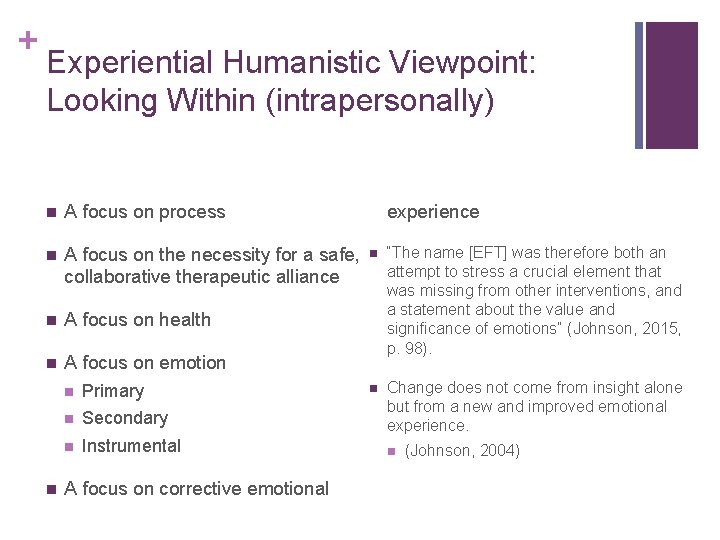
+ Experiential Humanistic Viewpoint: Looking Within (intrapersonally) n A focus on process n A focus on the necessity for a safe, collaborative therapeutic alliance n A focus on health n A focus on emotion n n Primary n Secondary n Instrumental A focus on corrective emotional experience n “The name [EFT] was therefore both an attempt to stress a crucial element that was missing from other interventions, and a statement about the value and significance of emotions” (Johnson, 2015, p. 98). n Change does not come from insight alone but from a new and improved emotional experience. n (Johnson, 2004)
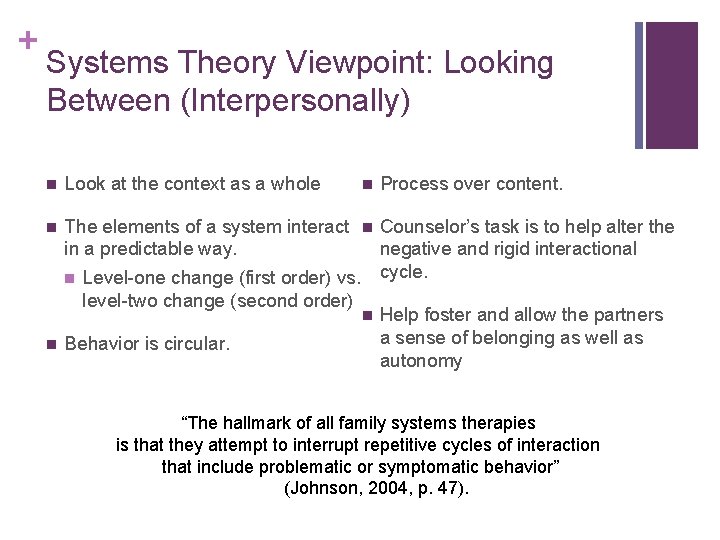
+ Systems Theory Viewpoint: Looking Between (Interpersonally) n Look at the context as a whole n n The elements of a system interact in a predictable way. n n Process over content. Counselor’s task is to help alter the negative and rigid interactional n Level-one change (first order) vs. cycle. level-two change (second order) n Help foster and allow the partners a sense of belonging as well as Behavior is circular. autonomy “The hallmark of all family systems therapies is that they attempt to interrupt repetitive cycles of interaction that include problematic or symptomatic behavior” (Johnson, 2004, p. 47).
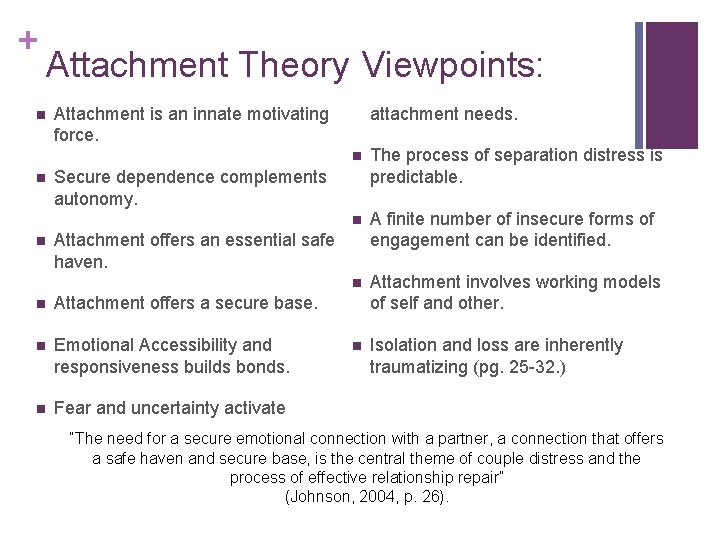
+ Attachment Theory Viewpoints: n n n Attachment is an innate motivating force. attachment needs. n The process of separation distress is predictable. n A finite number of insecure forms of engagement can be identified. n Attachment involves working models of self and other. n Isolation and loss are inherently traumatizing (pg. 25 -32. ) Secure dependence complements autonomy. Attachment offers an essential safe haven. n Attachment offers a secure base. n Emotional Accessibility and responsiveness builds bonds. n Fear and uncertainty activate “The need for a secure emotional connection with a partner, a connection that offers a safe haven and secure base, is the central theme of couple distress and the process of effective relationship repair” (Johnson, 2004, p. 26).
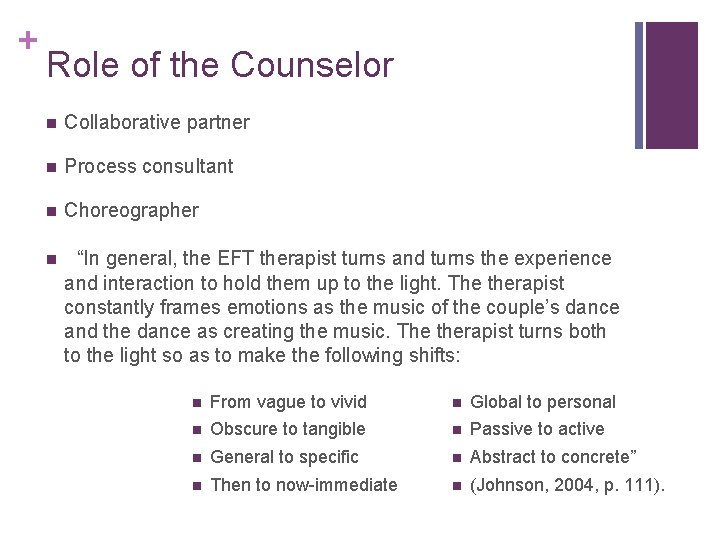
+ Role of the Counselor n Collaborative partner n Process consultant n Choreographer n “In general, the EFT therapist turns and turns the experience and interaction to hold them up to the light. The therapist constantly frames emotions as the music of the couple’s dance and the dance as creating the music. The therapist turns both to the light so as to make the following shifts: n From vague to vivid n Global to personal n Obscure to tangible n Passive to active n General to specific n Abstract to concrete” n Then to now-immediate n (Johnson, 2004, p. 111).
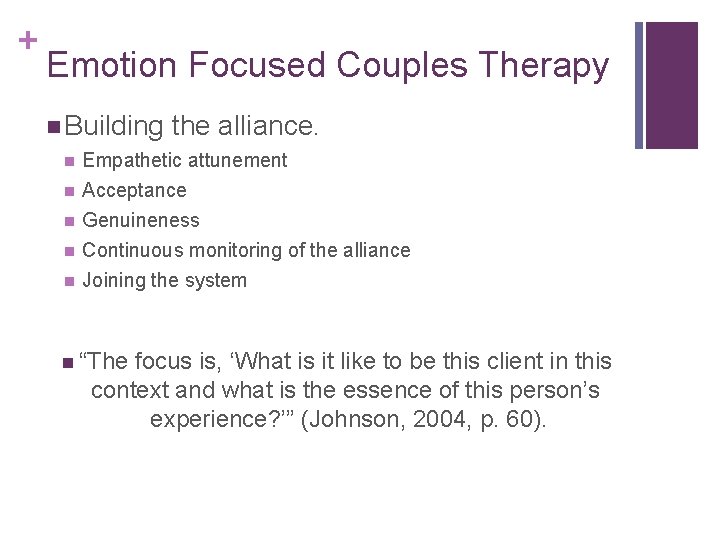
+ Emotion Focused Couples Therapy n Building n n n the alliance. Empathetic attunement Acceptance Genuineness Continuous monitoring of the alliance Joining the system n “The focus is, ‘What is it like to be this client in this context and what is the essence of this person’s experience? ’” (Johnson, 2004, p. 60).
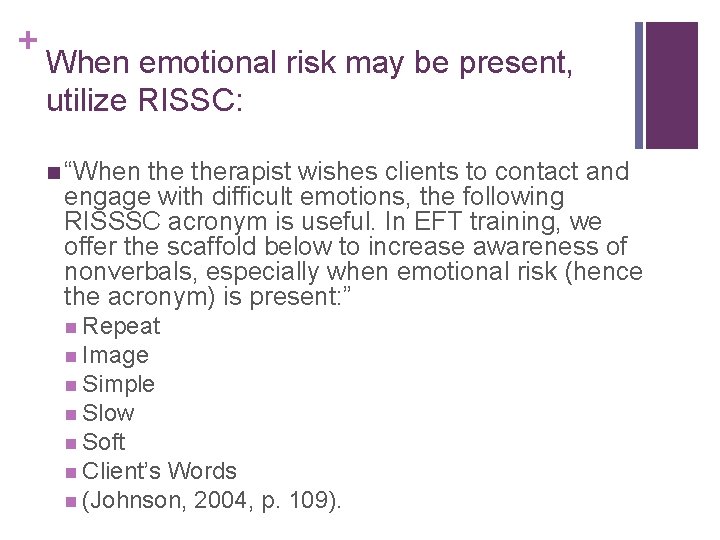
+ When emotional risk may be present, utilize RISSC: n “When therapist wishes clients to contact and engage with difficult emotions, the following RISSSC acronym is useful. In EFT training, we offer the scaffold below to increase awareness of nonverbals, especially when emotional risk (hence the acronym) is present: ” n Repeat n Image n Simple n Slow n Soft n Client’s Words n (Johnson, 2004, p. 109).
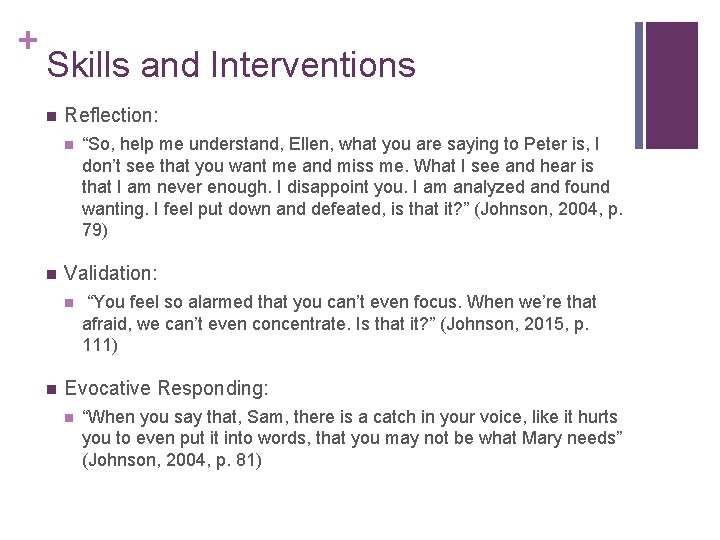
+ Skills and Interventions n Reflection: n n Validation: n n “So, help me understand, Ellen, what you are saying to Peter is, I don’t see that you want me and miss me. What I see and hear is that I am never enough. I disappoint you. I am analyzed and found wanting. I feel put down and defeated, is that it? ” (Johnson, 2004, p. 79) “You feel so alarmed that you can’t even focus. When we’re that afraid, we can’t even concentrate. Is that it? ” (Johnson, 2015, p. 111) Evocative Responding: n “When you say that, Sam, there is a catch in your voice, like it hurts you to even put it into words, that you may not be what Mary needs” (Johnson, 2004, p. 81)
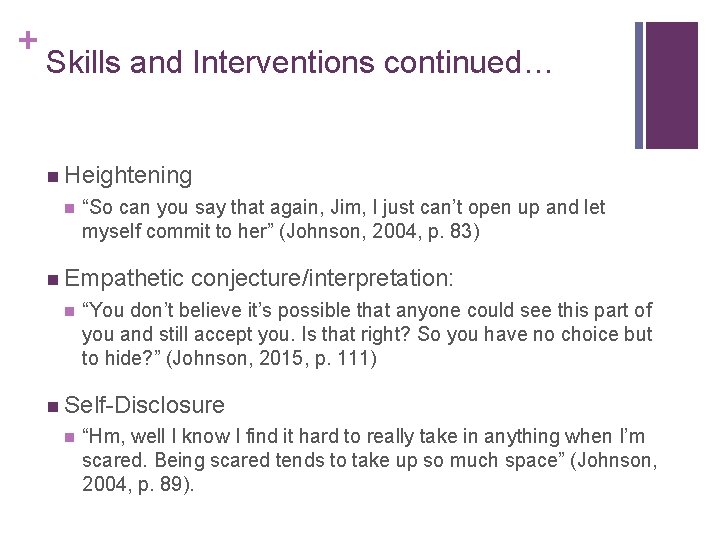
+ Skills and Interventions continued… n Heightening n “So can you say that again, Jim, I just can’t open up and let myself commit to her” (Johnson, 2004, p. 83) n Empathetic n conjecture/interpretation: “You don’t believe it’s possible that anyone could see this part of you and still accept you. Is that right? So you have no choice but to hide? ” (Johnson, 2015, p. 111) n Self-Disclosure n “Hm, well I know I find it hard to really take in anything when I’m scared. Being scared tends to take up so much space” (Johnson, 2004, p. 89).
+ Stages of Change n “The term choreograph is used deliberately in that, like a choreographer, therapist has an overview of the dance and gives stepby-step direction and structure, but the dance is also the dancers’ own creation and a vehicle for the expression of self” n (Johnson, 2004, 101).
+ EFT video n http: //search. alexanderstreet. com. proxybz. lib. montana. edu/view/work/ 1824849
+ References n Johnson, S. M. (2015) Emotionally Focused Couple Therapy. In Clinical Handbook of Couple Therapy (5 th ed, pp. 97 -128). New York, NY: The Guilford Press. n Johnson, S. M. (2004). The practice of emotionally focused couple therapy: Creating connection. (2 nd ed. ). Taylor & Francis Group, LLC.