World Meteorological Organization Working together in weather climate
- Slides: 18
World Meteorological Organization Working together in weather, climate and water WMO REGULATORY MATERIAL Standards & Best Practices ICG-WIGOS TT on Regulatory Material (Geneva, 19 -23 November 2012) Dr M. Ondráš Chief, WMO Observing Systems Division WMO/OBS www. wmo. int
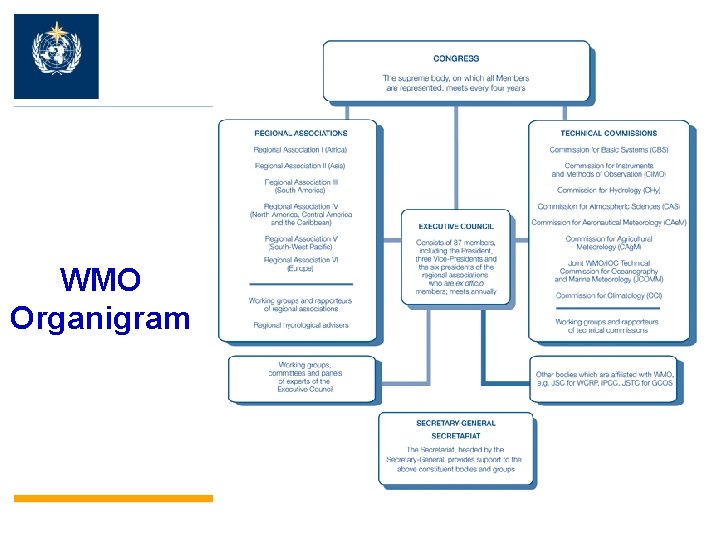
WMO Organigram
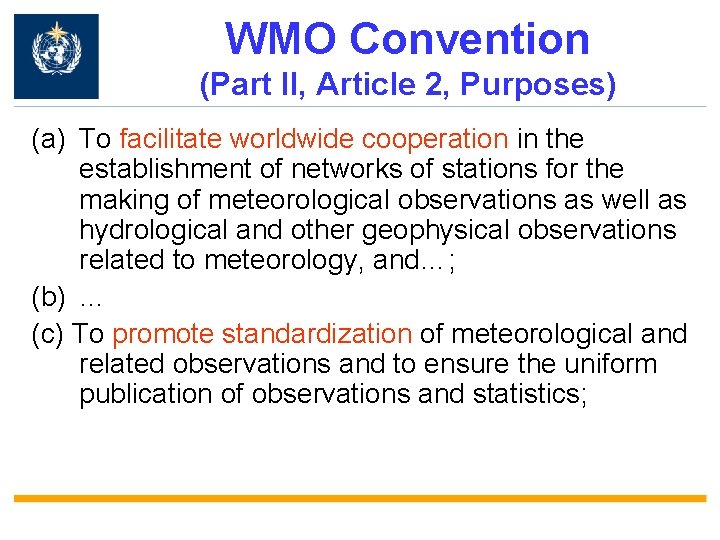
WMO Convention (Part II, Article 2, Purposes) (a) To facilitate worldwide cooperation in the establishment of networks of stations for the making of meteorological observations as well as hydrological and other geophysical observations related to meteorology, and…; (b) … (c) To promote standardization of meteorological and related observations and to ensure the uniform publication of observations and statistics;
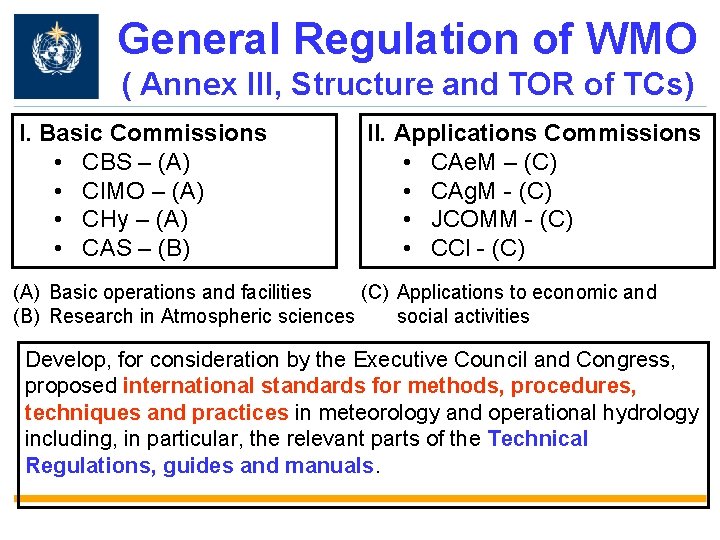
General Regulation of WMO ( Annex III, Structure and TOR of TCs) I. Basic Commissions • CBS – (A) • CIMO – (A) • CHy – (A) • CAS – (B) II. Applications Commissions • CAe. M – (C) • CAg. M - (C) • JCOMM - (C) • CCl - (C) (A) Basic operations and facilities (C) Applications to economic and (B) Research in Atmospheric sciences social activities Develop, for consideration by the Executive Council and Congress, proposed international standards for methods, procedures, techniques and practices in meteorology and operational hydrology including, in particular, the relevant parts of the Technical Regulations, guides and manuals.
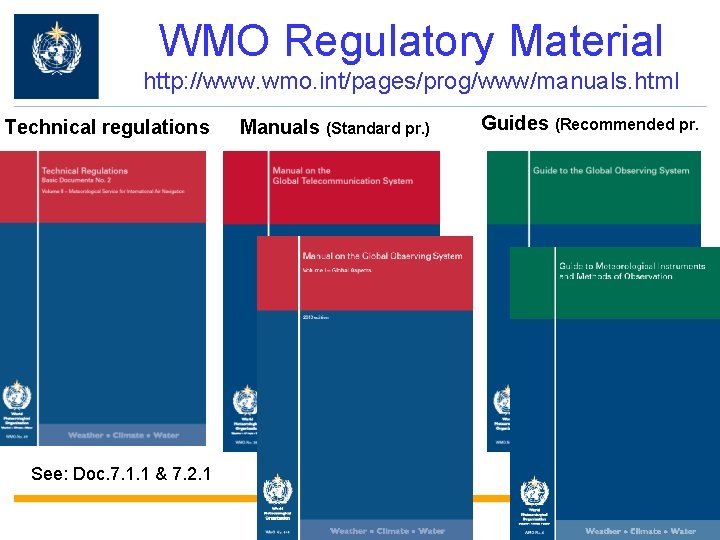
WMO Regulatory Material http: //www. wmo. int/pages/prog/www/manuals. html Technical regulations See: Doc. 7. 1. 1 & 7. 2. 1 Manuals (Standard pr. ) Guides (Recommended pr.
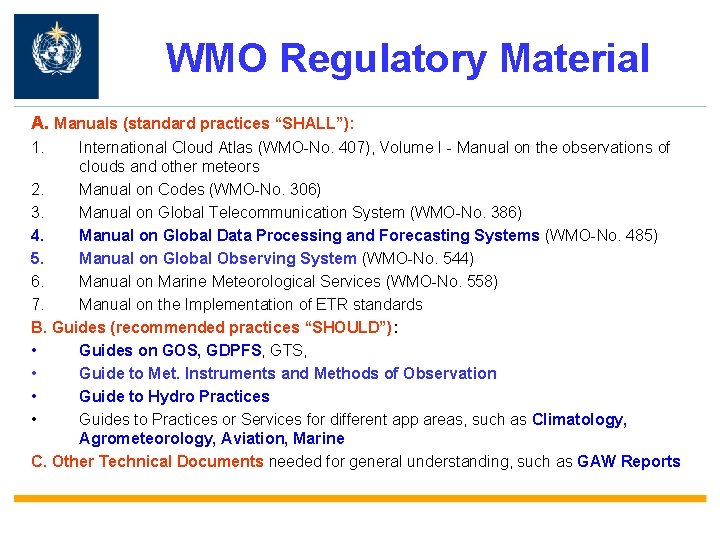
WMO Regulatory Material A. Manuals (standard practices “SHALL”): 1. International Cloud Atlas (WMO-No. 407), Volume I - Manual on the observations of clouds and other meteors 2. Manual on Codes (WMO-No. 306) 3. Manual on Global Telecommunication System (WMO-No. 386) 4. Manual on Global Data Processing and Forecasting Systems (WMO-No. 485) 5. Manual on Global Observing System (WMO-No. 544) 6. Manual on Marine Meteorological Services (WMO-No. 558) 7. Manual on the Implementation of ETR standards B. Guides (recommended practices “SHOULD”): • Guides on GOS, GDPFS, GTS, • Guide to Met. Instruments and Methods of Observation • Guide to Hydro Practices • Guides to Practices or Services for different app areas, such as Climatology, Agrometeorology, Aviation, Marine C. Other Technical Documents needed for general understanding, such as GAW Reports
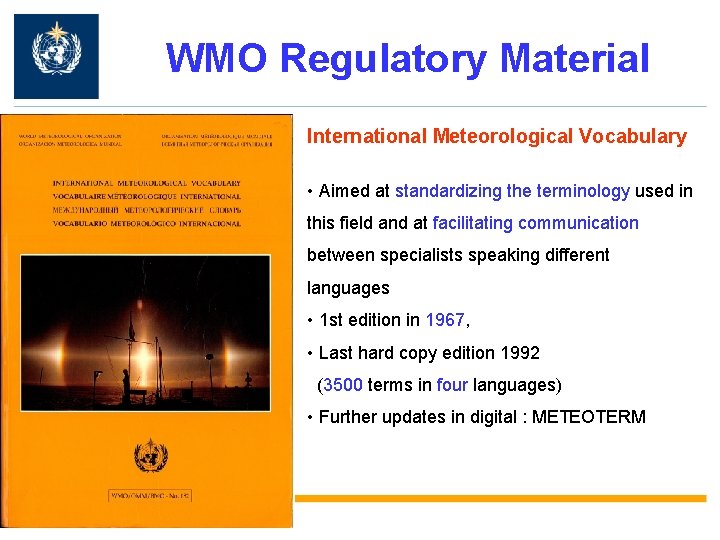
WMO Regulatory Material International Meteorological Vocabulary • Aimed at standardizing the terminology used in this field and at facilitating communication between specialists speaking different languages • 1 st edition in 1967, • Last hard copy edition 1992 (3500 terms in four languages) • Further updates in digital : METEOTERM
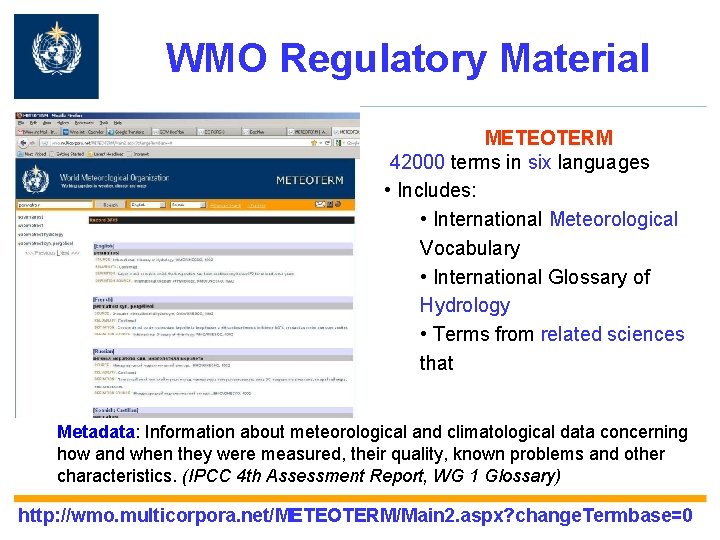
WMO Regulatory Material METEOTERM 42000 terms in six languages • Includes: • International Meteorological Vocabulary • International Glossary of Hydrology • Terms from related sciences that Metadata: Information about meteorological and climatological data concerning how and when they were measured, their quality, known problems and other characteristics. (IPCC 4 th Assessment Report, WG 1 Glossary) http: //wmo. multicorpora. net/METEOTERM/Main 2. aspx? change. Termbase=0
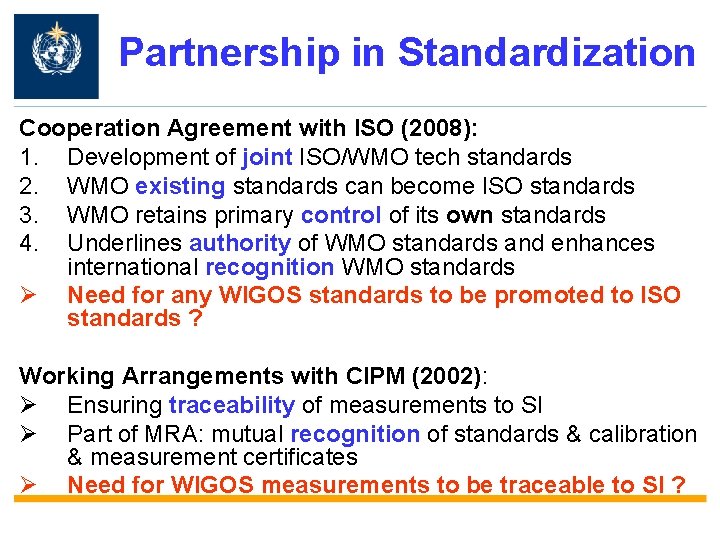
Partnership in Standardization Cooperation Agreement with ISO (2008): 1. Development of joint ISO/WMO tech standards 2. WMO existing standards can become ISO standards 3. WMO retains primary control of its own standards 4. Underlines authority of WMO standards and enhances international recognition WMO standards Ø Need for any WIGOS standards to be promoted to ISO standards ? Working Arrangements with CIPM (2002): Ø Ensuring traceability of measurements to SI Ø Part of MRA: mutual recognition of standards & calibration & measurement certificates Ø Need for WIGOS measurements to be traceable to SI ?
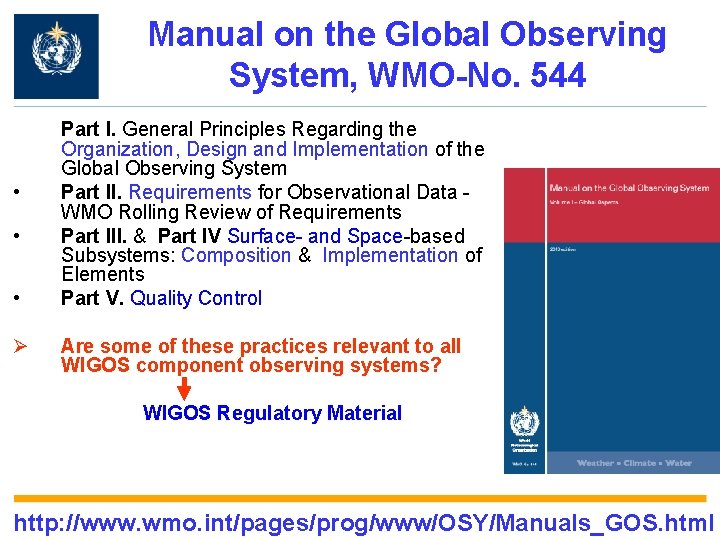
Manual on the Global Observing System, WMO-No. 544 • • • Ø Part I. General Principles Regarding the Organization, Design and Implementation of the Global Observing System Part II. Requirements for Observational Data - WMO Rolling Review of Requirements Part III. & Part IV Surface- and Space-based Subsystems: Composition & Implementation of Elements Part V. Quality Control Are some of these practices relevant to all WIGOS component observing systems? WIGOS Regulatory Material http: //www. wmo. int/pages/prog/www/OSY/Manuals_GOS. html
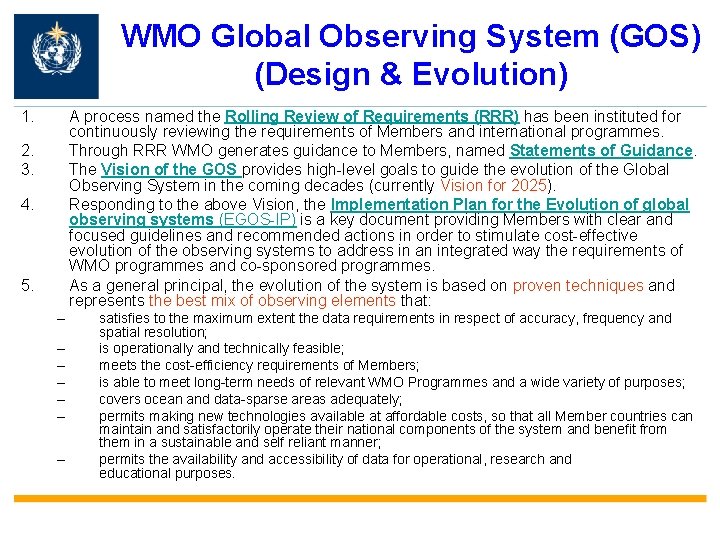
WMO Global Observing System (GOS) (Design & Evolution) 1. A process named the Rolling Review of Requirements (RRR) has been instituted for continuously reviewing the requirements of Members and international programmes. Through RRR WMO generates guidance to Members, named Statements of Guidance. The Vision of the GOS provides high-level goals to guide the evolution of the Global Observing System in the coming decades (currently Vision for 2025). Responding to the above Vision, the Implementation Plan for the Evolution of global observing systems (EGOS-IP) is a key document providing Members with clear and focused guidelines and recommended actions in order to stimulate cost-effective evolution of the observing systems to address in an integrated way the requirements of WMO programmes and co-sponsored programmes. As a general principal, the evolution of the system is based on proven techniques and represents the best mix of observing elements that: 2. 3. 4. 5. – – – – satisfies to the maximum extent the data requirements in respect of accuracy, frequency and spatial resolution; is operationally and technically feasible; meets the cost-efficiency requirements of Members; is able to meet long-term needs of relevant WMO Programmes and a wide variety of purposes; covers ocean and data-sparse areas adequately; permits making new technologies available at affordable costs, so that all Member countries can maintain and satisfactorily operate their national components of the system and benefit from them in a sustainable and self reliant manner; permits the availability and accessibility of data for operational, research and educational purposes.
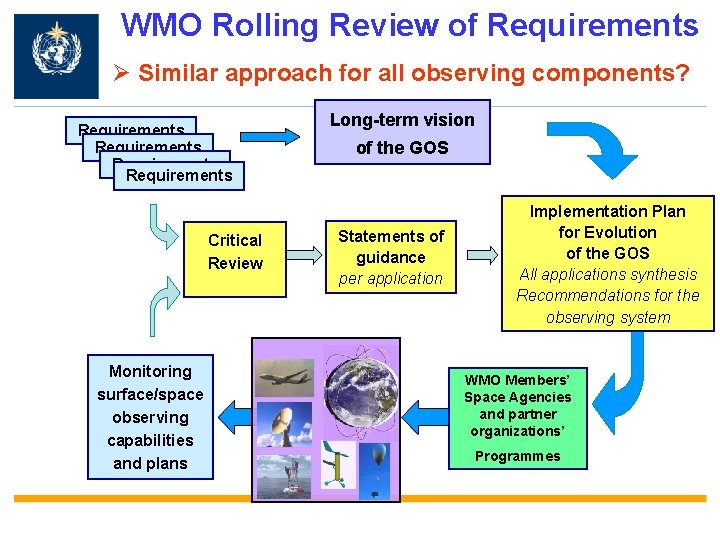
WMO Rolling Review of Requirements Ø Similar approach for all observing components? Long-term vision Requirements of the GOS Critical Review Statements of guidance per application Implementation Plan for Evolution of the GOS All applications synthesis Recommendations for the observing system Monitoring surface/space observing capabilities and plans WMO Members’ Space Agencies and partner organizations’ Programmes
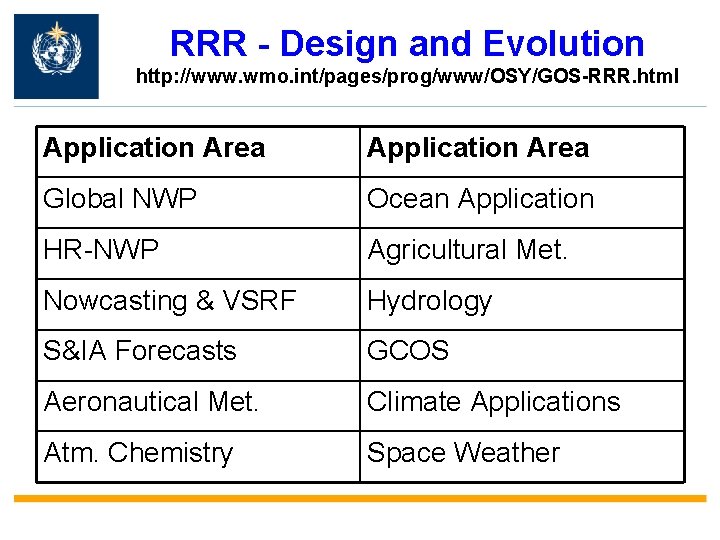
RRR - Design and Evolution http: //www. wmo. int/pages/prog/www/OSY/GOS-RRR. html Application Area Global NWP Ocean Application HR-NWP Agricultural Met. Nowcasting & VSRF Hydrology S&IA Forecasts GCOS Aeronautical Met. Climate Applications Atm. Chemistry Space Weather
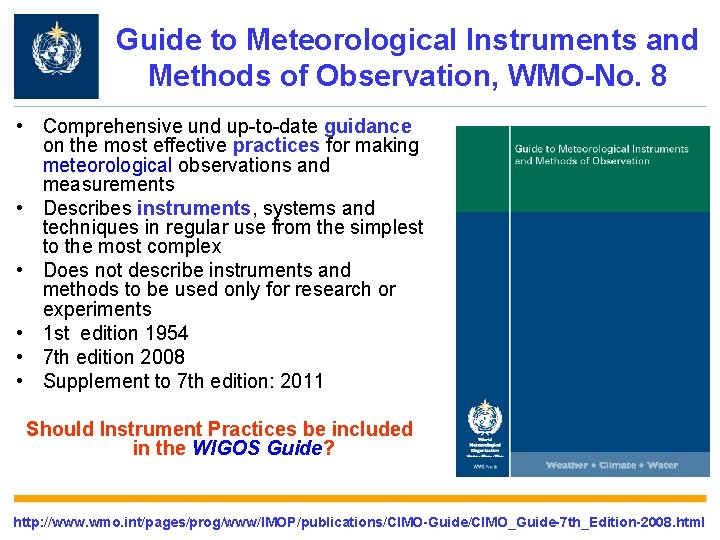
Guide to Meteorological Instruments and Methods of Observation, WMO-No. 8 • Comprehensive und up-to-date guidance on the most effective practices for making meteorological observations and measurements • Describes instruments, systems and techniques in regular use from the simplest to the most complex • Does not describe instruments and methods to be used only for research or experiments • 1 st edition 1954 • 7 th edition 2008 • Supplement to 7 th edition: 2011 Should Instrument Practices be included in the WIGOS Guide? http: //www. wmo. int/pages/prog/www/IMOP/publications/CIMO-Guide/CIMO_Guide-7 th_Edition-2008. html
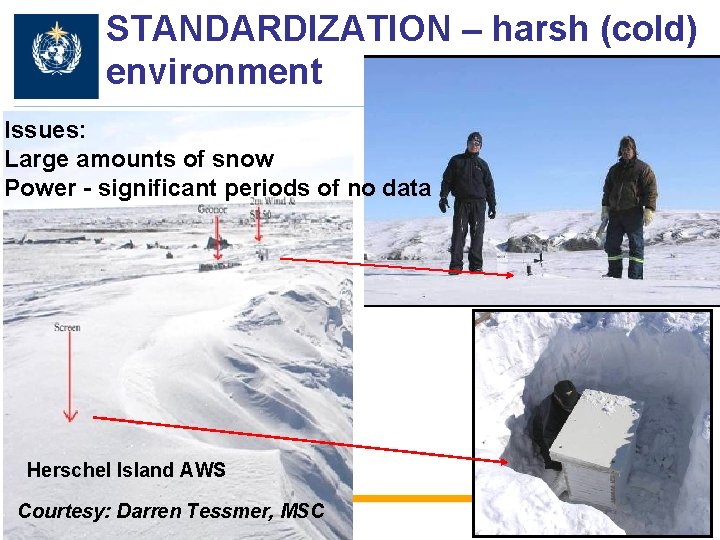
STANDARDIZATION – harsh (cold) environment Issues: Large amounts of snow Power - significant periods of no data Herschel Island AWS Courtesy: Darren Tessmer, MSC
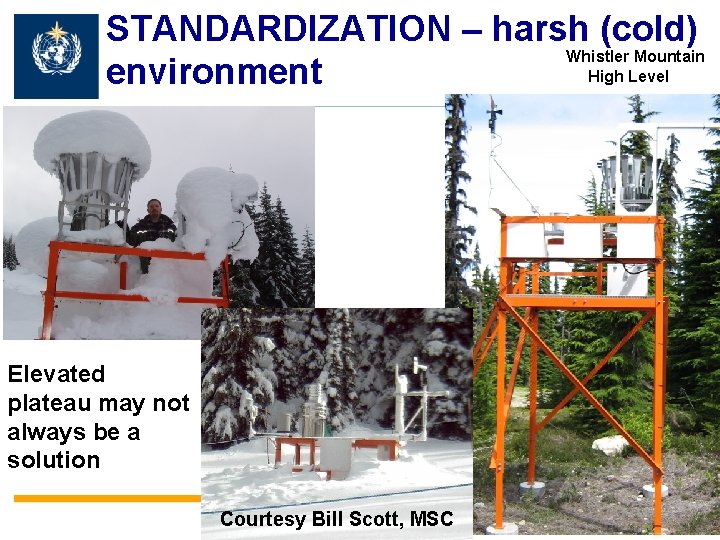
STANDARDIZATION – harsh (cold) Whistler Mountain High Level environment Elevated plateau may not always be a solution Courtesy Bill Scott, MSC
Task Team on WRM to discuss: – the scope, content and the form of WIGOS Regulatory Material – Develop a proposal of WIGOS-RM for the consideration by ICG-WIGOS
World Meteorological Organization 7 bis, avenue de la Paix CH-1211 Geneva 2 Switzerland u o y k n a h T