Workload Optimized Open Stack made easy Arkady Kanevsky

- Slides: 8
Workload Optimized Open. Stack made easy Arkady Kanevsky Service Provider Organization, Dell EMC
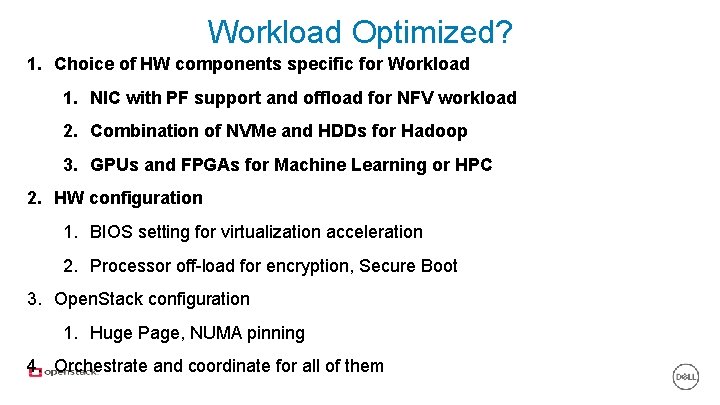
Workload Optimized? 1. Choice of HW components specific for Workload 1. NIC with PF support and offload for NFV workload 2. Combination of NVMe and HDDs for Hadoop 3. GPUs and FPGAs for Machine Learning or HPC 2. HW configuration 1. BIOS setting for virtualization acceleration 2. Processor off-load for encryption, Secure Boot 3. Open. Stack configuration 1. Huge Page, NUMA pinning 4. Orchestrate and coordinate for all of them
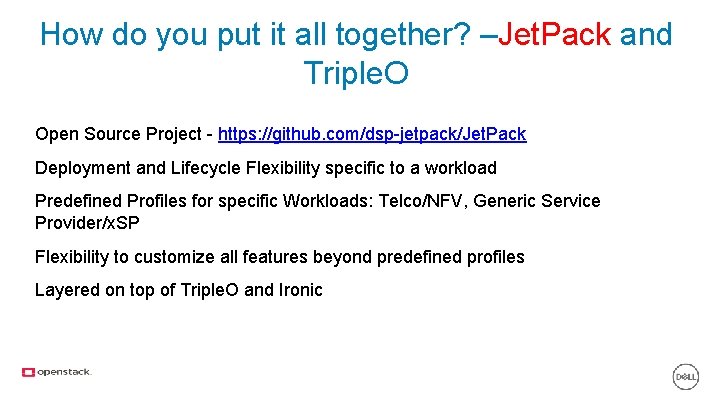
How do you put it all together? –Jet. Pack and Triple. O Open Source Project - https: //github. com/dsp-jetpack/Jet. Pack Deployment and Lifecycle Flexibility specific to a workload Predefined Profiles for specific Workloads: Telco/NFV, Generic Service Provider/x. SP Flexibility to customize all features beyond predefined profiles Layered on top of Triple. O and Ironic
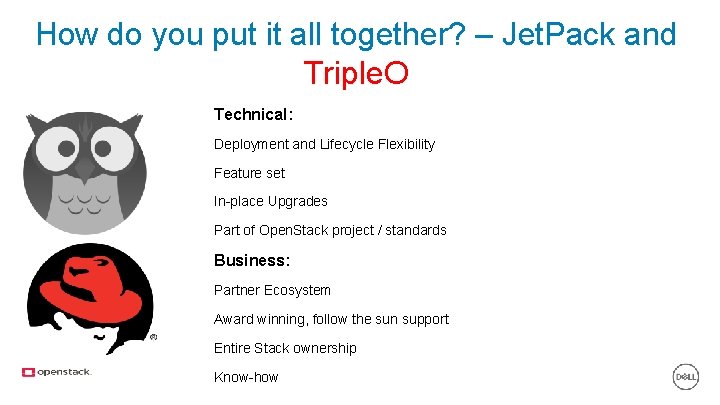
How do you put it all together? – Jet. Pack and Triple. O Technical: Deployment and Lifecycle Flexibility Feature set In-place Upgrades Part of Open. Stack project / standards Business: Partner Ecosystem Award winning, follow the sun support Entire Stack ownership Know-how
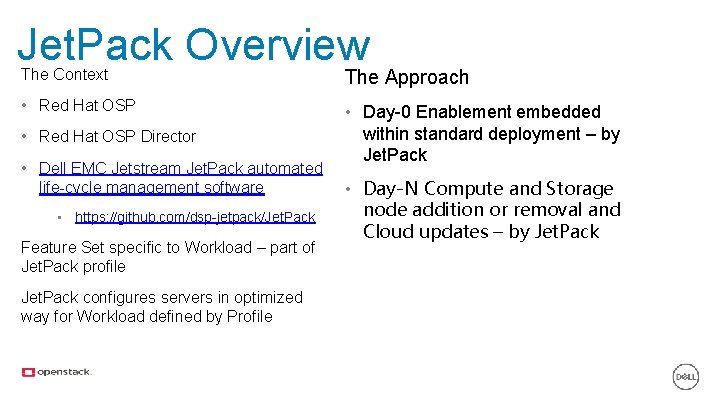
Jet. Pack Overview The Context The Approach • Red Hat OSP • Day-0 Enablement embedded within standard deployment – by Jet. Pack • Red Hat OSP Director • Dell EMC Jetstream Jet. Pack automated life-cycle management software • https: //github. com/dsp-jetpack/Jet. Pack Feature Set specific to Workload – part of Jet. Pack profile Jet. Pack configures servers in optimized way for Workload defined by Profile • Day-N Compute and Storage node addition or removal and Cloud updates – by Jet. Pack
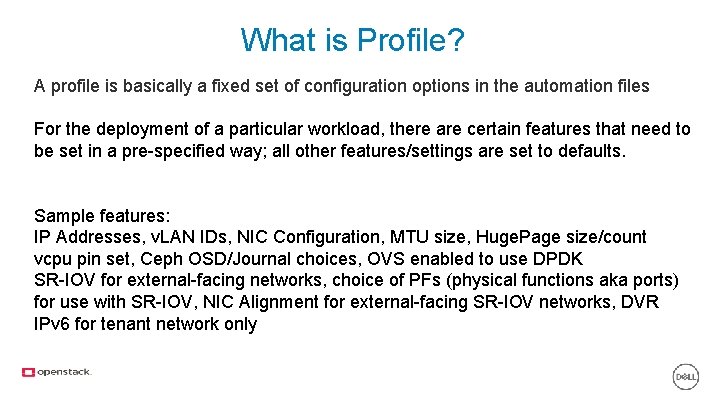
What is Profile? A profile is basically a fixed set of configuration options in the automation files For the deployment of a particular workload, there are certain features that need to be set in a pre-specified way; all other features/settings are set to defaults. Sample features: IP Addresses, v. LAN IDs, NIC Configuration, MTU size, Huge. Page size/count vcpu pin set, Ceph OSD/Journal choices, OVS enabled to use DPDK SR-IOV for external-facing networks, choice of PFs (physical functions aka ports) for use with SR-IOV, NIC Alignment for external-facing SR-IOV networks, DVR IPv 6 for tenant network only
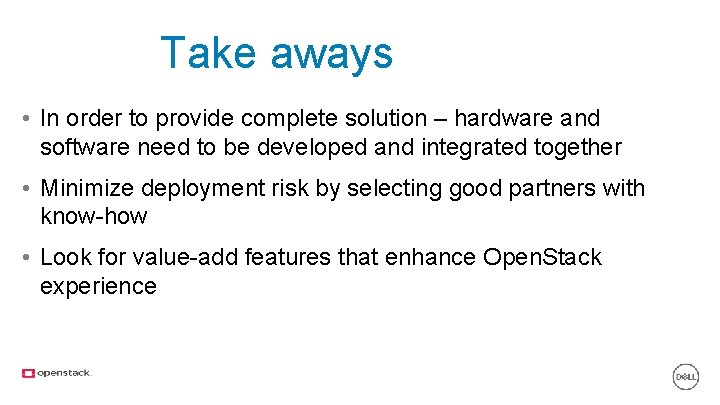
Take aways • In order to provide complete solution – hardware and software need to be developed and integrated together • Minimize deployment risk by selecting good partners with know-how • Look for value-add features that enhance Open. Stack experience