
Ro BERTa A Robustly Optimized BERT Pretraining Approach
Ro. BERTa: A Robustly Optimized BERT Pretraining Approach Yinhan Liu, Myle Ott, Naman Goyal, Jingfei Du, Mandar Joshi, Danqi Chen, Omer Levy, Mike Lewis, Luke Zettlemoyer, Veselin Stoyanov Facebook AI & University of Washington Presented by: Bin Zhan CS 886: Deep Learning for NLP
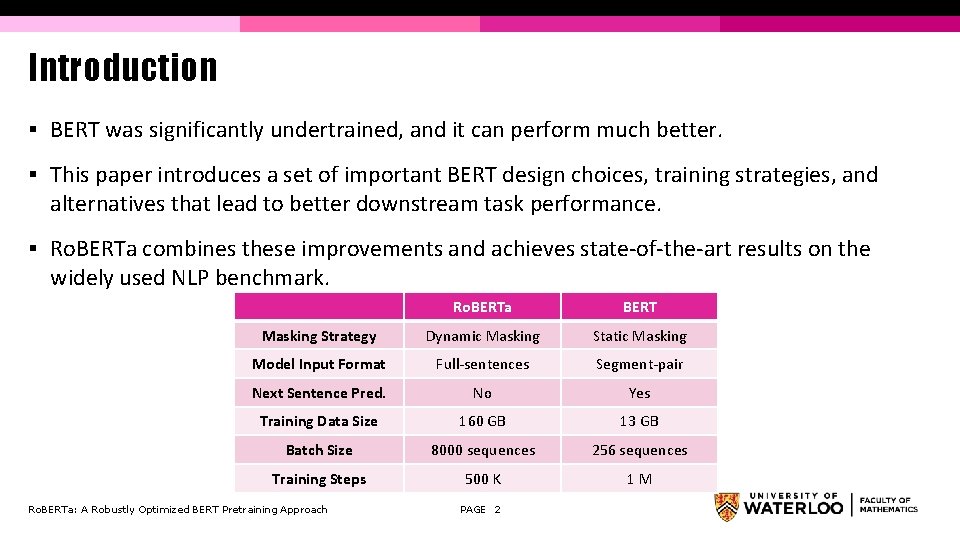
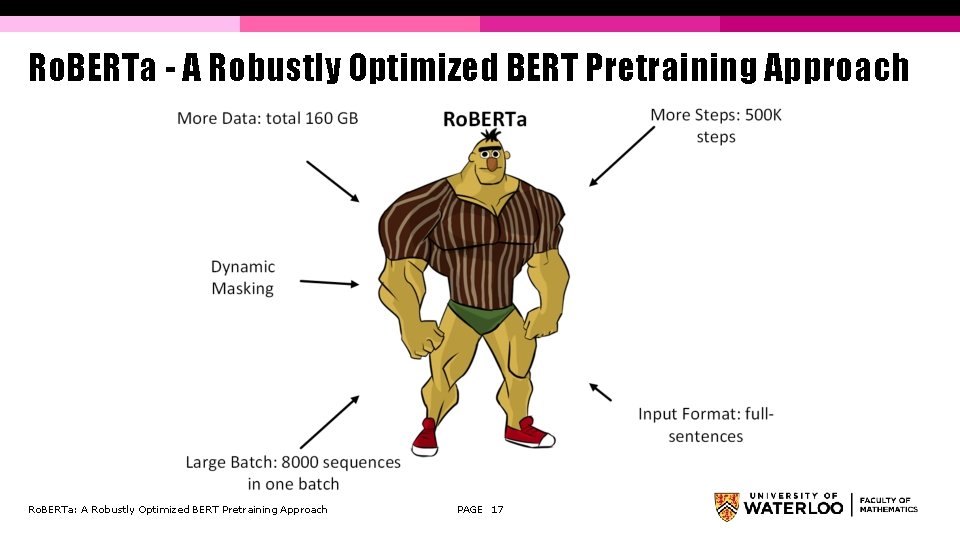
Introduction § BERT was significantly undertrained, and it can perform much better. § This paper introduces a set of important BERT design choices, training strategies, and alternatives that lead to better downstream task performance. § Ro. BERTa combines these improvements and achieves state-of-the-art results on the widely used NLP benchmark. Ro. BERTa BERT Masking Strategy Dynamic Masking Static Masking Model Input Format Full-sentences Segment-pair Next Sentence Pred. No Yes Training Data Size 160 GB 13 GB Batch Size 8000 sequences 256 sequences Training Steps 500 K 1 M Ro. BERTa: A Robustly Optimized BERT Pretraining Approach PAGE 2
Outline § Introduction § Training Procedure Analysis § Dynamic masking § Model input format § Remove next sentence prediction § More Data, Larger Batch Size, and Train Longer § Results § References Ro. BERTa: A Robustly Optimized BERT Pretraining Approach PAGE 3
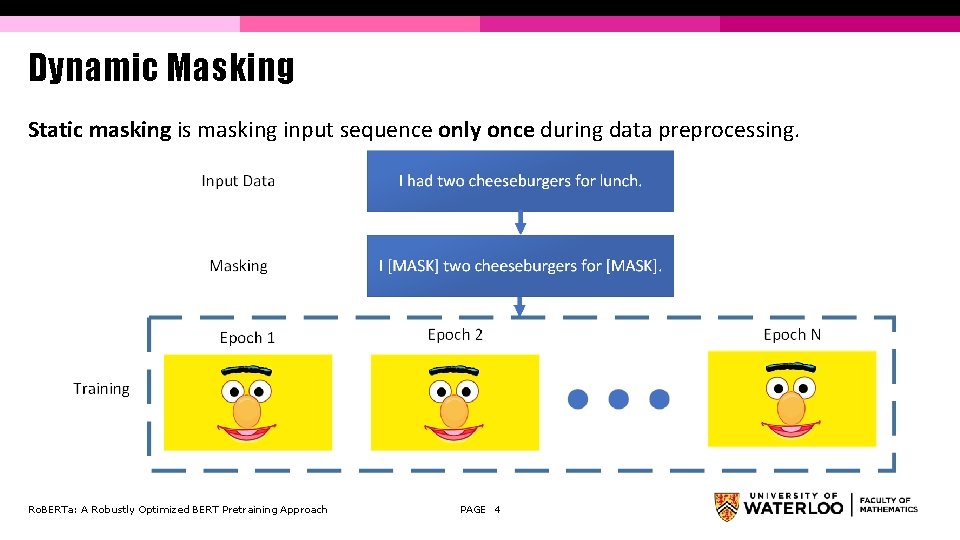
Dynamic Masking Static masking is masking input sequence only once during data preprocessing. Ro. BERTa: A Robustly Optimized BERT Pretraining Approach PAGE 4
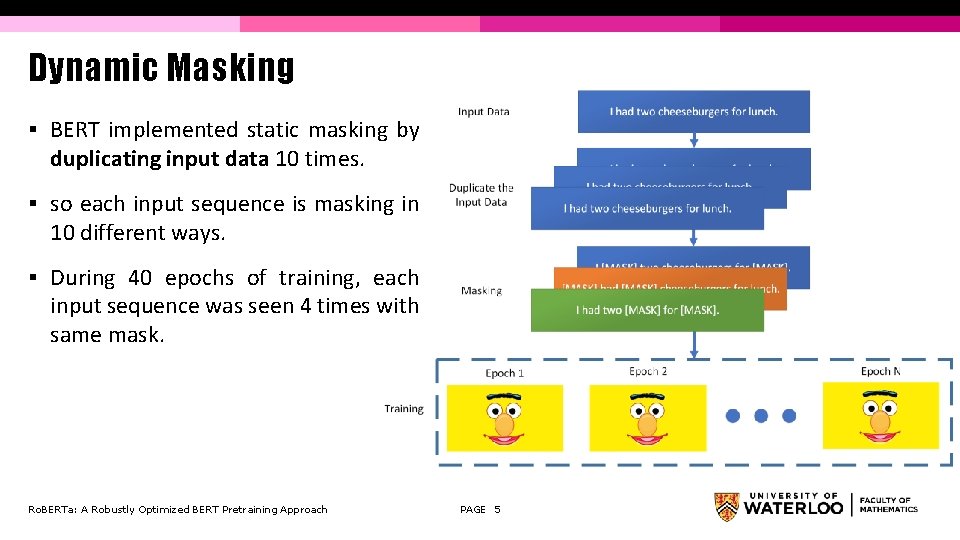
Dynamic Masking § BERT implemented static masking by duplicating input data 10 times. § so each input sequence is masking in 10 different ways. § During 40 epochs of training, each input sequence was seen 4 times with same mask. Ro. BERTa: A Robustly Optimized BERT Pretraining Approach PAGE 5
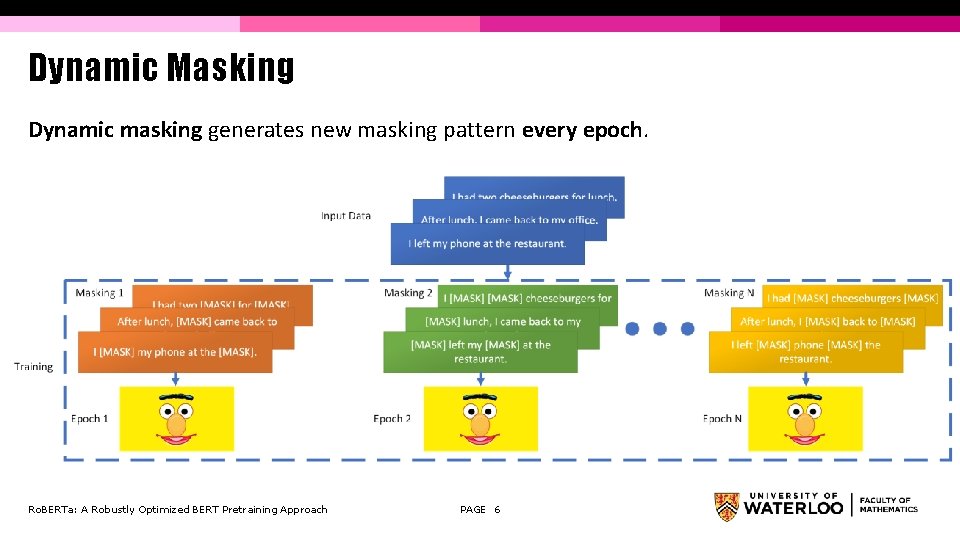
Dynamic Masking Dynamic masking generates new masking pattern every epoch. Ro. BERTa: A Robustly Optimized BERT Pretraining Approach PAGE 6
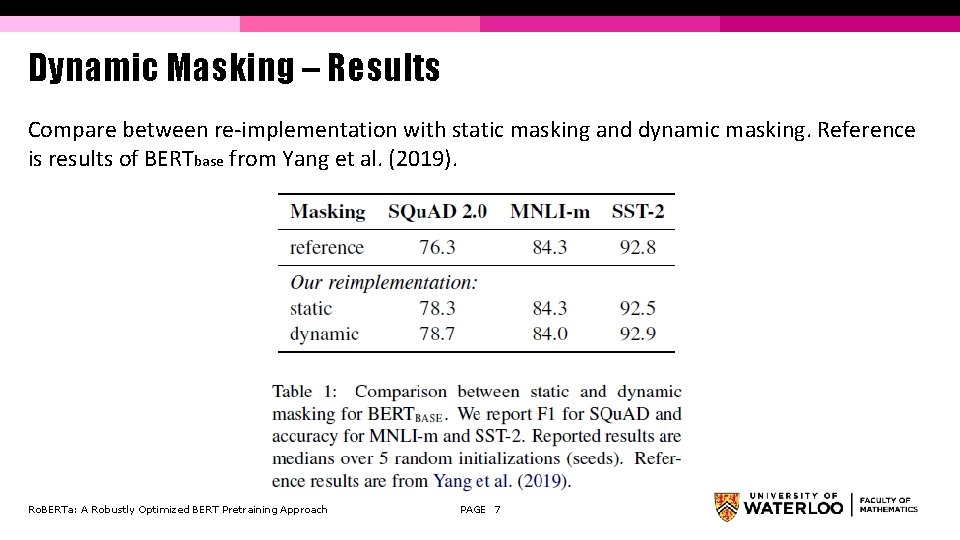
Dynamic Masking – Results Compare between re-implementation with static masking and dynamic masking. Reference is results of BERTbase from Yang et al. (2019). Ro. BERTa: A Robustly Optimized BERT Pretraining Approach PAGE 7
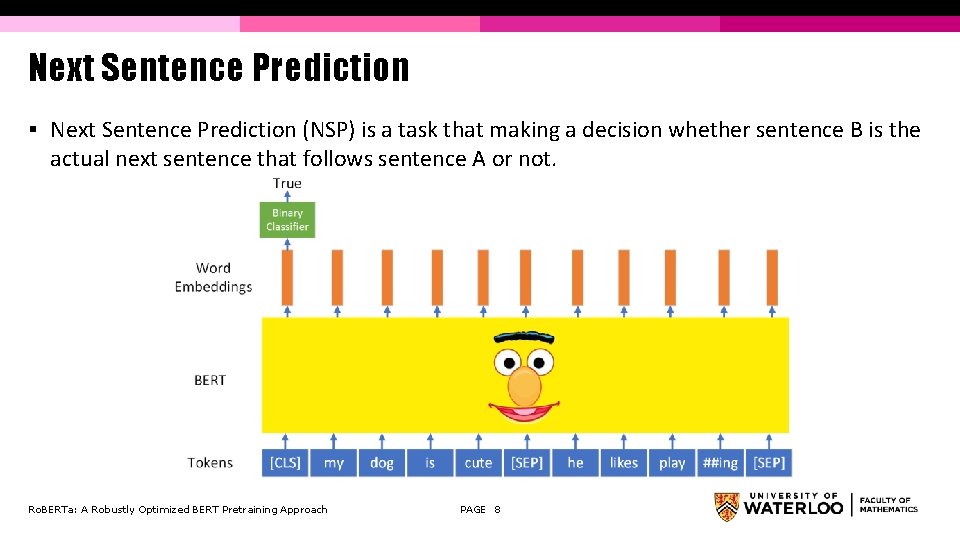
Next Sentence Prediction § Next Sentence Prediction (NSP) is a task that making a decision whether sentence B is the actual next sentence that follows sentence A or not. Ro. BERTa: A Robustly Optimized BERT Pretraining Approach PAGE 8
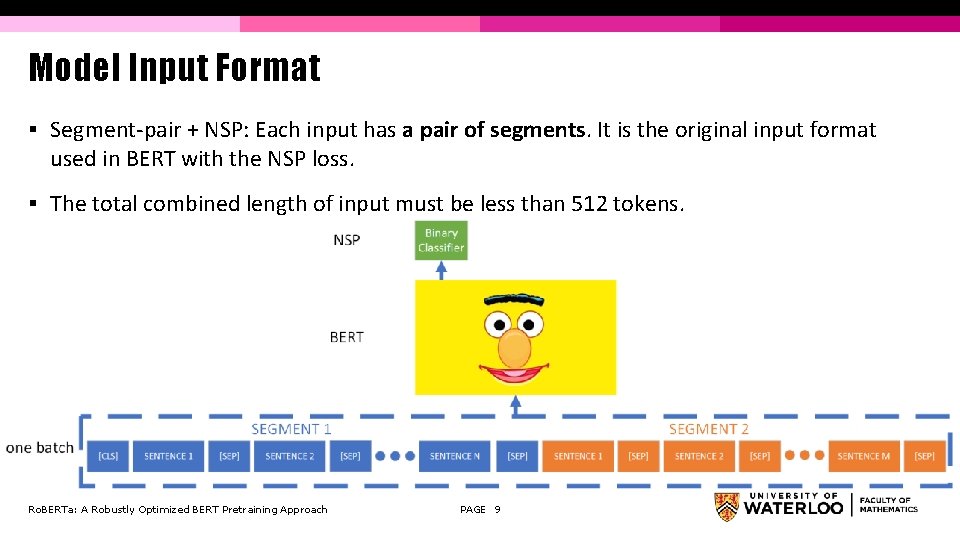
Model Input Format § Segment-pair + NSP: Each input has a pair of segments. It is the original input format used in BERT with the NSP loss. § The total combined length of input must be less than 512 tokens. Ro. BERTa: A Robustly Optimized BERT Pretraining Approach PAGE 9
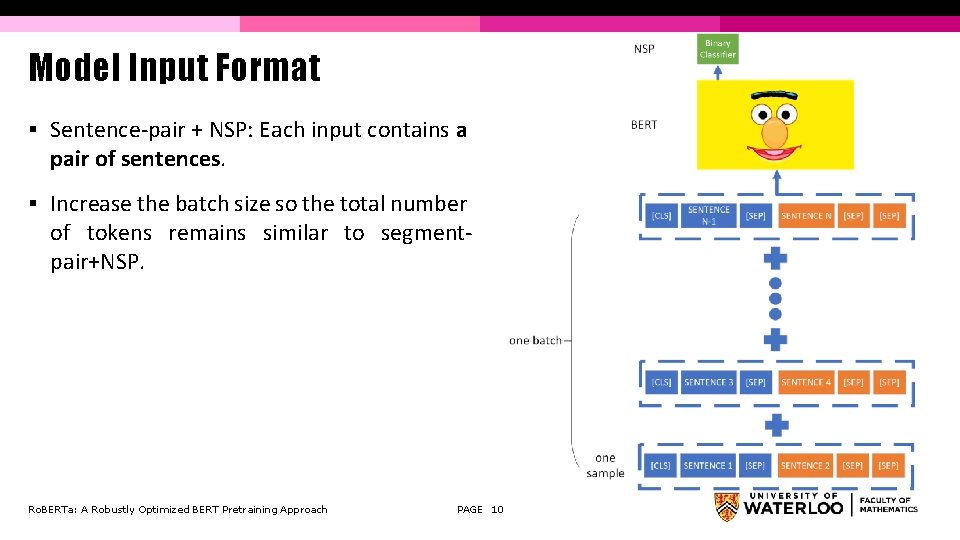
Model Input Format § Sentence-pair + NSP: Each input contains a pair of sentences. § Increase the batch size so the total number of tokens remains similar to segmentpair+NSP. Ro. BERTa: A Robustly Optimized BERT Pretraining Approach PAGE 10
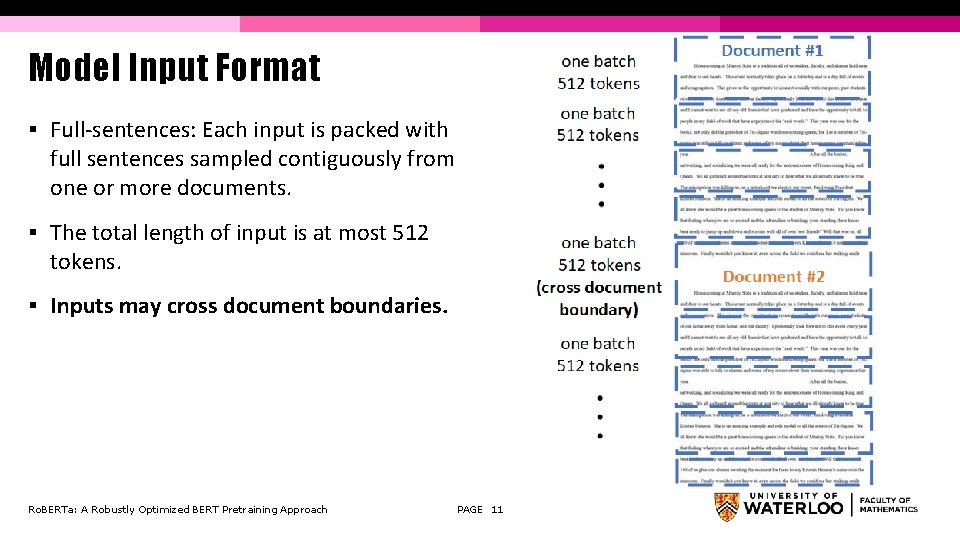
Model Input Format § Full-sentences: Each input is packed with full sentences sampled contiguously from one or more documents. § The total length of input is at most 512 tokens. § Inputs may cross document boundaries. Ro. BERTa: A Robustly Optimized BERT Pretraining Approach PAGE 11
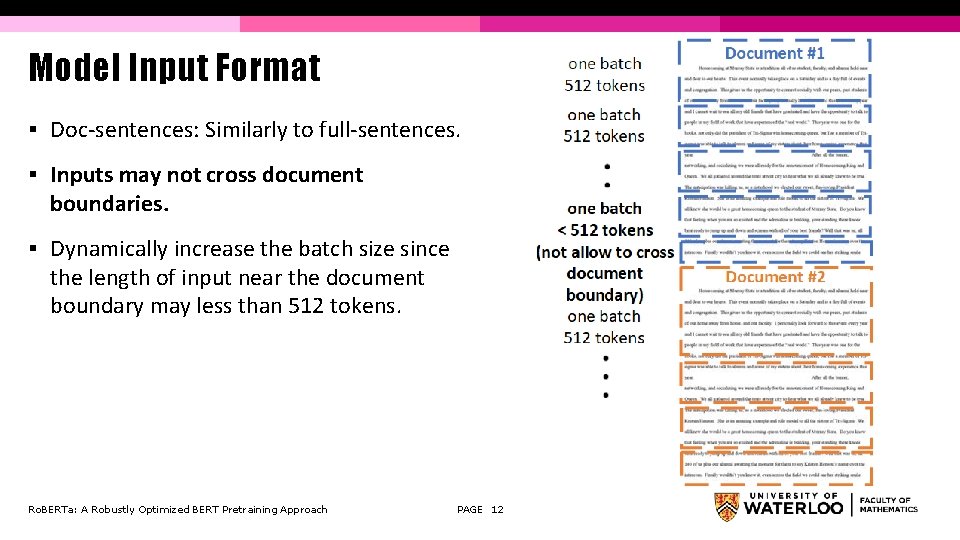
Model Input Format § Doc-sentences: Similarly to full-sentences. § Inputs may not cross document boundaries. § Dynamically increase the batch size since the length of input near the document boundary may less than 512 tokens. Ro. BERTa: A Robustly Optimized BERT Pretraining Approach PAGE 12
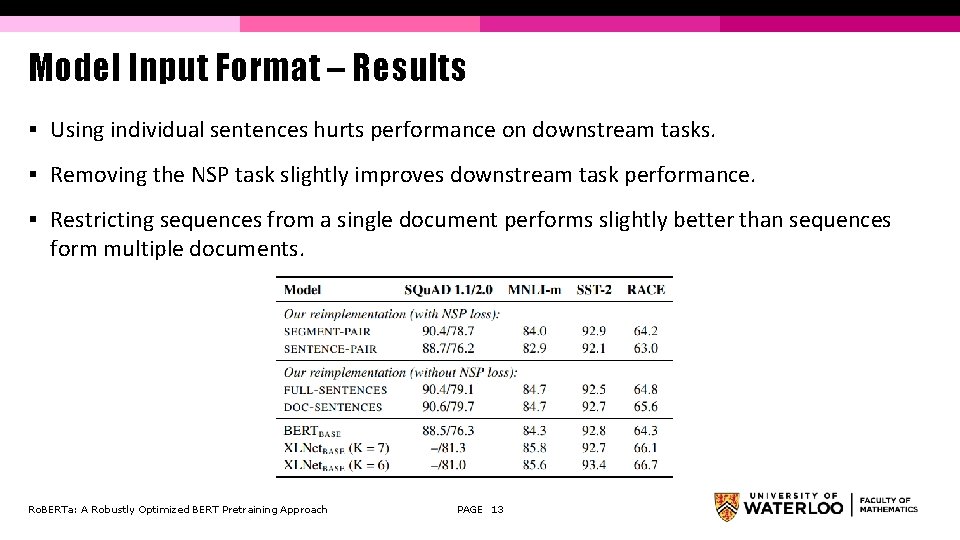
Model Input Format – Results § Using individual sentences hurts performance on downstream tasks. § Removing the NSP task slightly improves downstream task performance. § Restricting sequences from a single document performs slightly better than sequences form multiple documents. Ro. BERTa: A Robustly Optimized BERT Pretraining Approach PAGE 13
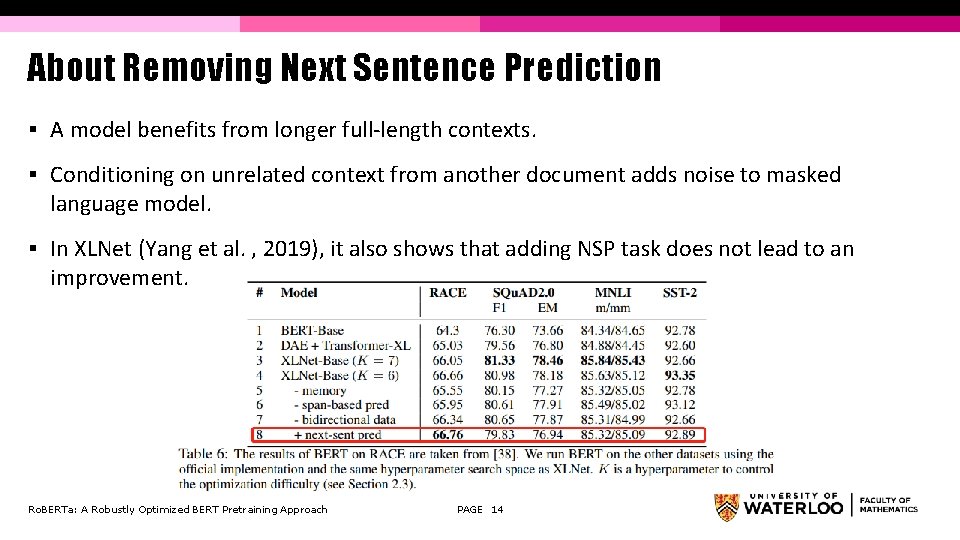
About Removing Next Sentence Prediction § A model benefits from longer full-length contexts. § Conditioning on unrelated context from another document adds noise to masked language model. § In XLNet (Yang et al. , 2019), it also shows that adding NSP task does not lead to an improvement. Ro. BERTa: A Robustly Optimized BERT Pretraining Approach PAGE 14
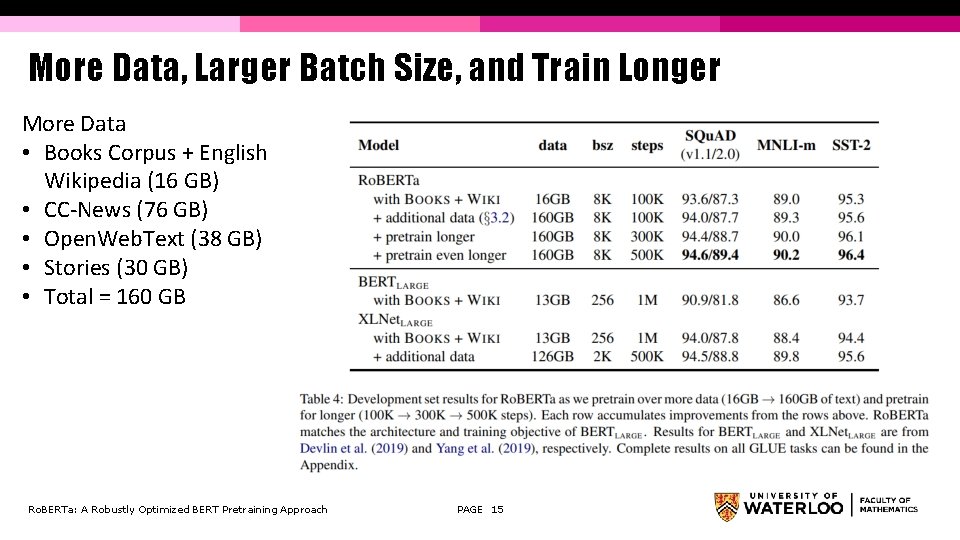
More Data, Larger Batch Size, and Train Longer More Data • Books Corpus + English Wikipedia (16 GB) • CC-News (76 GB) • Open. Web. Text (38 GB) • Stories (30 GB) • Total = 160 GB Ro. BERTa: A Robustly Optimized BERT Pretraining Approach PAGE 15
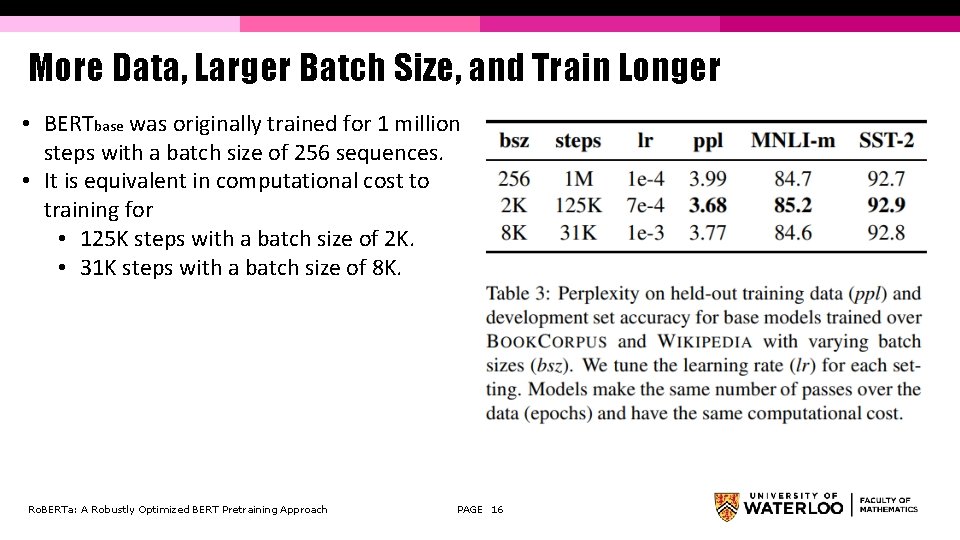
More Data, Larger Batch Size, and Train Longer • BERTbase was originally trained for 1 million steps with a batch size of 256 sequences. • It is equivalent in computational cost to training for • 125 K steps with a batch size of 2 K. • 31 K steps with a batch size of 8 K. Ro. BERTa: A Robustly Optimized BERT Pretraining Approach PAGE 16
Ro. BERTa - A Robustly Optimized BERT Pretraining Approach Ro. BERTa: A Robustly Optimized BERT Pretraining Approach PAGE 17
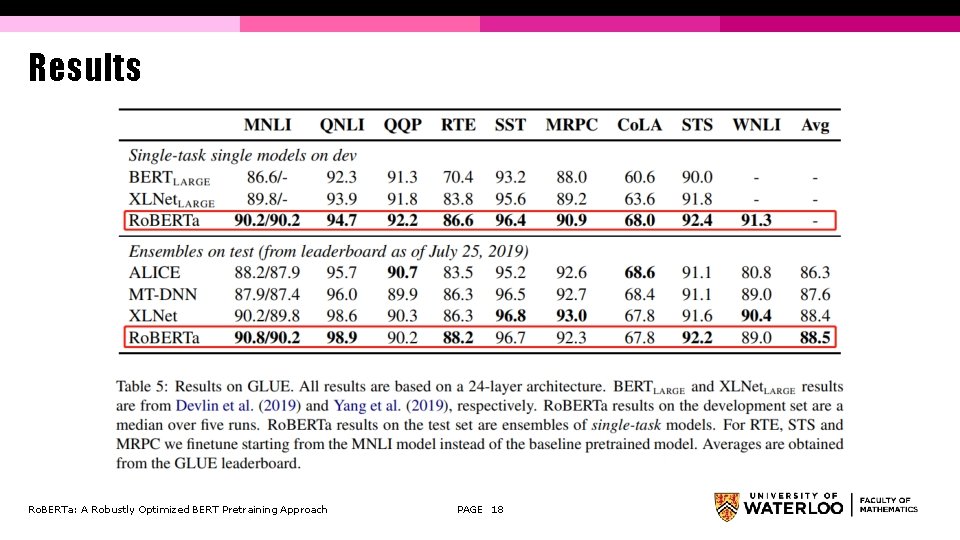
Results Ro. BERTa: A Robustly Optimized BERT Pretraining Approach PAGE 18
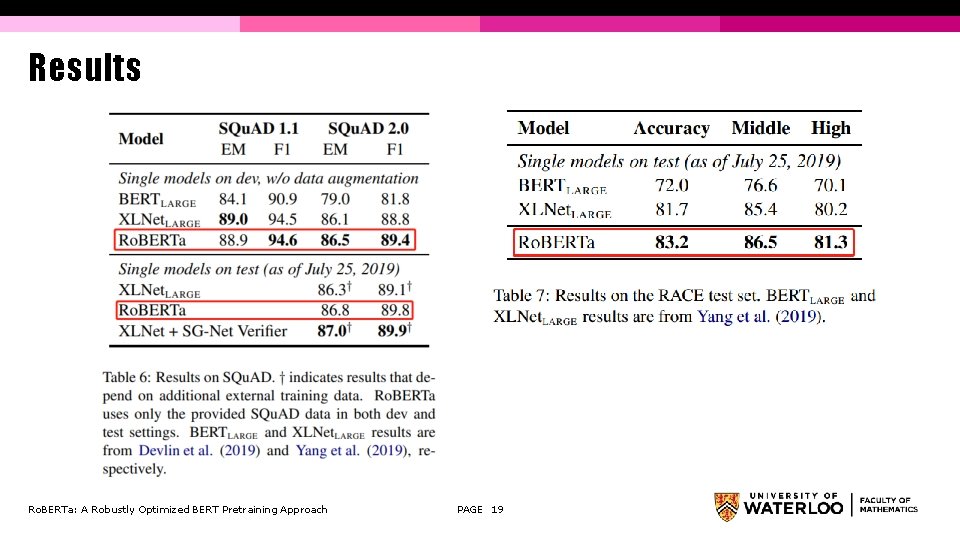
Results Ro. BERTa: A Robustly Optimized BERT Pretraining Approach PAGE 19
References § Liu, Yinhan, et al. "Roberta: A robustly optimized bert pretraining approach. " ar. Xiv preprint ar. Xiv: 1907. 11692 (2019). § Devlin, Jacob, et al. "Bert: Pre-training of deep bidirectional transformers for language understanding. " ar. Xiv preprint ar. Xiv: 1810. 04805 (2018). § Yang, Zhilin, et al. "Xlnet: Generalized autoregressive pretraining for language understanding. " Advances in neural information processing systems. 2019. § Joshi, Mandar, et al. "Spanbert: Improving pre-training by representing and predicting spans. " ar. Xiv preprint ar. Xiv: 1907. 10529 (2019). § Radford, Alec, et al. "Language models are unsupervised multitask learners. " Open. AI Blog 1. 8 (2019): 9. Ro. BERTa: A Robustly Optimized BERT Pretraining Approach PAGE 20
THANKS FOR YOUR ATTENTION Q&A Ro. BERTa: A Robustly Optimized BERT Pretraining Approach PAGE 21
- Slides: 21