WILLEM DE KOONING 5 W 1 H When
- Slides: 21
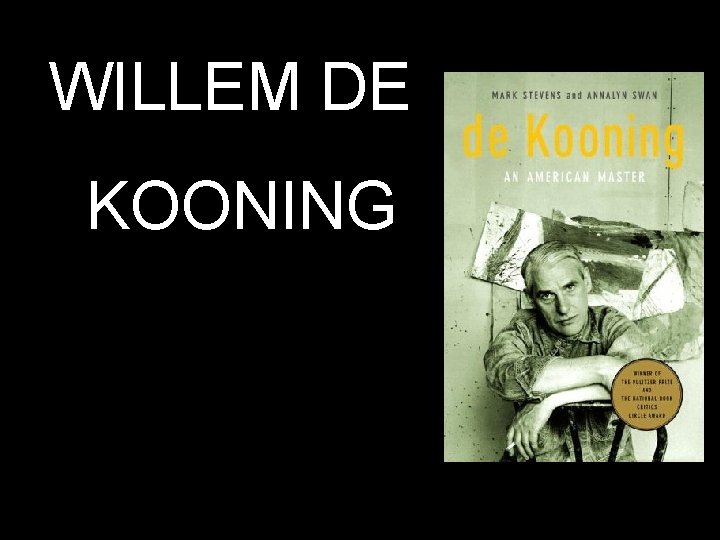
WILLEM DE KOONING
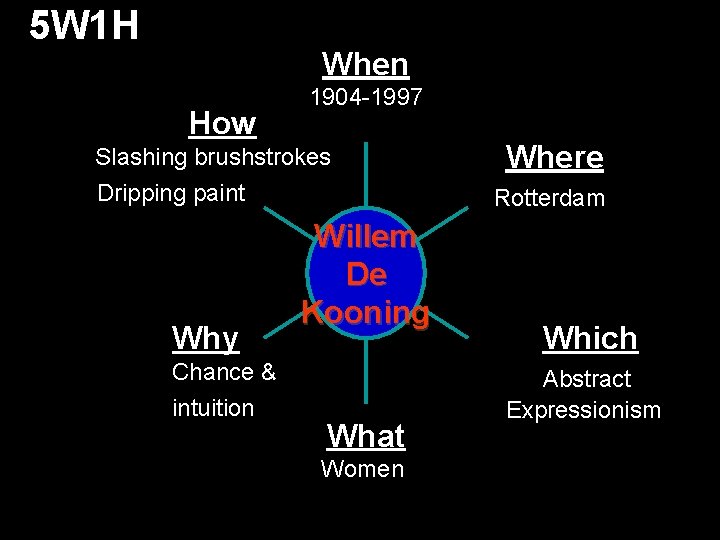
5 W 1 H When How 1904 -1997 Slashing brushstrokes Dripping paint Why Rotterdam Willem De Kooning Chance & intuition Where What Women Which Abstract Expressionism
WILLEM DE KOONING Who/ When/ Where • Willem de Kooning was born April 24, 1904, in Rotterdam. • From 1916 to 1925, he studied at night at the Academie voor Beeldende Kunsten en Technische Wetenschappen, Rotterdam, while apprenticed to a commercial-art and decorating firm and later working for an art director. • In 1924 he visited museums in Belgium and studied further in Brussels and Antwerp. • De Kooning came to the United States in 1926 and settled briefly in Hoboken, New Jersey. He worked as a house painter before moving to New York in 1927, where he met Stuart Davis, Arshile Gorky, and John Graham. • He took various commercial-art and odd jobs until 1935, when he was employed in the mural and easel divisions of the WPA Federal Art Project. Thereafter he painted full-time. • In the late 1930 s his abstract as well as figurative work was primarily influenced by the Cubism and Surrealism of Pablo Picasso and also by Gorky, with whom he shared a studio.
Who/ When/ Where • In 1938 de Kooning started his first series of Women, which would become a major recurrent theme. • During the 1940 s he participated in group shows with other artists who would form the New York School and become known as Abstract Expressionists. • De Kooning’s first solo show, which took place at the Egan Gallery, New York, in 1948, established his reputation as a major artist; it included a number of the allover black-and-white abstractions he had initiated in 1946. • The Women of the early 1950 s were followed by abstract urban landscapes, Parkways, rural landscapes, and, in the 1960 s, a new group of Women.
Who/ When/ Where • In 1968 de Kooning visited the Netherlands for the first time since 1926 for the opening of his retrospective at the Stedelijk Museum, Amsterdam. • In Rome in 1969 he executed his first sculptures—figures modeled in clay and later cast in bronze—and in 1970– 71 he began a series of life-size figures. • In 1974 the Walker Art Center, Minneapolis, organized a show of de Kooning’s drawings and sculpture that traveled throughout the United States, and in 1978 the Solomon R. Guggenheim Museum, New York, mounted an exhibition of his recent work. • In 1979 de Kooning and Eduardo Chillida received the Andrew W. Mellon Prize, which was accompanied by an exhibition at the Museum of Art, Carnegie Institute, Pittsburgh. De Kooning settled in the Springs, East Hampton, Long Island, in 1963. • He was honored with a retrospective at the Museum of Modern Art, New York, in 1997. • The artist died on March 19, 1997, on Long Island.
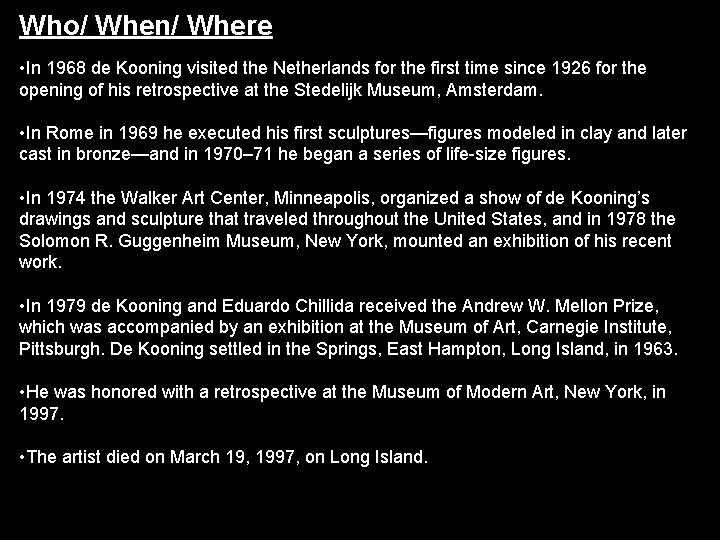
Which - Abstract Expressionism Term applied to a movement in American painting that flourished in the 1940 s and 1950 s, sometimes referred to as the New York School or, very narrowly, as Action Painting, although it was first coined in relation to the work of Vasily Kandinsky in 1929.
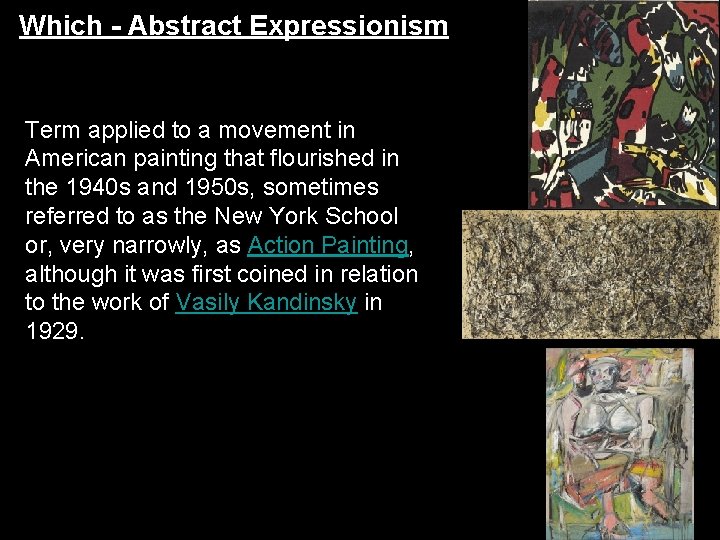
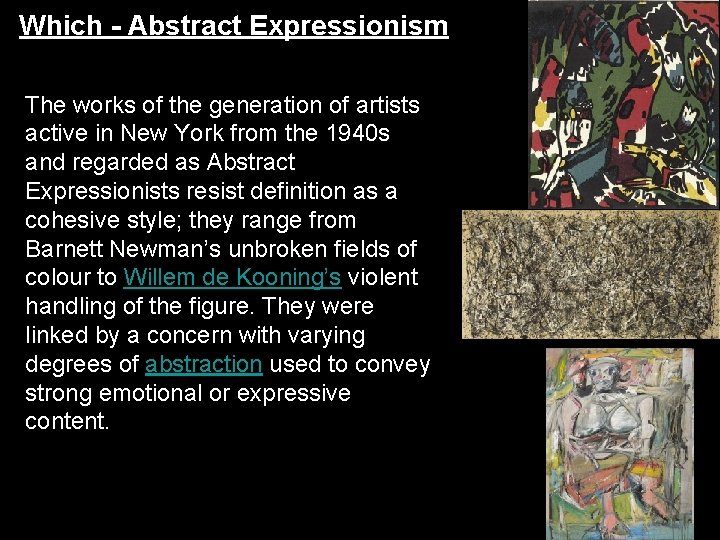
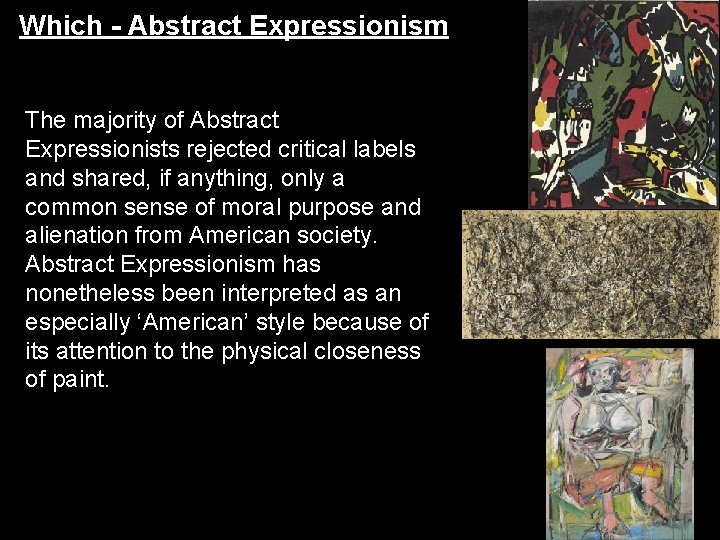
Which - Abstract Expressionism The works of the generation of artists active in New York from the 1940 s and regarded as Abstract Expressionists resist definition as a cohesive style; they range from Barnett Newman’s unbroken fields of colour to Willem de Kooning’s violent handling of the figure. They were linked by a concern with varying degrees of abstraction used to convey strong emotional or expressive content.
Which - Abstract Expressionism The majority of Abstract Expressionists rejected critical labels and shared, if anything, only a common sense of moral purpose and alienation from American society. Abstract Expressionism has nonetheless been interpreted as an especially ‘American’ style because of its attention to the physical closeness of paint.
What – Subject Matters De Kooning had painted women regularly in the early 1940 s and again from 1947 to 1949. The biomorphic shapes of his early abstractions were derived from objects found in the studio. But it was not until 1950 that he began to explore the subject of women exclusively.
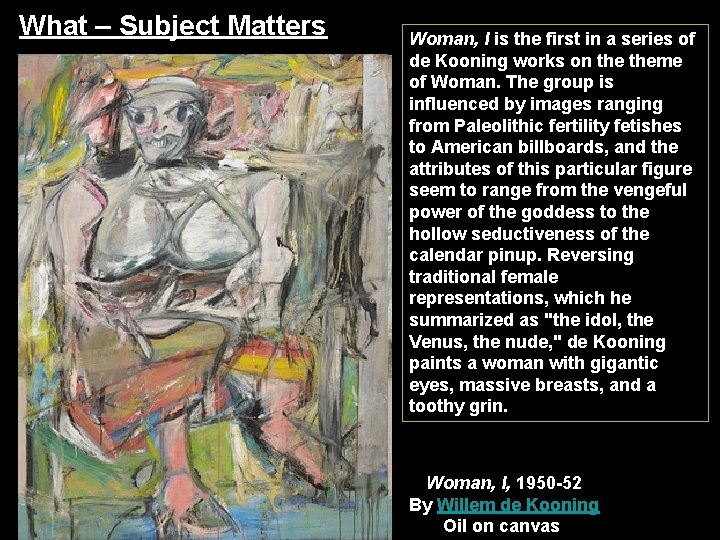
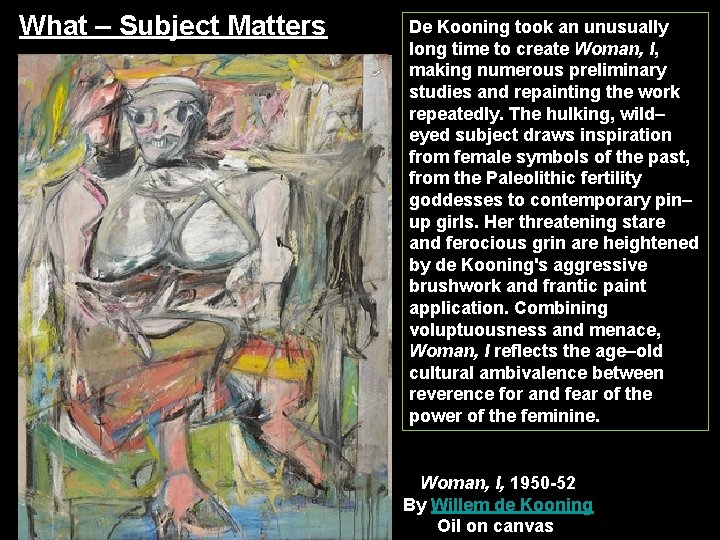
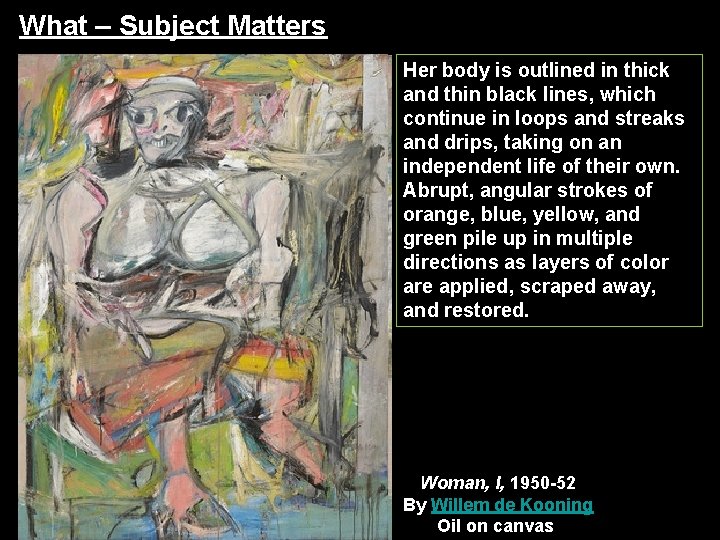
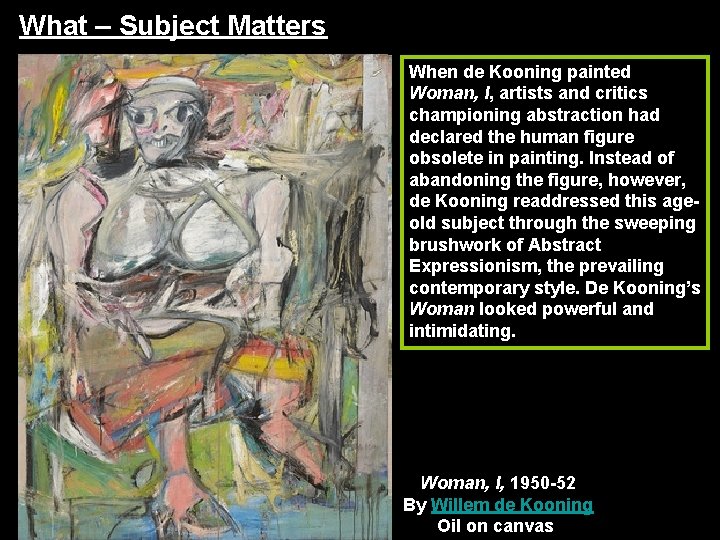
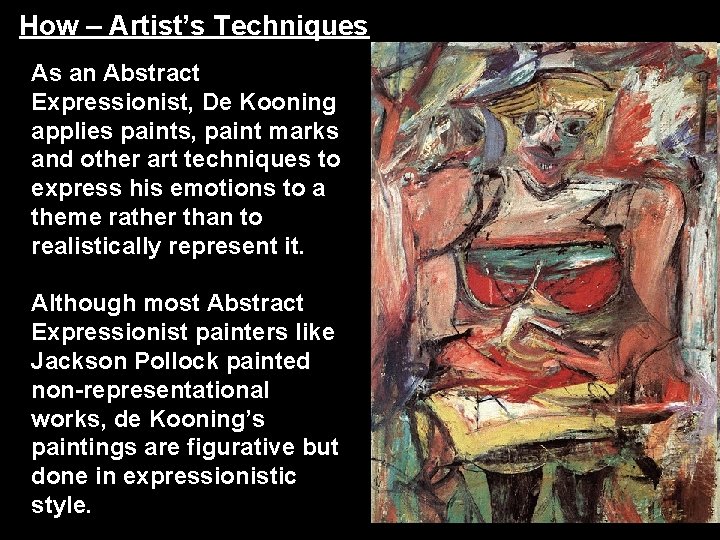
What – Subject Matters Woman, I is the first in a series of de Kooning works on theme of Woman. The group is influenced by images ranging from Paleolithic fertility fetishes to American billboards, and the attributes of this particular figure seem to range from the vengeful power of the goddess to the hollow seductiveness of the calendar pinup. Reversing traditional female representations, which he summarized as "the idol, the Venus, the nude, " de Kooning paints a woman with gigantic eyes, massive breasts, and a toothy grin. Woman, I, 1950 -52 By Willem de Kooning Oil on canvas
What – Subject Matters De Kooning took an unusually long time to create Woman, I, making numerous preliminary studies and repainting the work repeatedly. The hulking, wild– eyed subject draws inspiration from female symbols of the past, from the Paleolithic fertility goddesses to contemporary pin– up girls. Her threatening stare and ferocious grin are heightened by de Kooning's aggressive brushwork and frantic paint application. Combining voluptuousness and menace, Woman, I reflects the age–old cultural ambivalence between reverence for and fear of the power of the feminine. Woman, I, 1950 -52 By Willem de Kooning Oil on canvas
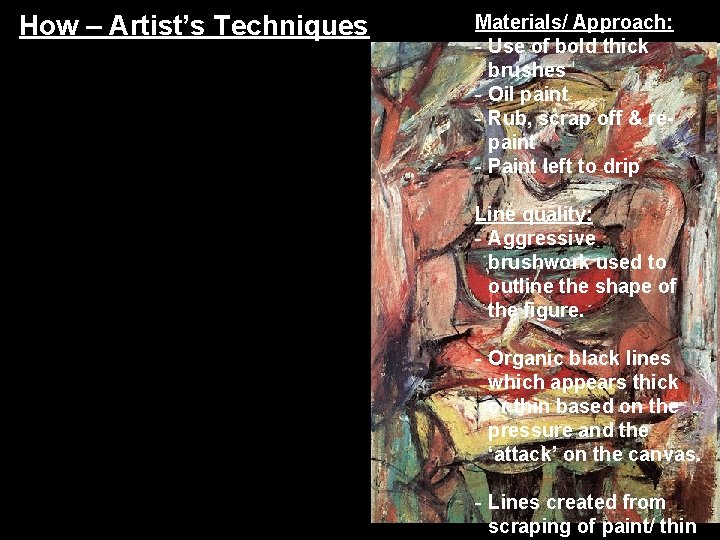
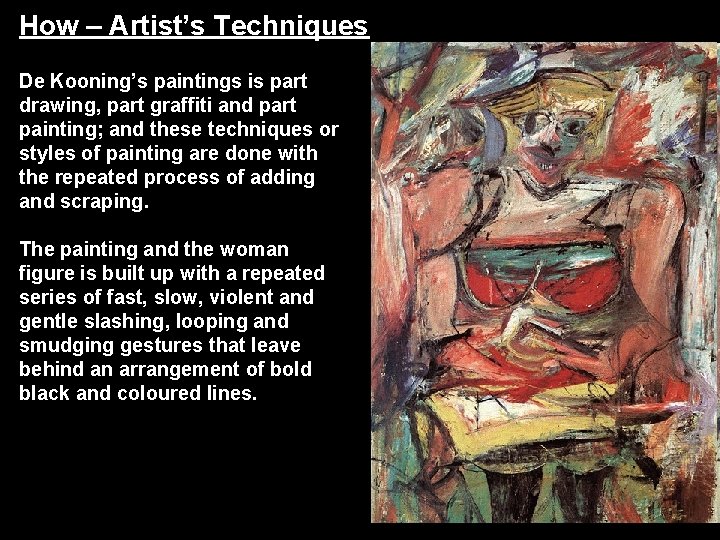
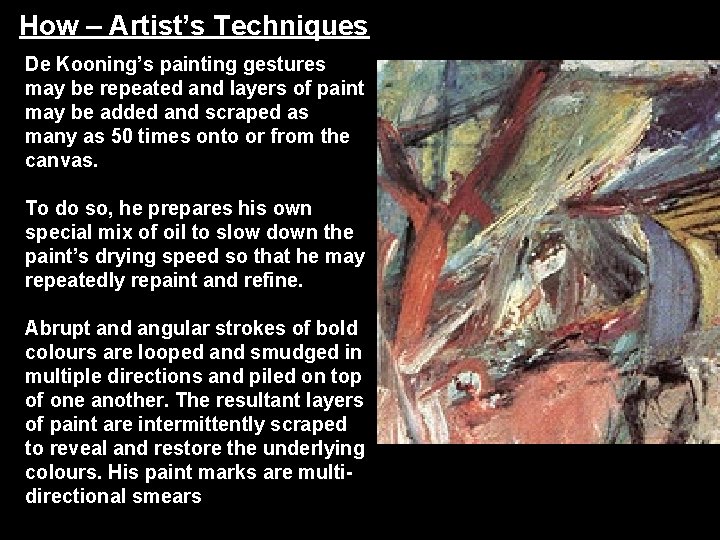
What – Subject Matters Her body is outlined in thick and thin black lines, which continue in loops and streaks and drips, taking on an independent life of their own. Abrupt, angular strokes of orange, blue, yellow, and green pile up in multiple directions as layers of color are applied, scraped away, and restored. Woman, I, 1950 -52 By Willem de Kooning Oil on canvas
What – Subject Matters When de Kooning painted Woman, I, artists and critics championing abstraction had declared the human figure obsolete in painting. Instead of abandoning the figure, however, de Kooning readdressed this ageold subject through the sweeping brushwork of Abstract Expressionism, the prevailing contemporary style. De Kooning’s Woman looked powerful and intimidating. Woman, I, 1950 -52 By Willem de Kooning Oil on canvas
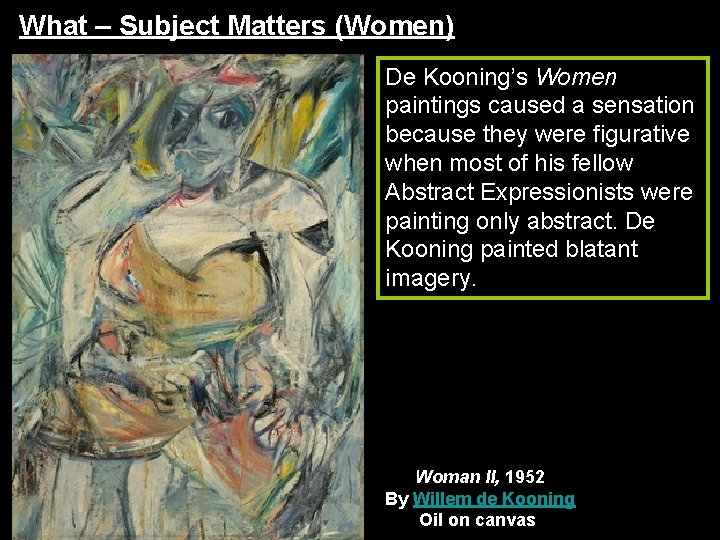
What – Subject Matters (Women) De Kooning’s Women paintings caused a sensation because they were figurative when most of his fellow Abstract Expressionists were painting only abstract. De Kooning painted blatant imagery. Woman II, 1952 By Willem de Kooning Oil on canvas
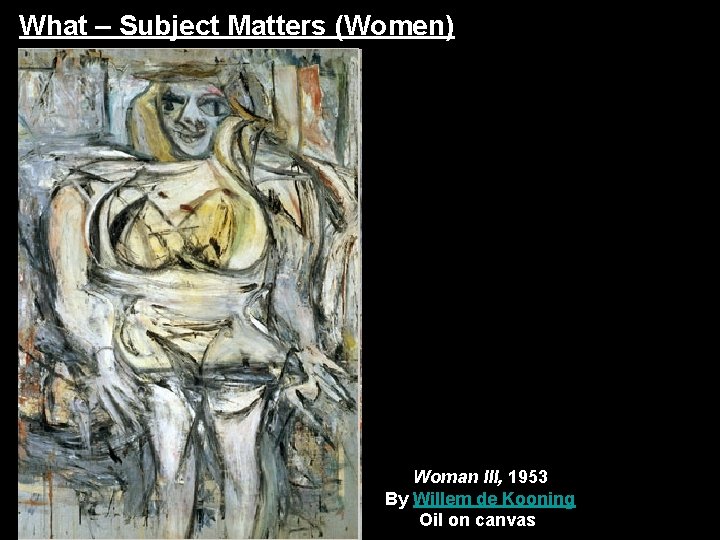
What – Subject Matters (Women) Woman III, 1953 By Willem de Kooning Oil on canvas
Why – Artist’s Intentions • De Kooning paints his conflicting reactions (desire and hatred) towards women and the process he went through to confront them. • His artistic intentions is much related to his technique. These techniques and processes bear his affections and hostility towards the figure; he seemed to be physically and psychologically assaulting the figure. • His technique is important to the process of unleashing the subconscious and emotions, typical to the Abstract Expressionist painters. His Woman paintings is barely recognisable a result of these techniques and processes. • Aggressive brushwork and strategically placed bright colors in these paintings merged with images of toothy snarls, big breasts, enlarged eyes and big hips to reveal a woman seemingly unattractive. • Not unlike an idealised portrait of a woman. Some of these paintings also appeared to reference early Mesopotamian works, with the large eyes and squarely chiseled bodies.
How – Artist’s Techniques As an Abstract Expressionist, De Kooning applies paints, paint marks and other art techniques to express his emotions to a theme rather than to realistically represent it. Although most Abstract Expressionist painters like Jackson Pollock painted non-representational works, de Kooning’s paintings are figurative but done in expressionistic style.
How – Artist’s Techniques Materials/ Approach: - Use of bold thick brushes - Oil paint - Rub, scrap off & repaint - Paint left to drip Line quality: - Aggressive brushwork used to outline the shape of the figure. - Organic black lines which appears thick or thin based on the pressure and the ‘attack’ on the canvas. - Lines created from scraping of paint/ thin
How – Artist’s Techniques De Kooning’s paintings is part drawing, part graffiti and part painting; and these techniques or styles of painting are done with the repeated process of adding and scraping. The painting and the woman figure is built up with a repeated series of fast, slow, violent and gentle slashing, looping and smudging gestures that leave behind an arrangement of bold black and coloured lines.
How – Artist’s Techniques De Kooning’s painting gestures may be repeated and layers of paint may be added and scraped as many as 50 times onto or from the canvas. To do so, he prepares his own special mix of oil to slow down the paint’s drying speed so that he may repeatedly repaint and refine. Abrupt and angular strokes of bold colours are looped and smudged in multiple directions and piled on top of one another. The resultant layers of paint are intermittently scraped to reveal and restore the underlying colours. His paint marks are multidirectional smears
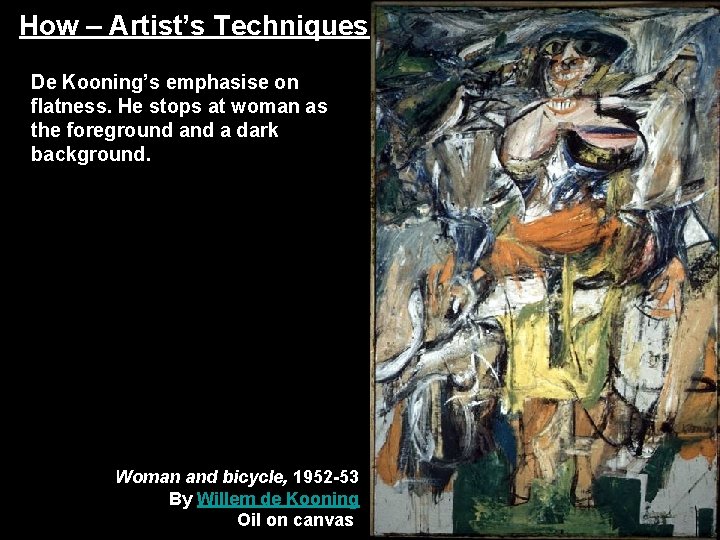
How – Artist’s Techniques De Kooning’s emphasise on flatness. He stops at woman as the foreground a dark background. Woman and bicycle, 1952 -53 By Willem de Kooning Oil on canvas