When RINA Meets NFV Diego R Lpez Telefnica




- Slides: 11
When RINA Meets NFV Diego R. López Telefónica I+D @ictpristine
The NFV Concept Network functions are fully defined by SW, minimising dependence on HW constraints DPI BRAS CG-NAT Firewall @ictpristine PE Router GGSN/ SGSN VIRTUAL NETWORK FUNCTIONS FUNCTION COMMON HW (Servers & Switches) CAPACITY 2
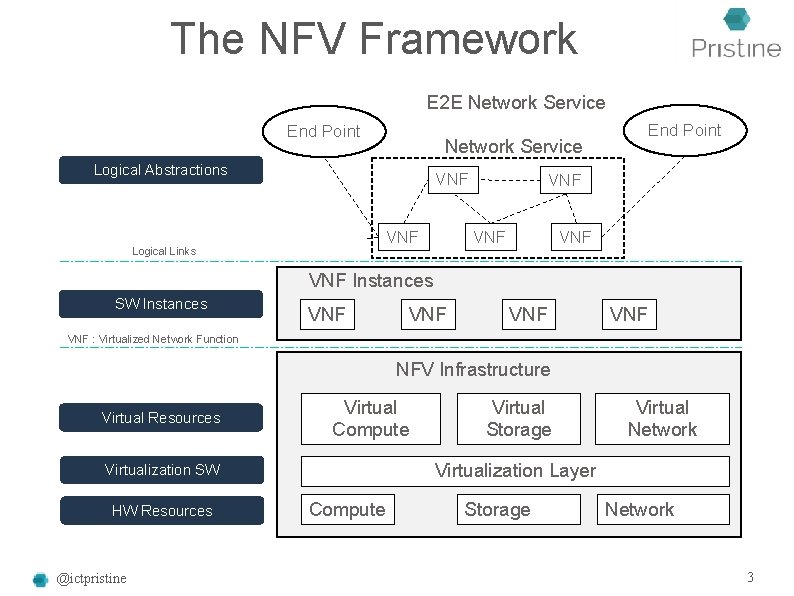
The NFV Framework E 2 E Network Service End Point Network Service Logical Abstractions VNF Logical Links End Point VNF VNF Instances SW Instances VNF VNF VNF : Virtualized Network Function NFV Infrastructure Virtual Resources Virtual Compute @ictpristine Virtual Network Virtualization Layer Virtualization SW HW Resources Virtual Storage Compute Storage Network 3
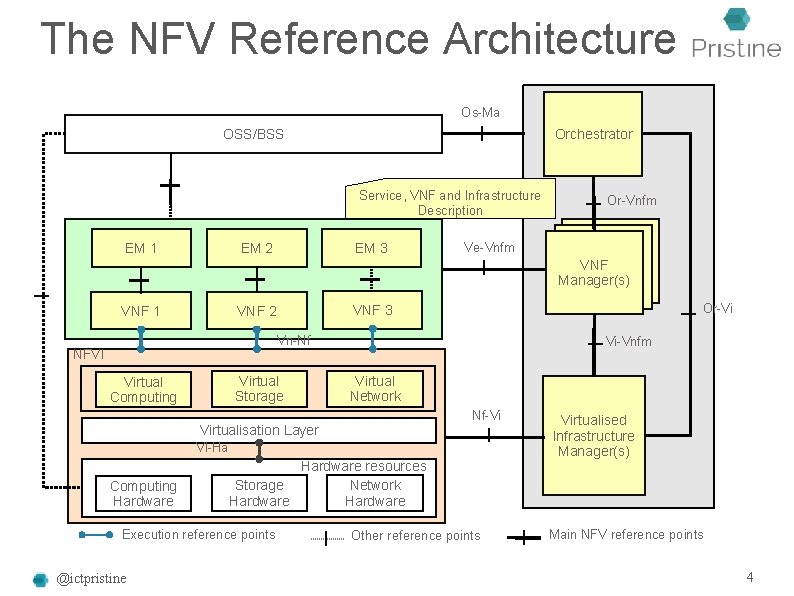
The NFV Reference Architecture Os-Ma OSS/BSS Orchestrator Service, VNF and Infrastructure Description EM 1 EM 2 EM 3 Or-Vnfm Ve-Vnfm VNF Manager(s) VNF 1 Or-Vi VNF 3 VNF 2 Vn-Nf NFVI Virtual Storage Virtual Computing Vi-Vnfm Virtual Network Nf-Vi Virtualisation Layer Vl-Ha Computing Hardware resources Storage Network Hardware Execution reference points @ictpristine Other reference points Virtualised Infrastructure Manager(s) Main NFV reference points 4
A Few NFV Challenges • Support the performance requirements of dataplane workloads • Optimization beyond current cloud practices • Adaptive security policy verification • Security beyond physical access and links • Enhanced resiliency by elasticity • Availability beyond overprovisioned failover • Network functions become applications and services at the same time • Support for recursive service and components beyond current overlay techniques @ictpristine 5
And Here Comes RINA • Apply RINA to provide the infrastructural network support for NFV • NFV Forwarding Graphs • VNF internal connections • VNF resiliency mechanisms • Circumscribed to NFV Po. Ps and the provision of IP-based services • Facilitate service provisioning and stability • Showcase the advantages of RINA • In a compatible way with current network deployments @ictpristine 6
RINA on the NFV Framework E 2 E Network Service End Point Network Service VNF Logical Abstractions VNF Logical Links End Point VNF RINA support for NFV Forwarding Graphs via SFC VNF Instances SW Instances VNF VNF RINA support for SFC and pooling VNF : Virtualized Network Function Single Po. P NFV Infrastructure Virtual Resources Virtual Compute Virtual Network Virtualization Layer Virtualization SW HW Resources Virtual Storage Compute Storage Network Multiple tenants Po. P fabric network untouched Optimized fabric usage @ictpristine 7
The SFC and Pooling Schema DC Boundary SFC Node (VNF) SFC Ingress Node (VNF/PNF) SFC Node (VNF) SFC Egress Node (VNF/PNF) VNF-C Instance SF Forwarder (VNF-C) VNF-C Instance Pool Manager Service Function (VNF-C) VNF-C Instance VNF Boundary @ictpristine VNF-C Boundary 8
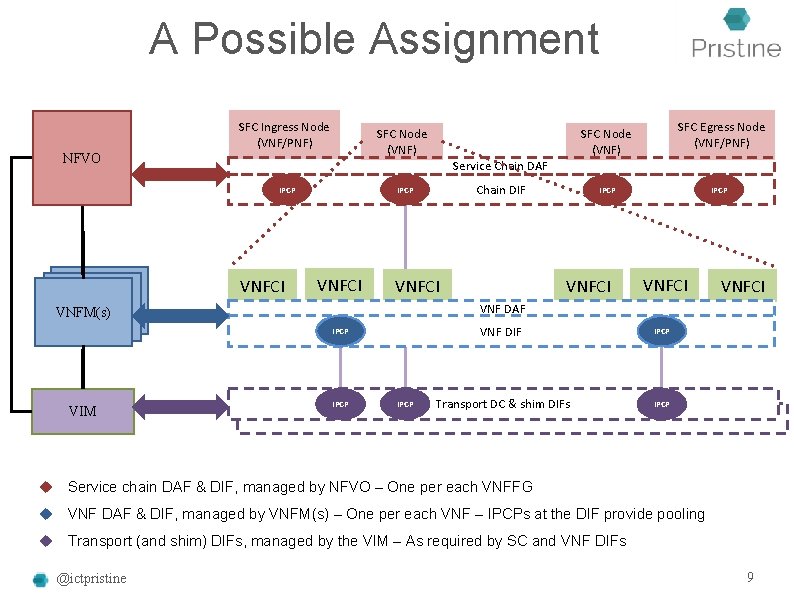
A Possible Assignment SFC Ingress Node (VNF/PNF) SFC Node (VNF) NFVO Service Chain DAF IPCP VNFCI Chain DIF IPCP VNFCI VNFCI VNF DAF VNFM(s) IPCP VIM SFC Egress Node (VNF/PNF) SFC Node (VNF) IPCP VNF DIF IPCP Transport DC & shim DIFs IPCP u Service chain DAF & DIF, managed by NFVO – One per each VNFFG u VNF DAF & DIF, managed by VNFM(s) – One per each VNF – IPCPs at the DIF provide pooling u Transport (and shim) DIFs, managed by the VIM – As required by SC and VNF DIFs @ictpristine 9
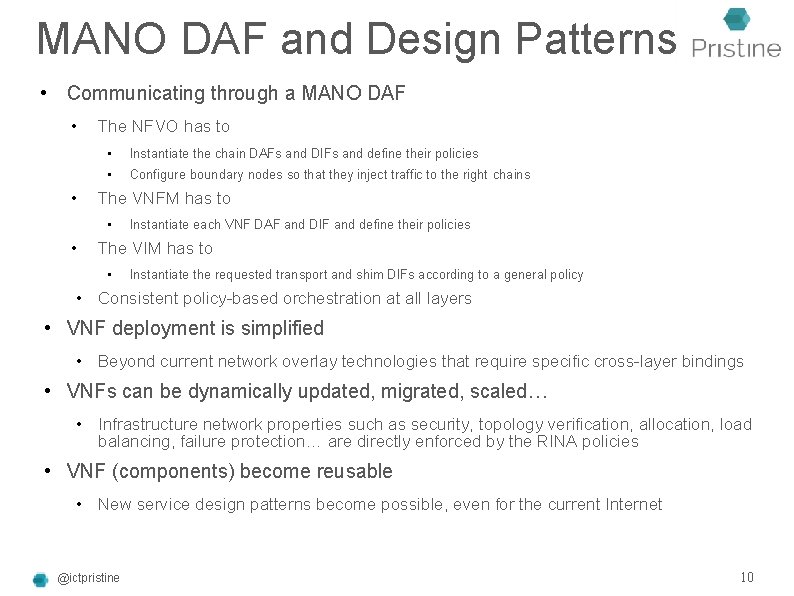
MANO DAF and Design Patterns • Communicating through a MANO DAF • • The NFVO has to • Instantiate the chain DAFs and DIFs and define their policies • Configure boundary nodes so that they inject traffic to the right chains The VNFM has to • • Instantiate each VNF DAF and DIF and define their policies The VIM has to • Instantiate the requested transport and shim DIFs according to a general policy • Consistent policy-based orchestration at all layers • VNF deployment is simplified • Beyond current network overlay technologies that require specific cross-layer bindings • VNFs can be dynamically updated, migrated, scaled… • Infrastructure network properties such as security, topology verification, allocation, load balancing, failure protection… are directly enforced by the RINA policies • VNF (components) become reusable • New service design patterns become possible, even for the current Internet @ictpristine 10
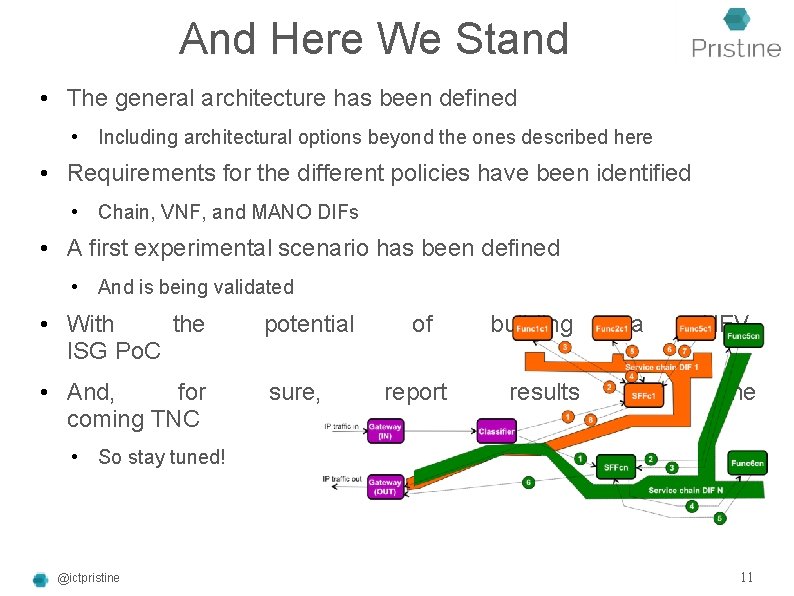
And Here We Stand • The general architecture has been defined • Including architectural options beyond the ones described here • Requirements for the different policies have been identified • Chain, VNF, and MANO DIFs • A first experimental scenario has been defined • And is being validated • With the ISG Po. C potential • And, for coming TNC sure, of report building results a in NFV the • So stay tuned! @ictpristine 11