What is ENP What was done Where are
- Slides: 13
What is ENP ? What was done ? Where are we going ? www. paris-neuroscience. fr Mai 2016 1
What is ENP ? The ENP is a non-profit private foundation created in 2007 by the Ministry of Research and Higher Education. • The institution is devoted to the development, promotion and outreach of neuroscience research through dedicated programs –Scientific events, Invited scientists, Starting grant, International internship and Graduate program. Founders, besides of the Ministry of Research and Higher Education, are INSERM, CNRS, CEA, Paris Sud University and the Pierre and Marie Curie University Partners since 2008: Paris Descartes university, the Brain and Spin Institute (ICM), Institut de la Vision, Labex Bio. Psy and Memo. Life, Region Ile de France, Fondation EDF, Fondation Schneider Electric, At the end of 2015, the ENP has a budget of € 5 million to continue its commitments.
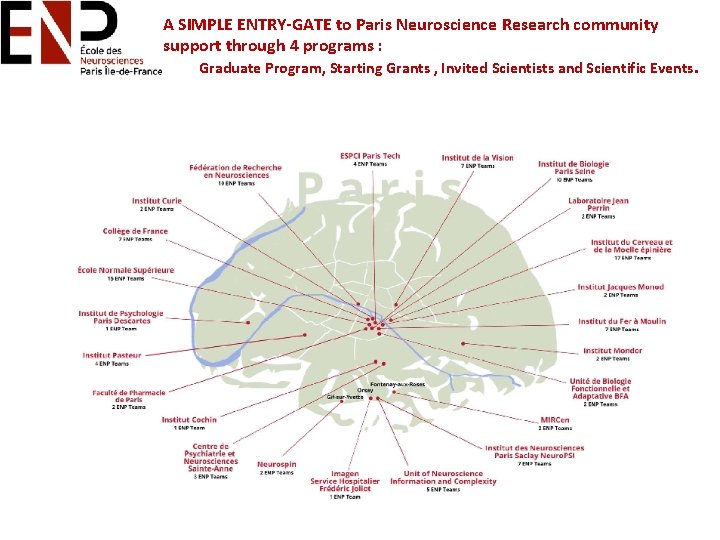
GOALS • Enhance international visibility of Paris region in Neuroscience research • Promote synergy between research groups, universities and institutes in the Paris area. • Support frontier research and multidisciplinary approaches. • Foster international exchange of knowledge. The ENP brings together : 114 teams located in 23 research centers in the Paris region Research areas : • Neurogenetics/neurodevelopment • Neuropharmacology/cell signaling • Neurophysiology/ systems neuroscience • Neurological and psychiatric diseases • Cognitive. Neurosciences/neuropsychology • Computational Neurosciences/ neural theory • Interface Physics /technology/Robotics 2016
ORGANIZATION www. paris-neuroscience. fr Board of Trustees Chair: F. Ailleret & 19 members The Board of Trustees take legal decisions and manage finances. Scientific Advisory Board 9 Foreign members from U. K. , USA, Germany, Switzerland Italy. The SAB provide evaluation of new teams and applications, and advice on scientific approaches. ENP Staff: General Secretary & three staff members who implement actions. Steering Committee: Director: S. Charpak & 11 ENP team leaders of complementary expertise. The Steering Committee evaluate and give directions on programs’ scientific contents Graduate Program Directors: L. Bally - Cuif and L. Venance They manage auditions, board of experts and recruitment processes for the Graduate Program. 2016 4
A SIMPLE ENTRY-GATE to Paris Neuroscience Research community support through 4 programs : Graduate Program, Starting Grants , Invited Scientists and Scientific Events.
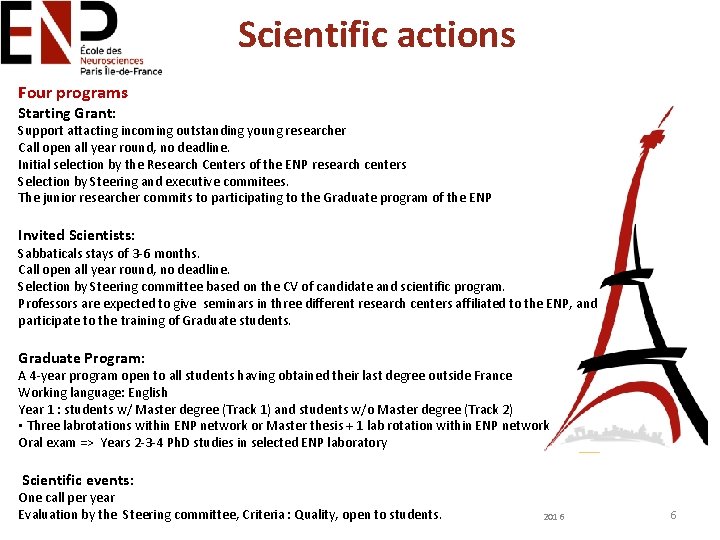
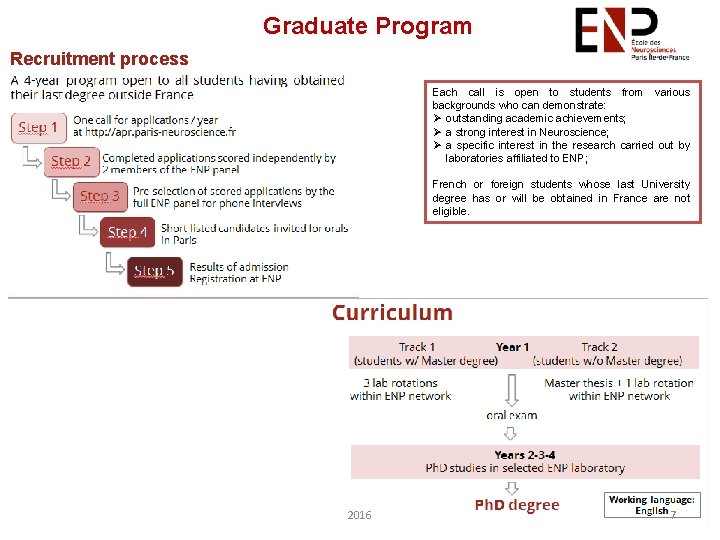
Scientific actions Four programs Starting Grant: Support attacting incoming outstanding young researcher Call open all year round, no deadline. Initial selection by the Research Centers of the ENP research centers Selection by Steering and executive commitees. The junior researcher commits to participating to the Graduate program of the ENP Invited Scientists: Sabbaticals stays of 3 -6 months. Call open all year round, no deadline. Selection by Steering committee based on the CV of candidate and scientific program. Professors are expected to give seminars in three different research centers affiliated to the ENP, and participate to the training of Graduate students. Graduate Program: A 4 -year program open to all students having obtained their last degree outside France Working language: English Year 1 : students w/ Master degree (Track 1) and students w/o Master degree (Track 2) • Three labrotations within ENP network or Master thesis + 1 lab rotation within ENP network Oral exam => Years 2 -3 -4 Ph. D studies in selected ENP laboratory Scientific events: One call per year Evaluation by the Steering committee, Criteria : Quality, open to students. 2016 6
Graduate Program Recruitment process Each call is open to students from various backgrounds who can demonstrate: Ø outstanding academic achievements; Ø a strong interest in Neuroscience; Ø a specific interest in the research carried out by laboratories affiliated to ENP; French or foreign students whose last University degree has or will be obtained in France are not eligible. 2016 7
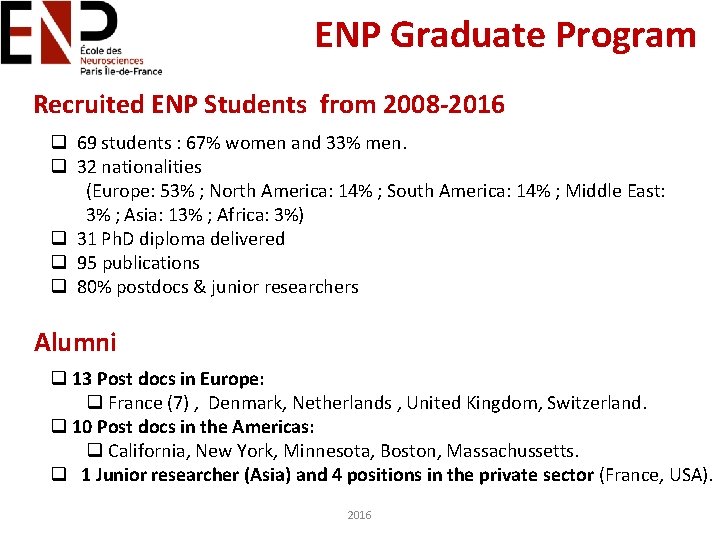
ENP Graduate Program Recruited ENP Students from 2008 -2016 q 69 students : 67% women and 33% men. q 32 nationalities (Europe: 53% ; North America: 14% ; South America: 14% ; Middle East: 3% ; Asia: 13% ; Africa: 3%) q 31 Ph. D diploma delivered q 95 publications q 80% postdocs & junior researchers Alumni q 13 Post docs in Europe: q France (7) , Denmark, Netherlands , United Kingdom, Switzerland. q 10 Post docs in the Americas: q California, New York, Minnesota, Boston, Massachussetts. q 1 Junior researcher (Asia) and 4 positions in the private sector (France, USA). 2016
What was done? Since 2007, ENP has launched several programs, recruited and / or supported : q 69 ENP Graduate students, 31 Alumni. q 5 Starting Grant: start-up support for young group leaders. q 18 Invited international scientists hosted by ENP teams. q 32 Post–Docs received short-term support. q more than 60 Scientific events supported and/or organized by ENP. q more than 4 000 ENP teams' papers in international peer-reviewed journals. q 19 interns within International collaborations and actions: • Hosting in Paris students who received IBRO Visiting Fellowships, • students from the Medical University of Okayama , • students from Chilean institutes , • exchange with Graduate Program in Munich. These programs aim to promote Neuroscience research at its highest level by fostering international exchange and multidisciplinary research. 2016
Collaboration with Chile since 2014 Objective of the agreement: q Cooperation between the two institutions in order to contribute to the cultural and scientific progress and to the consolidation of friendship between the two countries. Agreement signed in September 2014 Eligible trainees are undergraduates who have not started any doctoral program yet Ø Candidates are selected by a committee of experts (neuroscientists from several Chilean institutions dedicated to training students in the fields of cell biology / neuroscience) headed by Dr. Felipe Barros from the Centro de Estudios Científicos on the basis of their academic excellence January 2015 and January 2016: • 5 selected students start their six-month internships. -> Chilean students choose their research internships among those offered by ENP teams (as described on http: //www. paris-neuroscience. fr/en/chilean-interns) 2016
International Collaborations Since 2013 with Germany A collaboration established with the Graduate School of Systemic Neurosciences (GSN) of the Brain and Mind « Excellence Cluster » based in Munich, Germany. Objectives of the collaboration: • To promote exchanges with international researchers and broaden the opportunities for postdoctoral positions • To enable mutual invitations of researchers and students to symposia Eight ENP students have had the opportunity to participate to a mini Symposium of GSN’s annual meeting where they gave a scientific talk on their Ph. D work and to present the ENP Graduate program. The Director of the GSN program with GSN students have participated at the ENPDAYS 2015 and 2016. In 2014, Collaboration with the Edmond and Lily Safra Center for Brain sciences • ENP team leader and ENP students have had the opportunity to assist to the ELSC retreat in Ein Gedi near Jerusalem on January 26 th to 28 th 2014. This three-day retreat gathering more than one hundred scientists and students from international backgrounds (program) 2016
Where are we going? When it was created in 2007, the ENP received an endowment from its public founders. • Today, in order to pursue its scientific mission, the ENP is actively looking for financial partners either institutional or private partners. During the coming four years, the ENP wishes to pursue the following objectives • Developing ENP international training and invited professors programs, • Supporting synergy and multidisciplinarity between teams by fostering scientific meetings on innovative topics • Generating collaborations between academic neuroscience research and private sector http: //www. paris-neuroscience. fr/en/fundraising 2016 12
Thank you ! École des Neurosciences de Paris Ile de France www. paris-neuroscience. fr