WF SEM I 3 01 Target Markets Having

- Slides: 15
WF SEM I 3. 01 Target Markets
Having a Successful SEM Event • Satisfy customer wants – Interested in event – Willing to pay ticket price – Willing to travel to location
Terms Market: The group of potential consumers who share common needs and wants Target Market: The group of consumers that a company desires to have as customers Mass Marketing: A single marketing plan used to reach all consumers Niche Market: smaller group of the target market that a business can select to market goods and services
Pros/Cons of Mass Marketing • Pros • Reach broad audience • Consistent message • Cons • Spend $$ reaching outside target market • Can’t tailor message to different segments
Market Segments: different groups of customers with one or more shared characteristics Market Segmenting: Dividing the entire market into smaller groups (of people) who share similar characteristics. Allows businesses to customize products and marketing strategies
Pros/Cons of Market Segments • Pros • Able to target message • Able to target media • Cons • May miss part of segment • Requires extra time to tailor message to market
Appealing to Target Markets in SEM • Interested in SEM products • Have disposable income to spend
The Increase of Segmented Markets Increasingly fragmented media Cable/satellite TV Web sites Magazines Increasingly fragmented products
Demographic segmentation Segmenting the market based on personal characteristics such as age, gender, income, ethnic background, education and occupation. Example: middle class, males, ages 20 -40, who are construction workers.
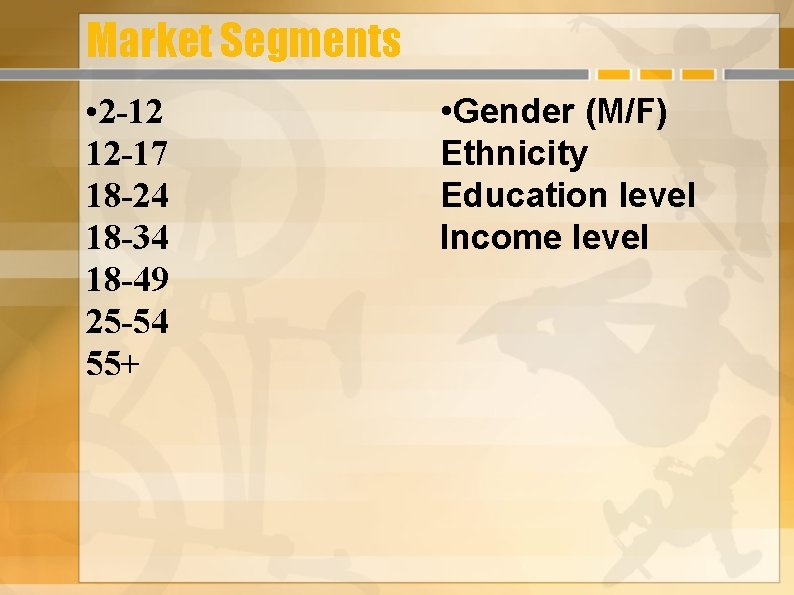
Market Segments • 2 -12 12 -17 18 -24 18 -34 18 -49 25 -54 55+ • Gender (M/F) Ethnicity Education level Income level
Geographic segmentation Segmenting a market based on where a person lives. Geographic segmentation can refer to local, regional, national or global markets. Example: A small local store will segment to the surrounding area like a town, while big companies like Nike market Internationally.
Value of Geographic Segmentation Limit marketing expenses to target consumers who live within certain area
Psychographic segmentation Segmenting the market based on values, attitudes and lifestyles. Example: People interested in professional football.
Psychographic Segmentation Limit marketing expenses to customers that behave with an inclination to buy your product
Behavioral segmentation Dividing consumers into groups according to their response to a product. Behavioral segmentation divides markets into groups based on what they are looking for in a product and why they buy the product. Example: Purchasing Nike shoes because Michael Jordan wears them.