Week 7 8 Topic Graph Algorithms CSE 5311



- Slides: 19
Week -7 -8 Topic - Graph Algorithms CSE – 5311 Prepared by: Sushruth Puttaswamy Lekhendro Lisham
Contents q q q q Different Parts of Vertices used in Graph Algorithms Analysis of DFS Analysis of BFS Minimum Spanning Tree Kruskal’s Algorithm Shortest Path’s Dijkshitra’s Algorithm
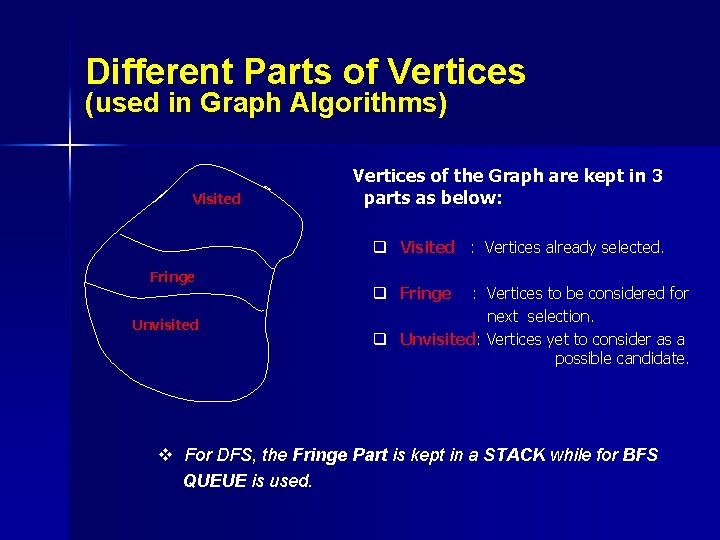
Different Parts of Vertices (used in Graph Algorithms) Visited Vertices of the Graph are kept in 3 parts as below: q Visited : Vertices already selected. Fringe Unvisited q Fringe : Vertices to be considered for next selection. q Unvisited: Vertices yet to consider as a possible candidate. v For DFS, the Fringe Part is kept in a STACK while for BFS QUEUE is used.
Brief Description of DFS n Explores a graph using greedy method. n Vertices are divided into 3 parts as it proceeds i. e. into Visited, Fringe & Unvisited n Fringe part is maintained in a Stack. n The path is traced from last visited node. n Element pointed by TOS is the next vertex to be considered by DFS algorithm to select for Visited Part.
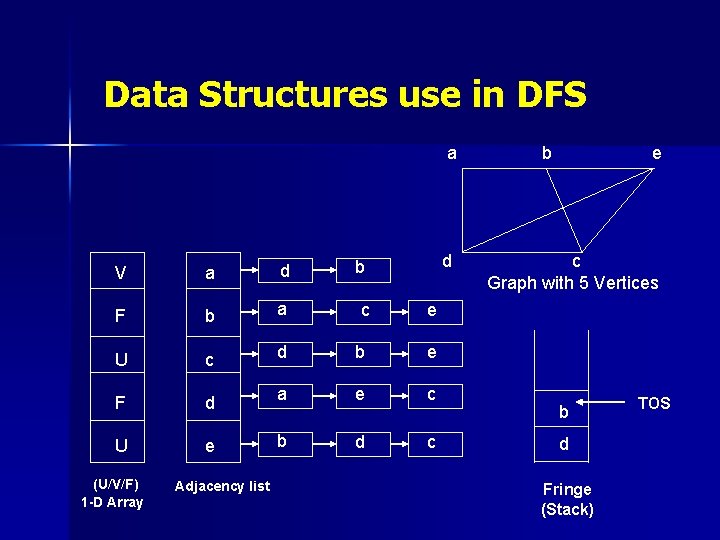
Data Structures use in DFS a d V a d b F b a c e U c d b e F d a e c U e b d c (U/V/F) 1 -D Array Adjacency list b e c Graph with 5 Vertices b d Fringe (Stack) TOS
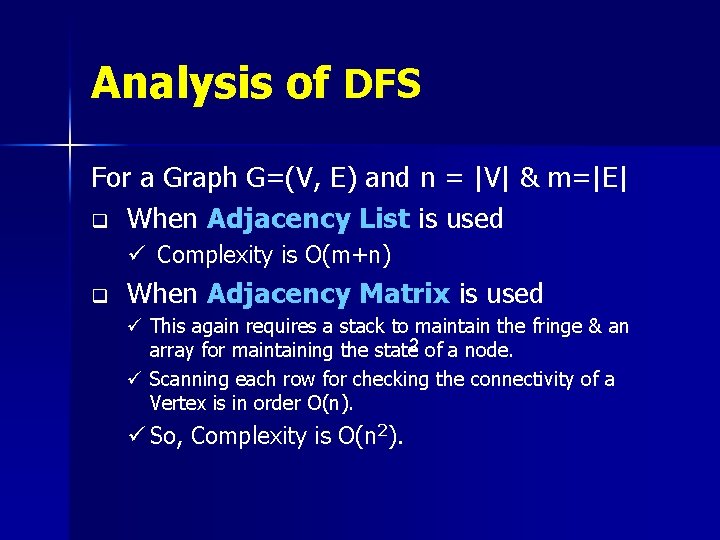
Analysis of DFS For a Graph G=(V, E) and n = |V| & m=|E| q When Adjacency List is used ü Complexity is O(m+n) q When Adjacency Matrix is used ü This again requires a stack to maintain the fringe & an array for maintaining the state 2 of a node. ü Scanning each row for checking the connectivity of a Vertex is in order O(n). ü So, Complexity is O(n 2).
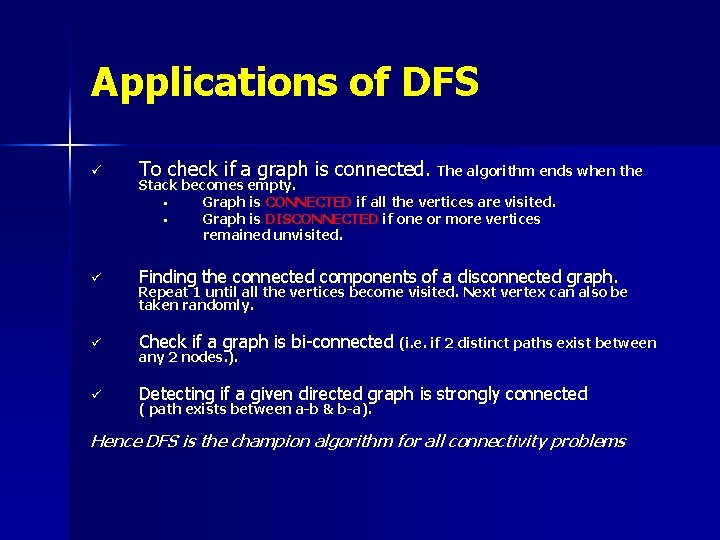
Applications of DFS ü To check if a graph is connected. The algorithm ends when the ü Finding the connected components of a disconnected graph. ü Check if a graph is bi-connected (i. e. if 2 distinct paths exist between ü Detecting if a given directed graph is strongly connected Stack becomes empty. • Graph is CONNECTED if all the vertices are visited. • Graph is DISCONNECTED if one or more vertices remained unvisited. Repeat 1 until all the vertices become visited. Next vertex can also be taken randomly. any 2 nodes. ). ( path exists between a-b & b-a). Hence DFS is the champion algorithm for all connectivity problems
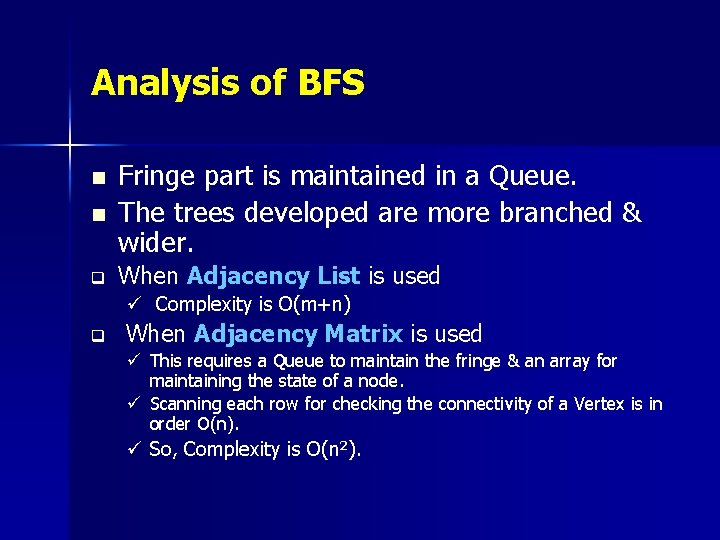
Analysis of BFS n Fringe part is maintained in a Queue. The trees developed are more branched & wider. q When Adjacency List is used n ü Complexity is O(m+n) q When Adjacency Matrix is used ü This requires a Queue to maintain the fringe & an array for maintaining the state of a node. ü Scanning each row for checking the connectivity of a Vertex is in order O(n). ü So, Complexity is O(n 2).
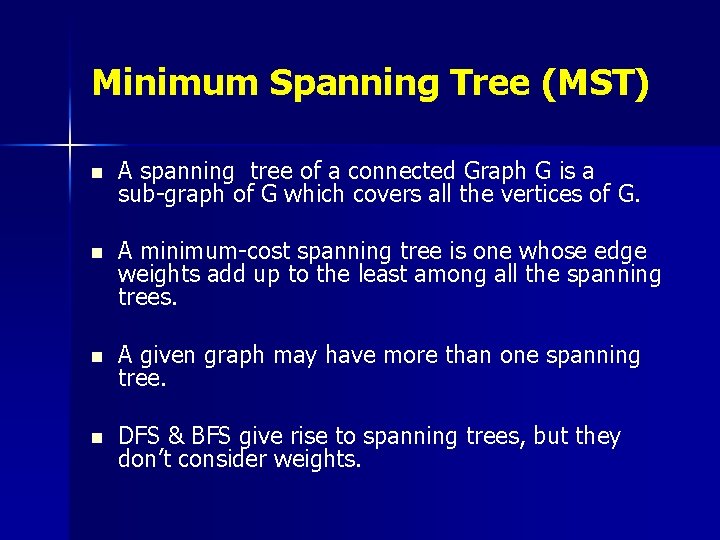
Minimum Spanning Tree (MST) n A spanning tree of a connected Graph G is a sub-graph of G which covers all the vertices of G. n A minimum-cost spanning tree is one whose edge weights add up to the least among all the spanning trees. n A given graph may have more than one spanning tree. n DFS & BFS give rise to spanning trees, but they don’t consider weights.
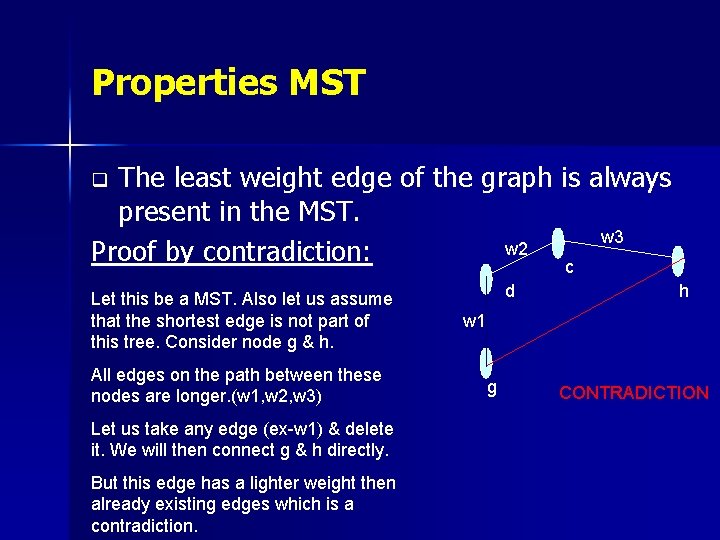
Properties MST The least weight edge of the graph is always present in the MST. w 3 w 2 Proof by contradiction: c q Let this be a MST. Also let us assume that the shortest edge is not part of this tree. Consider node g & h. All edges on the path between these nodes are longer. (w 1, w 2, w 3) Let us take any edge (ex-w 1) & delete it. We will then connect g & h directly. But this edge has a lighter weight then already existing edges which is a contradiction. d h w 1 g CONTRADICTION
…. Properties of MST q For any pair of vertices a & b, the edges along the path from a to b have to be greater than the weight of (a, b).
Kruskal’s Algorithm An algorithm to find the minimum spanning tree of connected graph. n It makes use of the previously mentioned properties. Step 1: Initially all the edges of the graph are sorted based on their weights. Step 2: Select the edge with minimum weight from the sorted list in step 1. Selected edge shouldn’t form a cycle. Selected edge is added into the tree or forest. Step 3: Repeat step 2 till the tree contains all nodes of the graph. n
…. Kruskal’s Algorithm n n This algorithm works because when any edge is rejected it will be longer than the already existing edge(s). The Union-Find data structure is tailor made to implement this algorithm. Cycle formation between any 2 vertices a & b is checked if Find(a)=Find(b). Applet Demo Link.
Analysis of Kruskal’s Alg. If an adjacency list is used. We have n vertices & m edges the following steps are followed. n Sort the edges – mlogm n Find operation – 2 m= O(m) n Union 2 - n-1= O(n) O(mlogm)= O(mlogn )= O(mlog n). n If we use path compression then find & union become m times inverse Ackerman’s function. But sorting always takes mlogm time.
Shortest Paths n n The problem is to find shortest paths among nodes. There are 3 different versions of this problem as shown below: 1. 2. 3. n Single source single destination shortest path (SSSP) Single source all destinations shortest path (SSAP). All pairs shortest path. For un-weighted graphs: ü ü ü BFS can be used for 1. BFS can used to for 2. Running BFS from all nodes is presently the best algorithm for 3.
Dijkshitra’s Algorithm n n This is an algorithm for finding the shortest path in a weighted graph. It finds the shortest path from a single source node to all other nodes. The shortest path from a single node to all destinations is a tree. The following applet gives a very good demonstration of the Dijkshitra’s Algorithm. It finds the shortest distances from 1 city to all the remaining cities to which it has a path. Applet
…. Dijkshitra’s Algorithm DIJKSTRA (G, w, s) 1. INITIALIZE-SINGLE-SOURCE(G, s) 2. S ← ø 3. Q ← V[G] 4. while Q ≠ ø 5. do u ← EXTRACT-MIN(Q) 6. S ← S U { u} 7. for each vertex v Є Adj[u] do 8. if d[v] > d[u] + w (u, v) 9. then d[v] ← d[u] + w (u, v) 10. π [ v] ← u The algorithm repeatedly selects the vertex u with the minimum shortest-path estimate, adds u to S, and relaxes all edges leaving u.
…. Analysis of Dijkshitra’s Alg. q For a Graph G=(V, E) and n = |V| & m=|E| ü When Binary Heap is used § Complexity is O((m+n) log n) When Fibonacci Heap is used ü § Complexity is O( m + n log n)
Thank you.