WarmUp Find the x and y intercepts 1

- Slides: 15
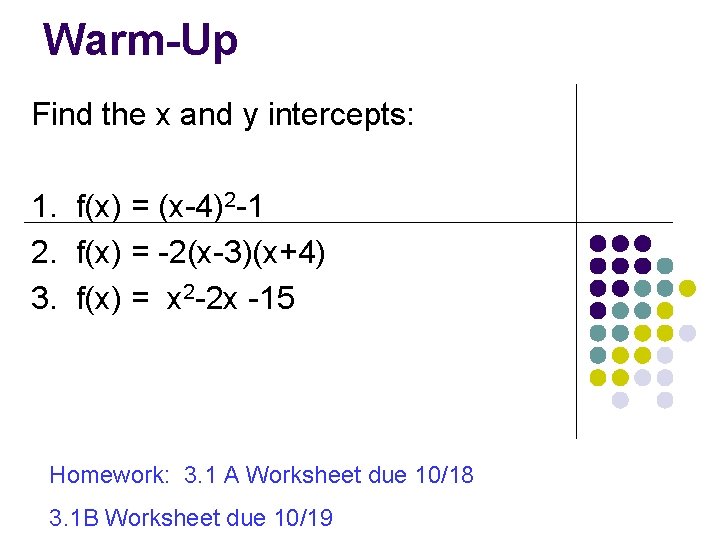
Warm-Up Find the x and y intercepts: 1. f(x) = (x-4)2 -1 2. f(x) = -2(x-3)(x+4) 3. f(x) = x 2 -2 x -15 Homework: 3. 1 A Worksheet due 10/18 3. 1 B Worksheet due 10/19
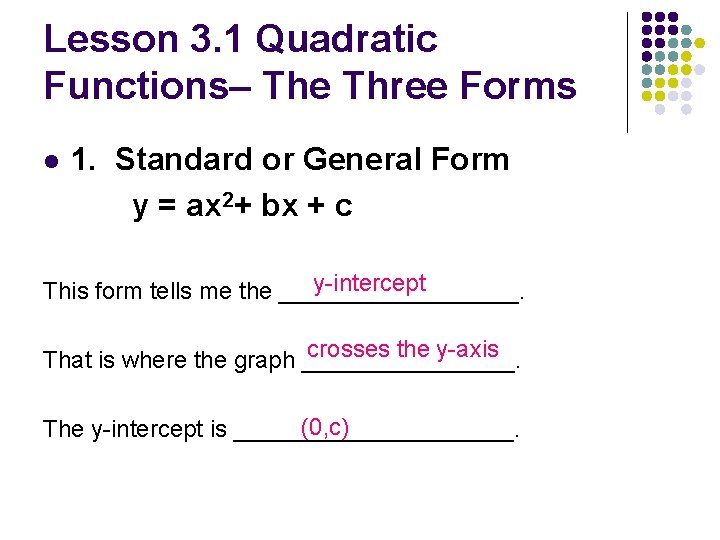
Lesson 3. 1 Quadratic Functions– The Three Forms l 1. Standard or General Form y = ax 2+ bx + c y-intercept This form tells me the _________. crosses the y-axis That is where the graph ________. (0, c) The y-intercept is ___________.
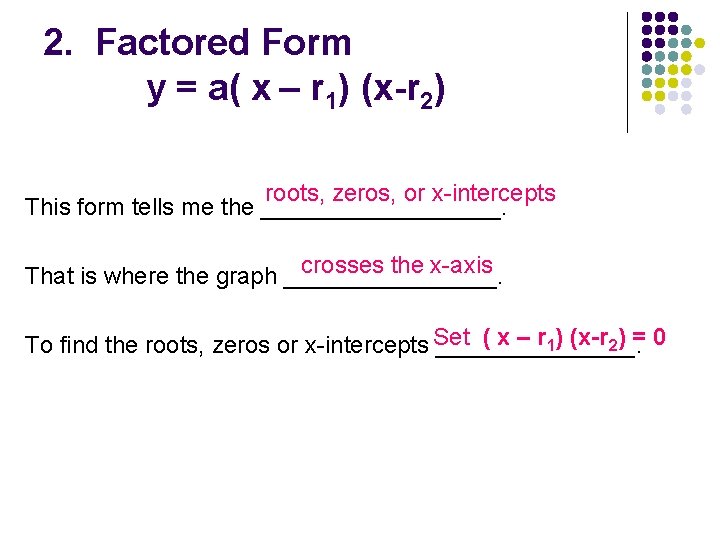
2. Factored Form y = a( x – r 1) (x-r 2) roots, zeros, or x-intercepts This form tells me the _________. crosses the x-axis That is where the graph ________. ( x – r 1) (x-r 2) = 0 To find the roots, zeros or x-intercepts Set ________.
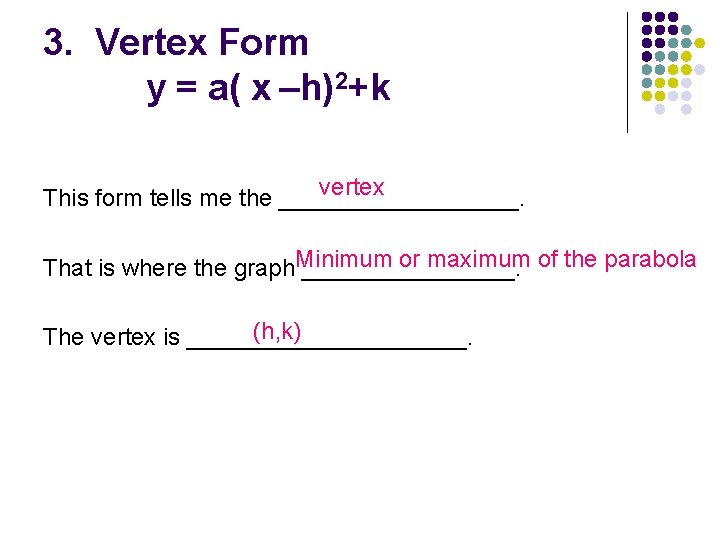
3. Vertex Form y = a( x –h)2+k vertex This form tells me the _________. or maximum of the parabola That is where the graph. Minimum ________. (h, k) The vertex is ___________.
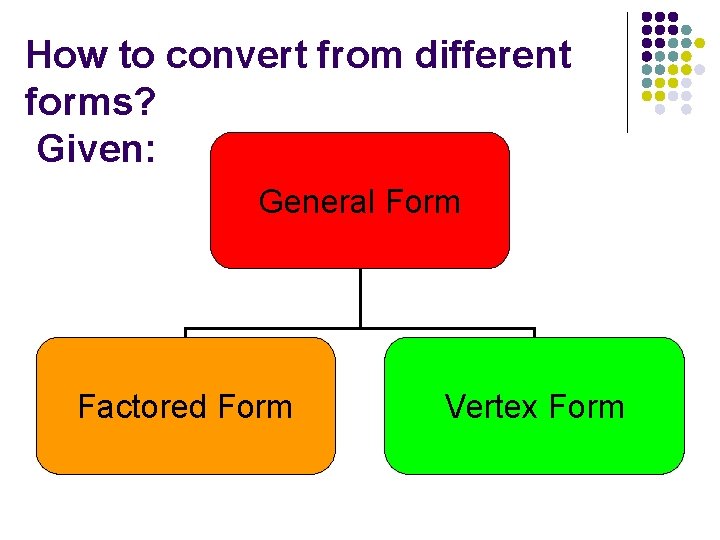
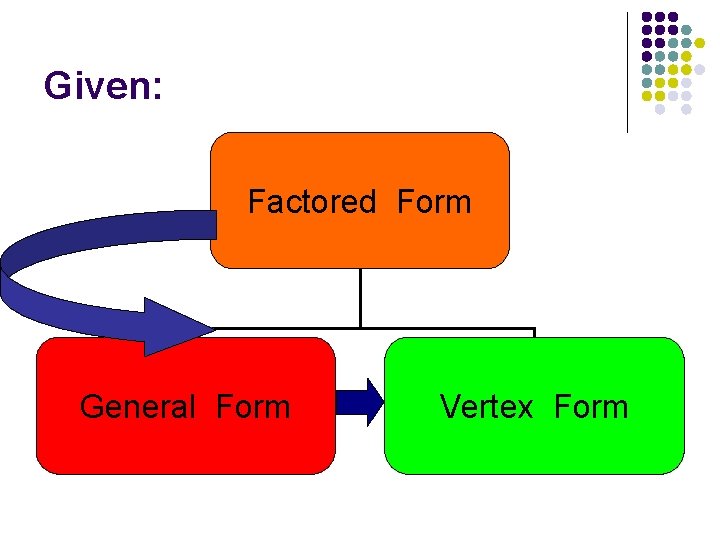
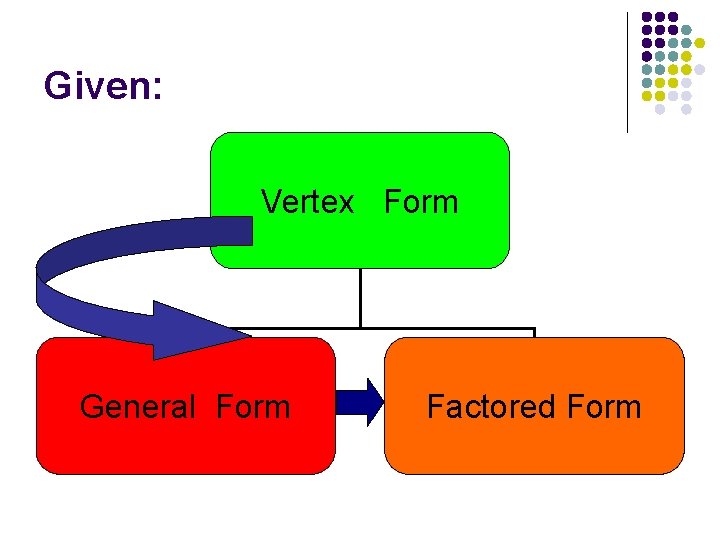
How to convert from different forms? Given: General Form Factored Form Vertex Form
Given: Factored Form General Form Vertex Form
Given: Vertex Form General Form Factored Form
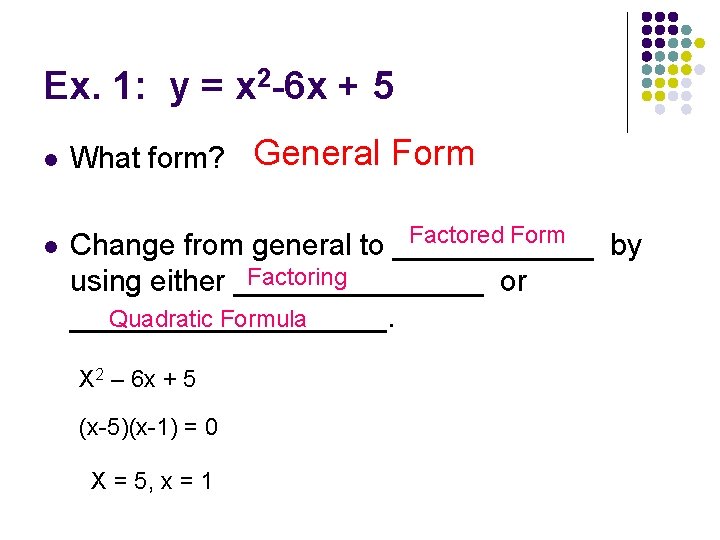
Ex. 1: y = x 2 -6 x + 5 l l What form? General Form Factored Form Change from general to ______ by Factoring using either ________ or __________. Quadratic Formula X 2 – 6 x + 5 (x-5)(x-1) = 0 X = 5, x = 1
Ex. 2: y = x 2 -6 x + 5 l Vertex form Change from general form to _____ Completing the square by using _____________. y = x 2 -6 x + 5 Complete the square 9 9 (x 2 -6 x + _____) = -5 + _____ (x-3)2 -4 = y Now Graph: (0, 5) Y-intercept: _______ (3, -4) Vertex : _______ (1, 0) X-intercepts: (5, 0) ______, ______
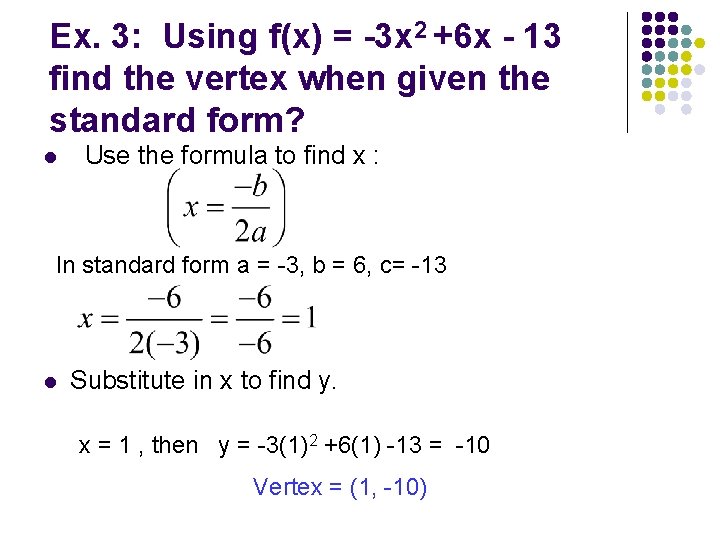
Ex. 3: Using f(x) = -3 x 2 +6 x - 13 find the vertex when given the standard form? l Use the formula to find x : In standard form a = -3, b = 6, c= -13 l Substitute in x to find y. x = 1 , then y = -3(1)2 +6(1) -13 = -10 Vertex = (1, -10)
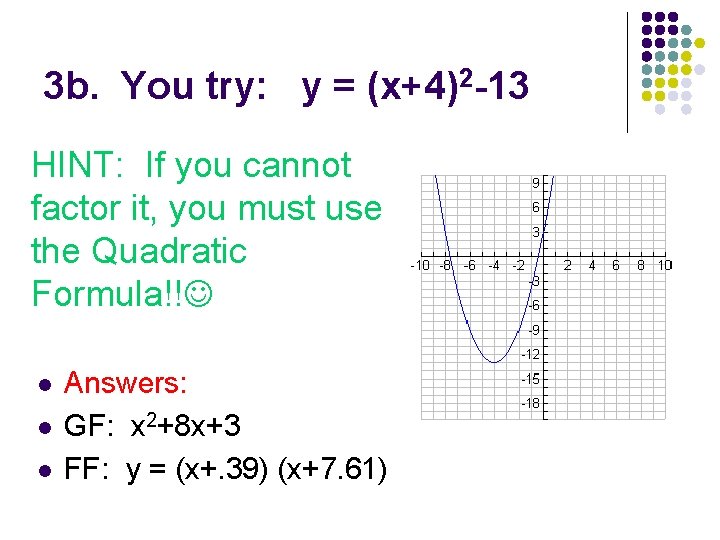
3 b. You try: y = (x+4)2 -13 HINT: If you cannot factor it, you must use the Quadratic Formula!! l l l Answers: GF: x 2+8 x+3 FF: y = (x+. 39) (x+7. 61)
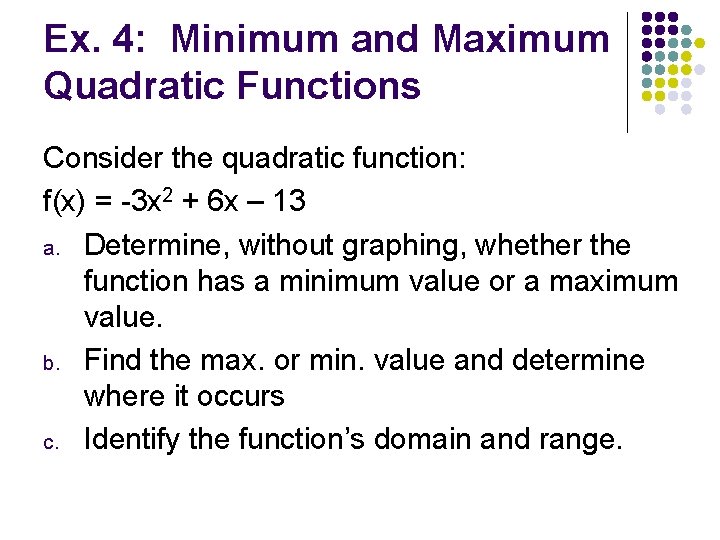
Ex. 4: Minimum and Maximum Quadratic Functions Consider the quadratic function: f(x) = -3 x 2 + 6 x – 13 a. Determine, without graphing, whether the function has a minimum value or a maximum value. b. Find the max. or min. value and determine where it occurs c. Identify the function’s domain and range.
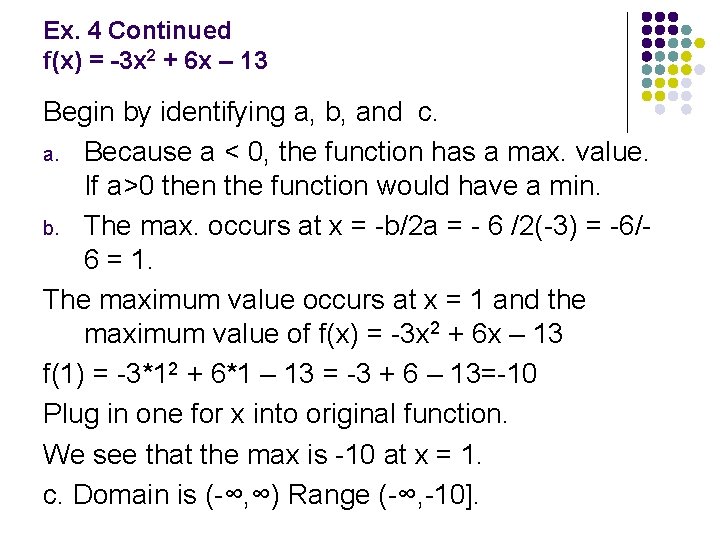
Ex. 4 Continued f(x) = -3 x 2 + 6 x – 13 Begin by identifying a, b, and c. a. Because a < 0, the function has a max. value. If a>0 then the function would have a min. b. The max. occurs at x = -b/2 a = - 6 /2(-3) = -6/6 = 1. The maximum value occurs at x = 1 and the maximum value of f(x) = -3 x 2 + 6 x – 13 f(1) = -3*12 + 6*1 – 13 = -3 + 6 – 13=-10 Plug in one for x into original function. We see that the max is -10 at x = 1. c. Domain is (-∞, ∞) Range (-∞, -10].
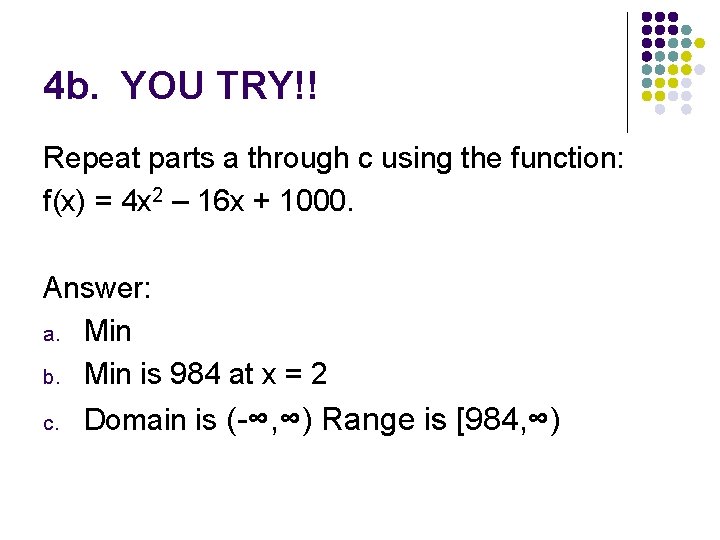
4 b. YOU TRY!! Repeat parts a through c using the function: f(x) = 4 x 2 – 16 x + 1000. Answer: a. Min b. Min is 984 at x = 2 c. Domain is (-∞, ∞) Range is [984, ∞)
Summary: l Describe how to find a parabola’s vertex if its equation is expressed in vertex form.