WA Pressure Injury Forum Comprehensive Skin Assessment Tool

- Slides: 11
WA Pressure Injury Forum Comprehensive Skin Assessment Tool
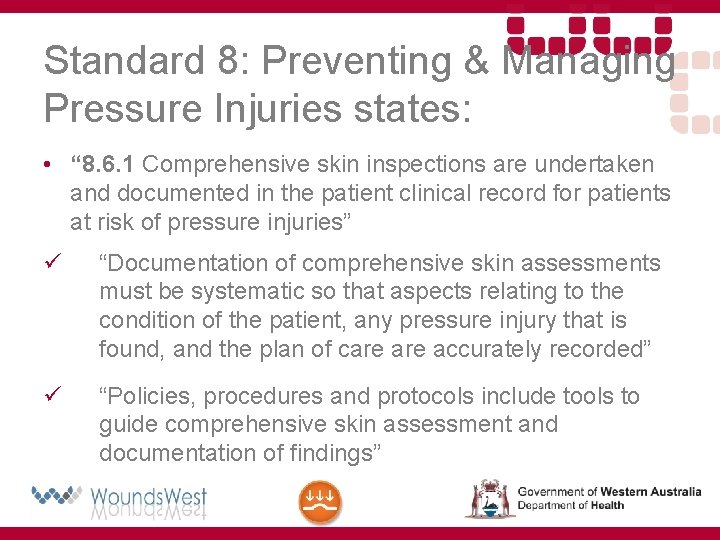
Standard 8: Preventing & Managing Pressure Injuries states: • “ 8. 6. 1 Comprehensive skin inspections are undertaken and documented in the patient clinical record for patients at risk of pressure injuries” ü “Documentation of comprehensive skin assessments must be systematic so that aspects relating to the condition of the patient, any pressure injury that is found, and the plan of care accurately recorded” ü “Policies, procedures and protocols include tools to guide comprehensive skin assessment and documentation of findings”
Pan Pacific Guideline 2012 states: • “Skin status is the most significant early indicator of the skin’s response to pressure exposure and the ongoing risk of PI” • “Document all skin assessments as soon as possible following admission* and within a minimum of eight hours (or on initial home or clinic visit for patients seen in the community), on a daily basis and whenever there is a change in the patient’s condition” • *Standard 8 recommends comprehensive skin inspection on… “patients at high risk of developing PI at presentation…”
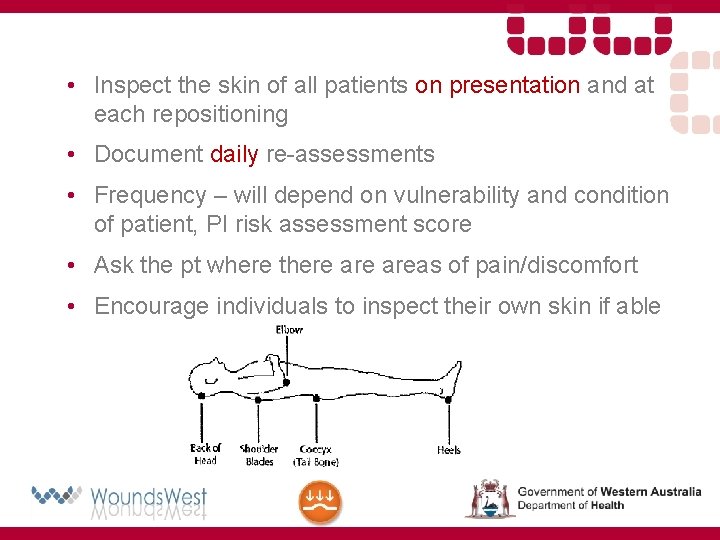
• Inspect the skin of all patients on presentation and at each repositioning • Document daily re-assessments • Frequency – will depend on vulnerability and condition of patient, PI risk assessment score • Ask the pt where there areas of pain/discomfort • Encourage individuals to inspect their own skin if able
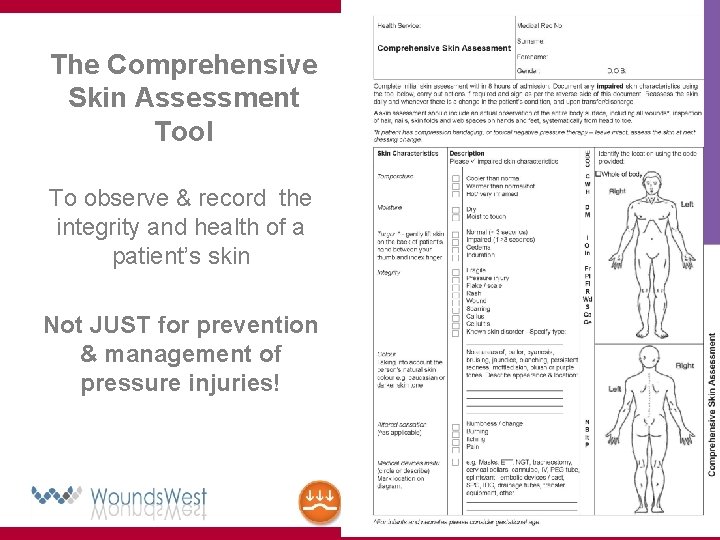
The Comprehensive Skin Assessment Tool To observe & record the integrity and health of a patient’s skin Not JUST for prevention & management of pressure injuries!
Completing the tool: • Complete ASAP (within 8 hours of presentation) • Document any impaired skin characteristics • Implement actions if required and sign • Subsequent skin assessments should be completed: üDaily üOn change of a patients condition üOn transfer or before discharge
Conducting a Skin Assessment • Inspection of the person’s skin, i. e. the entire body surface systematically from head to toe including: ühair and nails üskin folds üweb spaces on hands and feet üskin under medical devices (remove to inspect skin under these ensuring patient’s safety) • Wounds üType of skin injury
Skin characteristics • Temperature – record areas of coolness, heat, inflammation. If normally warm to touch no need to record • Moisture level – record areas of dry skin, moistness, perspiration, maceration (Not when wet & due for nappy/incontinence pad change) • Turgor – gently lift the skin, let go & time in seconds. Take care with neonates, paediatrics (Induration is tissue hardness/firmness)
Skin characteristics • Integrity - record any areas of impaired skin integrity (tick box for intact skin on back of form with signature) • Colour – consider the patient’s natural skin tone, extra care with darkly pigmented skin • Sensation – ask the patient of any alterations • Medical Devices – list of devices provided, check skin under device if safe. Includes skin under dressing products, bandaging, TEDs
What to do if there is a skin issue: • Implement actions ü Listed on back of the form ü Your local facility will have pressure injury policy and wound care guidelines available e. g. AWMA flowchart, skin tear protection strategies • Initiate referral if required ü Listed on back of form, other available ü Your local facility may have Clinical Nurse Consultants – Wound Care and Pressure Injury Link Nurses to assist with Patient Care Planning
Remember: • Complete in conjunction with Pressure Injury Risk Assessment Tool • Sign and document your admission assessment on back of form, room for extra comments • Skin intact tick box located here if no issues • Describe, sign & date new skin issues using reassessment table on back • Document interventions in the patient care plan • Document wound assessments on wound Ax form